- The paper introduces a three-stage GNN that jointly optimizes PA placement, RIS phase shifts, beamforming, and BS-UE association under stringent physical and power constraints.
- It demonstrates superior spectral and energy efficiency performance through unified optimization and strict feasibility, eliminating the need for penalty relaxations.
- Empirical results reveal scalable, millisecond-level inference with significant performance gains in 6G environments, confirming the synergy between PA mobility and RIS reconfiguration.
Spectral- and Energy-efficient Multi-BS Multi-RIS Pinching-antenna Systems: A GNN-based Approach
Introduction and Motivation
This paper provides a rigorous investigation of coordinated downlink transmission in multi-base station (multi-BS), multi-reconfigurable intelligent surface (RIS)-assisted pinching-antenna (PA) systems, where each user equipment (UE) is associated with a single BS, and each BS comprises movable PAs deployed on parallel dielectric waveguides. In the context of 6G wireless networks, spectral and energy efficiency are paramount under highly dynamic propagation environments. The integration of environment-side control (via RISs) and transmitter-side spatial reconfiguration (via PAs) significantly expands the degrees of freedom (DoFs) in wireless propagation, addressing limitations of conventional fixed-array transceivers, especially in challenging or cell-edge scenarios.
The design problem involves jointly optimizing PA placement, RIS phase shifts, transmit beamforming, and BS-UE association under multiple coupled constraints (inter-PA spacing, power budget, unit-modulus phase shifts, binary association), leading to a highly coupled mixed-variable optimization task. Classical iterative algorithms are computationally prohibitive for such high-dimensional, tightly coupled settings. The paper advances structured learning-based optimization for this regime, presenting a three-stage graph neural network (GNN) leveraging both heterogeneous and homogeneous graph representations, trained end-to-end in an unsupervised fashion.
The system comprises B PA-equipped BSs, R RISs, and K single-antenna UEs in a rectangular region. Each BS has N parallel waveguides, each with M movable PAs. Each UE is associated with a single BS through binary association variables. Channels include in-waveguide propagation, PA-RIS links, RIS-UE links, and direct PA-UE links. Effective downlink transmission is a sum of direct and RIS-reflected signals, subject to physical-layer constraints.
Two main objectives are formalized:
- Sum Rate (SR) Maximization: Maximize aggregate achievable rate across all UEs.
- Energy Efficiency (EE) Maximization: Maximize system EE, defined as the sum rate over total consumed power.
Both involve mixed continuous, unit-modulus, and binary variables, subject to constraints (PA placement, RIS phase normalization, BS power, binary one-hot association).
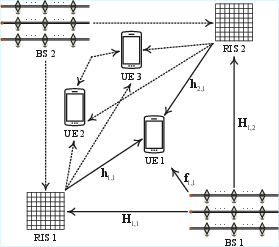
Figure 1: Illustration of multi-BS multi-RIS-assisted PA systems for downlink multi-user communications.
Three-Stage Graph Neural Network Architecture
The proposed GNN framework sequentially optimizes system variables via staged graph representations:
- ChanGNN (Stage 1): Employs a heterogeneous graph capturing BS-RIS-UE interactions. Complex node embeddings are mapped to PA positions and RIS phase shifts using Complex Heterogeneous Graph Attention Layers (CHAL) and fully-connected layers (CFL). Feasibility-preserving mappings guarantee physical constraints on PA placement and RIS phases.
- BeamGNN (Stage 2): Utilizes a homogeneous graph where each node represents a BS-UE link, characterized by effective channels. Parallel branches coordinate the learning of hybrid zero-forcing/maximal ratio transmission (HZM) coefficients and power allocation, ensuring per-BS power constraints.
- AssocGNN (Stage 3): Further operates on the homogeneous graph, initializing node features with beamforming gains. Differentiable association via Gumbel-Softmax ensures one-hot BS-UE mapping during training, with hard assignment during inference.
Constraint satisfaction is enforced strictly in all stages via reparameterization and normalization procedures, avoiding penalty-based relaxation and assuring solution feasibility.
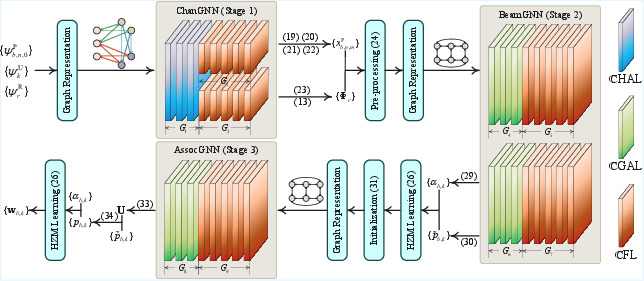
Figure 2: Structure of the proposed three-stage GNN, highlighting ChanGNN for channel optimization, BeamGNN for beamforming, and AssocGNN for association.
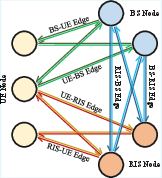
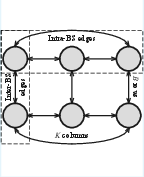
Figure 3: Example graph representation for K=3, B=2, R=2, delineating heterogeneous and homogeneous node connections.
Numerical Results and Model Scalability
Extensive evaluations demonstrate the superiority of the proposed GNN in SR and EE against both system (No-RIS PA, Fixed-PA, etc.) and model baselines (MLP, HAN, GAT). Ablation studies verify the necessity of message passing, residual fusion, and complex-valued mappings for performance retention. The framework exhibits strong scalability with unseen numbers of UEs, BSs, and RISs, achieving only mild performance degradation as graph topology varies, especially when the mismatch is moderate.
A key numerical finding is the consistent improvement in SR and EE as the number of PAs per waveguide increases. The marginal gain saturates eventually, reflecting the DoF ceiling imposed by finite spatial apertures and propagation geometry.
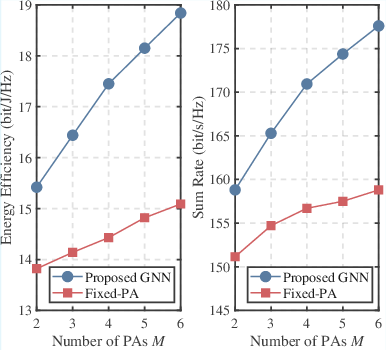
Figure 4: Impact of number of PAs on EE and SR for R0, displaying monotonic, sublinear improvement as R1 grows.
Architectural and Practical Implications
The paper makes several bold claims substantiated by strong numerical results:
- Unified Optimization: By incorporating transmitter and environment-side spatial reconfigurability, the framework exhibits robust coverage and high efficiency inaccessible to architectures relying on either PAs or RISs alone.
- Strict Feasibility: Output mechanisms eliminate the need for penalty-based constraint handling; all physical and communication constraints are strictly enforced.
- Scalability and Generalization: Parameter sharing and graph-based inductive biases enable millisecond-level inference times and generalization to unseen deployment sizes/configurations.
- Complementarity of PA and RIS: Removing either leads to significant performance degradation, confirming theoretical synergy.
From a practical standpoint, the architecture offers a viable pathway to real-time optimization in dynamic 6G settings. By leveraging model structure matching the propagation and interference topology, the framework is scalable and robust, enabling rapid adaptation to environmental and network variations without retraining.
Theoretical and Future Directions
The staged heterogeneous-homogeneous GNN design underscores the importance of architectural matching to physical system structure. The use of complex-valued attention layers and unsupervised end-to-end training positions the approach at the intersection of physics-informed and inductive learning. Future research may extend this methodology to further dynamic elements (e.g., mobile RISs, active reflectors, non-linear hardware constraints) and expand to uplink coordination, multi-cell joint transmission, and physical-layer security.
Conclusion
The paper systematically addresses joint PA placement, RIS phase, beamforming, and BS-UE association in coordinated multi-BS multi-RIS PA systems, introducing a three-stage GNN integrating heterogeneous and homogeneous graph representations. Empirical results substantiate the complementary gains from PA mobility and RIS reconfiguration and demonstrate strong scalability, feasibility, and millisecond-level inference times. The framework constitutes a robust solution for next-generation wireless communication system optimization under stringent spectral and energy efficiency requirements (2605.01307).