- The paper introduces a shared-recurrent convolution mechanism that decouples message-passing depth from the number of trainable parameters.
- It demonstrates that SR-CGCNN-3 achieves nearly identical accuracy to traditional CGCNNs while using only 34.5% of the convolutional parameters.
- The study underscores that iterative local update rules capture medium-range structural information effectively, promoting parameter efficiency in materials prediction.
SR-CGCNN: Shared-Recurrent Depth in Crystal Graph Neural Networks for Parameter-Efficient Materials Property Prediction
Architectural Motivation and Context
SR-CGCNN proposes a shared-recurrent graph convolution mechanism within Crystal Graph Convolutional Neural Networks (CGCNN), aiming to decouple the relationship between message-passing depth and model parameter count. Traditional CGCNNs deepen spatial propagation by stacking independently parameterized convolutional blocks, thus increasing both the receptive field and the number of trainable parameters. This coupling complicates attribution of accuracy improvements and limits efficiency, particularly with moderate-sized materials datasets where model compactness is essential for robust generalization.
SR-CGCNN introduces a weight-sharing paradigm by applying the same convolutional transformation recurrently across multiple message-passing steps, leaving the graph construction, pooling, and prediction head unchanged. The approach leverages physical intuition from iterative refinement methods in materials science, e.g., self-consistent field cycles and charge equilibration, to motivate repeated application of a local update rule for encoding structural information across increasing spatial neighborhoods.
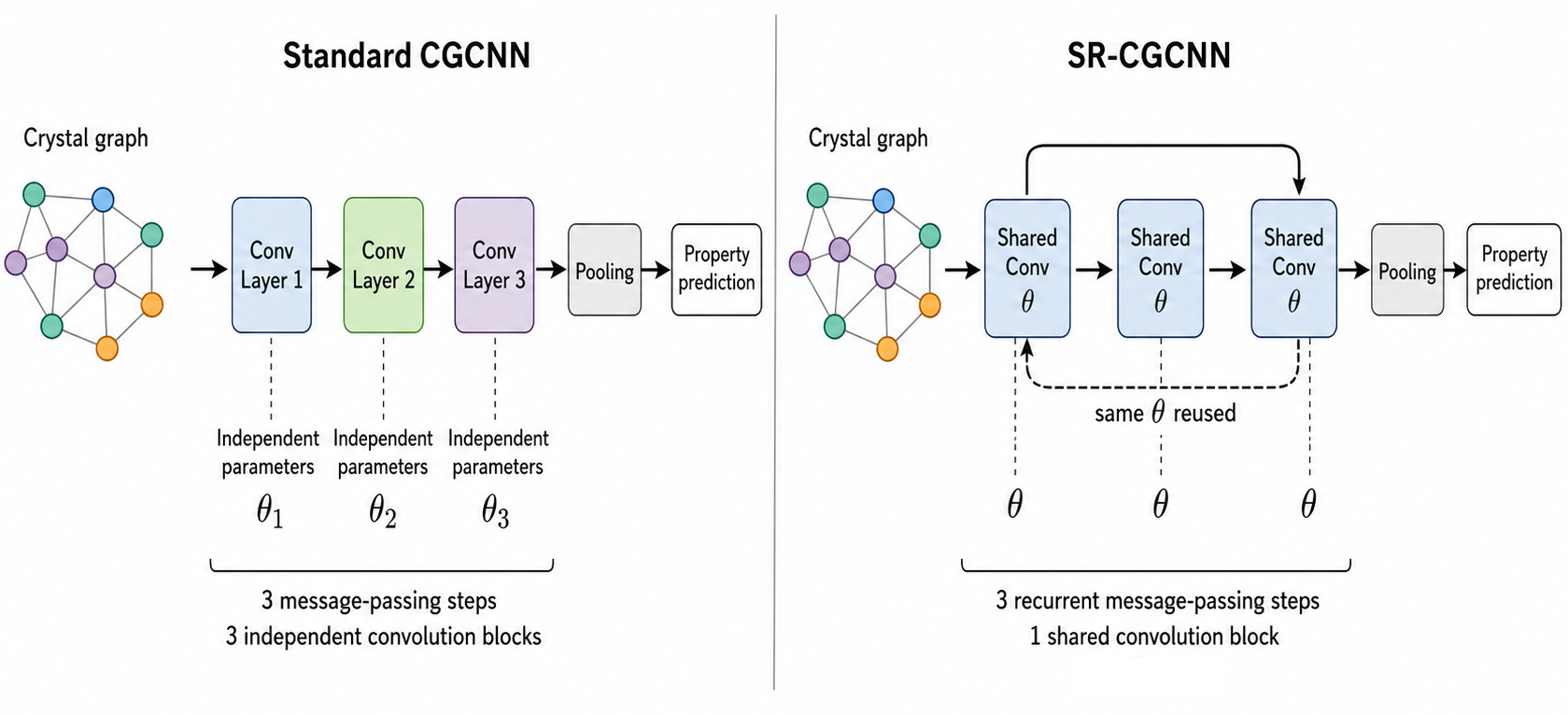
Figure 1: Schematic comparison between a standard three-layer CGCNN and SR-CGCNN. SR-CGCNN utilizes shared weights, applied recurrently, maximizing parameter efficiency while matching propagation depth.
Methodology and Model Variants
The study benchmarks four architectures: CGCNN-1 (single-layer), CGCNN-3 (three independently parameterized layers), SR-CGCNN-3 (three shared recurrent steps), and SR-CGCNN-5 (five shared recurrent steps). Each variant applies identical training, data representation, and input processing. Models are trained and evaluated on two tasks derived from the Materials Project: formation-energy prediction and band-gap regression, using fixed samples of 10,000 unique crystal structures per task. Evaluation is done via mean absolute error (MAE) in physical units—eVatom−1 for formation energy and eV for band gap.
SR-CGCNN employs convolutional blocks with shared weights along recurrent steps, allowing normalization parameters to remain step-specific, ensuring flexibility in feature distributions across propagation.
Parameter Efficiency and Numerical Results
SR-CGCNN-3 achieves nearly identical predictive performance to CGCNN-3 while drastically reducing model complexity. For formation energy, SR-CGCNN-3’s test MAE is 0.0986 eVatom−1 versus CGCNN-3’s 0.0945 eVatom−1, with convolutional parameters reduced from 66,432 to 22,912 (34.5% of CGCNN-3's count). For band gap regression, SR-CGCNN-3 attains a test MAE of 0.4503 eV compared to CGCNN-3’s 0.4346 eV, again using just a third of the convolutional parameter budget.
The shallow CGCNN-1 baseline shows substantially worse performance, confirming that recurrent message passing with shared weights captures essential medium-range structural information absent in single-step models. With SR-CGCNN-5, adding recurrent steps beyond three does not enhance accuracy; in fact, performance degrades modestly, indicative of oversmoothing or diminishing returns for deep recurrent message passing consistent with known GNN bottleneck effects.
The SR-CGCNN design implies that in crystal graph neural networks, most predictive power attributed to depth arises from iterative local information propagation, not from additional independent transformations. This demonstrates that parameter count can be minimized—critical for materials informatics where data scarcity and transferability are frequent concerns—without sacrificing representation of coordination shells relevant for thermodynamic and electronic properties.
Practically, this enables deployment of compact GNNs for formation-energy and band-gap prediction, enhancing generalization prospects across chemistry domains, especially with moderate dataset sizes. Theoretically, the result reinforces the view that iterative refinement (via recurrent message passing) suffices for propagating local chemical context, matching stacked layer expressivity up to moderate depths. It further surfaces the importance of adaptive normalization within recurrent architectures, optimizing flexibility without bloating parameter space.
Limitations and Future Directions
SR-CGCNN-3 truncates diminishing returns, as SR-CGCNN-5’s empirically higher MAE underscores the risk of oversmoothing in deeper recurrent architectures. Future work should systematically sweep recurrent depth, evaluate alternative normalization strategies, and extend benchmarks to diverse materials properties and larger datasets. Exploration of adaptive step counts, learned damping schemes, and transferability assessments across chemically heterogeneous datasets may further generalize the induced inductive bias. Extensions could also consider integrations with richer local descriptors as in ALIGNN and SchNet for synergistic improvements.
Conclusion
The SR-CGCNN architecture efficiently approximates stacked-depth CGCNNs for materials property prediction by employing shared recurrent convolutional transformations. This achieves substantial parameter reduction (65.5% fewer convolutional parameters than CGCNN-3), with only minor trade-offs in predictive accuracy for formation energy and band gap. The study demonstrates that repeated application of a local crystal graph update is sufficient to capture medium-range coordination, offering a compact, interpretable alternative especially suitable for moderate-sized materials datasets. The findings motivate further investigation into recurrent-depth variants in GNNs, adaptive normalization, and application across broader materials modeling challenges.