- The paper introduces a diffusion-based framework that jointly generates crystal structures and local electronic descriptors to balance property conditioning and physical plausibility.
- The methodology integrates Bader charges and atomic DOS via a shared GemNet-T denoising network, achieving higher VSUN success rates for targeted band gaps and formation energies.
- The results demonstrate improved structural diversity, enhanced novelty, and accurate electronic descriptor predictions that accelerate AI-driven materials discovery.
Inverse Materials Design via Joint Generation of Crystal Structures and Local Electronic Descriptors: An Expert Analysis
Overview and Motivation
The paper "Inverse Materials Design via Joint Generation of Crystal Structures and Local Electronic Descriptors" (2605.01286) addresses a central challenge in computational materials discovery: the inverse design of inorganic crystals with specified target properties, high physical plausibility, and compositional diversity. Standard generative models—especially those based on structural attributes alone—struggle to balance property conditioning with preservation of diversity and physical plausibility. The key innovation presented in this work is a diffusion-based framework that jointly generates crystal structure variables and site-resolved local electronic descriptors, such as Bader charges and atomic densities of states (atomic DOS). By integrating electronic descriptors directly into the generative process, the model augments physical realism and more effectively targets user-prescribed properties (e.g., band gap, formation energy), as detailed herein.
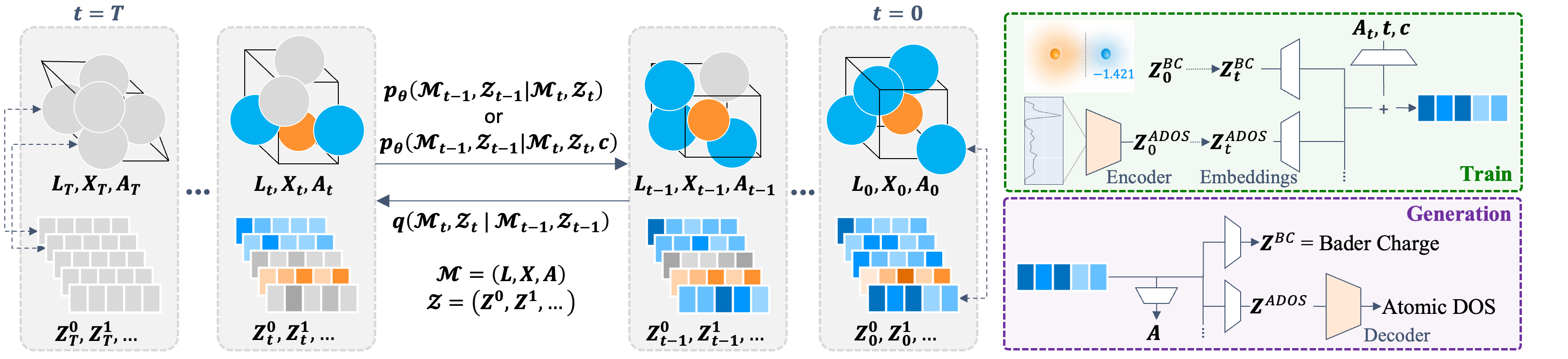
Figure 1: Schematic illustration of the proposed diffusion framework for the joint generation of crystal structures M and local electronic descriptors Z.
Methodology: Joint Diffusion of Structural and Electronic Variables
The generative process is framed as a joint diffusion problem, wherein the forward Markov chain corrupts both structure (lattice, atomic positions, atom types) and electronic descriptor variables. Importantly, the reverse process employs a shared denoising network (a GemNet-T-based graph neural network) that predicts updates conditioned on both aspects, ensuring tight coupling during the generative trajectory. Two classes of local descriptors are considered:
- Bader charges: Compact, site-resolved scalars reflecting local charge distribution and bonding environments.
- Atomic DOS: Richer, site-resolved spectral profiles encapsulating the local electronic structure, compressed via an autoencoder for tractable modeling.
In both settings, the generative objective is to learn p(M,Z) under property-conditioned and unconstrained (ab initio) sampling. Auxiliary constraints, such as charge neutrality during Bader charge diffusion and value-range limits for atomic DOS, are enforced dynamically during reverse sampling.
Numerical Evaluation and Results
Property-Conditioned Success Rates
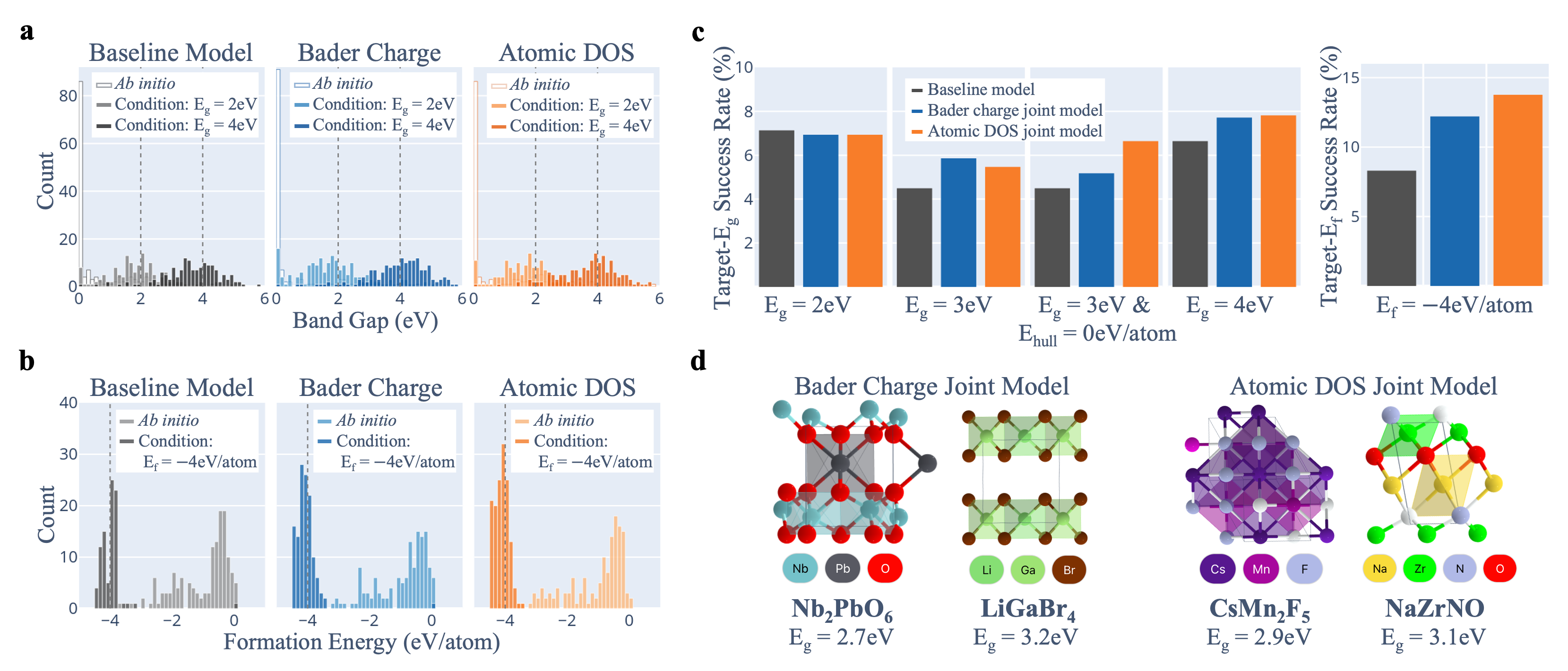
Figure 2: Band-gap and formation-energy distributions and conditional generation success rates for VSUN structures across baseline (gray), Bader charge (blue), and atomic DOS (orange) joint models.
The framework is evaluated with three variants: baseline (structures only), Bader-charge joint, and atomic-DOS joint models. Extensive generation and evaluation are conducted with:
- VSUN criteria: Validity, Stability, Uniqueness, Novelty.
Key quantitative indicators emerge:
- Band-gap-conditioned generation: At Eg=3 and $4$ eV, joint models yield higher VSUN success rates (e.g., Eg=4 eV: 6.6% baseline, 7.7% Bader, 7.8% DOS).
- Formation energy targeting: With a rare target (Ef=−4 eV/atom), joint models yield substantially elevated VSUN success (baseline 8.3%, Bader 12.2%, DOS 13.8%).
These trends underscore the efficacy of local electronic descriptors in mitigating the tradeoff between property targeting and structural quality.
Structural Diversity and Novelty
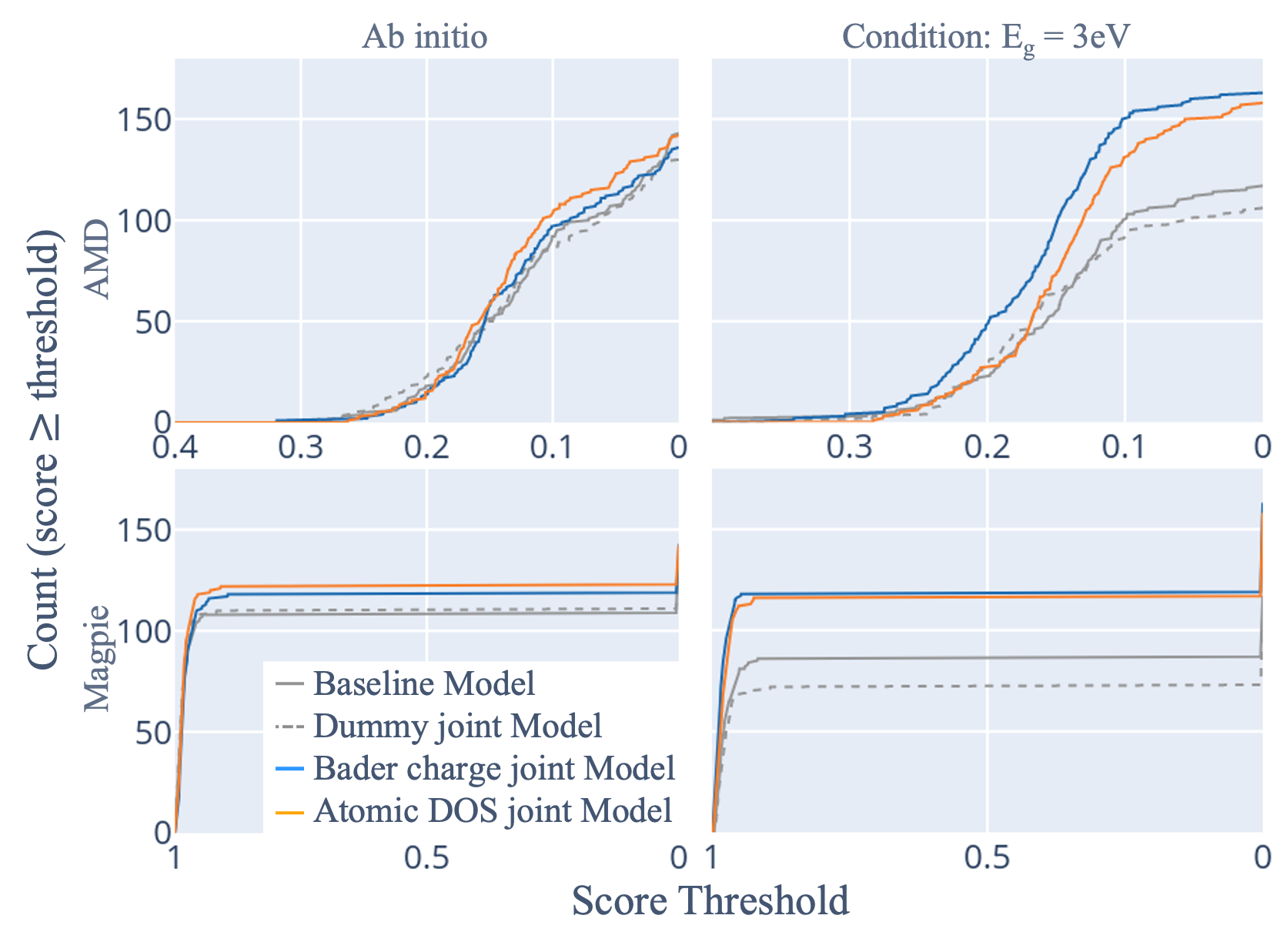
Figure 3: Number of generated VSUN structures with novelty score exceeding set thresholds, showing increased novelty for the joint descriptor models, particularly along composition (Magpie metric).
Joint models systematically yield higher counts of unique, thermodynamically-stable, and novel samples under conditioning, with statistically significant improvements (two-sided z-test, p<0.05 in most cases). Notably, this enhancement arises only from physically meaningful descriptors, as demonstrated by control runs with random dummy site-wise variables, which offer no such gains.
Accuracy of Jointly Generated Electronic Descriptors
Bader Charge Generation
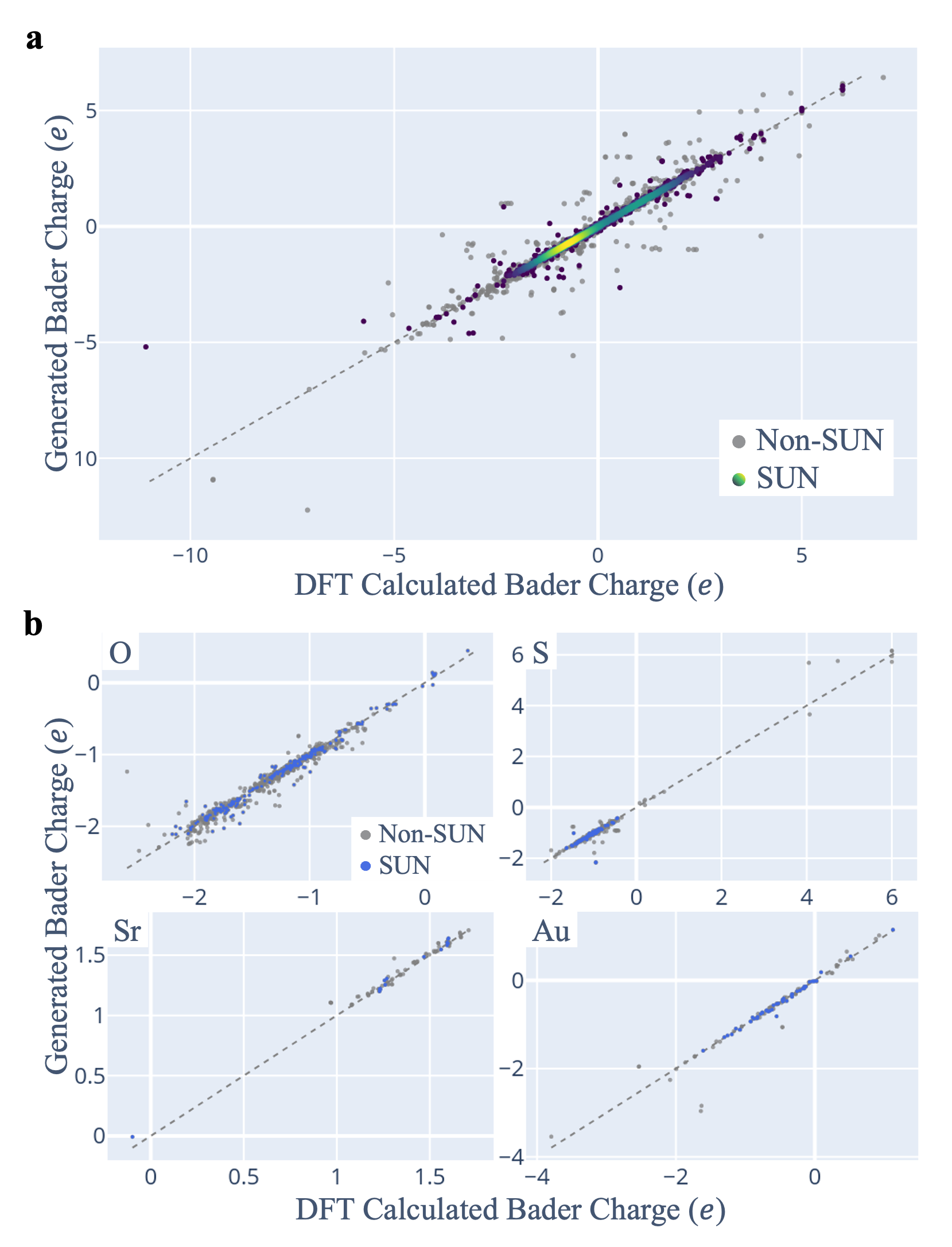
Figure 4: Correlation between generated and DFT-calculated Bader charges, with high accuracy for SUN structures (MAE: 5.5×10⁻² e).
The joint models achieve strong quantitative agreement with DFT Bader charges, especially for physically plausible (SUN) structures. MAEs are sub-0.1 e for most elements, except for underrepresented cases.
Atomic DOS Generation
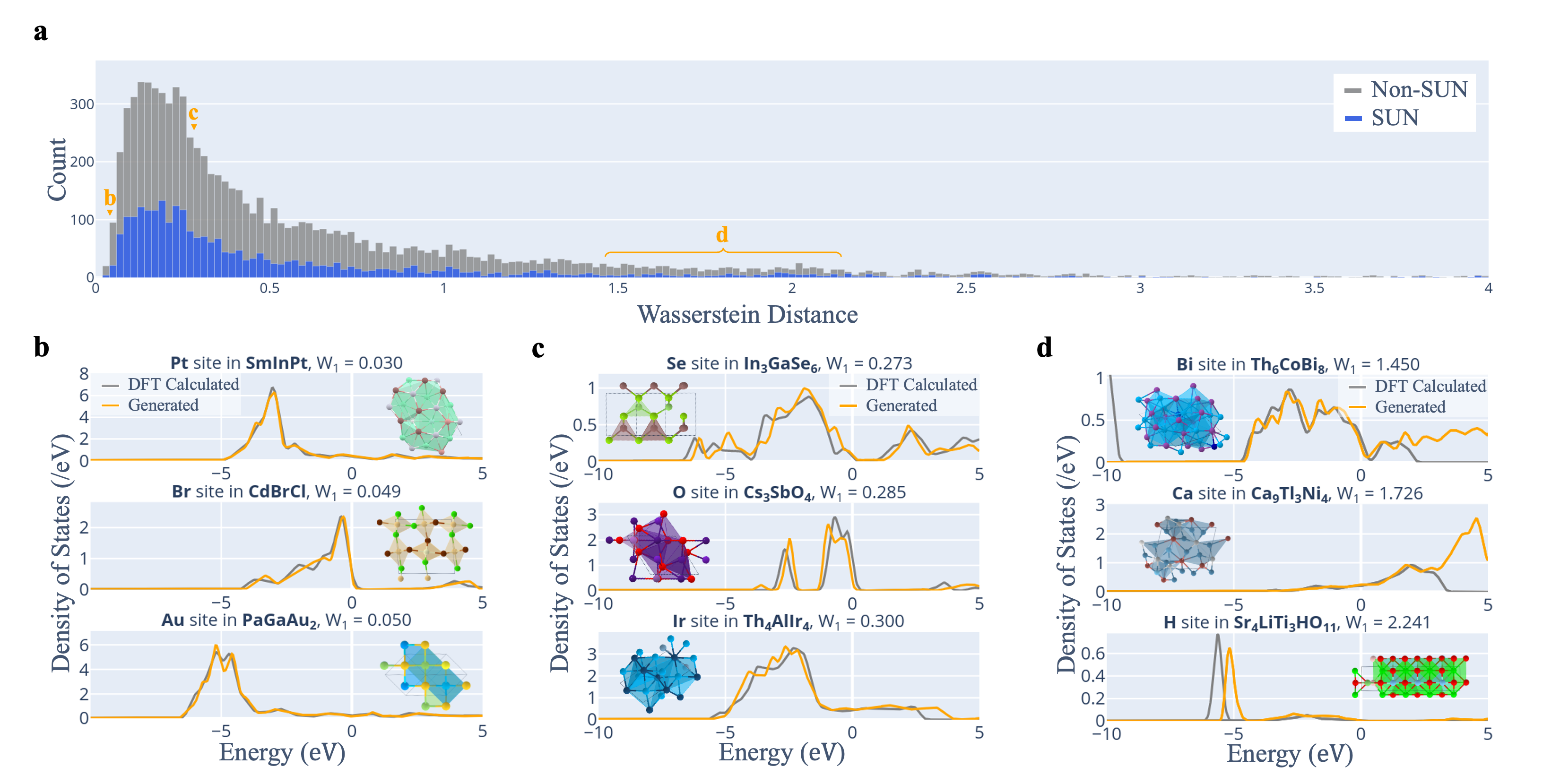
Figure 5: Wasserstein distance W1 between generated and DFT atomic DOS profiles, with representative cases illustrating high-fidelity reconstructions at low Z0; element-specific accuracy gradients highlighted.
Atomic DOS generation exhibits modal accuracy with summarized Z1 distributions; coarse spectral features are captured reliably, but fine details and overall accuracy show substantial element dependence. Transition metals are especially amenable to generative learning, with low Z2, whereas light nonmetals (B, C, N) are more challenging.
Element-Resolved Trends
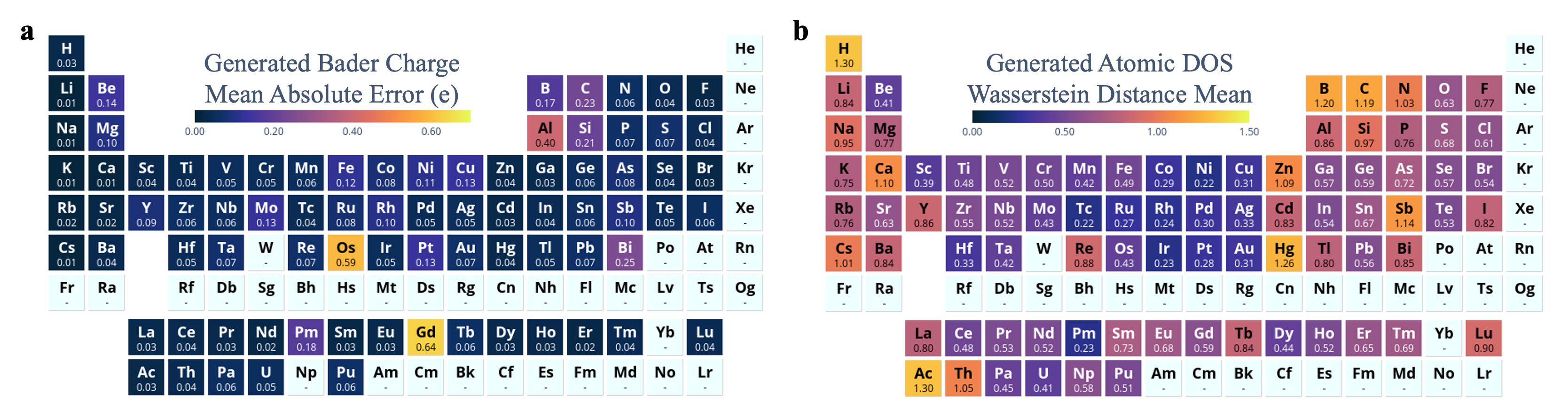
Figure 6: Element-wise MAE for Bader charge and Z3 for atomic DOS, illustrating chemical trends—transition metals favor accurate DOS generation, whereas sparsely represented elements and light Z4-block elements are less well captured.
These findings support the interpretation that descriptor learnability is governed by both representation richness and chemical identity.
Theoretical and Practical Implications
The demonstrated benefit of physically meaningful, site-resolved electronic descriptors in joint generative modeling manifests in two key ways:
- Expanded structural diversity: Sampling trajectories are constrained to electronically plausible regions, preventing collapse or oversampling of marginally valid motifs common in conditionally-trained, structure-only generative models.
- Improved property tailoring: Especially when targeting rare or challenging properties, electronic descriptors facilitate the identification of structurally and electronically feasible compounds, as seen in the increased VSUN yields for extreme formation energies.
The separation of roles between Bader charge (favoring validity/stability) and atomic DOS (favoring property success rates) provides actionable insight into descriptor selection for future work. Dummy-variable controls validate that true improvements demand physical content in joint variables, not mere expansion of generative capacity.
For practical screening, the framework enables rapid access to approximate local electronic environments for generated structures prior to DFT validation. Caveats remain—accuracy is highest in thermodynamically plausible structures and element-dependent for atomic DOS—suggesting that downstream filtering with surrogate ML potentials and composition-based rules is judicious.
Outlook and Future Directions
The findings suggest several future research directions and broader implications:
- Descriptor optimization: Determining, via systematic study, which electronic descriptors (and which latent representations) maximize learnability, physical fidelity, and property-targeting performance will be critical.
- Integration with ML-potential filtering: Incorporating more robust, high-fidelity property predictors in the generative-in-the-loop framework can further accelerate candidate screening and reduce reliance on exhaustive ab initio confirmation.
- Generalization to multiscale descriptors: Extension to global electronic features, defect states, or additional local observables may further enlarge the practical utility of generative inverse design.
- Delimiting theoretical limits: Quantitative exploration of the tradeoff surface between structural diversity, electronic plausibility, and precise property targeting will clarify ultimate model potential.
Conclusion
This work rigorously demonstrates that joint diffusion over crystal structures and physically meaningful, site-resolved electronic descriptors (Bader charge, atomic DOS) enables inverse materials generation with superior diversity, stability, and property-tailoring success. The detailed quantitative and chemical resolve of the results provides critical guidance for the design and selection of generative variables in future AI-driven materials discovery frameworks. The approach establishes a foundation for next-generation generative models that synergistically incorporate geometric and electronic information for efficient exploration of inorganic materials space.