- The paper introduces a quantum kinetic NEGF framework that models impact ionization at an atomistic scale in silicon avalanche photodiodes.
- It employs an energy- and orbital-resolved methodology to link avalanche gain with key quantum network performance metrics.
- The simulation framework advances device optimization by integrating spectral resolution, band structure fidelity, and carrier multiplication dynamics.
NEGF-Based Modeling of Impact Ionization in Silicon Avalanche Photodiodes for Quantum Networking
Context and Motivation
Quantum networking architectures critically depend on high-performance single-photon detectors that bridge fragile quantum states and classical digital outputs. Silicon single-photon avalanche diodes (SPADs) serve as the dominant platform owing to their mature fabrication, high efficiency, and system-level scalability. Device-level physics, particularly impact ionization and avalanche gain, directly affect quantum network performance metrics including secret-key rate in QKD, fidelity in quantum teleportation, and error tolerance in photonic quantum computation. Traditional modeling frameworks, reliant on empirical ionization coefficients or semiclassical carrier transport, inadequately capture strongly non-equilibrium, energy-resolved scattering essential for nanoscale avalanche onset. The paper introduces a quantum kinetic simulation framework based on the Non-Equilibrium Green’s Function (NEGF) formalism as an atomistic, first-principles methodology for modeling impact ionization in APDs, targeting realistic device-scale and operational regimes relevant for quantum networking (2605.01244).
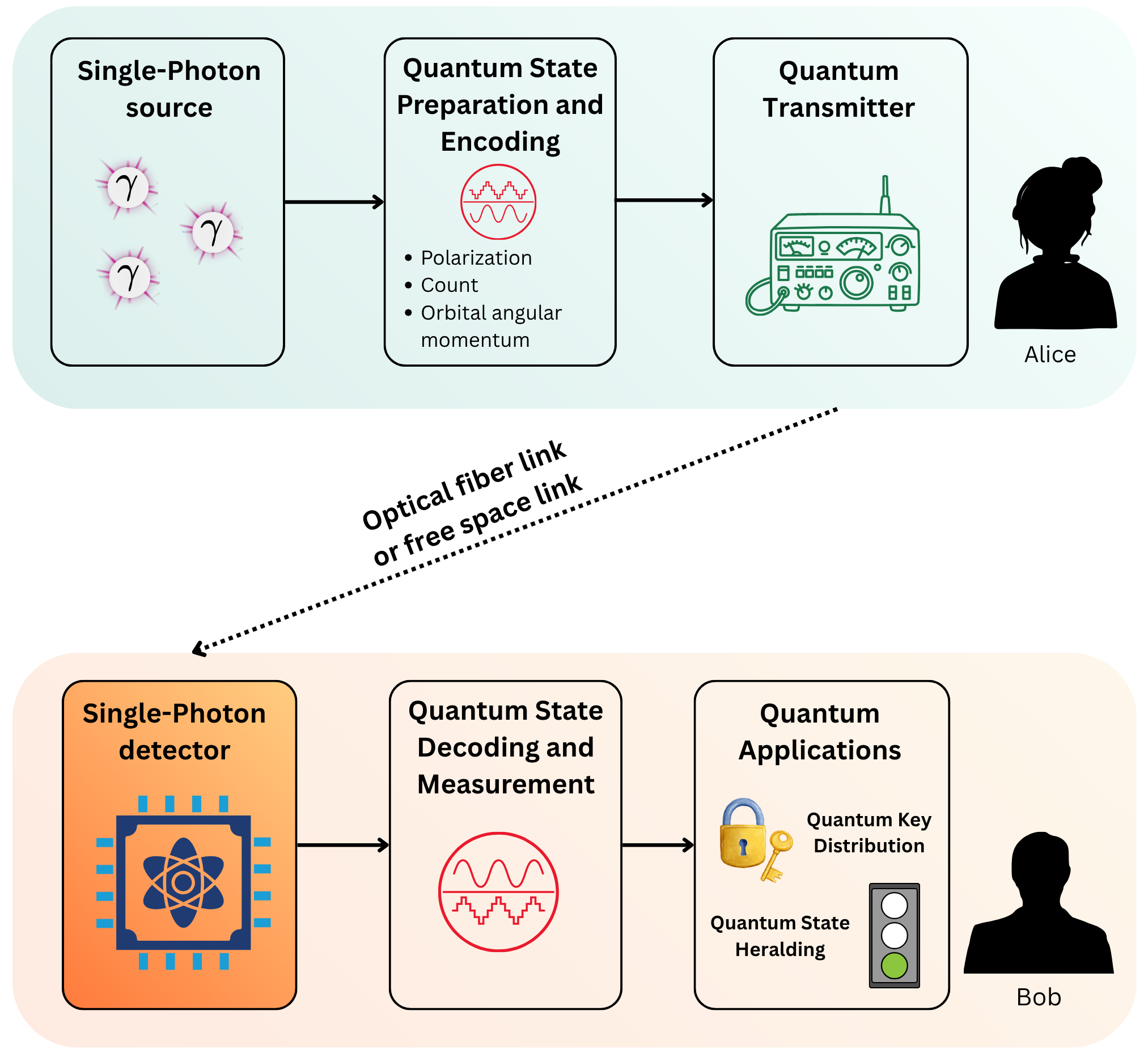
Figure 1: Block diagram illustrating the key components of quantum networking with focus on the silicon avalanche-based single-photon detector interface.
The NEGF framework provides an energy- and orbital-resolved description of quantum transport in open systems, decomposing the device into a finite channel tightly coupled to semi-infinite contacts. The channel Hamiltonian encodes band structure and electrostatics, while boundary and internal scattering are captured as energy-dependent self-energies. Impact ionization is modeled as a multi-particle, non-perturbative self-energy, formulated in terms of convolution of band-resolved Green's functions that enforce strict energy conservation and explicit correlation between carriers.
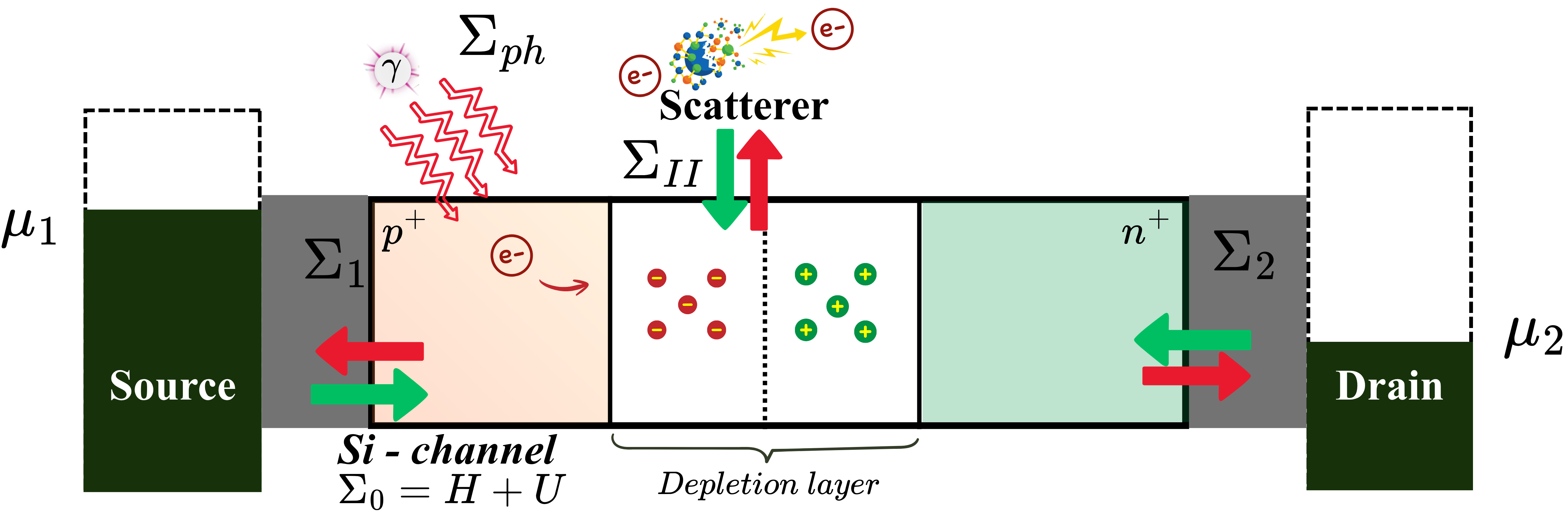
Figure 2: Block diagram of NEGF modeling, showing device Hamiltonian, contact self-energies, impact ionization scattering, and injection/removal functions.
The paper delineates how the spectral function A(E) defines the density of available states, while occupation functions G<(E) and G>(E) reflect actual carrier populations, distinguishing injected nonequilibrium distributions from equilibrium reservoir states. Both coherent transport (Landauer-Büttiker) and dissipative scattering (Meir-Wingreen) current formulations are discussed, allowing for direct calculation of local and terminal observables.
Impact Ionization: Energy-Resolved Approach
Impact ionization is intrinsically a correlated two-body inelastic process, treated within NEGF by constructing a self-energy ΣII that depends nonlocally on products of lesser and greater Green’s functions across conduction and valence bands. The convolution structure ensures that only quartet combinations of energetic, occupied, and empty states consistent with E4−E3=E2−E1 contribute (Figure 3).
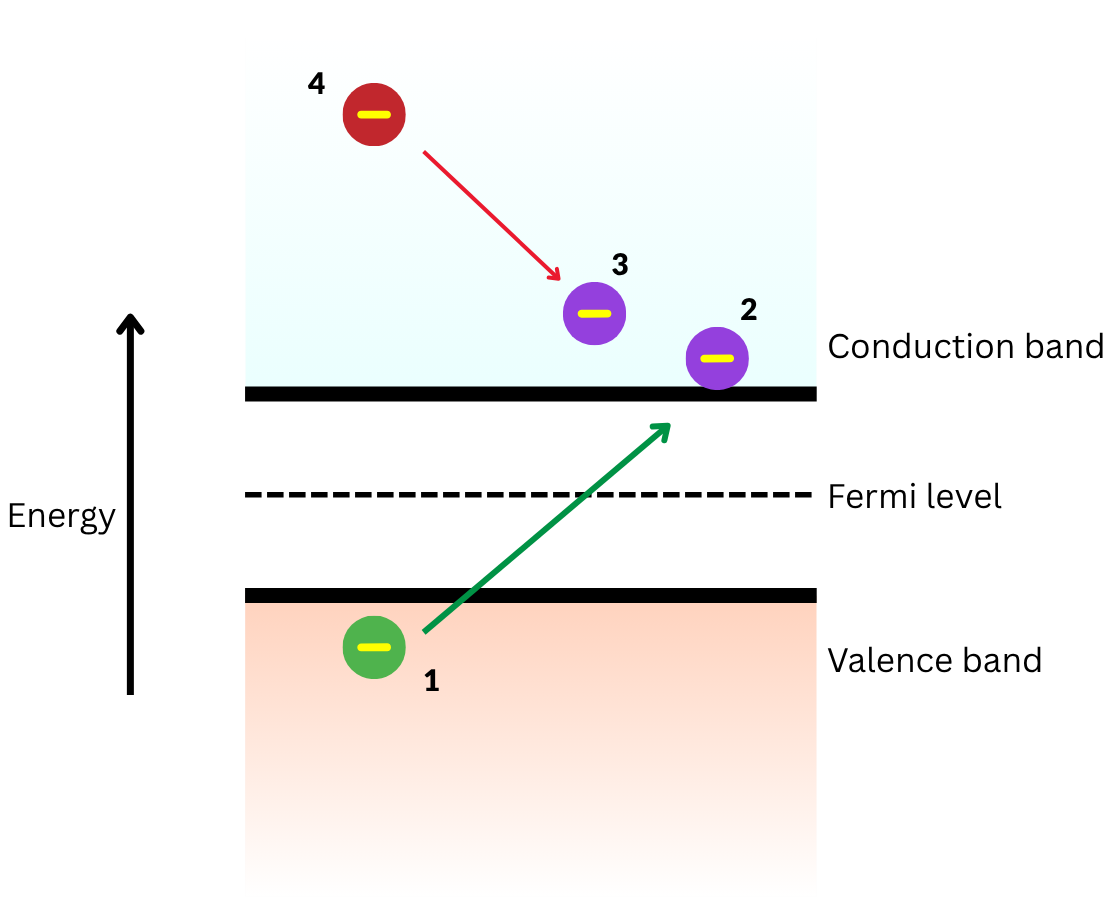
Figure 3: Illustration of the four-state impact ionization process with energy conservation between incoming and outgoing carriers.
This quantum kinetic treatment supersedes mean-field local ionization coefficients and Monte Carlo scattering by directly linking device geometry, field profile, and band structure to avalanche onset as a spectral overlap phenomenon. Carrier multiplication emerges only when both high-energy populations and accessible partner final states are resolved in nonequilibrium occupation, determined self-consistently via the Born approximation and fixed-point iteration.
Computational Realization and Simulation Results
The silicon device model is built from a fitted tight-binding Hamiltonian that accurately reproduces low-energy DFT reference bands while remaining numerically tractable for NEGF calculations. The device comprises an atomistic depletion region sandwiched between heavily doped p+ and n+ contacts, with electrostatic potential gradient imposing band tilting and high field across the channel.
The band structure, orbital composition, and contact-broadened density of states are validated, confirming that sp3 bonding dominates transport near the gap. The NEGF simulation resolves both available and occupied states subject to applied reverse bias and optical excitation, identifying the spatial tilt of bands and selective population emerging from contact injection. The simulated spectra show the locality of states participating in avalanche buildup and highlight the necessity of both spectral availability and actual occupation for impact ionization.
Theoretical Implications and Methodology Advancements
By formulating impact ionization as a non-empirical, microscopic self-energy within NEGF, the approach enables predictive modeling of avalanche gain, breakdown dynamics, and multiplication statistics from atomistic device parameters. The simulation framework moves beyond phenomenological descriptions, establishing the foundational methodology for self-consistent avalanche modeling in single-photon detectors used in quantum networks.
Contrary to conventional drift-diffusion and Monte Carlo protocols, the NEGF-based model explicitly resolves strongly non-equilibrium transport, energy- and orbital-resolved kinetics, and quantum coherence effects, all mandatory for device miniaturization and operation in high-field regimes. The paper argues that only microscopic, spectral-phase-space-resolved avalanche modeling can accurately link detector physics to system-level figures of merit in quantum networking.
Practical Applications and Future Prospects
The simulation provides the basis for design optimization and predictive performance assessment of silicon SPADs in integrated receivers, with direct impact on measurement fidelity, timing precision, dark count suppression, and single-photon detection probability. Implications include improved APD layout—band engineering, spatial field profiling, and contact design—to maximize gain onset and minimize noise for quantum communications and computation.
Extensions are proposed to include full self-consistent Poisson–NEGF electrostatics, increased basis dimensions for more accurate band structure, phonon and defect scattering, and benchmarking against experimental avalanche statistics. The NEGF methodology will facilitate development of device-level design rules for advanced photonic network receivers, enabling deeper integration between physical layer engineering and quantum protocol performance.
Conclusion
The paper demonstrates a quantum kinetic, atomistic NEGF simulation framework for impact ionization in silicon APDs tailored to quantum networking applications. The formulation and implementation resolve the spectral and occupation structure requisite for avalanche gain, facilitating first-principles analysis of carrier multiplication in nanoscale, high-field detectors. By connecting microscopic device physics to macroscopic quantum network performance, the framework provides a foundation for predictive modeling and optimization of single-photon detection modules, advancing capabilities for next-generation quantum communication systems (2605.01244).

