- The paper introduces a pendulum-based platform that mimics free-fall gravitational phase accumulation for entanglement certification within BMV-type protocols.
- Modeling shows that small-angle pendulum dynamics yield negligible deviations (<10⁻⁶) from ideal free-fall behavior over relevant short timescales.
- The mechanically constrained design enhances operational stability and control, providing a practical route for scalable quantum gravity tests.
Gravity-Induced Entanglement under Constrained Dynamics: A Technical Overview
Motivation and Context
The quantum nature of gravity remains a central open question in fundamental physics. Recent protocols such as the Bose–Marletto–Vedral (BMV) scheme propose that observation of entanglement generated via gravitational interaction between two spatially separated quantum systems constitutes evidence for the quantumness of gravity. Historically, these experiments have been framed in the context of free-fall interferometry, requiring the preparation and control of massive quantum superpositions over macroscopic separations and extended distances. Achieving these requirements introduces severe experimental challenges, including maintaining coherence during long free-fall times and mitigating environmental decoherence and uncontrolled motion.
This work addresses these challenges by proposing a mechanically constrained platform using pendulum-based dynamics. The core claim is that systems exhibiting effectively inertial, short-time dynamics replicate the gravitational phase accumulation responsible for entanglement, rendering them suitable for BMV-type entanglement certification. The study provides detailed modeling of such a platform based on micron-scale diamonds attached to ultralong carbon nanotube pendula.
The platform employs carbon nanotube pendula, each supporting a micron-scale nanodiamond with a single NV center spin. The pendular motion is confined to a small angular range, ensuring operation within the small-angle regime, where the motion can be approximated as locally inertial for short durations. The NV spin couples to the center-of-mass via a magnetic field gradient, implementing a spin-dependent force—the mechanism underlying the realization of a Stern–Gerlach interferometer in this architecture.
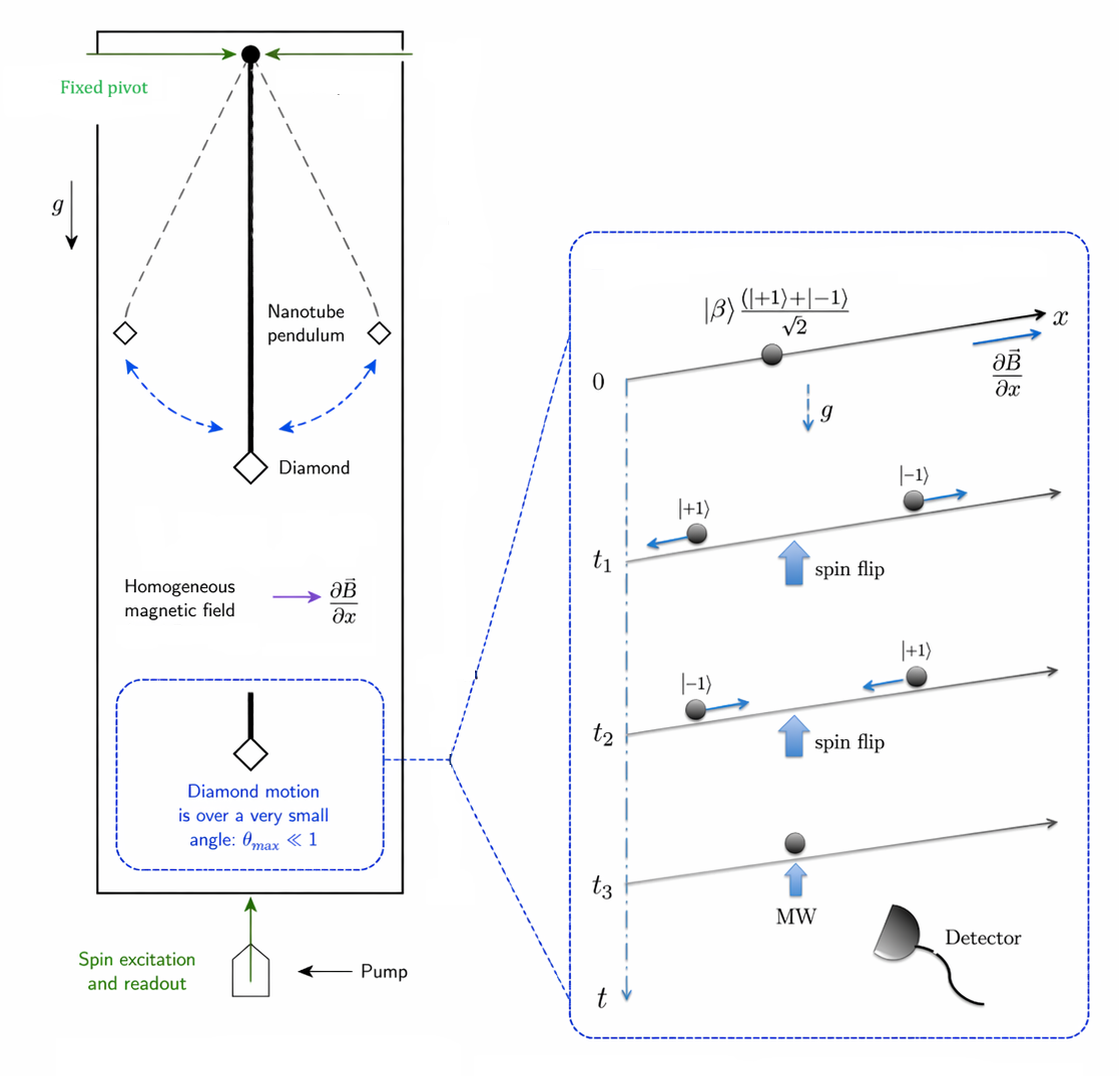
Figure 1: Schematic of the proposed nanotube-based platform showing a nanodiamond (with NV center) attached to a long, thin carbon nanotube, forming a mechanically constrained pendulum primed for interferometry.
Distinctly, this architecture avoids the need for long, uncontrolled free-fall paths and the concomitant instabilities. Instead, the pendulum operates as a static, equilibrated structure, inherently suppressing macroscopic drift and providing robust trajectory reproducibility—a significant stability enhancement over free-flight approaches.
Dynamical Analysis and Phase Accumulation
The model demonstrates that for interferometric timescales t much shorter than the pendulum period T, the tangential coordinate s(t) of the pendulum endpoint closely approximates the kinematics of free fall:
s(t)≈s0−21gt2
Deviations from the ideal free-fall trajectory scale as (t/T)2, becoming negligible (<10−6 relative correction) for accessible experimental parameters (t∼10−4–10−3 s, T∼1 s). This validates the effective realization of the BMV protocol dynamics within the constrained system and preserves the functional dependence of the accumulated gravitational phase responsible for entanglement.
The gravitationally mediated phase difference between the interferometer branches arises from pairwise, branch-dependent Newtonian interactions, ensuring fully analogous entanglement generation pathways as in the original BMV scheme.
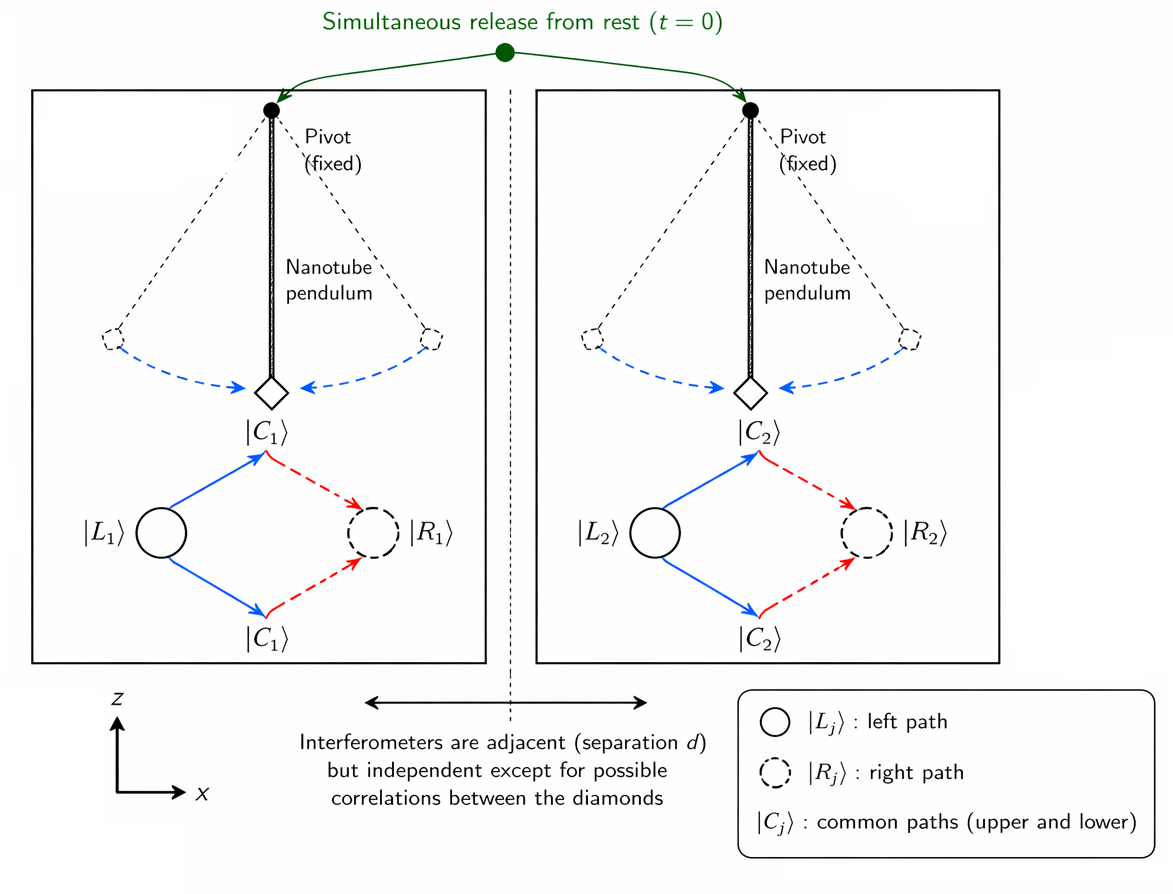
Figure 2: Schematic of two adjacent nanotube-based interferometers; each generates spatial superpositions, interacting gravitationally to accumulate relative phase and establish entanglement.
Noise, Stability, and Practical Considerations
Thermal vibrations of the nanotube pendulum are rigorously analyzed, with mean-squared displacement for the fundamental mode calculated for cryogenic operation. For typical mechanical parameters (T=10 mK, T0 sT1, T2 kg), root-mean-square displacements are shown to be on the order of picometers, which is negligible compared to the superposition size. Diamagnetic and environmental noise is further suppressed by employing paramagnetic compensation.
The platform allows for repeated, controlled operation with long integration times—a critical advantage for interference-based entanglement certification. Importantly, the experiment circumvents the necessity for complex magnetic tooth structures and precise free-fall control, reducing overhead and permitting larger accessible branch separations due to the large lever arm of the nanotube.
Entanglement Certification and Visibility
Within this regime, the operational visibility T3 for the certification of entanglement remains unaffected by the mechanical constraint except for a negligible correction at T4 order. The analysis strictly quantifies corrections to the phase and to the visibility, bounding them at T5 for the full set of parameters considered. The entanglement witness is thus robust to the implementation details of the pendulum confinement, validating the use of this constrained dynamics realization for quantum gravity tests.
Implications and Outlook
By demonstrating that gravity-induced entanglement protocols can be extended from free-fall-based architectures to mechanically constrained settings without compromising operational entanglement signatures, this work significantly relaxes the experimental requirements for quantum gravity witness protocols. The shift to a quasi-inertial, bounded configuration both stabilizes the dynamical environment and enables systematic control and averaging strategies, minimizing noise sources that plague free-fall methods.
This technique opens the path for scalable experimental approaches to quantum gravity tests, supporting the theoretical framework for generalized entanglement mediation via gravitational interaction under a broader class of system dynamics. Future work may include extensions to different forms of constrained systems and the study of multi-partite entanglement generation under gravitational mediation, helping to delimit the boundary between classical and quantum treatments of gravity at mesoscopic scales.
Conclusion
The development of a pendulum-based, mechanically constrained platform for gravity-induced entanglement preserves the operational features required for BMV-type protocols while dramatically enhancing practical stability and control. By validating the indistinguishability of gravitational phase accumulation between free-fall and constrained regimes to within tight tolerances, this work provides a concrete and experimentally tractable strategy for advancing quantum gravity tests in the laboratory.

