Published 22 Dec 2016 in quant-ph and gr-qc | (1612.07735v2)
Abstract: It is currently believed that there is no experimental evidence on possibly quantum features of gravity or gravity-motivated modifications of quantum mechanics. Here we show that single-atom interference experi- ments achieving large spatial superpositions can rule out a framework where the Newtonian gravitational inter- action is fundamentally classical in the information-theoretic sense: it cannot convey entanglement. Specifically, in this framework gravity acts pairwise between massive particles as classical channels, which effectively induce approximately Newtonian forces between the masses. The experiments indicate that if gravity does reduce to the pairwise Newtonian interaction between atoms at the low energies, this interaction cannot arise from the exchange of just classical information, and in principle has the capacity to create entanglement. We clarify that, contrary to current belief, the classical-channel description of gravity differs from the model of Diosi and Penrose, which is not constrained by the same data.
The paper demonstrates that classical gravity models based on LOCC fail to explain observed quantum entanglement in atom interference experiments.
The experimental analysis reveals a discrepancy between predicted decoherence rates from classical-channel frameworks and the minimal decoherence measured.
The findings imply the need for revised gravitational models that incorporate quantum dynamics and non-local interaction capabilities.
Gravity as Non-Classical Channels: Analysis and Implications
Overview of Gravity in Quantum Systems
The paper "Gravity is not a Pairwise Local Classical Channel" (1612.07735) challenges the classical understanding of gravity, particularly in the context of quantum mechanics. Traditionally, gravity is considered a classical interaction, incapable of inducing quantum entanglement. However, this research posits that single-atom interference experiments involving large spatial superpositions can empirically refute models where gravity solely functions as a classical channel. These models suggest that gravity, acting through Newtonian pairwise interactions, should not be able to convey entanglement. The experiments indicate otherwise, suggesting that gravity may indeed have the capacity to create entanglement at low energies, contrary to current beliefs about its classical nature.
Experimental Framework and Analysis
The KTM (Kafri-Taylor-Milburn) framework applies information-theoretic principles to gravitational interactions, proposing that for gravity to be fundamentally classical, it should act as an LOCC (Local Operations and Classical Communication) channel. This would imply that the corresponding interactions should not increase entanglement between masses. However, the research shows that under the assumption of a fundamentally classical gravitational field, experiments on atom interference fail to confirm the model's premise. Classical channels conceptualize gravity's mechanics, but the findings suggest that such a model would necessitate decoherence rates beyond those observed experimentally.
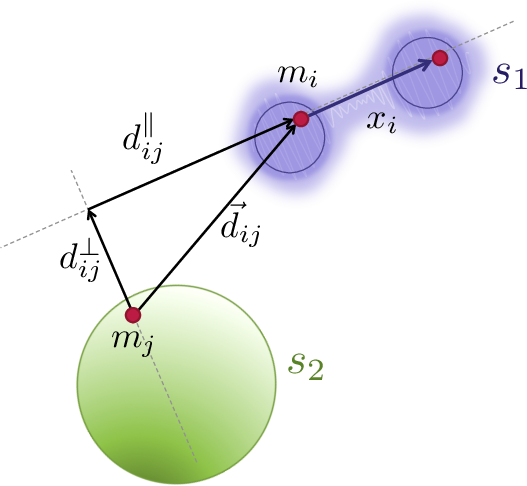
Figure 1: Test body s1 in a spatial superposition in the presence of a source mass s2. For any pair of elementary masses (mi,mj) forming the bodies, the distance dij.
The in-depth examination of gravitational interactions in single-atom interference setups, which align large masses (like Earth) with small, interferometric atoms, illustrates significant empirical discrepancies with classical gravitational models. Experiments in this domain clearly demonstrate interference with minimal decoherence, starkly contrasting with predictions made by classical-channel frameworks.
Comparison and Contrast with Diosi-Penrose Model
In order to differentiate between the information-theoretic KTM approach and the Diosi-Penrose (DP) model, the authors explore theoretical and empirical distinctions, particularly in decoherence rates. The DP model posits that quantum superpositions of mass distributions naturally lead to gravitationally induced decoherence. This is distinctly different from the KTM approach, which posits indirect entanglement distortion via local gravitational interactions. Interestingly, the DP model's predictions of decoherence timescales largely exceed those of recent experiments, supporting the inadequacy of purely classical gravitational models.
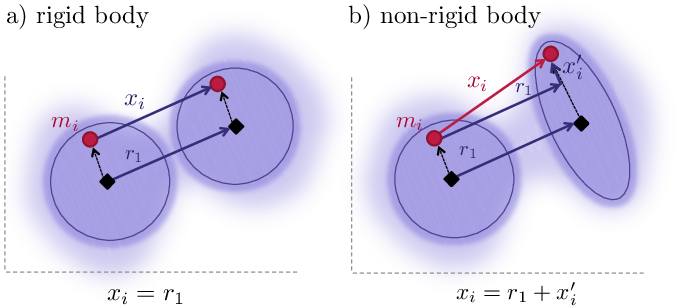
Figure 2: Displacement xi of the ith constituent of a test body.
While both frameworks address the gravitational dynamics at an intersection of classical and quantum theories, the KTM demands stricter empirical validation. Additionally, the inherent assumptions in the DP model, such as those relating to local interactions without overarching field dynamics, invite reconsideration in light of the data provided by large momentum transfer interferometric tests.
Implications and Future Directions
The implications of this study are manifold, posing fundamental questions about the quantum characteristics of gravitational fields. Should gravity indeed demonstrate entangling capabilities, it would necessitate reconciling quantum mechanics with gravitational dynamics on a fundamental level. The research encourages exploring gravitational interaction models that account for potential non-locality or quantum channel capacity — characteristics atypical of classical interactions.
Future work could focus on refining experimental setups to further disentangle gravitational interactions at quantum scales. Developing experiments with enhanced sensitivity to quantum gravitational signals can aid in comprehensively evaluating gravity's channel capacity for entanglement creation.
Conclusion
In conclusion, the study underlines the insufficiency of classical models in entirely explaining gravitational interactions in quantum systems, as evidenced by single-atom interference experiments. It brings to light the necessity of re-examining gravitational models through a quantum lens, potentially reshaping the cornerstone assumptions in theoretical physics. As such, while these experiments do not conclusively mandate gravity's quantum nature, they significantly delimit the scope for gravity's classical description, creating a ripe domain for future theoretical and empirical exploration.