- The paper presents a quantum gradient-based framework that integrates Sobel kernels into quantum circuits for efficient edge and corner detection.
- It compares QPIE and FRQI image encoding techniques, highlighting QPIE's superior fidelity and lower reconstruction error under finite sampling.
- The research implements a hybrid quantum–classical pipeline that achieves competitive feature localization with polynomial circuit scalability.
Quantum Gradient-Based Edge and Corner Detection with Sobel Kernels: A Technical Assessment
Problem Statement and Context
The paper "Quantum Gradient-Based Approach for Edge and Corner Detection Using Sobel Kernels" (2605.00744) presents a framework for performing edge and corner detection on digital images using quantum circuits. The approach systematically builds on the established Harris corner and Sobel edge detectors, recasting core operations (notably, spatial gradient computation) within quantum amplitude-encoded representations. The authors analyze and contrast two mainstream quantum image encoding schemes—Quantum Probability Image Encoding (QPIE) and Flexible Representation of Quantum Images (FRQI)—with an emphasis on their suitability for subsequent quantum gradient-based feature extraction and on practical pipeline implementation considerations.
Quantum Image Processing (QIP) has received increased attention as contemporary quantum hardware approaches scales relevant to image and signal domains. Processing paradigms focused on parallel amplitude encoding, superposition-driven differencing, and hybrid quantum–classical workflows are progressively maturing, offering potential circuit-level accelerations for localized image analysis tasks.
Quantum Image Encoding: QPIE and FRQI
The core practical prerequisite of quantum image algorithms is an efficient and robust mapping from pixel intensity arrays into quantum states. This work evaluates two leading encodings:
- QPIE encodes normalized pixel intensities directly into amplitude coefficients of computational basis states, requiring r=⌈log2(mn)⌉ qubits for an m×n image. This paradigm exploits amplitude superposition but requires careful normalization for returning to the physical domain during measurement.
- FRQI utilizes an ancilla qubit to encode pixel intensities via rotation angles (linear or nonlinear mapping), with the remaining position qubits specifying spatial locations. The ancilla-based framework is more straightforward to realize but exhibits increased shot complexity due to angle encoding, especially for high-resolution images.
Reconstruction analysis evidences superior fidelity and structural similarity preservation for QPIE versus FRQI under equal, finite sampling budgets. SSIM and relative difference plots (see below) indicate the robustness of amplitude encoding.
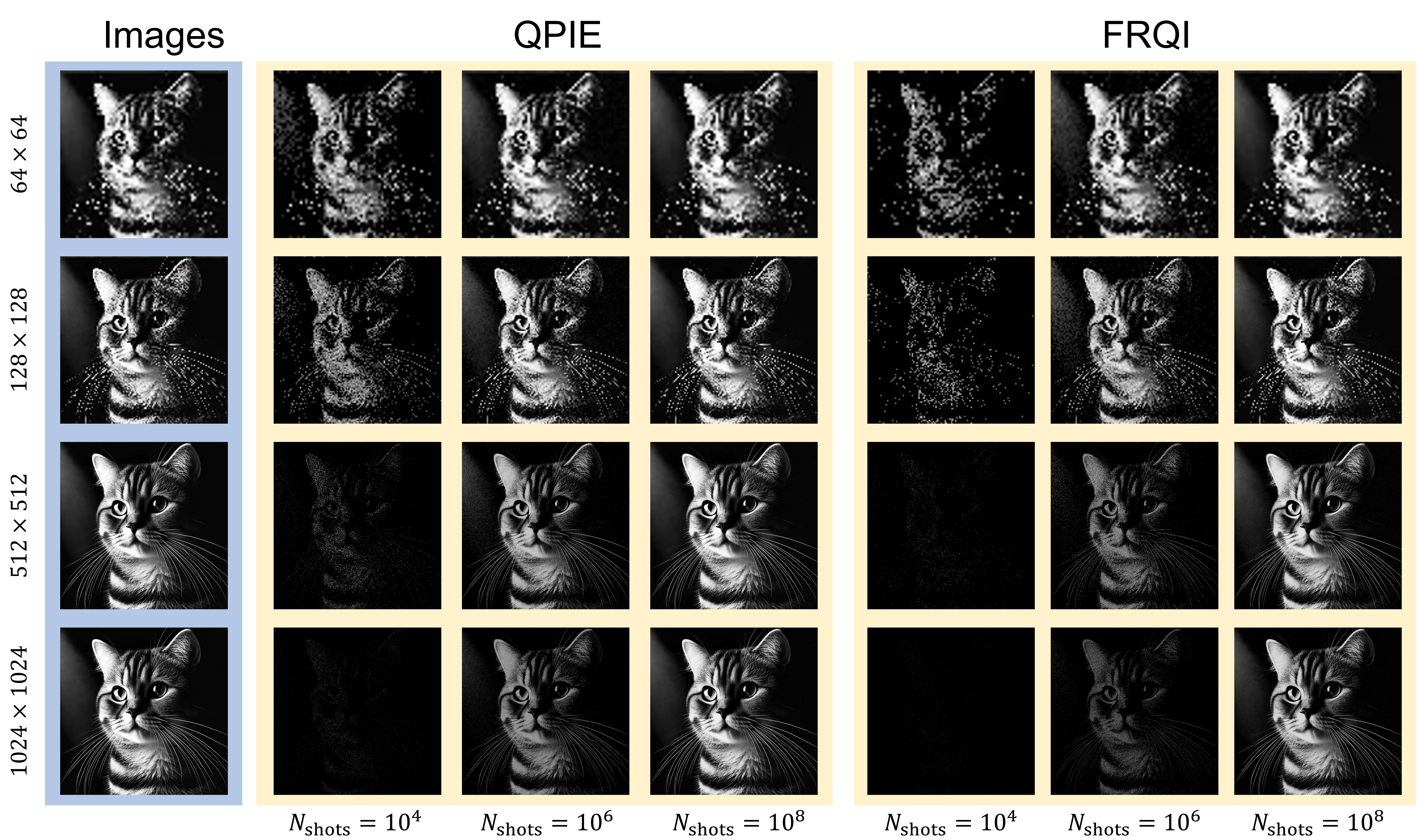
Figure 1: Comparison of QPIE and FRQI image encoding methods at varying image resolutions and shot counts. QPIE demonstrates higher reconstruction fidelity, especially for small-to-moderate shot numbers.
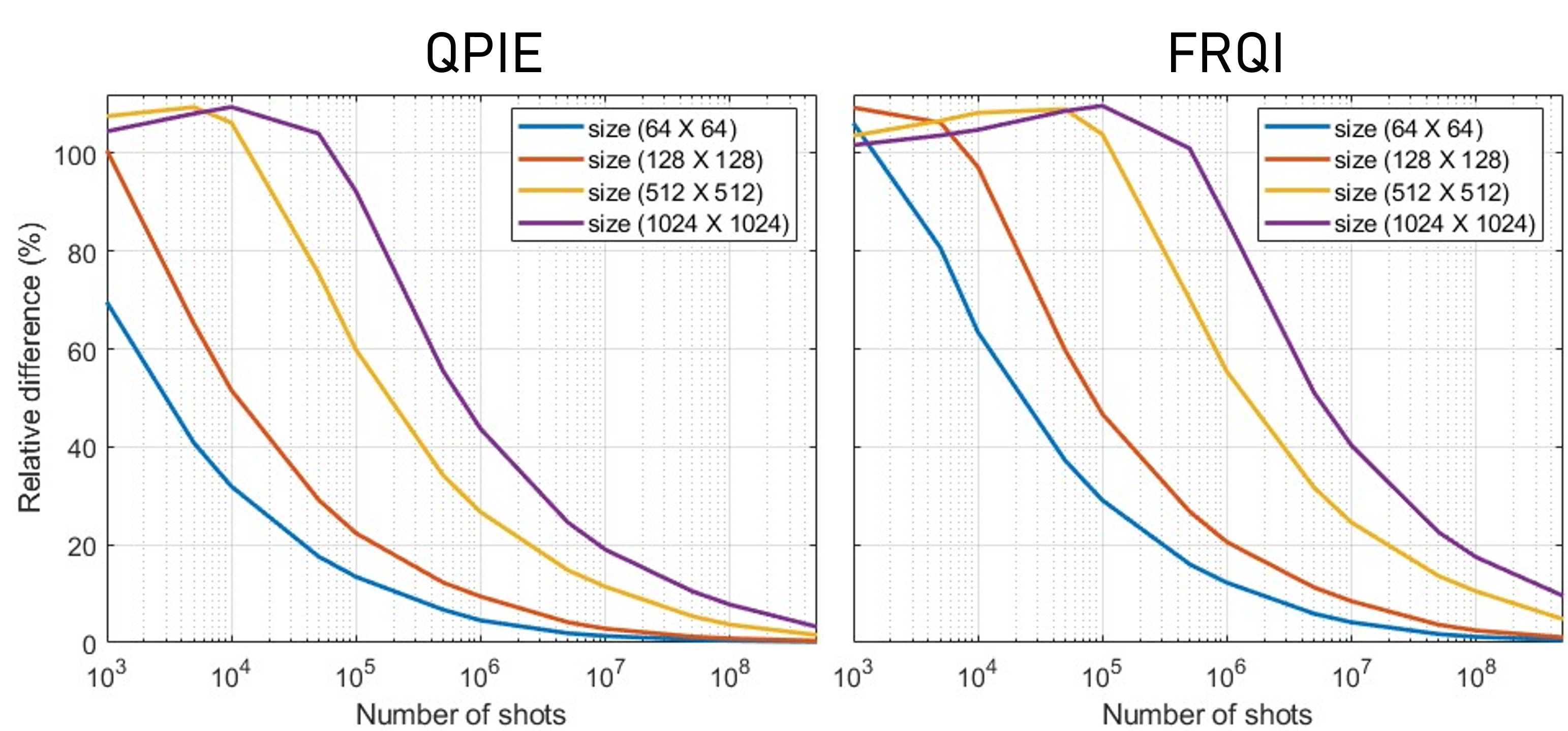
Figure 2: Relative reconstruction error between original and quantum-retrieved images after QPIE and FRQI encoding. QPIE exhibits lower error for a fixed number of shots.
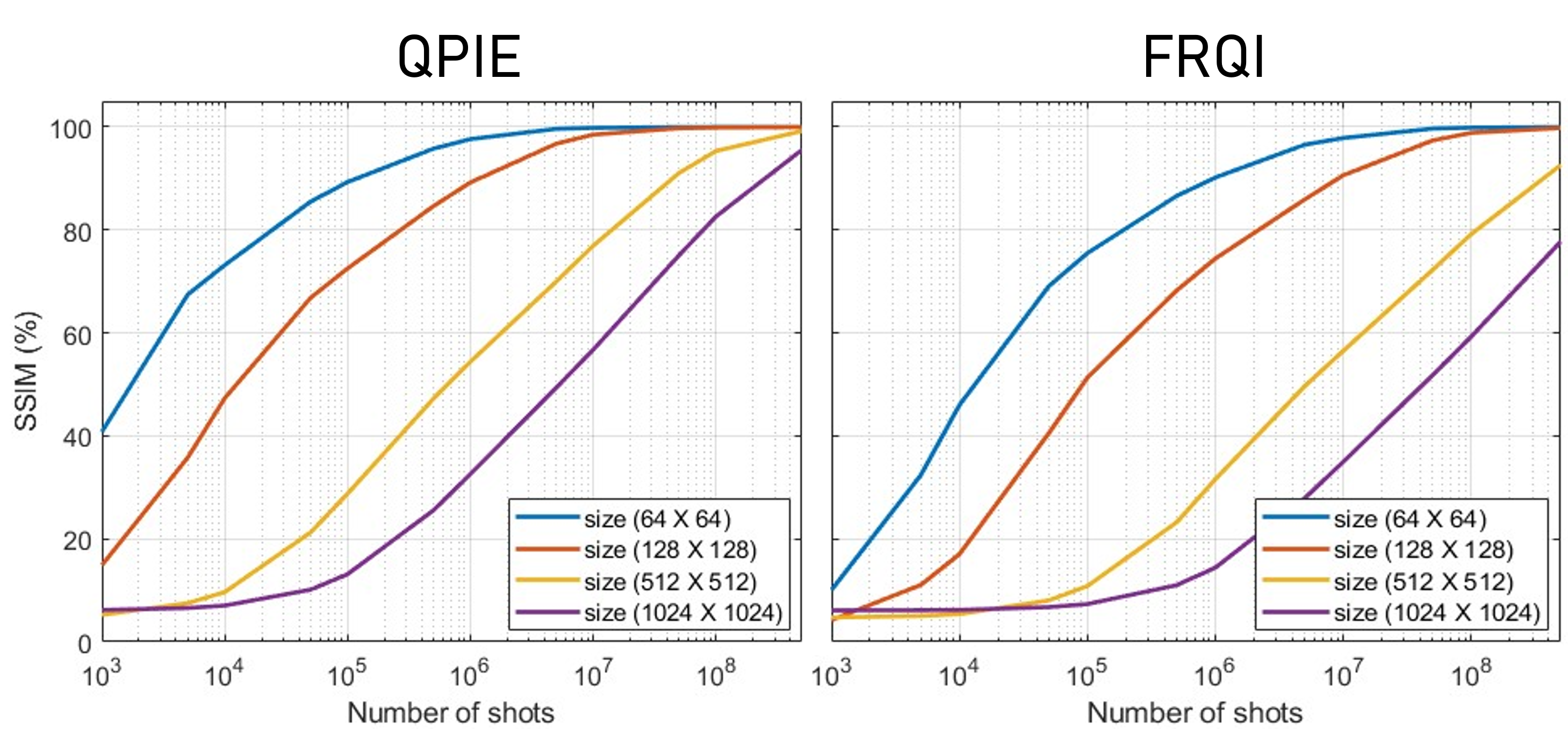
Figure 3: SSIM comparison for QPIE and FRQI encoding; QPIE achieves higher SSIM at finite measurement budgets.
Quantum Gradient Kernel Circuit: Lag-2 Difference Operator
Central to the proposed framework is the "Quantum Gradient Kernel Circuit" (QGKC), which enables quantum-native computation of spatial (lag-k) differences. The construction relies on permutation operators acting on position registers, combined with amplitude superposition and projective measurement. For lag-2 (the focus here), the circuit efficiently computes [ci−ci+2] for all i in a single application, mapping the operation complexity to polynomial in r (the number of qubits), distinct from classical O(N) pixel operations.
The shift and swap primitives, alongside controlled Hadamard and Pauli-X gates, effect the difference computation without explicit convolution, paving the way for direct evaluation of Sobel-style gradients in the quantum domain.
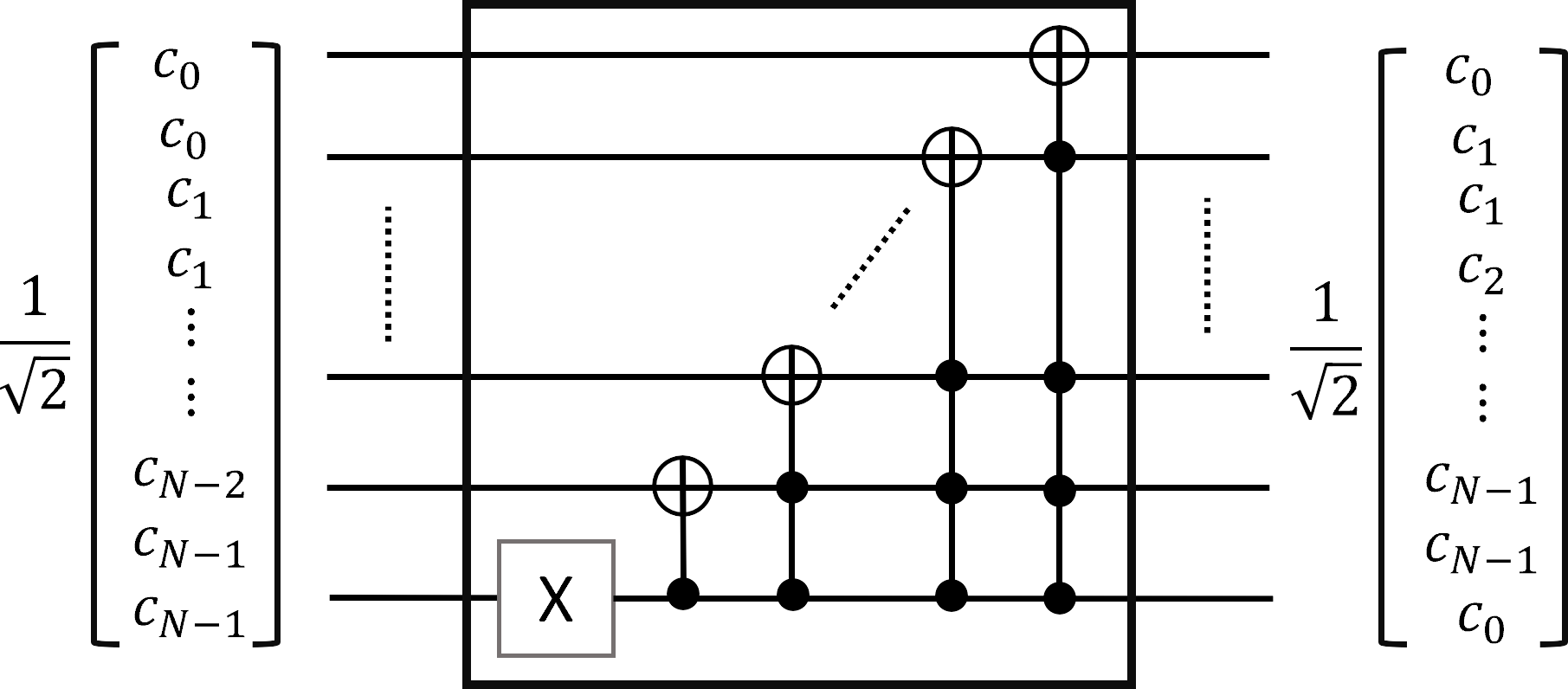
Figure 4: Quantum circuit realization of the (r+1)-qubit amplitude permutation (cyclic shift) operator D, an essential primitive in quantum lag-2 differencing.
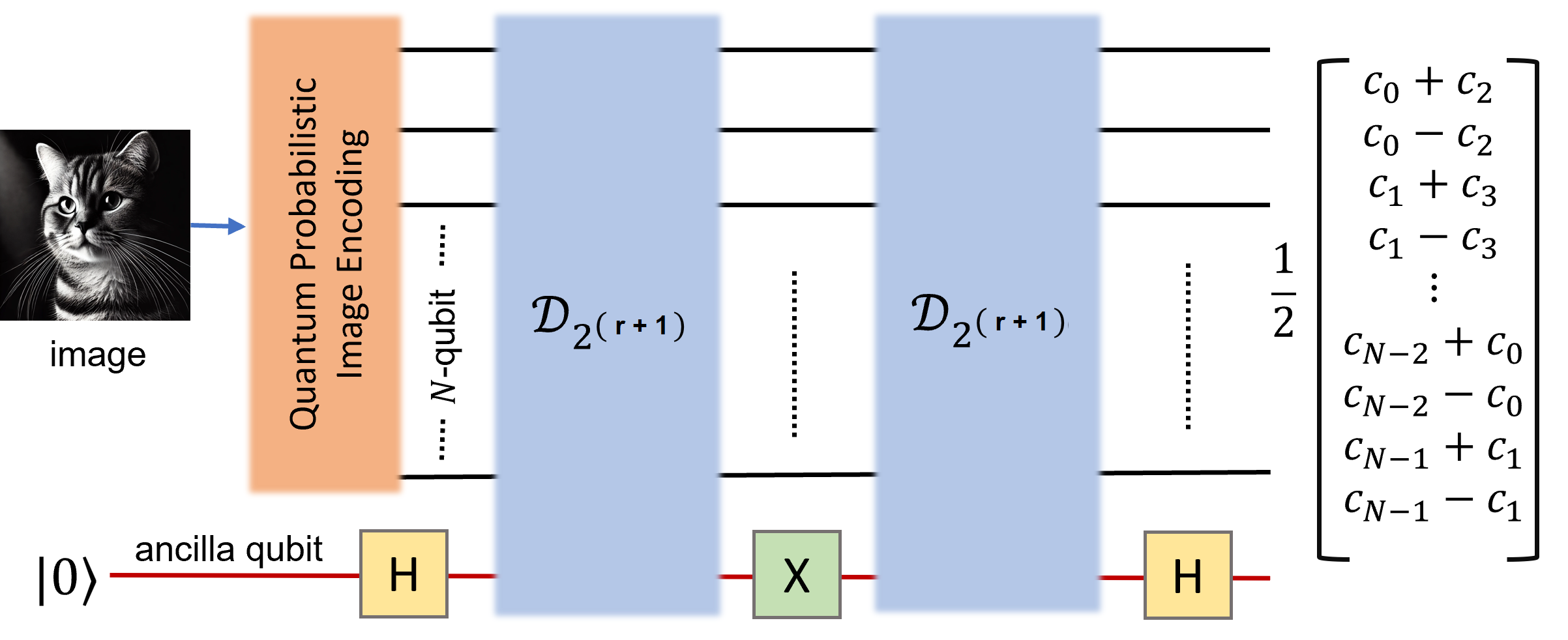
Figure 5: Quantum circuit for lag-2 gradient (QPIE representation), mapping amplitude differences directly into computational basis.
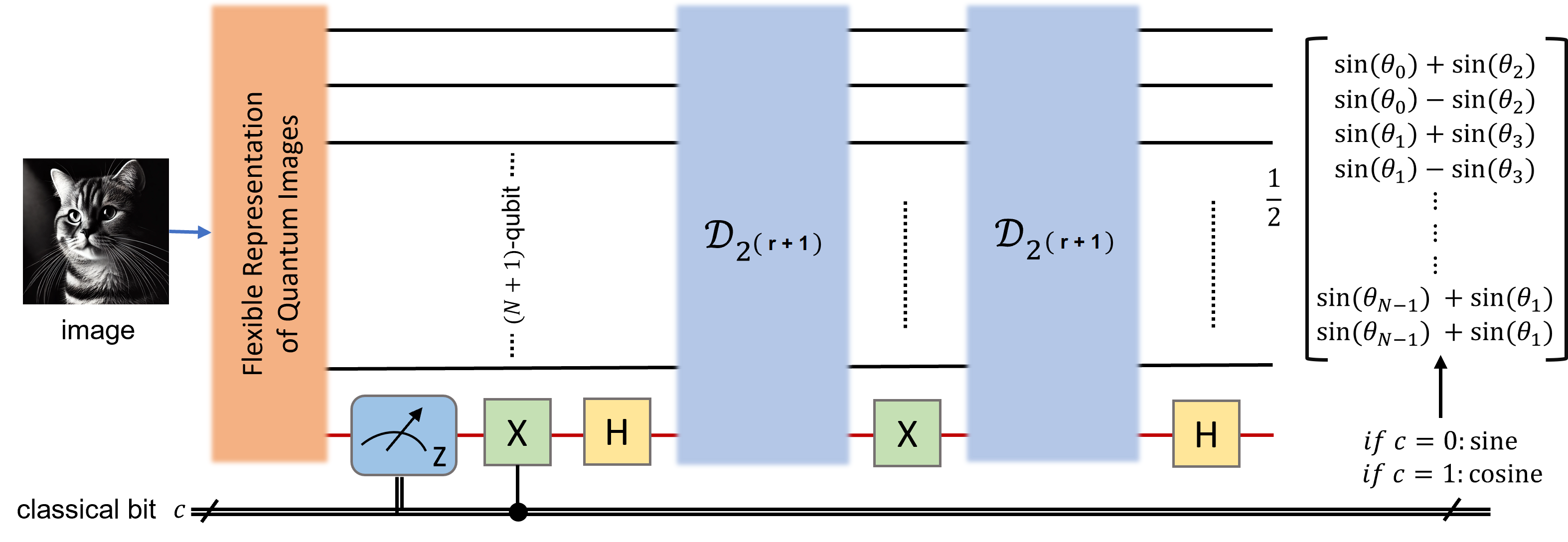
Figure 6: Quantum circuit for lag-2 gradient calculation under FRQI encoding, leveraging the ancilla qubit for sin/cos parameterization.
The computational complexity of the quantum lag-2 operator is m×n0, leveraging existing quantum adder and permutation schemes ((2605.00744), [fijany1999quantum]).
Hybrid Quantum–Classical Pipeline and Feature Extraction
The quantum gradient circuits are integrated into hybrid workflows. After quantum estimation of lag-2 gradients, subsequent processing steps (gradient magnitude calculation, Harris matrix formation, response thresholding) are performed classically. This decoupling reflects practical limitations imposed by measurement and state preparation cost in amplitude-encoded paradigms.
Edge Detection: Sobel and QHED
Sobel-based quantum edge detection leverages quantum lag-2 differences as gradient surrogates. Post-processing computes Sobel gradients and applies classical thresholding.
Quantum Hadamard Edge Detection (QHED), in contrast, uses Hadamard-based amplitude mixing to emphasize high-frequency (edge-like) changes but exhibits higher fragmentation and noise sensitivity in practice.
Edge-detection benchmarks on standard and AI-generated datasets illustrate that Sobel post-processing of quantum-derived gradients yields more coherent, thicker, and less fragmented edge maps than QHED, with 20–80% reductions in edge fragment count (EF) depending on the encoding and image.
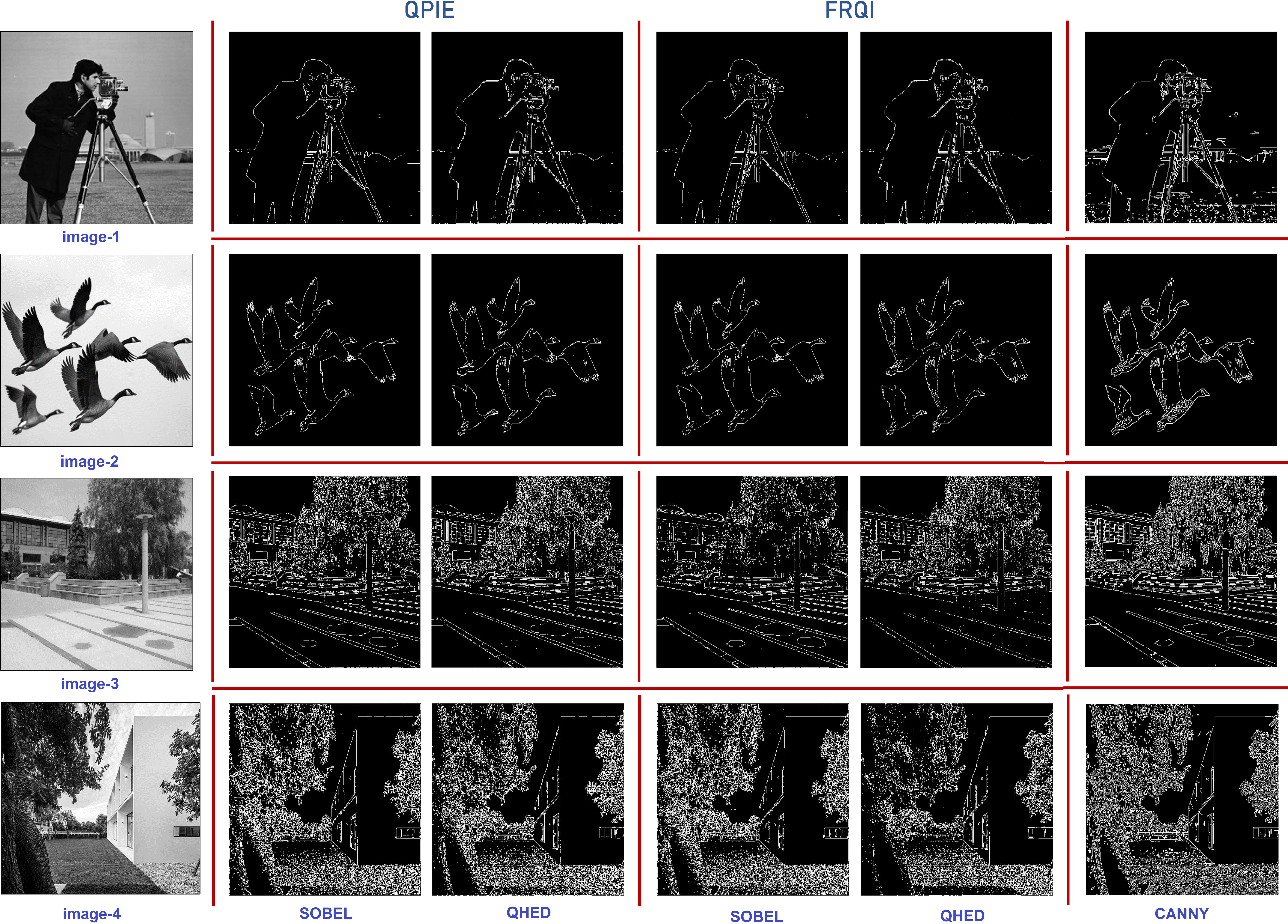
Figure 7: Edge detection experiment results (UDED dataset)—edge maps generated by QPIE/FRQI encoding, Sobel, QHED, and classical Canny algorithms. Sobel-processed quantum gradients retain structural correspondence; QHED maps are more fragmented.
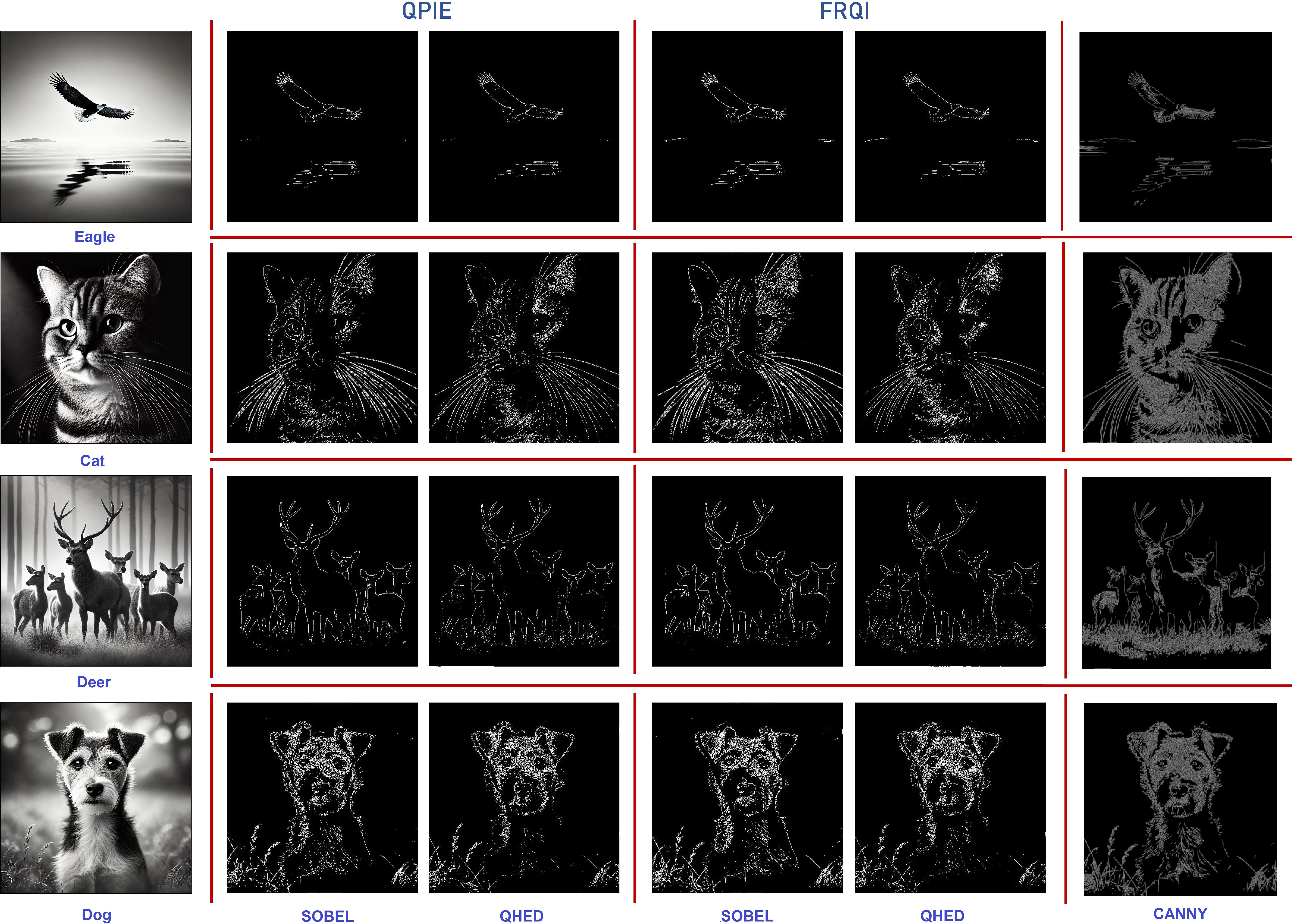
Figure 8: Edge detection on generative AI animal images; Canny gives the smoothest and most connected results, QPIE/FRQI with Sobel outperforms QHED.
Corner Detection: Quantum Harris and Evaluation
The Quantum Harris Corner Detection (QHCD) pipeline reconstructs structure tensors using quantum-derived Sobel gradients, after which post-processing (scoring, non-maxima suppression, FAST-style local verification) isolates corners. Contrasting QHED-derived feature maps, which identify potential corners as edge intersections, QHCD achieves higher localization fidelity with drastically reduced false positives—across both QPIE and FRQI.
Comprehensive evaluation against ground-truth Urban100 annotations confirms:
- QHCD (Sobel-based quantum gradients) achieves high Corner Detection Accuracy (CDA; 74–100%) with low False Positive Rate (FPR; frequently 0%).
- QHED-based corner proposals yield substantially higher FPR (often >50–90%), reflecting their susceptibility to edge over-segmentation and clustering.
- Classical Harris remains a strong baseline, yielding competitive TP rates, but both quantum pipelines—when properly post-processed—match or surpass its localization reliability and can exploit quantum circuit-level parallelism.

Figure 9: QPIE and FRQI corner detection overlays on Urban100 images, accompanied by classical Harris results. QHCD (Sobel) isolates corners with high spatial precision; QHED often clusters detections along edge boundaries.
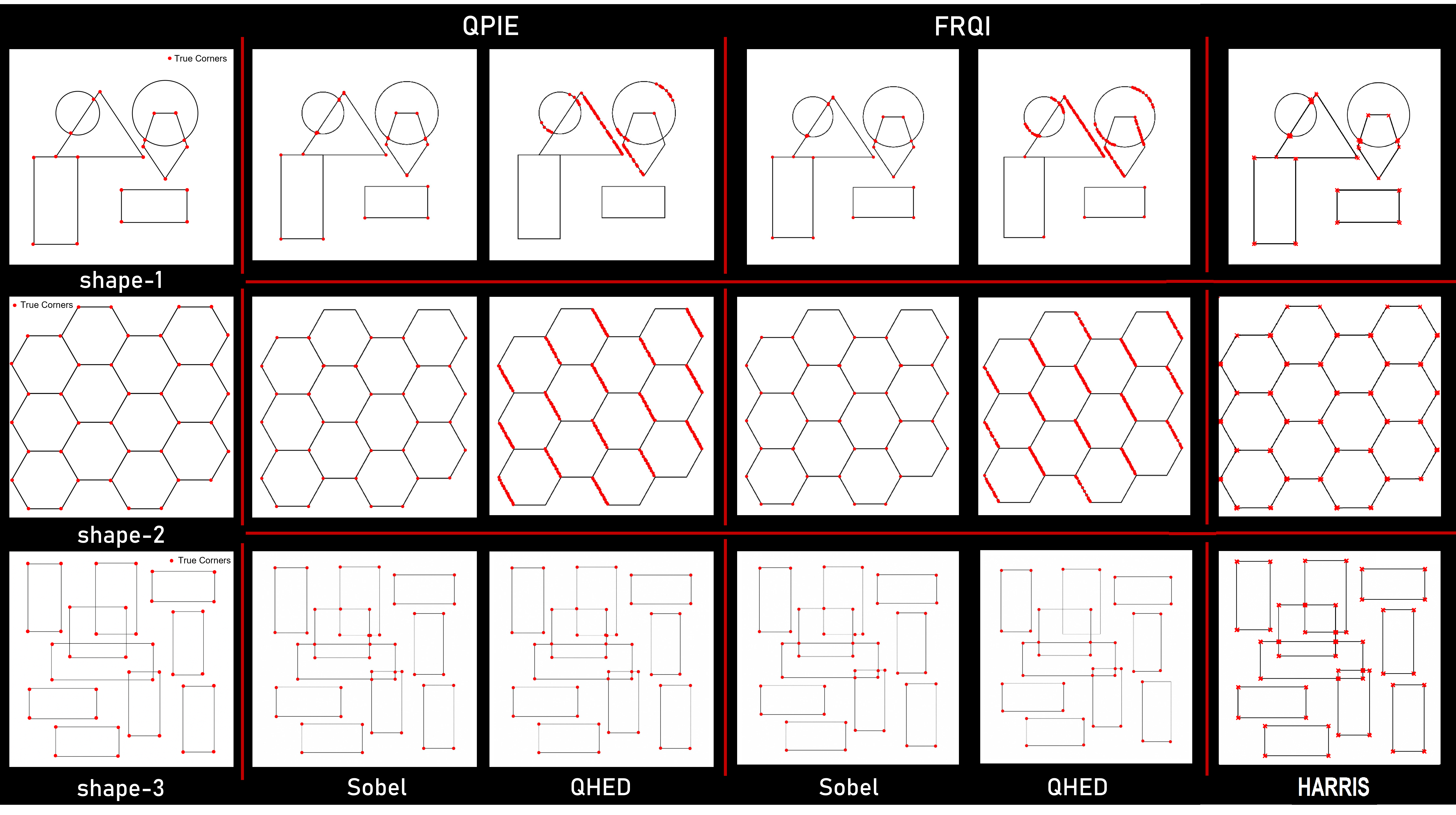
Figure 10: Additional Urban100 overlays. Classical Harris and quantum Sobel results show consistency in meaningful corner localization.
Computational and Practical Implications
At the quantum-circuit level (excluding state preparation and measurement), the quantum gradient kernel offers polynomial resource scaling in qubit number, a fundamental asymptotic separation from pixel-wise classical convolutions (m×n1 per image for classical, m×n2 for quantum). However, due to the exponential scaling of measurement shots required for dense classical map recovery, quantum computational advantage remains subroutine-localized for the NISQ era.
QPIE's direct amplitude encoding is empirically more robust than FRQI, owing to its stability under finite sampling and insensitivity to nonlinearity or parameter thresholding. FRQI's sin/cos parameterization requires careful tuning, particularly for Sobel/Harris score thresholding.
Comprehensive benchmarking against classical Canny and corner-detection pipelines further supports the conclusion that the quantum gradient kernel is best used as a primitive within hybrid quantum–classical frameworks, where complex classical post-processing is retained to maximize localization fidelity while exploiting quantum parallelization in the subroutine bottleneck.
Limitations and Directions for Future Research
All results are reported in a noiseless simulation regime, omitting NISQ hardware artifacts such as decoherence, gate infidelity, and measurement error. State-preparation and measurement dominate computational cost for large images, and the theoretical quantum speedup herein is best interpreted as circuit-local, under idealized conditions. Robustness to shot noise in Sobel-based quantum gradients (as opposed to global image reconstruction) is left to future work, as is large-scale, hardware-backed empirical validation.
Potential augmentations include data-driven threshold selection (e.g., Bayesian or ML-based), integration with deep quantum models for feature scoring, and end-to-end pipelines for quantum video domain analysis exploiting the lag-based kernel's extension to time.
Conclusion
This work rigorously implements and analyzes quantum Harris/Sobel-style feature detection pipelines, anchored by a scalable quantum lag-2 gradient kernel and two prominent quantum image encodings. The results empirically establish the superiority of QPIE encoding for stable and efficient quantum feature extraction. The proposed quantum corner and edge detection pipelines, evaluated against classical baselines, demonstrate that quantum gradient computation, when combined with classical post-processing, achieves competitive or superior feature localization, with clear advantages in corner detection accuracy and edge continuity relative to direct Hadamard-based extraction. The practical advantage—at present—resides at the gate-level for specific subroutines, not yet as an end-to-end speedup, but the methodological innovations provide a robust foundation for further advances in quantum-enhanced image understanding and integration in quantum machine learning workflows.