An Error-aware and Adaptive Method for the Estimation of Quantum Observables on Qudit-Based Quantum Computers
Published 1 May 2026 in quant-ph | (2605.00682v1)
Abstract: The accurate estimation of observables is a crucial task in quantum computing. Recent advances have highlighted the need for (a) specialized protocols for qudit-based devices, that include (b) error-aware strategies. Here, we present AQUIRE, the first protocol that can (a) accurately estimate both the mean and the error of an observable on qudit-based quantum computers. AQUIRE achieves this by constructing a Bayesian model to accommodate generalized Pauli operators. It is designed to continuously monitor the estimated average and the associated error of the observable, adjusting the subsequent measurements in real-time. Additionally, AQUIRE is (b) device- and experiment-specific error-aware, and accounts for hardware imperfections and experimental noise during the estimation process. We demonstrate AQUIRE's advantage via numerical simulations and showcase its ability to quantify the noise affecting the estimation by implementing it on a trapped-ion qudit quantum processor. By exploiting general commutation relations and overlap grouping measurements, our protocol is state-of-the-art when restricted to qubit-based quantum computers and extends this advantage to the qudit case.
The paper presents AQUIRE, an adaptive Bayesian protocol that accurately estimates quantum observables in qudit systems by integrating statistical and hardware noise into error estimates.
It employs adaptive shot allocation and clique-based joint measurements to reduce measurement resource requirements by up to 40–60% for qubit observables and twofold for qudit observables.
The methodology leverages MCMC sampling and real-time Bayesian updates to dynamically manage error estimation, enhancing reliability for quantum simulation and variational algorithms.
Error-Aware and Adaptive Measurement Protocols for Qudit-Based Quantum Computers
Context and Motivation
The estimation of quantum observables is a central task underpinning quantum algorithms in simulation, optimization, and other quantum information processing applications. As quantum computers transition from NISQ devices towards early fault-tolerance, qudit-based architectures—where each quantum register encodes multiple levels—are increasingly relevant for improved resource efficiency and enhanced expressivity. However, no practical protocol exists for estimating observables within qudit systems, particularly concerning accurate error reporting that incorporates both statistical and hardware noise components. Existing qubit-centric protocols either neglect error-awareness or use overly conservative bounds, which significantly limits the utility of quantum algorithms that depend on precise state discrimination, such as variational algorithms.
This work introduces AQUIRE (Adaptive Quantum Measurements with Real-time Error-awareness), a measurement protocol purpose-built for multi-dimensional qudit-based quantum computers, which adaptively estimates both the mean and error of an observable in a manner that is error-aware with respect to device-specific imperfections and environmental noise.
Theoretical Framework
AQUIRE generalizes measurement protocols to handle qudit-based systems by developing a Bayesian model for the estimation of observables composed of generalized Pauli Strings (PS). Given a quantum observable O^, it is decomposed into PS suitable for multi-qudit configurations:
O^=∑iciP^i
where each P^i is a tensor product of generalized Pauli operators for the respective qudit dimensions. The protocol ensures that spin operators—ubiquitous in physical Hamiltonians—are efficiently mapped to qudit Pauli operators with a polynomial number of terms, avoiding the exponential blowup that plagues higher-dimensional systems.
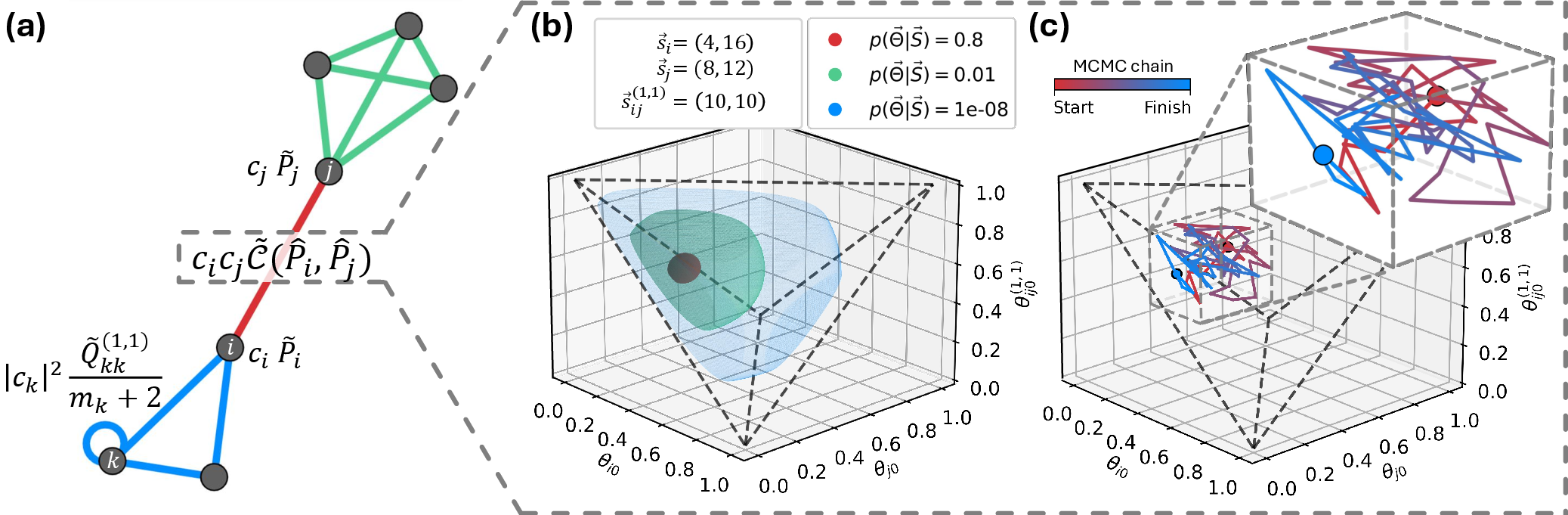
A central methodological advance is treating the measurement allocation process as one of minimizing the estimation variance (ΔO)2, computed using real-time Bayesian updates. The protocol constructs a commutation graph with vertices corresponding to PS; cliques within the graph represent groups of jointly measurable PS (via general, not merely bitwise, commutation relations).
Figure 1: Bayesian estimation process for dP=2 visualized as a commutation graph, illustrating joint measurement cliques and their contribution to the estimation error.
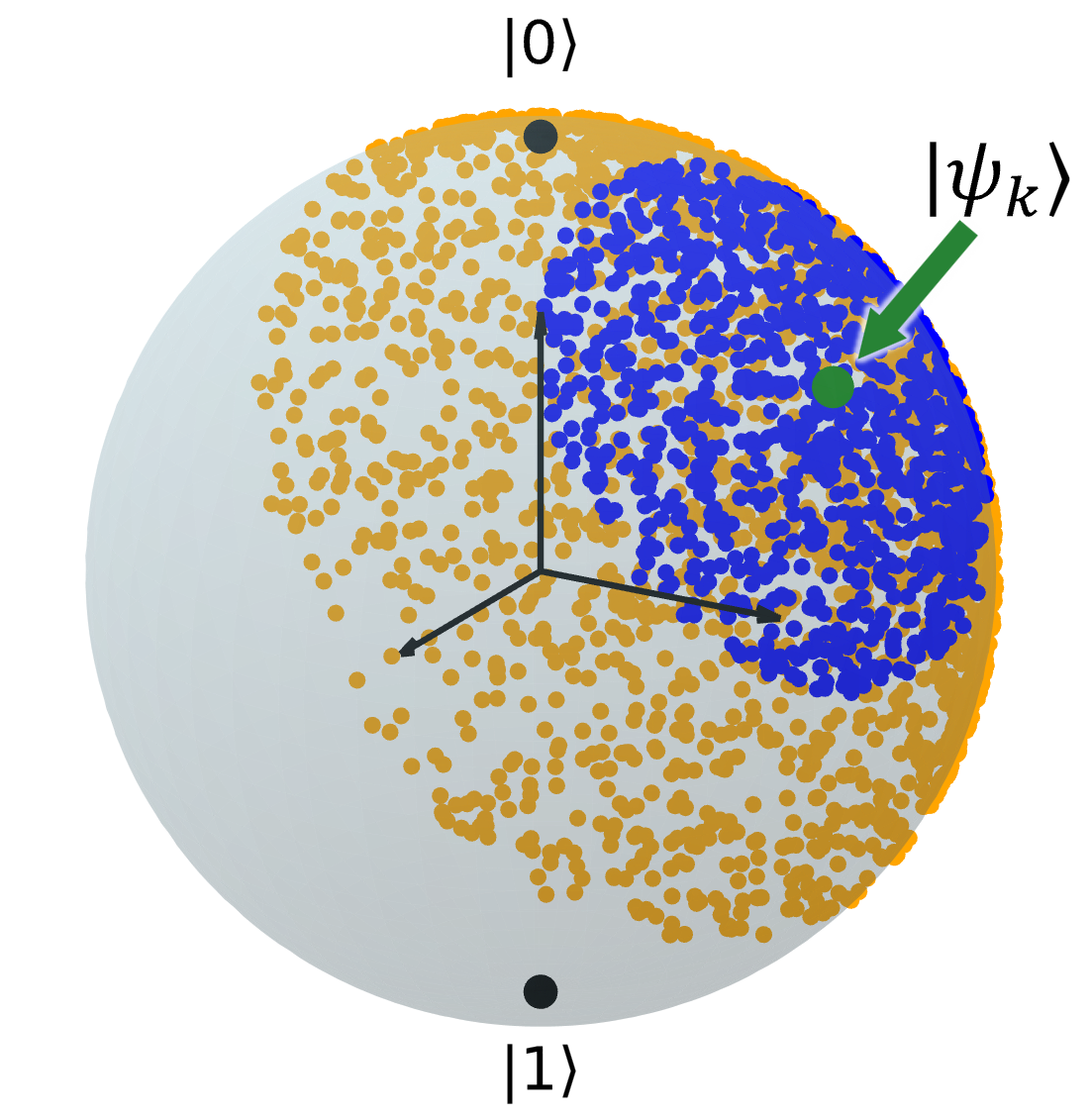
The Bayesian inference procedure leverages Markov Chain Monte Carlo (MCMC) sampling over the constrained probability simplex defined by physical measurement outcomes and commutation structure. This incorporates the covariance contributions from simultaneous measurement of commuting PS and adapts measurement shot allocation dynamically based on observed variances. The resultant model computes not only the average of the observable but also an error estimate inclusive of statistical and systematic (hardware) noise effects.
Algorithmic Pipeline
The measurement algorithm proceeds with the following steps:
Pauli Decomposition:O^ is decomposed into qudit PS, using efficient classical routines.
Clique Cover Construction: The commutation graph is built, supporting both general and bitwise commutation. Cliques of PS that can be measured simultaneously are identified.
Shot Allocation: Measurement shots are adaptively allocated across cliques, prioritizing variance reduction per shot, with real-time Bayesian updates after each batch.
Clifford Circuit Synthesis: For each clique, diagonalizing Clifford circuits are constructed using generalized Hadamard, Phase, and controlled-SUM gates (for qudits), allowing measurement in the computational basis.
Error-Awareness Integration: Stabilizer circuits are applied to empirically estimate hardware error rates per clique, integrating systematic error contributions into the total estimation variance.
Shot allocation is optimized either according to simple PS weights (non-adaptive) or with Bayesian-updated covariance estimates (adaptive). AQUIRE can transition between general and bitwise commutation modes to trade off measurement efficiency against susceptibility to hardware noise.
Numerical and Experimental Validation
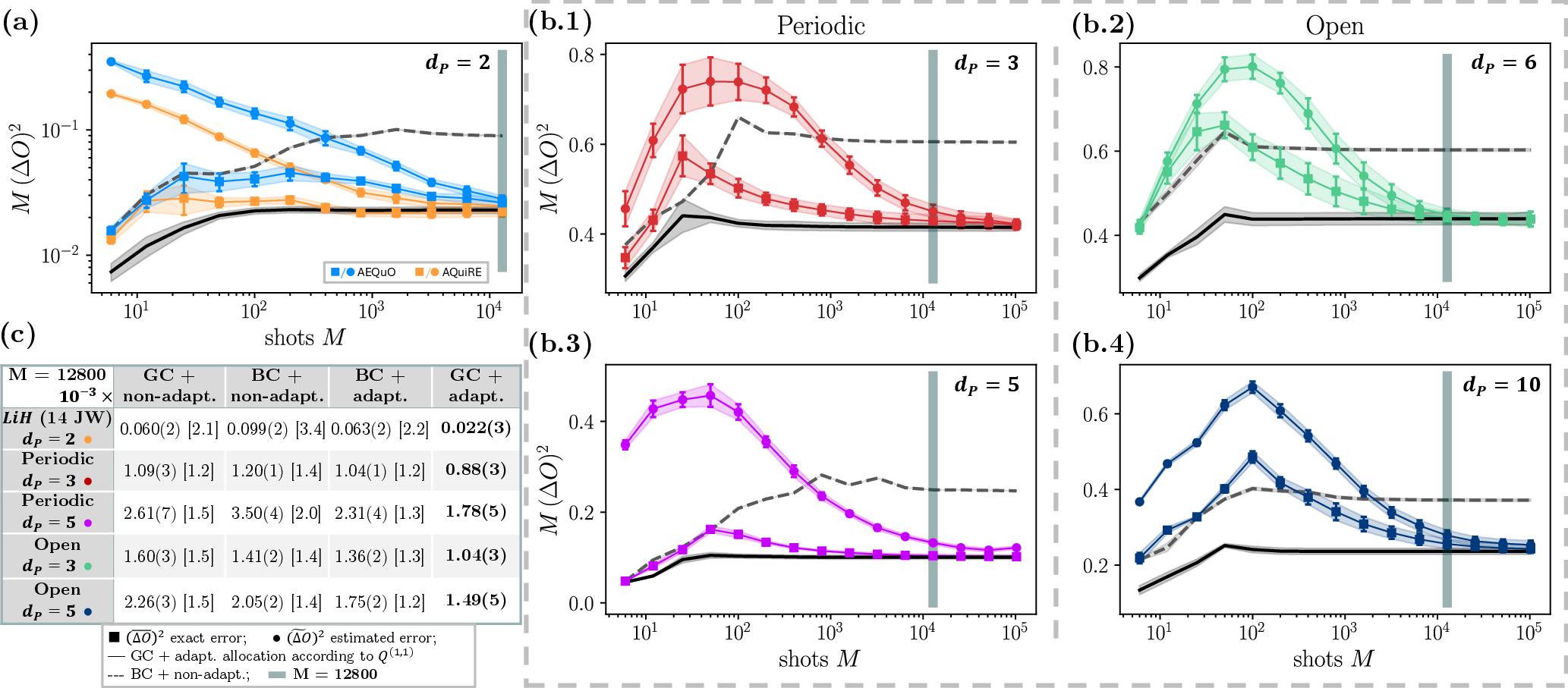
Extensive numerical simulations validate the accuracy and efficiency of AQUIRE against AEQuO—the state-of-the-art qubit measurement protocol—as well as on chemistry and lattice gauge theory (LGT) Hamiltonians involving qubits, qutrits, and ququints with both open and periodic boundary conditions.
Figure 2: Rescaled relative estimation variance M(ΔO)2 for ground state energy measurements, comparing adaptive/general commutation vs. bitwise strategies across system sizes and Hamiltonians.
Results demonstrate that AQUIRE achieves substantially improved error estimates and more rapid convergence to true variances, especially with restricted measurement budgets (low M). For qubit observables, AQUIRE achieves comparable accuracy to AEQuO with 40–60% fewer shots in typical regimes. For qudit observables in LGTs, adaptive/general commutation achieves up to a twofold reduction in required measurements versus bitwise/non-adaptive allocation.
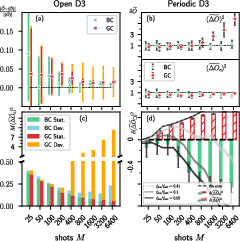
Figure 3: Experimental validation of AQUIRE on a trapped-ion qudit quantum computer, showing error-aware estimation under realistic hardware noise and the effect of employing entangling gates.
Experimental implementation on a trapped-ion qudit QC confirms AQUIRE's robustness: the protocol yields meaningful error estimates for both average observables and systematic contributions arising from hardware imperfections. Critically, the error-awareness capability quantifies the extent and impact of hardware-induced noise, enabling statistically correct error bars. When entangling gates are used to enable larger joint measurement cliques, their associated higher error rates are correctly integrated into variance estimates, allowing informed strategy switching between general and bitwise commutation regimes.
Figure 4: Visualization of the MCMC sampling process mapped to the Bloch sphere for physical state proposals, illustrating constrained Bayesian integration.
Practical and Theoretical Implications
AQUIRE establishes a principled, device- and experiment-specific method for quantum measurement, particularly necessary for adaptive or variational quantum algorithms that depend on precise state and error discrimination. The protocol's Bayesian approach avoids over-conservative worst-case bounds typical of previous methods, providing experimenters and algorithm developers with actionable error estimates that reflect both statistical uncertainty and hardware limitations.
Practically, the ability to adapt between general and bitwise commutation strategies, coupled with real-time error-awareness, is essential for maximizing measurement efficiency on noisy platforms—especially as gate fidelities and scale continue to improve. The results quantitatively demonstrate that enhanced entangling gate quality extends the regime where general commutation is advantageous, implying concrete engineering targets for future qudit hardware.
Theoretically, the Bayesian model developed is extensible to richer measurement settings and non-commuting observables, and the integration of hardware-error estimation paves the way for quantum error mitigation methods tightly coupled to observable measurement.
Future Directions
Several extensions are envisioned:
Dynamic clique selection strategies, enabling switches from general to bitwise commutation based on real-time error tradeoff.
Bayesian models incorporating priors from device tomography, further refining error estimates.
Integration of error correction or mitigation based on measurement-driven error characterization.
Extension to more complex observables and non-Clifford measurement groups.
Conclusion
AQUIRE resolves the longstanding challenge of error-aware and adaptive measurement in qudit-based quantum computers, offering a scalable, rigorous, and practically validated protocol. Its Bayesian approach to estimation and noise quantification constitutes a significant methodological advance for quantum simulation, variational algorithms, and near-term quantum computer applications.
References
"An Error-aware and Adaptive Method for the Estimation of Quantum Observables on Qudit-Based Quantum Computers" (2605.00682)
“Emergent Mind helps me see which AI papers have caught fire online.”
Philip
Creator, AI Explained on YouTube
Sign up for free to explore the frontiers of research
Discover trending papers, chat with arXiv, and track the latest research shaping the future of science and technology.Discover trending papers, chat with arXiv, and more.