- The paper presents LIMINAL, a data-driven method to extract minimal Lindblad models from time-resolved quantum tomography data.
- It employs likelihood-based statistical tests and advanced optimization techniques using JAX and Adam to fit Hamiltonian and dissipative dynamics.
- Experimental validation on a five-qubit superconducting processor demonstrates robust model selection for precise device calibration and error mitigation.
Minimal Lindblad Model Learning in Superconducting Quantum Processors
Introduction
The accurate modeling of open quantum systems is critical for advancing superconducting quantum processors, which necessitates a precise identification of Hamiltonian and dissipative dynamics. The Lindblad master equation formalism provides a Markovian description of such systems but often requires simplifying assumptions to yield tractable models. The paper "Learning Lindblad Dynamics of a Superconducting Quantum Processor" (2605.00626) introduces LIMINAL: a data-driven framework for model selection and parameter learning tailored to extracting minimal adequate Lindblad operators from time-resolved quantum tomography. This approach leverages likelihood-based statistical tests to rigorously validate the inclusion of physical mechanisms (interactions, dissipation, hidden subsystems), supporting interpretation and calibration tasks in the context of multi-qubit superconducting circuits.
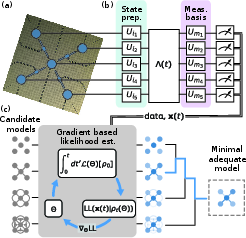
Figure 1: Conceptual overview of LIMINAL learning; (a) shows an optical micrograph of the 5-qubit device, (b) depicts the tomographic measurement sequence, (c) illustrates hierarchical model fitting and likelihood-based selection.
Experimental Infrastructure
The experiments utilize a five-qubit superconducting processor with fixed-frequency transmons and four tunable couplers fabricated at Chalmers University of Technology. Each qubit is equipped with dedicated microwave and flux lines, and readout is performed via high-Q resonators with cryogenic amplification chains for optimal fidelity. The calibration and measurement orchestration is managed with an OPX1000 controller integrated via a custom software stack (Pelagic), allowing for quick and iterative tuning of state preparation, gate calibration, and readout parameters.
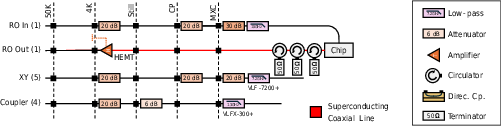
Figure 2: Cryogenic setup schematic illustrating drive, flux, and readout paths through the dilution refrigerator and amplification chain.
Qubit Characterization and Gate Benchmarking
Comprehensive spectroscopy and time-domain calibration ensure the working point of each qubit. Randomized benchmarking (RB) and interleaved RB yield gate error estimates and validate state preparation/measurement fidelity. Single-shot readout characterization yields fidelities from $0.71$ to $0.92$ per qubit. Gate errors extracted via Clifford RB are consistently below 0.2%, with advanced gate calibration using DRAG pulse shaping and virtual Z-gate techniques.
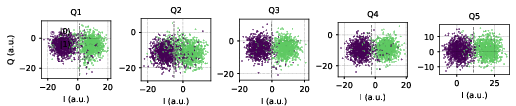
Figure 3: IQ plots for single qubit readouts, showing distribution for ground and excited states.
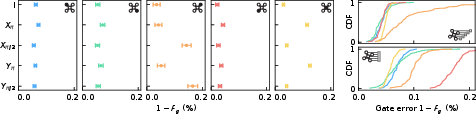
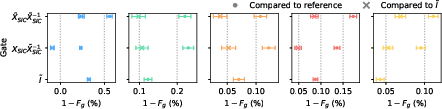
Figure 4: Interleaved RB results and fidelity extraction for the gate set, enabling robust benchmarking.
LIMINAL Framework: Model Selection and Parameter Estimation
LIMINAL systematically constructs nested candidates for Lindblad generators, mapping Hamiltonian and dissipator terms up to k-locality (single-, pair-, three-qubit). Classical model fitting is performed via differentiable ODE simulation integrated with automatic differentiation in JAX, with parameter updates using Adam. Minibatch optimization and various adjoint methods (checkpointed, backward, direct) trade-off memory and runtime efficiently. Likelihood-ratio tests, following Wilks' theorem, rigorously select models by explanatory power versus parameter count.
Model parameterization uses Pauli decompositions for Hamiltonians, and lower-triangular complex matrices for dissipators, ensuring positive semidefinite Lindblad terms. Degrees of freedom are precisely accounted for, supporting robust statistical interpretation.
Experimental Results
Five-Qubit Idling Dynamics
LIMINAL is applied to the processor under idling conditions, fitting data from nearly 7.7×10⁸ shots. The analysis identifies a minimal Markovian model consisting of three-local Hamiltonian terms and two-local dissipation, with no evidence for three-local dissipative couplings. The hierarchical fitting demonstrates that increasing locality in dissipation does not improve the likelihood sufficiently to warrant inclusion, aligning with physical intuition about dominant decoherence channels.
Single-Qubit Driven Dynamics
Constant drive experiments reconstruct full Lindblad parameters for varying amplitudes. Dissipator components Dmn exhibit amplitude-dependent structure, with dissipation remaining weak and mostly diagonal in the Pauli basis.
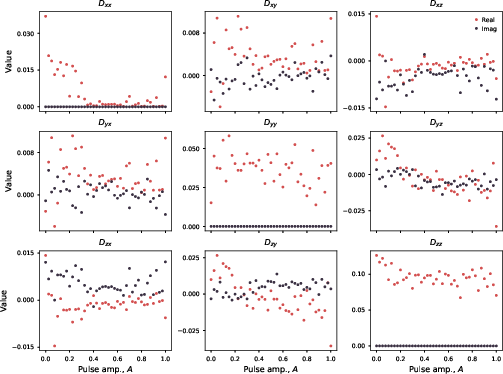
Figure 5: Dissipator matrix elements Dmn as a function of amplitude, showing detailed structure and detection of weak non-diagonal terms.
Time-dependent pulse experiments reconstruct shaped-pulse Hamiltonians without requiring analytic pulse models. The recovered dissipation matrix is weak and off-diagonal contributions are minor compared to diagonal terms. Uncertainties in parameters are large due to non-Gaussian error landscapes.
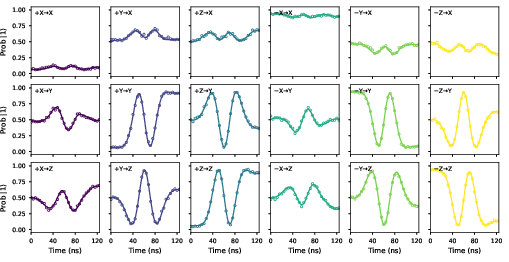
Figure 6: Comparison of measured and simulated population dynamics for all initialized states and measurement axes under time-dependent pulse envelope.
LIMINAL is extended to reconstruct hidden-qubit models for coupler-mediated interactions. A sequence of increasingly complex models, incorporating hidden TLS subsystems, is fitted and selected via likelihood testing against observed one- and two-qubit tomography.
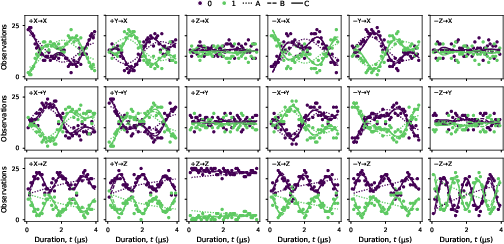
Figure 7: Tomographic reconstruction for one-qubit data under driven coupler, validating model selection.
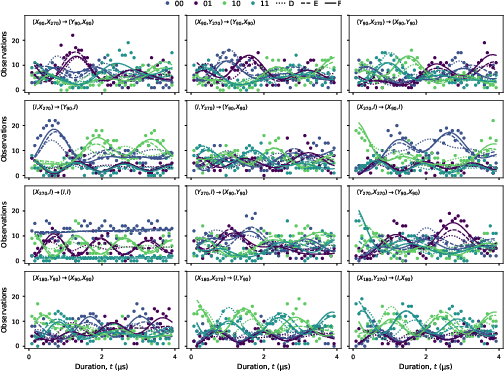
Figure 8: Fit-versus-data for a selection of two-qubit configurations, demonstrating agreement with the LIMINAL-selected model.
Across all experiments, the framework avoids overfitting by discarding marginally explanatory higher-locality dissipative terms, consistently identifying only those mechanisms supported by the data.
Theoretical and Practical Implications
The study provides a practical protocol for extracting minimal, physically interpretable Lindblad models from quantum processor data, bridging the gap between experimental characterization, calibration, and foundational model validation. LIMINAL offers strong support for discriminating physically relevant interactions (e.g., crosstalk, hidden TLS), facilitating diagnostics for noise engineering and device design.
The approach is extensible to larger systems, scalable via efficient minibatch optimization and advanced adjoint differentiation. It sets the stage for integrating non-Markovian extensions and hybrid neural/Lindblad models, as explored in recent quantum tomography and process tensor research [Varona et al. 2025b].
Numerical Results and Claims
- Gate error rates obtained via Clifford RB and interleaved RB are consistently below 0.2%, with advanced pulse optimization yielding one-pulse gate infidelities near 0.1%.
- Minimal five-qubit Markovian model includes three-local Hamiltonian and two-local dissipator, with likelihood statistics rigorously excluding three-local dissipation.
- Fitted dissipator terms in driven single-qubit experiments reveal amplitude-dependent structure; off-diagonal elements are weaker by an order of magnitude compared to diagonal dissipation terms.
Future Directions
The LIMINAL framework motivates extensions toward non-Markovian environment learning, integration with shadow and classical-quantum tomography protocols, and automated discovery of microscopic noise processes. Future algorithmic developments may include hierarchical Bayesian model selection, neural ODE integration for complex noise environments, and scalability analysis for hundreds of qubits.
Conclusion
"LIMINAL" presents an authoritative data-driven method for learning minimal Lindblad models in multi-qubit superconducting processors, offering statistically robust model selection deeply linked to physical processes. The framework is practically applicable for device calibration, error mitigation, and elucidation of dominant decoherence channels, with the potential for broad applicability in quantum hardware characterization and future quantum simulator development.

