- The paper proposes a federated LoRA-based adaptation method that recovers 90% of full fine-tuning performance using only 5.1% of parameters, achieving around a 12.8% BER improvement.
- The approach drastically reduces communication costs by limiting updates to 14,400 parameters per node, offering up to a 20-fold efficiency gain compared to full-model federated learning.
- The framework demonstrates stable convergence and effective knowledge transfer across non-IID interference scenarios, providing a scalable solution for O-RAN deployments.
Federated Parameter-Efficient Adaptation for Interference Mitigation at the Wireless Edge
Problem Motivation and Background
Densification in cellular networks, especially as 6G emerges, amplifies the challenge of heterogeneous co-channel interference at base stations (gNBs). Conventional, centrally trained DNN-based interference mitigation models, effective in homogeneous environments, become impractical for distributed, privacy-sensitive, and bandwidth-constrained deployments typical of O-RAN systems. Federated learning (FL) frameworks address privacy but encounter debilitating communication costs and instability under the non-IID interference conditions across geographically distributed nodes. Additionally, the computational and memory burden of full-model fine-tuning is prohibitive for resource-limited edge hardware.
Parameter-efficient fine-tuning (PEFT), particularly Low-Rank Adaptation (LoRA), enables adaptation by only updating and exchanging a small number of adapter parameters—significantly reducing the communication and computational footprint. Previous applications of LoRA have focused on NLP and vision models; this work investigates LoRA's application to dilated convolutional architectures for temporal interference suppression, a regime unexplored with PEFT.
System Architecture and Adapter Design
The paper proposes a federated adaptation framework built upon a centrally pretrained WaveNet backbone, optimized for source separation from mixed interference in the time domain. Each gNB, representing a unique and non-IID local interference environment, is equipped with lightweight LoRA adapters placed on the dilated convolutional layers. The backbone is kept frozen to maintain general signal extraction capacity, while LoRA modules—comprising only 5.1% of overall parameters—are optimized locally and periodically aggregated via FedAvg at the Near-RT RIC, constituting the federated server.
(Figure 1)
Figure 1: Federated LoRA system: gNBs train LoRA adapters on local interference data with a frozen WaveNet backbone, exchanging only adapter parameters with the Near-RT RIC for aggregation and redistribution.
The LoRA adapters are implemented as parallel low-rank convolutional branches that strictly preserve receptive field and dilation parameters across all residual blocks, maintaining crucial temporal filtering properties. Careful architectural choices limit communication to as few as 14,400 parameters per node per round (compared to 281,954 for the full model), achieving a roughly 20-fold communication efficiency enhancement without sacrificing expressiveness.
The FiLM method—channel-wise affine transformations—is evaluated as a minimalist PEFT baseline, while full fine-tuning of the backbone serves as an upper-bound benchmark.
Experimental Protocol
A synthetic wireless scenario with five gNBs is constructed, each exposed to unique interference profiles (CommSignal2, CommSignal3, EMISignal1, and their mixtures) in both balanced and imbalanced (data-starved EMI) allocation regimes. The backbone is pretrained on two interference types, intentionally excluding EMI to force adaptation. Each node is evaluated both on matched and global test sets using average BER across -10 dB to +10 dB SINR intervals.
Six adaptation strategies are compared: backbone only (no adaptation), full FedAvg, local and federated LoRA, local and federated FiLM, and local full fine-tuning. Federated variants are evaluated for several LoRA ranks to elucidate communication vs. performance trade-offs.
Empirical Results
Significant numerical findings emerge:
- Local LoRA on dilated convolutions consistently captures 90% of the full fine-tuning gain with only 5.1% of parameters, effecting a 12.8% average BER improvement over the backbone.
- Fed-LoRA attains comparable performance (~12.6% average improvement), with the added benefit of strong knowledge transfer for nodes with limited local data (EMI)—demonstrated by a 46.6% improvement versus 42.5% for non-federated LoRA in the worst-case node.
- Full-model FedAvg, representing a naïve federated approach, induces catastrophic negative transfer on well-represented nodes under non-IID conditions. For instance, Node 1 (CS2) BER degrades by over 150%.
- FiLM-based conditioning is markedly less effective, capturing only 5.9% average improvement in the federated setting and often suffering convergence instability under data heterogeneity.
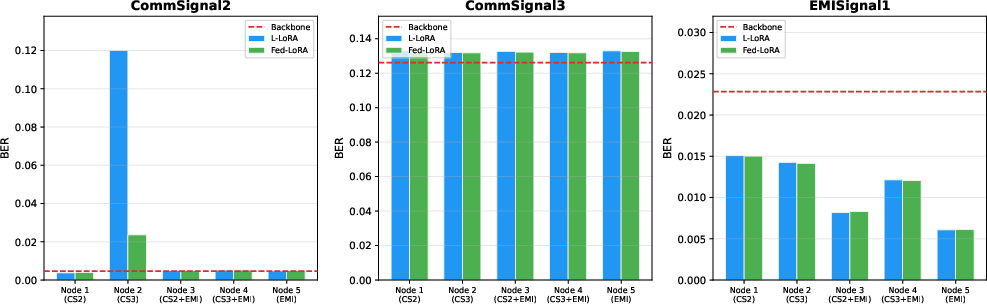
Figure 2: Per-interference-type BER on the global test set demonstrates robust cross-type generalization through Fed-LoRA, in particular improved suppression of interference types that are unseen locally but represented at other nodes.
- There is a clear Pareto-superiority for Fed-LoRA: increasing rank from 2 (7,200 parameters) to 8 (28,800) yields diminishing returns, with 11.3% → 13.5% improvement, while remaining orders of magnitude more efficient than full FedAvg for greater per-round BER reduction.
- Convergence analysis confirms Fed-LoRA's stability, unlike Fed-FiLM, which diverges on heterogeneous tasks.
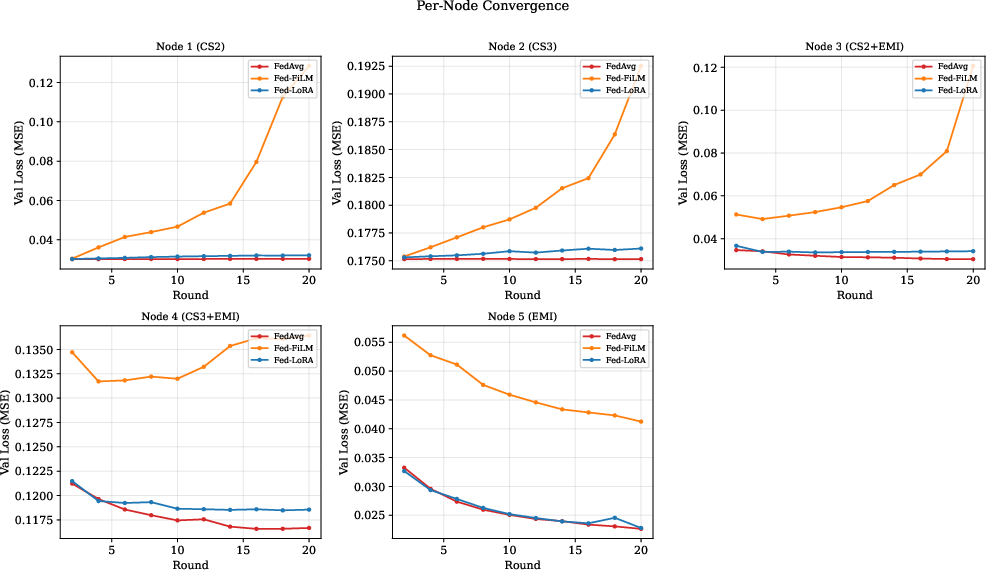
Figure 3: Per-node validation loss (MSE) curves demonstrate stable, monotonic convergence for Fed-LoRA, while Fed-FiLM diverges under non-IID interference scenarios.
- A unique capability of Fed-LoRA is transfer across non-overlapping data supports: for example, a CS3-only node improves its CommSignal2 BER by 80% via federated aggregation, a transfer unattainable with local adaptation. Conversely, CommSignal3 remains a bottleneck interference, with all methods plateauing near backbone BER, indicating the need for further backbone expressivity.
Practical and Theoretical Implications
The results manifest that in non-IID wireless edge environments, PEFT—specifically LoRA adapters on temporal convolutional modules—enables both effective personalization and knowledge sharing, with drastic reductions in communication cost. Restricting federation to small adapter subspaces circumvents the destructive interference inherent to FedAvg in heterogeneous regimes, and ensures scalability as deployment density rises. The findings provide strong experimental justification for LoRA-style federated adaptation over classical FL in the PHY-layer, especially for dynamic, privacy-conscious, and bandwidth-limited O-RAN deployments.
From a theoretical standpoint, this architecture demonstrates that the representational power captured in a modest number of low-rank temporal filters suffices for most practical adaptation needs, short of cases where the backbone lacks sufficient inductive bias for certain interference (e.g., CommSignal3).
Future Directions
Several prospects arise:
- Adaptive per-node or per-layer LoRA ranking, responsive to local interference complexity, may improve the trade-off envelope.
- Extending the framework to other PEFT paradigms (e.g., prompt-tuning, dynamic adapters) and downstream PHY-layer tasks.
- Empirical deployment in a real, asynchronous O-RAN setting with realistic network latencies and failures.
- Architectural augmentation (e.g., attention, wider receptive fields) to better handle outlier interference types.
- Advanced aggregation and compression techniques (e.g., FFA-LoRA, FAH-QLoRA) for even greater communication savings.
Conclusion
This work demonstrates that federated parameter-efficient adaptation via LoRA-adapted temporal convolutions is a highly effective, robust, and scalable strategy for interference mitigation in heterogeneous wireless edge environments. Restricting federated updates to adapter parameters provides strong numerical gains and avoids pitfalls encountered by full-model FL, offering a practical blueprint for future FL deployments in O-RAN and beyond.