- The paper introduces a physics-encoded FNO (PeFNO) that embeds divergence-free constraints by learning stress potentials, ensuring mechanical equilibrium.
- Methodology leverages Fourier spectral decomposition to architecturally enforce equilibrium, bypassing the need for additional loss penalties.
- Numerical studies demonstrate that PeFNO significantly reduces divergence errors compared to PgFNO and PiFNO, yielding improved accuracy and robustness.
Encoding Divergence-Free Stress Fields in Neural Approximations via Stress Potentials
Introduction and Motivation
The empirical modeling of quasi-static equilibrium stress fields in heterogeneous solids presents significant challenges due to data sparsity and the imperative to respect intrinsic physical constraints, such as mechanical equilibrium (divergence-free stress fields). Recent paradigms in scientific machine learning—namely, physics-guided (PgNNs), physics-informed (PiNNs), and physics-encoded neural networks (PeNNs)—offer strategies for incorporating these constraints. However, while PiNNs typically introduce physics via additional terms in the loss function, PeNNs embed constraints directly into the network architecture, yielding solutions that are physically consistent by construction.
This work proposes a method for encoding the divergence-free property of stress fields into neural approximations, exploiting a representation based on stress potentials. The focus is on Fourier Neural Operators (FNOs), where the equilibrium constraint is enforced architecturally rather than via the loss function. The proposed physics-encoded FNO (PeFNO) is contrasted with conventional PgFNO and PiFNO variants to ascertain the accuracy and robustness benefits of direct encoding. The study targets heterogeneous polycrystals under uniaxial extension, using data generated via high-fidelity boundary-value problem solutions.
Theoretical Framework and Potential-Based Stress Representation
The divergence-free condition of equilibrium stress fields is re-expressed through generalized potential formulations rooted in the Helmholtz-Hodge decomposition. For nonlinear (finite deformation) mechanics, the first Piola-Kirchhoff stress P is represented as
P=curlA,
where A is the stress potential. This approach ensures that the divergence of P vanishes identically. In practice, this is discretized via Fourier components, leveraging the computational tractability of FNOs for operator learning:


Figure 1: E(x) field for a representative microstructure, highlighting the heterogeneity encoded in the input data.
Periodic boundary conditions allow efficient and exact enforcement of the equilibrium constraint in Fourier space. The network's output is thus constructed through learned representations of the potential field, transformed via a fixed, physics-grounded operator into a stress field.
Physics-Constrained FNO Architectures
The proposed PeFNO architecture modifies the standard FNO output transformation. Instead of directly regressing stress components, PeFNO learns the stress potential A, with the output stress P constructed through the discretized curl operator in spectral (Fourier) space. For comparison:
- PgFNO: Ignores physics in both output layer and loss, regresses stress directly.
- PiFNO: Adds a divergence-free penalty to the loss function.
- PeFNO: Builds physical admissibility into the network output by encoding the equilibrium constraint.
This architectural encoding guarantees that, up to errors from discretization and series truncation, the predicted stress is divergence-free.
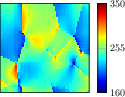
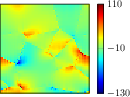
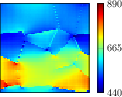
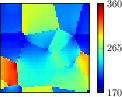
Figure 2: P11 component of the stress field, extracted from data for a polycrystalline microstructure under uniaxial extension.
Computational Studies and Numerical Results
Synthetic datasets are produced via spectral solvers for elastostatics in periodic polycrystals, encoded by fields of material parameters E(x) and ν(x). The networks are trained on P=curlA,0 and tested on P=curlA,1 stress fields, each resolved over P=curlA,2 spatial points per dimension.
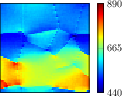
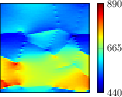
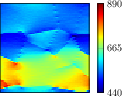
Figure 3: Spatial distribution of P=curlA,3, the dominant stress component in the direction of loading.
The PeFNO consistently produces stress outputs with divergence errors orders of magnitude smaller than either PiFNO or PgFNO, without sacrificing accuracy in the predicted stress fields. Notably, the enforcement of physics via the loss (PiFNO) can only achieve comparable equilibrium satisfaction at the expense of increased error in the stress predictions, especially when the divergence penalty coefficient is large.
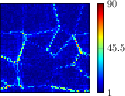
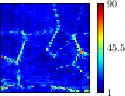
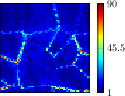
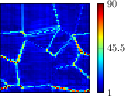
Figure 4: PeFNO output for P=curlA,4 stress, demonstrating excellent agreement with the reference solution and robust enforcement of equilibrium.
Strong numerical results include:
- Uniformly low divergence error: The maximum violation of the equilibrium constraint in PeFNO outputs is three orders of magnitude smaller than in PiFNO/PgFNO for comparable stress prediction error.
- Error localization: Largest errors are observed near grain boundaries and triple junctions, correlating with regions of large stress gradients and data undersampling.
- Trade-off in PiFNO: Increasing the weight of the divergence penalty decreases equilibrium violations, but at the expense of accuracy in the stress field itself.
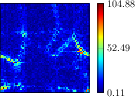
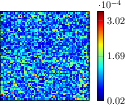
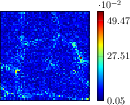
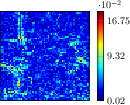
Figure 5: PgFNO output for P=curlA,5, showing accurate stress prediction in grain interiors, but with higher equilibrium error compared to PeFNO.
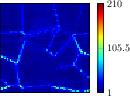
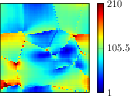
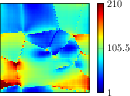
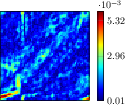
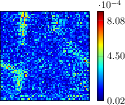
Figure 6: Magnitude of divergence error P=curlA,6 for various FNO variants. PeFNO achieves nearly uniform, minimal error throughout the domain.
Discussion and Implications
The embedding of physical constraints in neural architectures (PeNNs/PeFNOs) offers distinct advantages over loss-based enforcement (PiFNOs):
- Generalization: By restricting the function class to physically admissible outputs, PeFNOs are less sensitive to data sparsity and more robust in extrapolation.
- Training stability: Physical constraints are guaranteed for all inputs, not just those observed during training.
- Computational efficiency: The need to tune penalty hyperparameters is obviated, and the network output is interpretable in terms of underlying physics (stress potentials).
These results have salient implications for scientific ML in computational mechanics. Architectural encoding can enhance the reliability, interpretability, and trustworthiness of surrogate models for complex physical systems, particularly under data-limited regimes and in safety-critical applications.
Future work should address:
- Adaptive data weighting: To improve accuracy near grain boundaries, use non-uniform spatial weighting during training based on stress gradients.
- Extension to more general constitutive laws: Incorporation of anisotropy, inelasticity, and additional physics renders the approach applicable to a wider class of problems.
- Inclusion of angular momentum balance: For materials with complex behavior (e.g., couple stresses, micropolarity), concurrent enforcement of higher-order equilibrium constraints.
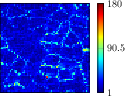
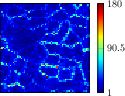
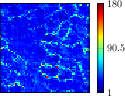
Figure 7: PeFNO predictions for fine-grained microstructures, showcasing the model's ability to generalize to microstructures distinct from the training data.
Conclusion
This study presents a rigorous framework for encoding divergence-free properties in neural operators modeling stress fields in solids, achieved through a direct, potential-based representation in the PeFNO. The results underscore the limitations of physics-informed loss terms relative to architectural encoding, particularly in satisfying mechanical equilibrium without sacrificing predictive accuracy. These findings advocate for a broader adoption of physics-encoded neural architectures in scientific machine learning, especially where strict physical fidelity is paramount.
Reference: "An approach to encode divergence-free stress fields in neural approximations based on stress potentials" (2605.00509).

