- The paper introduces HyperODE-RCA, a unified framework that learns data-driven hyperedges to capture high-order service interactions in microservices.
- It models continuous anomaly dynamics using latent neural ODEs and ODE-RNNs to extract propagation velocity and robust diagnostic features.
- Adaptive multimodal fusion via cross-attention and regularization techniques yields superior performance in root cause localization.
Hypergraph and Latent ODE Learning for Multimodal Root Cause Localization in Microservices
Motivation and Problem Statement
Microservice architectures present significant challenges for root cause localization due to complex inter-service dependencies, continuous and irregular anomaly evolutions, and vast heterogeneity across observability modalities (logs, traces, metrics, entities, events). Conventional approaches relying on pairwise dependency graphs, discrete-time modeling, and simplistic feature fusion fail to capture high-order fault propagation, robustly integrate evidence, or articulate continuous anomaly dynamics. The paper proposes HyperODE-RCA, a unified framework leveraging differentiable hypergraph attention, latent neural ODEs, and multimodal adaptive fusion to address these deficits.
The architectural rationale is to (i) learn data-driven hyperedges for higher-order service interactions, (ii) model latent continuous anomaly trajectories and propagation velocity through ODE-RNNs, and (iii) adaptively fuse and weigh distinct observability signals via cross-attention transformers with context-sensitive routing. Variational bottlenecks and causal invariance regularization are introduced to enhance robustness and interpretability, especially under noisy or adversarial observability evidence.
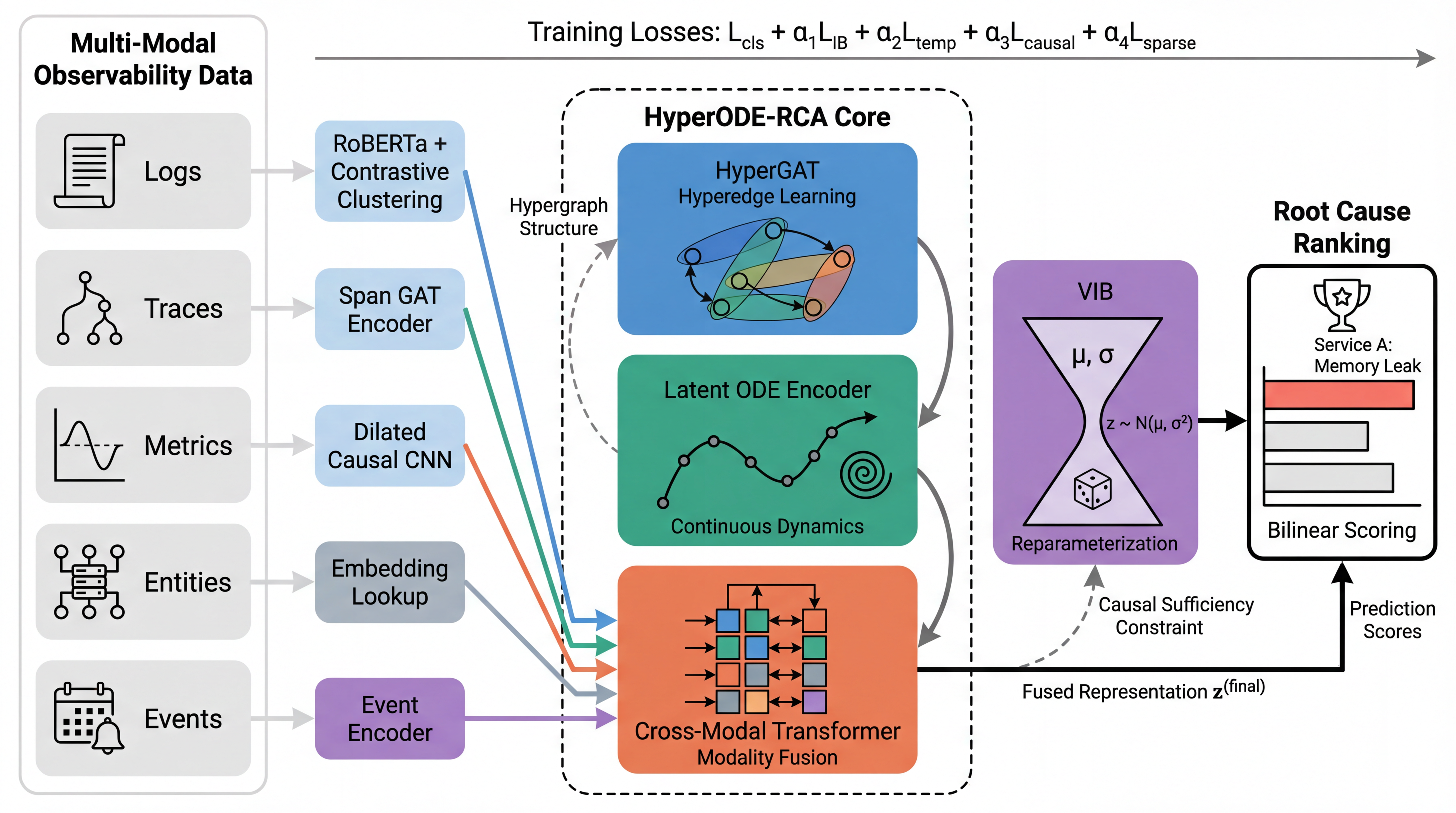
Figure 1: Multi-modal observability signals (logs, traces, metrics, entities, events) are encoded by modality-specific encoders, then processed through three core modules.
HyperGAT: Hypergraph Attention Network
Hypergraph Construction and Learning
Traditional graph neural network (GNN) designs are insufficient for capturing multi-service failure coordination inherent in microservice platforms. HyperODE-RCA employs a differentiable hypergraph model, where hyperedges are not statically defined but learned from co-occurrence statistics derived from traces and logs. Gumbel-Softmax relaxation with temperature annealing enables gradient-based optimization over the hyperedge assignments. The hypergraph enables overlapping multi-service relations, critical for capturing propagation chains and correlated faults.
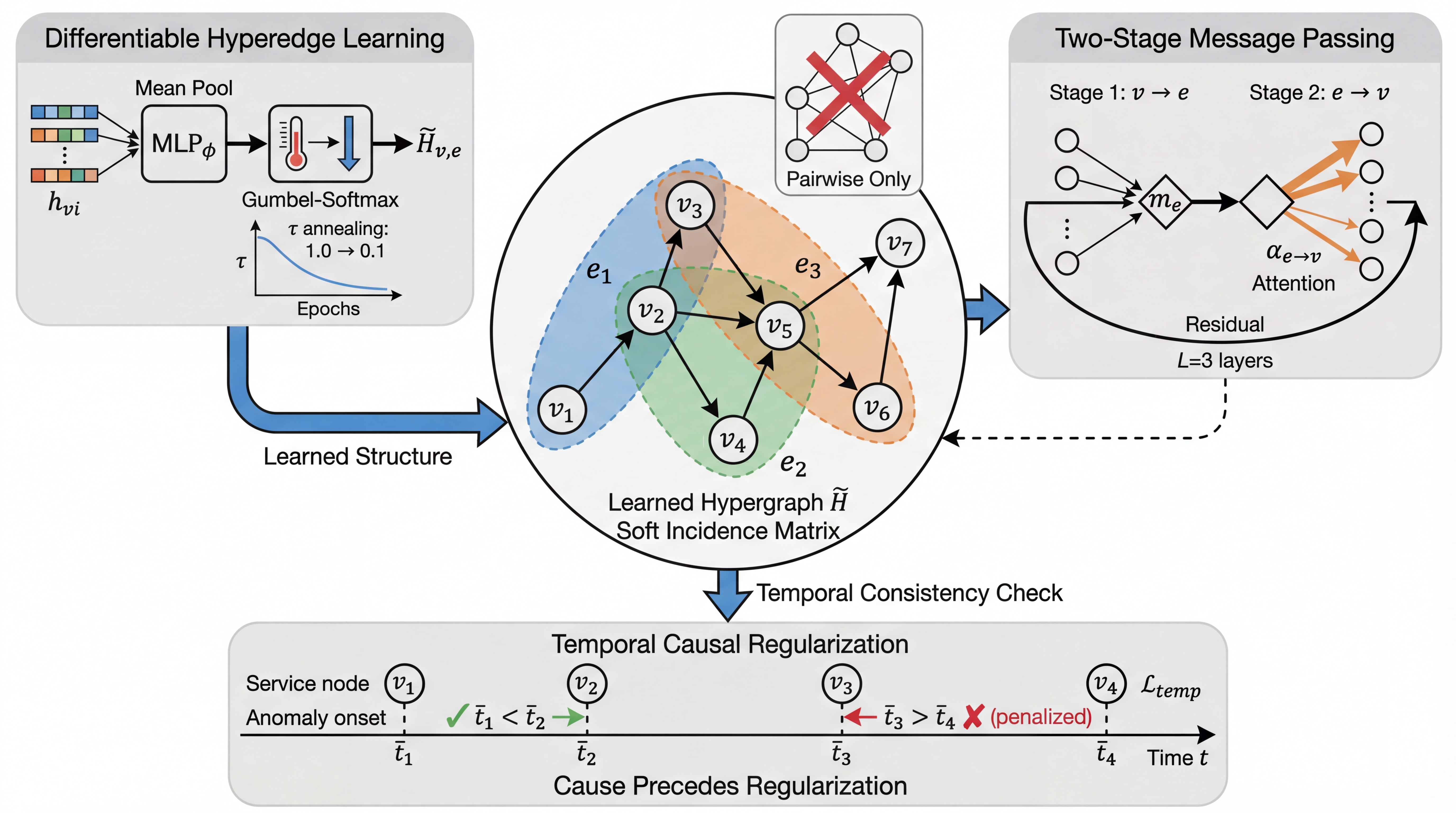
Figure 2: HyperGAT module. Learned hypergraph with overlapping hyperedges, differentiable hyperedge learning, two-stage message passing, and temporal causal regularization.
Message Passing and Temporal Causal Regularization
HyperGAT implements two-stage message passing: vertex-to-hyperedge aggregation followed by attention-weighted hyperedge-to-vertex distribution. Attention coefficients are learned to prioritize causal links and explainable fault paths. Temporal causal regularization penalizes attention weights that imply backward-in-time dependencies, thus enforcing plausible precedence constraints and enhancing diagnostic faithfulness. Residual connections and sparsity-promoting terms enable interpretable hypergraph structures.
Latent ODE Encoder for Continuous Dynamics
To model continuous-time propagation under irregular observation patterns, HyperODE-RCA leverages a neural ODE-based latent trajectory framework. The latent state evolves under a parameterized vector field with temporal encodings. GRU-based ODE-RNNs incorporate new evidence at observed timestamps, efficiently updating the trajectory and supporting interpolation at arbitrary points via adaptive numerical integration.
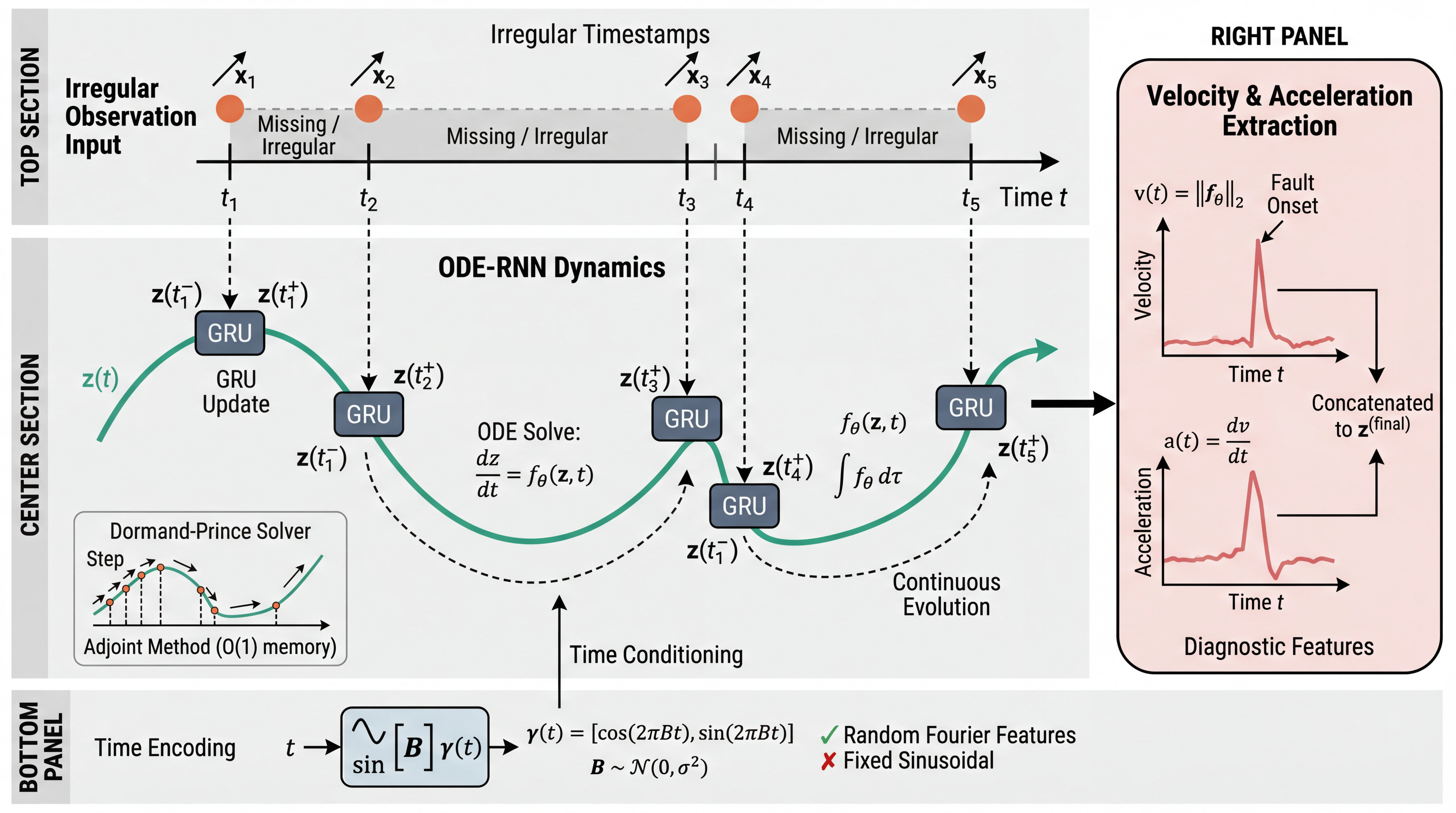
Figure 3: Latent ODE Encoder. Irregularly sampled observations are integrated into a continuous latent trajectory, allowing the extraction of propagation velocity and acceleration.
Derivative-Based Diagnostic Features
Propagation velocity and acceleration extracted from the continuous latent trajectory serve as robust diagnostic signals, enabling the framework to identify anomaly onset, propagation speed, and change points. Adjoint sensitivity methods are used for efficient gradient computation during training.
Multimodal Adaptive Fusion
Modality-Specific Encoding and Cross-Attention Routing
Each observability modality receives specialized encoding: logs via pre-trained RoBERTa after contrastive clustering, traces through graph attention networks, and metrics by dilated causal convolutions. Entities and events are likewise embedded appropriately. A hierarchical transformer architecture first applies intra-modal self-attention for feature refinement, followed by cross-modal adaptive attention. Routing weights βm,m′ are incident-conditioned, permitting selective evidence transfer based on detected context.
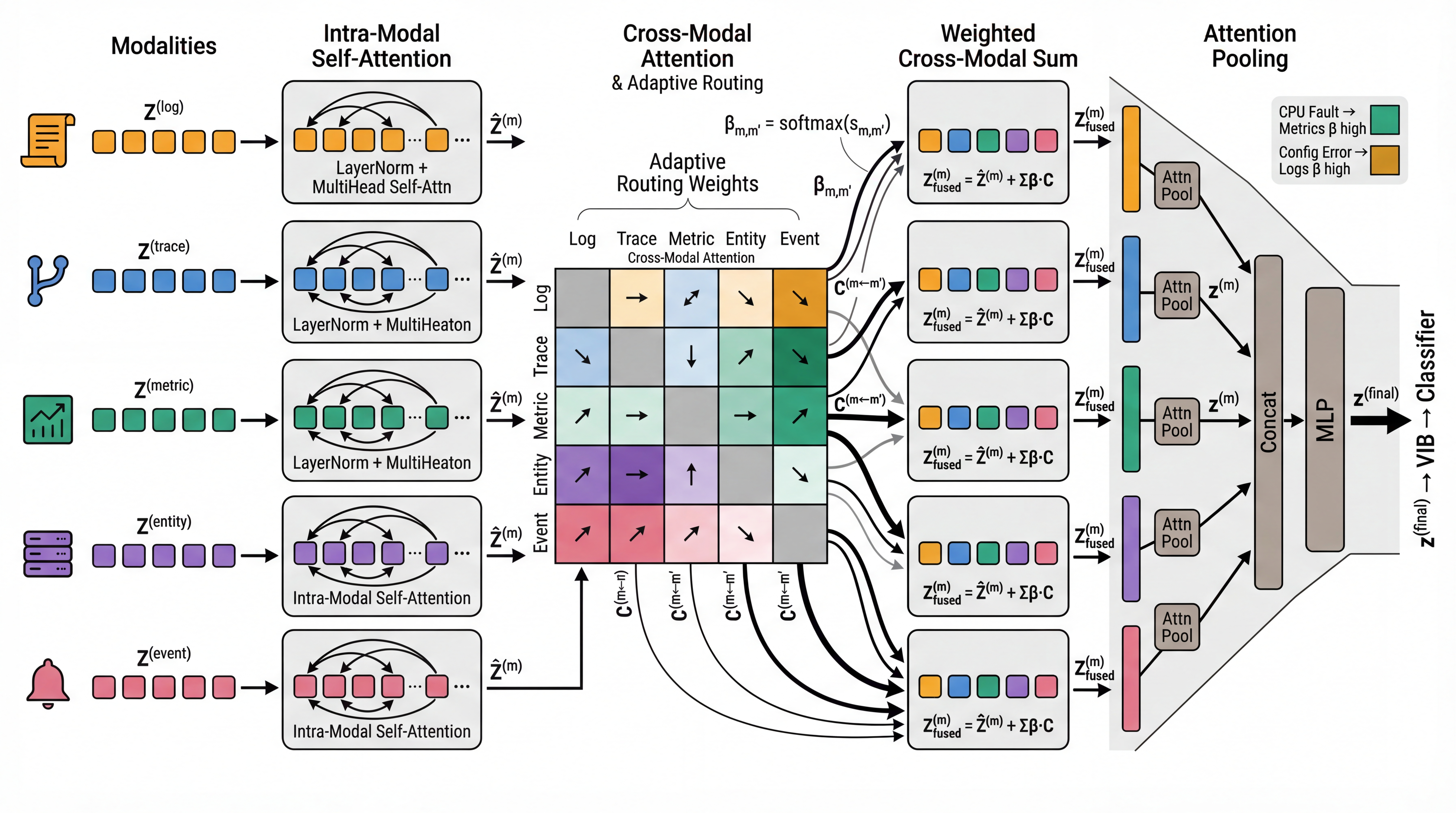
Figure 4: Multi-modal cross-attention fusion architecture, with incident context determining routing weights between modality embeddings.
Hierarchical Aggregation
Token-level modality representations are aggregated via attention pooling, and final fused embeddings are constructed through an MLP. This enables downstream classification and ranking by bilinear scoring, promoting both flexibility and interpretability.
Robustness Regularization
HyperODE-RCA employs a variational information bottleneck to encourage representations that are maximally informative for root cause labels and minimally dependent on spurious input correlations. KL-divergence-based regularization combined with environmental invariance constraints reduces brittle adaptation and enhances generalization under variable observability streams.
Causal Sufficiency and Invariant Risk Minimization
Causal sufficiency constraints enforce performance invariance across different environmental conditions (e.g., time periods, service subsets), further promoting reliability in diverse operational contexts. Gradients are regularized to suppress overfitting to transient or non-causal evidence patterns.
Evaluation and Results
The Tianchi AIOps benchmark is utilized for systematic comparison. HyperODE-RCA demonstrates superior F1-score, mean reciprocal rank, Matthews correlation coefficient, and AUC relative to MicroRCA, CloudRanger, and recent causal discovery baselines. Key performance gains are attributed to the joint modeling of high-order dependencies, continuous anomaly dynamics, and adaptive multimodal fusion.
Notably, HyperODE-RCA achieves both higher ranking/classification accuracy and better interpretability through attention visualization and sparse hyperedge learning. The framework is robust to heavy-tailed metrics, missing values, and class imbalance, with preprocessing routines such as median absolute deviation normalization and hybrid interpolation.
Practical Implications and Future Directions
HyperODE-RCA advances the state of multimodal root cause localization by enabling end-to-end modeling of high-order, temporally continuous, and context-dependent anomaly propagation in microservice systems. The architectural components are modular and extensible, paving the way for future integration of retrieval augmentation, on-the-fly context adaptation, and stronger hybrid classification strategies. The principles demonstrated here suggest further incorporation of retrieval-enhanced evidence grounding and robust ensemble learning for real-world deployments.
Practical implications include improved automated RCA in cloud platforms, enhanced interpretability for incident response, and reduced mean time to resolution under complex, ambiguous failure modes. Theoretical extensions may involve deeper causal graph learning, fine-grained anomaly attribution, and integration with reinforcement learning-based incident remediation.
Conclusion
HyperODE-RCA presents a comprehensive, technically rigorous solution for root cause analysis in microservice architectures, unifying hypergraph attention learning, latent neural ODE dynamics, and incident-dependent multimodal fusion. The system outperforms strong baselines in both ranking and classification, maintains interpretability, and demonstrates robustness against noisy and irregular input streams. Its modular design and theoretical underpinnings make it a promising basis for future developments in AI-driven cloud operations and multimodal anomaly diagnosis.