- The paper introduces IEFF, a system that decouples feature rollouts from retraining by applying incremental, serving-time fading.
- It demonstrates that gradual feature fading reduces distribution instability and online regression by up to 55% compared to abrupt feature ablation.
- IEFF increases rollout velocity up to 5×, avoiding 140 retraining iterations and cutting infrastructure costs by approximately 15% annually.
Intelligent Elastic Feature Fading for Retrain-Free Feature Rollouts in Large-Scale Ranking Systems
Introduction
Large-scale industrial ranking systems operate under stringent efficiency constraints, often relying on thousands of behavioral and contextual features to optimize relevance, click-through rate (CTR), and conversion rate (CVR) predictions. Feature management—including deprecation, migration, and cleanup—poses substantial operational challenges due to the entanglement of feature rollouts with explicit model retraining cycles. Traditional workflows induce significant latency, resource consumption, and bottleneck iteration velocity, largely arising from the dependency on retraining to safeguard against abrupt performance regressions. The paper "Intelligent Elastic Feature Fading: Enabling Model Retrain-Free Feature Efficiency Rollouts at Scale" (2605.00324) addresses this challenge by introducing Intelligent Elastic Feature Fading (IEFF), a system infrastructure enabling safe, reversible, and retrain-free feature efficiency rollouts through serving-time feature adaptation.
System Design and Architecture
IEFF is architected as a system-level infrastructure, expressly designed to decouple feature rollouts from explicit retraining in heterogeneous, large-scale ranking pipelines while ensuring modularity, safety, scalability, and model-agnostic operation. The architecture incorporates a centralized control plane and a lightweight serving-time feature adapter. Raw features continue to be generated via existing pipelines; IEFF intervenes exclusively at the serving and logging stage, applying deterministic, configuration-driven adjustments to feature coverage or distribution. This ensures serving–training consistency: the same feature values ingested by the model during inference are logged and subsequently consumed in recurring training, obviating training–serving skew.
The centralized control plane manages rollout policy, safety guardrails, and reversibility, while the serving-time feature adapter applies incremental, fine-grained control over target features' coverage or distribution in accordance with the rollout schedule. Safety and stability are enforced through pre-rollout validation (QRT), continuous monitoring (e.g., of normalized entropy, NE, and business KPIs), and instant revert capabilities. IEFF imposes negligible system overhead, as decisions are cached locally and applied synchronously within the feature path.
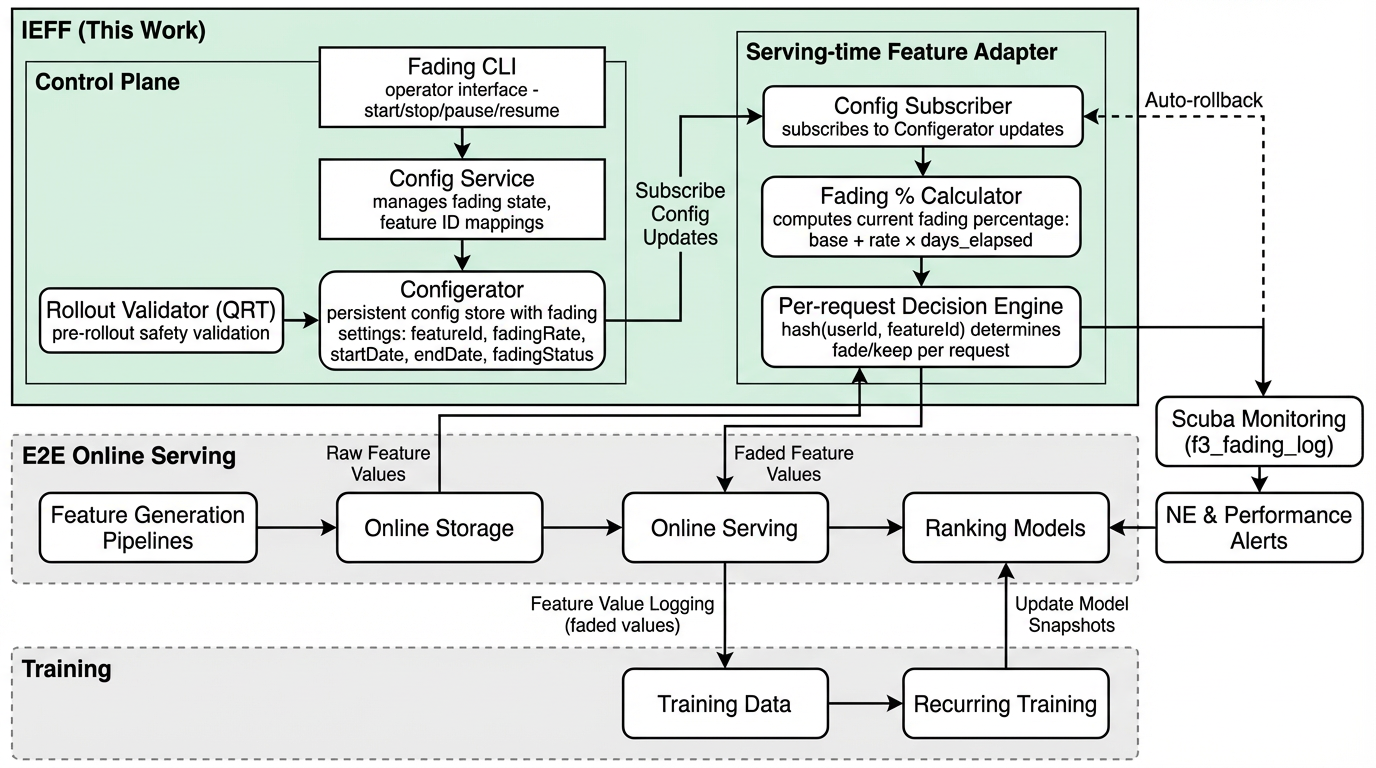
Figure 1: IEFF system architecture, with centralized control over serving-time feature adaptation, full reversibility, and serving–training consistency for retrain-free rollouts.
Gradual Feature Fading: Mechanism and Rationale
IEFF's core is the fading control mechanism, which incrementally adjusts feature coverage or distribution according to a configurable, schedule-driven decay (typically from 1–10% per day). Experiments in prior work have established that abrupt feature ablation (zero-out) leads to severe distribution shift and model instability—manifested as spikes in NE and protracted performance degradation—necessitating costly retraining. In contrast, gradual fading constrains distribution shift magnitude per unit time, allowing the model to adapt parameters via recurring training on the evolving input distribution, which is continually logged at serving time.
The fading mechanism is generic and extensible, accommodating both coverage-based (feature drop-out) and value-based (distribution adjustment) scenarios. Pre-rollout QRT is employed to empirically estimate sensitivity and select the safest possible fading rate, balancing rollout speed against operational risk. IEFF thus enables practical realization of the insight that retraining is not an intrinsic requirement for most feature rollouts provided changes are applied incrementally and logged consistently.
IEFF's efficacy is validated across multiple production ranking models with diverse feature modalities, including sparse and embedding-based features. Experiments systematically compare IEFF-based fading with abrupt zero-out and standard retraining workflows, both offline (simulated recurring training) and online (A/B experimentation). The principal evaluation metrics are peak and cumulative NE as a proxy for distributional instability, and direct online performance measures such as CTR/CVR deltas.
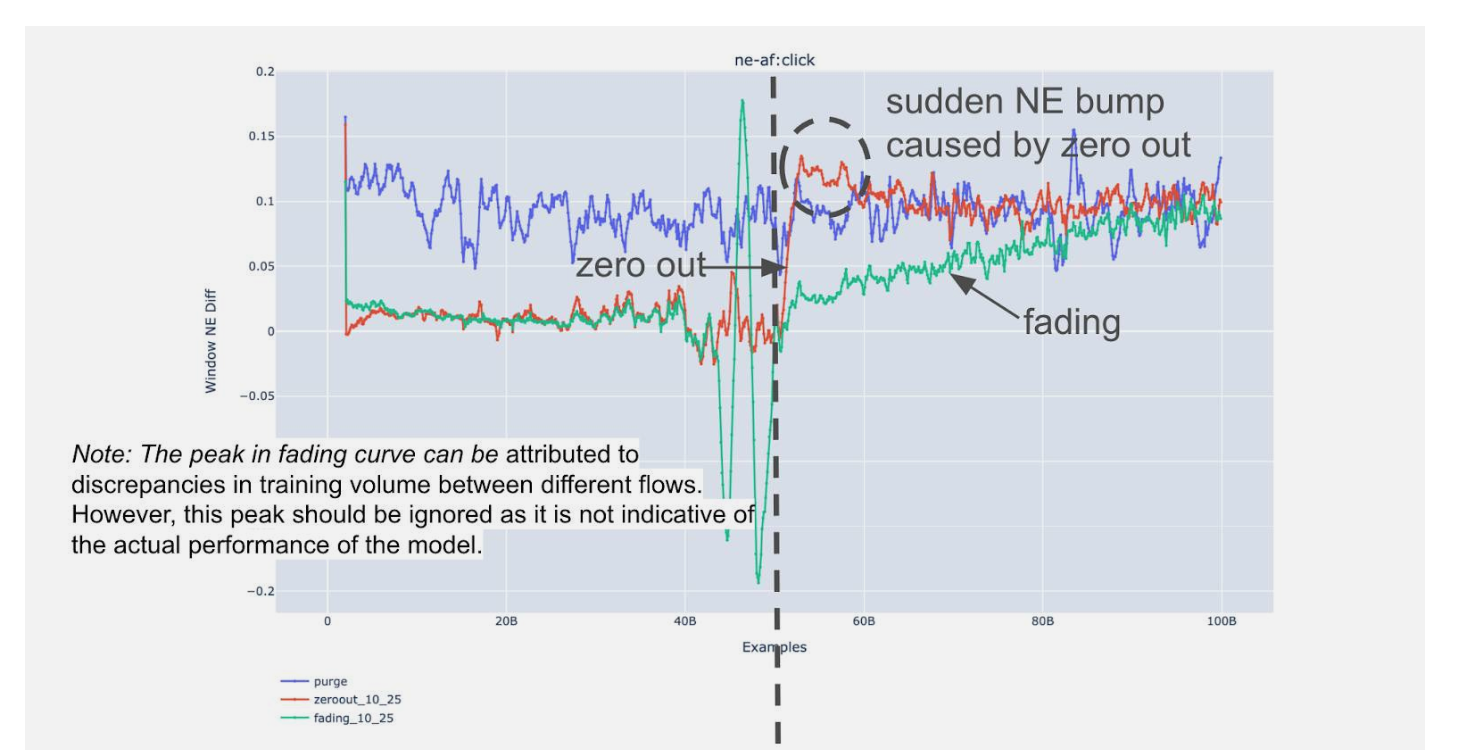
Figure 2: Gradual feature fading reduces peak and cumulative normalized entropy increases, stabilizing model adaptation compared to abrupt zero-out.
Strong empirical results are reported:
- Gradual fading yields approximately 50% reduction in daily NE increases and online regression compared to abrupt zero-out for both sparse and embedding features.
- When removing the top 50 sparse features, abrupt zero-out induces a 0.83% online regression, while gradual fading confines this to 0.37%, reducing rollout-induced loss by ~55%.
- Abrupt removal causes transient instability necessitating orders of magnitude more training samples for recovery; fading achieves smooth adaptation without such spikes.
- IEFF enables feature efficiency rollouts to proceed at up to 5× higher velocity, with complete elimination of retraining-induced GPU costs and faster capacity recycling.
- The system was deployed across 275 feature rollouts, avoiding around 140 full retraining iterations and leading to infrastructure savings of ~15% annually.
Phase-wise analysis further demonstrates that the primary benefit of IEFF is not only in the final steady state, but in substantially mitigating transient regressions during the most sensitive, intermediate phases—thereby lowering operational risk across the entire rollout trajectory.
Practical Implications and Lessons Learned
IEFF fundamentally shifts the operational paradigm for feature rollouts in production ML systems by leveraging continuous training infrastructure and serving-time control to achieve decoupling from retraining. Key lessons include:
- Incremental change control is critical: The rate and granularity of feature fading dominate stability outcomes, surpassing even the ultimate feature set chosen.
- Serving-time intervention simplifies coordination: By operating on the serving pathway, IEFF sidesteps upstream pipeline modifications and reduces cross-team friction.
- Safety guardrails are essential: Pre-rollout QRT, strict fading-rate limits, and monitoring are necessary to guarantee the feasibility and reversibility of retrain-free rollouts.
- Not all features are amenable: Highly non-linear or interdependent features may still require retraining for safe modification; further research on adaptive rate selection and advanced rollout scheduling is warranted.
Advantages over Prior Work and Theoretical Implications
Prior studies have concentrated on feature selection, pruning, and retraining cost, but have not offered a principled, system-level approach for safe, retrain-free rollouts. IEFF introduces a new abstraction that unifies feature management and model lifecycle considerations, capitalizing on the observation that modern models, given continuous retraining, can safely track incremental upstream input changes. This serves as a system-level realization of the principle that distributional stability, rather than static feature sets, is the key determinant of retraining need.
IEFF opens further research avenues in adaptive fading schedules, test-time compute scaling, and leveraging fading as a proxy for per-feature uncertainty and staleness. It also provides a path for increasingly automated, robust, and sustainable ML operations at industrial scale.
Conclusion
IEFF represents a significant advance in large-scale ranking system infrastructure, demonstrating that safe, efficient, and retrain-free feature rollouts are scaffolded not on static retraining cycles but on precise, incremental serving-time adaptation and rigorous system safety controls. Empirical results validate that IEFF substantially reduces operational overhead, safeguards online metrics, and accelerates deployment lifecycles, establishing a blueprint for scalable feature management in production ML systems (2605.00324).