Caracal: Causal Architecture via Spectral Mixing
Abstract: The scalability of LLMs to long sequences is hindered by the quadratic cost of attention and the limitations of positional encodings. To address these, we introduce Caracal, a novel architecture that replaces attention with a parameter-efficient, $\mathcal{O}(L \log L)$ Multi-Head Fourier (MHF) module. Our contributions are threefold: (1) We leverage the Fast Fourier Transform (FFT) for sequence mixing, inherently addressing both bottlenecks mentioned above. (2) We apply a frequency-domain causal masking technique that enforces autoregressive capabilities via asymmetric padding and truncation, overcoming a critical barrier for Fourier-based generative models. (3) Unlike efficient models relying on hardware-specific implementations (e.g., Mamba), we uses standard library operators. This ensures robust portability, eliminating common deployment barriers. Evaluations demonstrate that Caracal performs competitively with Transformer and SSM baselines, offering a scalable and simple pathway for efficient long-sequence modeling. Code is available in Appendix.
Paper Prompts
Sign up for free to create and run prompts on this paper using GPT-5.
Top Community Prompts
Explain it Like I'm 14
What is this paper about?
This paper introduces a new way to build LLMs, called Caracal. Instead of using the usual “attention” method (which becomes slow and expensive on long texts), Caracal mixes information using the Fourier transform, a math tool that’s very fast for long sequences. The big idea: keep models accurate while making them much more efficient and easier to run on regular hardware.
What questions were the researchers asking?
The researchers focused on three simple questions:
- Can we replace attention with something faster so long texts are cheaper to process?
- Can a Fourier-based method generate text one token at a time without “peeking” at the future (that is, be causal/autoregressive)?
- Can we avoid tricky extras like positional encodings and special hardware kernels, and still match the performance of today’s best models?
How did they do it?
To understand their approach, it helps to think in everyday terms:
- Attention (the standard method) is like asking every word to compare itself with every other word. That’s powerful but slow for long sequences because the number of comparisons grows very quickly.
- The Fourier transform is like turning a song into its bass, mid, and treble levels. It lets you mix information across the whole sequence quickly by working in “frequency space” instead of word-by-word comparisons.
The key idea: Multi-Head Fourier (MHF) module
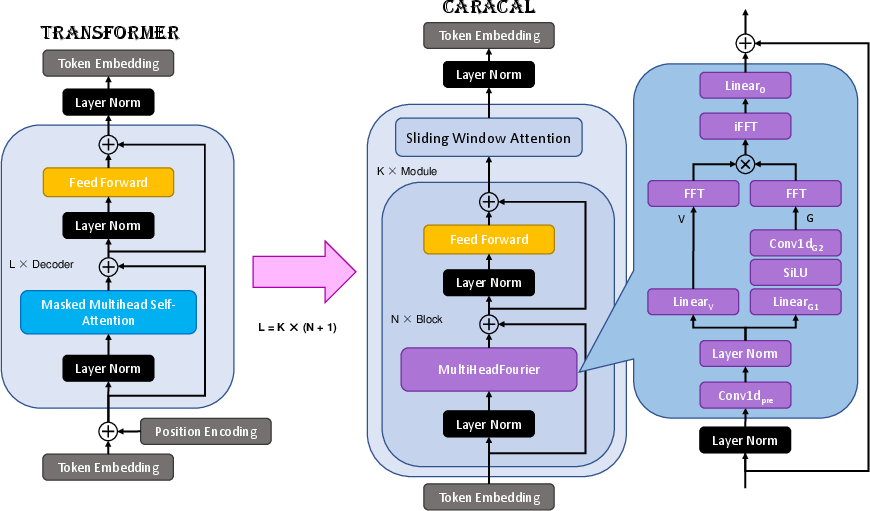
Caracal swaps out attention for a module that mixes tokens using FFT (Fast Fourier Transform). Here’s the simplified flow:
- Learn local patterns first:
- The model runs a tiny causal 1D convolution (think of it as a short “look-back” filter) so it can notice small patterns like short phrases, without breaking the rule of not looking ahead in the text.
- Split into two signals: content and gate
- Content is “what the tokens say.”
- Gate is “how strongly to mix different parts.”
- The gate is computed from the input, so mixing depends on the meaning of the current text (data-dependent), not a fixed recipe.
- Mix in frequency space (the FFT trick)
- Convert both content and gate into frequencies using FFT.
- Multiply them element-by-element in frequency space (like using a smart equalizer that adapts to the content).
- Convert back to the original sequence with an inverse FFT.
- Make it causal (no peeking at future words)
- They use a careful pad-and-trim procedure: pad on the left, do the FFT mixing, then trim off the extra part so the output for each position only depends on past positions. This is mathematically the same as a causal convolution, but computed efficiently with FFT.
- Keep a little attention for local detail
- To sharpen fine details, they keep a few “sliding window attention” layers that only look at a small neighborhood (like a small magnifying glass). Because the window is small, this stays efficient.
Why no positional encodings? The Fourier transform uses sine and cosine waves that naturally carry ordered position information, so the model “feels” where words are without adding special position tags.
Why is this efficient?
- Standard attention costs about L2 steps for sequence length L (it compares everything with everything).
- Caracal’s FFT-based mixing costs about L log L, which grows much more slowly as L gets large.
- It uses standard, well-optimized library functions (no custom low-level code), so it’s easier to run on different machines.
What did they find?
Here are the main takeaways from their tests:
- Competitive accuracy: On a variety of language tasks (like HellaSwag, ARC, BoolQ, PIQA), Caracal performs about as well as strong Transformer models and state-space models (like Mamba).
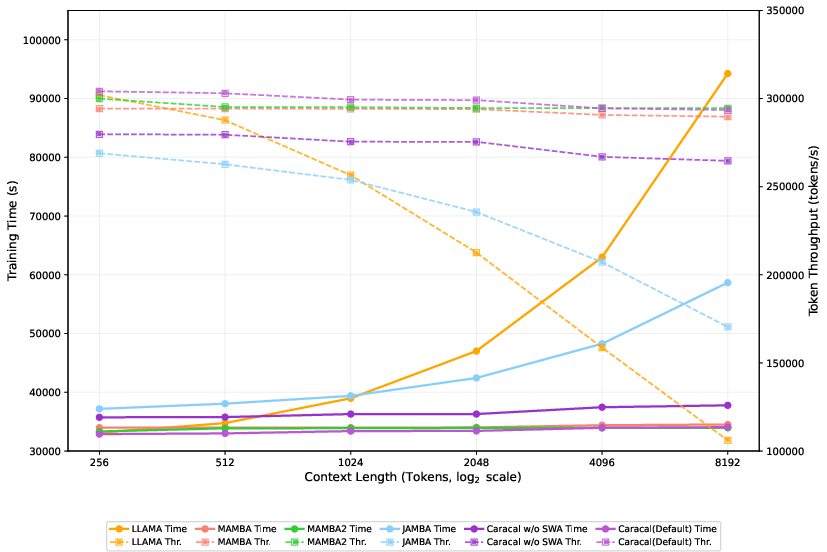
- Faster on long contexts: As sequences get very long (thousands of tokens), Caracal stays fast and scales close to linearly. At 8192 tokens, it’s about three times faster to train than a standard Transformer with attention.
- Good, but not best, at exact retrieval: On tasks that need pinpoint “find-and-match” ability over long contexts, standard attention still does better. Caracal is similar to other efficient models here.
- Ablations (what matters inside Caracal):
- Keeping a few sliding-window attention layers helps local precision.
- The tiny pre-convolution helps with short-range patterns.
- Extra positional encodings don’t help, confirming Fourier already gives position awareness.
- A two-step “gating” design works better than a simpler one, making the mixing smarter.
Why is this important?
- Handles long texts efficiently: Caracal makes it more practical to train and run models on very long documents, code files, logs, or transcripts.
- Lower compute and energy cost: Using L log L instead of L2 saves time and electricity as sequences grow.
- Easier to deploy and modify: Because it uses standard FFT operators instead of custom kernels, it’s more portable and simpler for researchers and engineers to adapt.
- Strong general performance: It keeps up with popular architectures while offering better scaling for long contexts.
What could this change in the future?
- More affordable long-context models: Teams with fewer resources can work with longer sequences without huge costs.
- Greener AI: Reduced compute can lower energy use and carbon footprint.
- New hybrid designs: Combining frequency-based global mixing with small local attention could become a common pattern.
- Next steps: Improve exact retrieval over long contexts (where attention still shines), so models can be both fast and razor-accurate at finding details in long documents.
Knowledge Gaps
Knowledge gaps, limitations, and open questions
Below is a concise list of what remains missing, uncertain, or unexplored, framed to be actionable for future work:
- Length-extrapolation accuracy, not just throughput: The paper trains at L=512 and reports efficiency up to L=8192, but does not evaluate language modeling quality (e.g., perplexity) or task accuracy at long contexts (4k–32k+). Quantify how performance degrades or holds when extrapolating far beyond training lengths.
- Autoregressive inference latency and caching: Training efficiency is shown, but the per-token decoding cost likely remains O(L log L) without a cache. No incremental-update or overlap-save strategy is described for data-dependent kernels. Develop and benchmark a caching/incremental FFT scheme for fast autoregressive decoding.
- Expressivity of time-invariant convolution vs attention/SSMs: Frequency-domain multiplication implements a single time-invariant (Toeplitz) kernel per sequence. This lacks position-specific adaptation inherent in attention or selective SSMs. Quantify the expressivity gap and explore efficient time-varying/doubly-block Toeplitz variants that preserve sub-quadratic complexity.
- Retrieval precision gap remains: Caracal underperforms attention on fine-grained retrieval (SWDE, FDA). Investigate augmentations that improve exact token matching (e.g., content-aware sparse cross-correlation, learned k-NN memory, or small cross-attention patches) without sacrificing global FFT efficiency.
- Dependence on Sliding Window Attention (SWA): The best results rely on interleaved SWA using FlashAttention, partially undermining the “standard-ops only” portability claim. Systematically study pure-MHF performance across sizes/tasks, and explore adaptive window sizes/schedules that do not rely on specialized kernels.
- Numerical stability and FFT specifics: There is no analysis of numerical issues (complex dtypes, Hermitian symmetry handling, phase/round-off errors), spectral leakage/Gibbs effects from truncation, or sensitivity to non–power-of-two sequence lengths. Provide stability diagnostics, error bounds, and best practices for mixed-precision training with complex FFTs.
- Memory/computation on diverse hardware: Claims of portability are untested on CPUs, mobile/edge accelerators, and different FFT libraries (cuFFT, rocFFT, oneMKL, FFTW). Profile memory footprint, planning overhead, and throughput across hardware and very long sequences (32k–128k), including energy measurements.
- Formal guarantees and theory: The paper motivates a “dynamic Toeplitz” view but provides no formal approximation or universality results relative to attention/SSMs. Develop theoretical bounds on expressivity, length generalization, and conditions under which MHF matches or fails to emulate attention-like behaviors.
- Channel/head mixing limitations: The spectral mixing is channel-independent and uses grouped (per-head) 1×1 conv gating; inter-head frequency interactions are deferred to the output projection. Assess whether limited cross-head/channel mixing in the frequency domain bottlenecks performance; test alternatives (e.g., small cross-head mixing in frequency, depthwise-separable spectral mixers).
- Gating network design space: The gate path (Linear → SiLU → grouped 1×1 conv) is minimal. Explore deeper or wider gating, multi-scale/dilated pre-convolutions, or lightweight attention in the gate to enhance content adaptivity; quantify compute/accuracy trade-offs.
- Positional robustness and absolute-position sensitivity: The claim that Fourier bases obviate positional encodings is not validated on position-sensitive probes (e.g., needle-in-a-haystack, index retrieval, absolute position tagging). Run targeted diagnostics to verify absolute/relative position fidelity and drift at long lengths.
- Training-scale generalization: Experiments are limited to ≤~0.8B parameters and 10–15B tokens. It is unclear how Caracal scales to 1–7B+ models and 100B+ tokens, or to multilingual, code, math, and instruction-tuning regimes. Perform large-scale pretraining and diverse downstream evaluations.
- Benchmarks breadth: Evaluations emphasize small reasoning/classification sets; there is no assessment on coding, math proofs, long-form generation, or few-shot in-context learning. Add comprehensive benchmarks to stress long-range compositionality and step-by-step reasoning.
- Long-context training vs short-context pretraining: Models are trained at L=512; the effect of pretraining directly at long contexts (e.g., 8k–32k) on both efficiency and quality is unknown. Compare short- vs long-context pretraining and curriculum schedules.
- Pre-convolution (local inductive bias) design: Only a small causal conv (k=3) is used and lightly ablated. Systematically sweep kernel sizes, multi-branch local filters, and layerwise schedules to optimize local/global synergy.
- Variable-length and padding behavior: The handling of padding/masks in the FFT pipeline is not detailed. Specify and test robust masking for variable-length batches to avoid spurious frequency content from pad tokens.
- Backpropagation cost and memory: FFT/iFFT gradients can have high memory overhead. Quantify training-time memory, activation checkpointing strategies, and compare against attention/SSMs at long contexts.
- Ultra-long-range scaling beyond 8k: Throughput is reported up to 8k, but not for 32k–128k contexts where FFT constant factors and memory may dominate. Provide empirical scaling curves and break-even points with SSMs and attention.
- Reproducibility and implementation details: The causal masking procedure (“pad-FFT-multiply-iFFT-truncate”) lacks precise implementation specifics (normalization, complex conjugate symmetry, padding strategy). Release complete code, tests, and reference configs to ensure faithful reproduction.
- Multimodal and 2D/3D extensions: The method is evaluated only on 1D text. Investigate applicability to images/audio (2D/3D FFT or STFT), and whether causal variants remain efficient and expressive across modalities.
Practical Applications
Practical Applications Derived from the Paper
Below are actionable applications that flow from Caracal’s main contributions: an attention-replacing Multi-Head Fourier (MHF) module with frequency-domain causal masking, O(L log L) global mixing, no positional encodings, and hardware-agnostic implementation using standard FFT operators. Each item names target sectors, candidate tools/products/workflows, and key assumptions/dependencies that affect feasibility.
Immediate Applications
- Bold drop-in spectral layer for current LLM stacks
- Sectors: Software/AI platforms, Cloud ML, Open-source tooling
- What: Replace a portion of self-attention blocks with MHF in decoder-only models to reduce cost at long contexts while keeping quality competitive. Use the default 2:1 MHF:SWA ratio and remove positional encodings in the stack.
- Tools/products/workflows: PyTorch modules for MHF; Hugging Face-style model configs “CaracalHybrid”; training recipes reusing AdamW/FlashAttention for SWA; evaluation via lm-eval harness.
- Assumptions/dependencies: Availability of high-performance FFT libraries (e.g., cuFFT/torch.fft); memory headroom for pad-to-2L; current inference stacks must support batched FFT/iFFT.
- Lower-cost long-context fine-tuning and inference
- Sectors: Enterprise IT, Cloud providers, MLOps
- What: Reduce training time and inference cost at 4k–8k+ tokens by swapping quadratic attention for log-linear spectral mixing where feasible.
- Tools/products/workflows: Inference servers that route long-context requests to Caracal variants; cost dashboards tracking tokens/sec vs context; autoscaling policies tuned for O(L log L).
- Assumptions/dependencies: Gains are largest at longer contexts; for short contexts attention may remain competitive. Throughput improvements proven up to 8k in paper; further contexts require benchmarking.
- Long-document assistants for regulated domains
- Sectors: Legal, Compliance, Government
- What: Summarization, contract triage, policy synthesis over extended filings using hybrid Caracal to keep compute budgets low on-prem or in private clouds.
- Tools/products/workflows: Document pipelines with chunking + SWA refinement; RAG for pinpoint retrieval; audit logs for compliance.
- Assumptions/dependencies: Caracal’s exact-token retrieval is weaker than dense attention; pair with RAG or small-window attention for fine-grained extraction.
- On-prem privacy-preserving modeling
- Sectors: Healthcare (EHR notes), Public sector
- What: Deploy mid-sized models that handle longer patient notes/history on hospital servers without custom CUDA kernels.
- Tools/products/workflows: HIPAA-aligned deployments; simple DevOps due to standard ops; continual fine-tuning of longitudinal notes.
- Assumptions/dependencies: Quality parity with attention on domain tasks not guaranteed; clinical validation required; FFT libraries must be optimized on target hardware.
- High-throughput log and time-series modeling
- Sectors: DevOps/SRE, Cybersecurity, Energy (SCADA), Industrial IoT
- What: Autoregressive forecasting/anomaly detection on long telemetry sequences with causal spectral mixing.
- Tools/products/workflows: Log anomaly detectors; time-series forecasters; sliding-window attention for local spikes; FFT-friendly batching.
- Assumptions/dependencies: Domain adaptation needed; pipeline must accommodate pad-FFT-iFFT-truncate; evaluation against SSM baselines advisable.
- Code intelligence for large repositories
- Sectors: Software engineering
- What: Repository-level summarization, cross-file context for PR review and refactoring with improved throughput at long contexts.
- Tools/products/workflows: Index + RAG + hybrid Caracal for global reasoning; SWA for nearby token precision; CI/CD plugins.
- Assumptions/dependencies: Fine-grained symbol resolution may still favor attention; augment with static analysis or retrieval to compensate.
- Education and research compute democratization
- Sectors: Academia, EdTech
- What: Course/research usage of long-context models on modest GPUs thanks to standard FFT ops and reduced quadratic costs.
- Tools/products/workflows: Teaching materials on spectral causal models; ablation-friendly code; reproducible labs with configurable MHF:SWA ratios.
- Assumptions/dependencies: Students need access to GPUs/fast FFTs for best results; pedagogy should cover trade-offs in retrieval precision.
- Green AI optimization in MLops
- Sectors: Sustainability, Cloud FinOps
- What: Immediate CO2e and cost savings for long-context training/inference by shifting workloads to O(L log L) models.
- Tools/products/workflows: Carbon dashboards; workload policies that auto-select spectral models beyond a context threshold; cost–latency optimizers.
- Assumptions/dependencies: Accurate energy metering; well-characterized performance curves per context length.
- Simpler cross-platform deployment
- Sectors: Edge/Embedded, Enterprise IT
- What: Deploy models on diverse accelerators/OSes due to reliance on standard library ops (FFT/Conv/Linear) rather than custom kernels.
- Tools/products/workflows: ONNX export; TensorRT or vendor FFT libraries; container images without custom drivers.
- Assumptions/dependencies: FFT performance varies by platform; ensure numerical stability in mixed precision; memory overhead from padding.
- Baseline for spectral-causal research
- Sectors: ML research
- What: A clear, modifiable, hardware-agnostic baseline to study causal spectral mixing, gating, and hybridization with attention.
- Tools/products/workflows: Ablation harness for pre-convolution/gating/SWA; benchmarking suite for length extrapolation and retrieval.
- Assumptions/dependencies: Community adoption and shared benchmarks; reproducibility with public datasets/settings.
Long-Term Applications
- Mobile/edge long-context assistants
- Sectors: Consumer devices, Automotive, IoT
- What: On-device assistants that handle long personal histories or multi-app context with spectral cores for efficiency.
- Tools/products/workflows: Mobile-optimized FFT kernels; KV/state reuse strategies for decoding; quantization/low-rank adapters.
- Assumptions/dependencies: Efficient streaming/incremental FFT; memory- and energy-aware kernels on NPUs/ASICs; privacy requirements.
- Specialized FFT-centric hardware for LLMs
- Sectors: Semiconductors, Cloud hardware
- What: Accelerators tuned for FFT/iFFT + pointwise ops to maximize spectral LLM throughput.
- Tools/products/workflows: Compiler passes recognizing pad-FFT-multiply-iFFT patterns; scheduling fusion for i/o bounds.
- Assumptions/dependencies: Sufficient demand for spectral models; robust software stacks to target new hardware.
- Million-token context knowledge management
- Sectors: Enterprise search, Personal knowledge bases
- What: Global reasoning over extremely long corpora by scaling spectral layers and interleaving retrieval for precision.
- Tools/products/workflows: Hierarchical chunking + spectral global passes; selective SWA insertion; memory-mapped context streaming.
- Assumptions/dependencies: FFT scalability/distribution across nodes; improved retrieval mechanisms to offset local precision limits.
- Multimodal spectral generative models
- Sectors: Speech/ASR, Bioinformatics (DNA/proteins), Remote sensing
- What: Apply frequency-domain causal masking to audio, genomics, and geospatial sequences for long-horizon generation/forecasting.
- Tools/products/workflows: Domain-specific pre-convolutions/filters; hybrid spectral–SSM stacks; evaluation on modality benchmarks.
- Assumptions/dependencies: Data preprocessing and sampling rates; handling non-stationarity; domain-specific loss/metrics.
- Real-time streaming translation and ASR
- Sectors: Communications, Call centers
- What: Low-latency autoregressive decoding with spectral mixing if incremental-FFT or blockwise causal updates are engineered.
- Tools/products/workflows: Sliding-block FFT updates; cache-aware decode kernels; endpointing strategies.
- Assumptions/dependencies: Efficient incremental spectral updates; latency budgets; careful numerical stability.
- Privacy-first clinical LLMs at scale
- Sectors: Healthcare
- What: Hospital-scale longitudinal modeling (multi-year notes) with on-prem spectral models plus federated fine-tuning.
- Tools/products/workflows: Federated training across institutions; de-identified EHR pipelines; evaluation on clinical NLP suites.
- Assumptions/dependencies: Regulatory approvals; domain fine-tuning; robust safety/QA.
- Financial tick-stream forecasting and risk modeling
- Sectors: Finance
- What: Long-range, high-frequency autoregressive models for ticks/limit-order books with spectral efficiency.
- Tools/products/workflows: Feature pipelines; hybrid attention windows around events; latency-sensitive inference integration.
- Assumptions/dependencies: Backtesting; handling regime shifts; compliance and model risk governance.
- Robotics and long-horizon planning
- Sectors: Robotics, Autonomous systems
- What: Policy learning over extended sensor-action histories with causal spectral mixing for global dependencies.
- Tools/products/workflows: Offline RL with spectral sequence encoders; model-based planning with hybrid local attention.
- Assumptions/dependencies: Bridging sim2real; incorporating continuous control primitives; safety constraints.
- Standardization and policy for green long-context AI
- Sectors: Public policy, Standards bodies
- What: Guidelines that favor sub-quadratic architectures for long-context workloads to reduce energy use.
- Tools/products/workflows: Benchmarks reporting energy per 1k tokens vs context; procurement criteria referencing O(L log L) scaling.
- Assumptions/dependencies: Transparent reporting; consensus metrics; verification mechanisms.
- Open ecosystem integrations and optimizations
- Sectors: Open-source, Tooling vendors
- What: First-class Caracal blocks in major frameworks; exporters (ONNX), compilers (TVM), and quantization toolchains.
- Tools/products/workflows: Graph-level pattern fusion (FFT–mul–iFFT); per-layer quantization-aware training; multi-backend CI.
- Assumptions/dependencies: Community contributions; alignment on APIs; CI for numerical parity across backends.
Notes on global assumptions and dependencies:
- Performance trade-off: Caracal’s global modeling is competitive, but exact token-level retrieval is weaker than dense attention; hybrid SWA and/or RAG is often required for precision tasks.
- Engineering details: The causal pipeline relies on pad-FFT-multiply-iFFT-truncate; doubling sequence length temporarily increases memory bandwidth needs.
- Throughput profile: Benefits grow with longer contexts; at short contexts, attention can be similar or faster due to kernel optimizations.
- Inference specifics: The paper validates training/inference throughput at batch scale; ultra-low-latency, token-by-token streaming may require incremental spectral updates and further engineering.
- Portability: Success hinges on mature FFT libraries on target hardware (GPUs, NPUs, CPUs). Mixed-precision and quantization support must be validated per platform.
Glossary
- AFNO: A Fourier-based neural operator architecture used primarily in vision tasks to capture global patterns efficiently. "vision models like GF-Net \citep{rao2021gfnet} and AFNO \citep{guibas2022afno}, building on FNO \citep{li2021fno}"
- ALiBi: A relative positional encoding method that adds linear biases based on token distance to improve extrapolation. "Concurrent sophisticated relative positional encodings like RoPE \citep{su2021roformer}, YaRN \citep{peng2024yarn}, and ALiBi \citep{press2022alibi}, which encode relative distances or apply distance-aware biases, have dramatically improved length extrapolation."
- ARC-c: The challenging subset of the AI2 Reasoning Challenge dataset focused on complex science questions. "ARC-e & ARC-c \citep{clark2018arc}"
- ARC-e: The easy subset of the AI2 Reasoning Challenge dataset focused on simpler science questions. "ARC-e & ARC-c \citep{clark2018arc}"
- Associative memory: A mechanism for storing and retrieving information via content-based addressing, often used for sequence modeling with dynamic updates. "a concept further formalized via associative memory with momentum-based updates \citep{behrouz2025mym}."
- Autoregressive: A generative modeling approach where each token prediction depends only on previous tokens to enforce causality. "We apply a frequency-domain causal masking technique that enforces autoregressive capabilities via asymmetric padding and truncation"
- BigBird: A Transformer variant with sparse attention patterns enabling longer context handling. "as seen in Longformer \citep{beltagy2020longformer} and BigBird \citep{zaheer2020bigbird}"
- BoolQ: A yes/no question-answering dataset used for evaluating common sense and reading comprehension. "BoolQ \citep{clark2019boolq}"
- Causal convolution: A convolution operation ensuring outputs at time t depend only on inputs up to t, preserving temporal causality. "This \"pad-FFT-multiply-iFFT-truncate\" pipeline is mathematically equivalent to a causal convolution."
- Causal masking: A technique to prevent a model from using future tokens when predicting the current token. "We apply a frequency-domain causal masking technique that enforces autoregressive capabilities via asymmetric padding and truncation."
- CUDA kernels: Hardware-specific GPU routines (often custom) used to accelerate computation, particularly in sequence models. "hardware-specific custom CUDA kernels, hindering portability, modification, and broad adoption."
- Delta rule: An update rule for adjusting representations or weights based on error signals, used here to selectively update hidden states. "employ a (gated) delta rule to selectively update hidden states"
- Depthwise convolution: A convolution type applying separate filters to each input channel, reducing computation while capturing local patterns. "We pass the input through a lightweight, depthwise causal 1D convolution to capture local syntactic patterns (e.g., n-grams):"
- Discrete Cosine Transform (DCT): A transform similar to the Fourier transform that uses cosine basis functions, often for compression and spectral analysis. "DCT-Former \citep{scribano2023dctformer} which uses discrete cosine transforms."
- Discrete Fourier Transform (DFT): A transformation that converts a sequence from the time domain into frequency components. "We deconstruct the Discrete Fourier Transform (DFT) from this perspective."
- FDA: A long-context retrieval and extraction benchmark. "FDA \citep{arora2023fda} (retrieval {paper_content} extraction over extended sequences)"
- FlashAttention: An optimized attention implementation that improves memory and speed using tiling and fused kernels. "leveraging the native FlashAttention implementation provided by PyTorch's scaled dot product attention (SDPA)."
- FNet: A Transformer replacement using 2D FFTs for token mixing instead of attention. "The seminal FNet \citep{lee-thorp2022fnet} replaces attention with a parameter-free 2D FFT in BERT."
- Fourier Transform: A mathematical transform that represents signals as sums of sinusoids, enabling efficient global mixing. "Another line of research leverages the Fourier Transform to achieve global token mixing with complexity."
- FourierNAT: A method that employs Fourier-based mixing to aid non-autoregressive decoding. "FourierNAT \citep{kiruluta2025fouriernat} employs a Fourier-mixing block to aid non-autoregressive decoding."
- FSAT: A method that predicts sparse attention masks using Fourier convolution. "FSAT \citep{zhuang2022fsat} predicts sparse masks via Fourier convolution"
- Frequency domain: The representation of signals in terms of their frequency components rather than time-ordered values. "Convolution in the time domain equals multiplication in the frequency domain."
- GEMM: General Matrix-Matrix Multiplication, a fundamental HPC primitive often used to approximate or accelerate convolutions. "Monarch Mixer \citep{fu2023monarch} approximates convolutions via GEMMs to maximize utilization"
- GLA: A linear recurrent model that adds hardware-efficient gating mechanisms. "GLA \citep{yang2024gla} adds hardware-efficient gating."
- Global convolution: A convolution that aggregates information across the entire sequence length, typically computed efficiently via FFT. "leveraging a formulation computable as a global convolution."
- Group convolution: A convolution where channels are partitioned into groups and each group is convolved independently. "where is SiLU and is 1D group convolution (kernel size 1) with $n_{\text{head}$ groups."
- Hellaswag: A commonsense reasoning dataset evaluating plausible continuation of scenarios. "Hellaswag \citep{zellers2019hellaswag}"
- Hyena: An architecture that uses FFTs and position-based filters to achieve implicit long convolutions. "Hyena \citep{poli2023hyena} employs implicit long convolutions by generating filters via a small MLP acting on positional encodings, leveraging FFTs for sub-quadratic processing."
- Inverse FFT (iFFT): The operation that transforms frequency-domain data back into the time domain. "We transform the mixed spectrum back to the time domain using the inverse FFT and truncate the result to the original length "
- Jamba: A hybrid architecture interleaving Mamba layers with attention for efficiency and expressivity. "Jamba: A hybrid architecture \citep{lenz2025jamba} interleaving Mamba layers with Attention, serving as a direct competitor to our hybrid spectral design."
- LAMBADA: A language modeling benchmark measuring ability to predict masked words in long narratives; often reported with accuracy and perplexity. "LAMBADA \citep{paperno2016lambada} (reporting both Accuracy and Perplexity)."
- Layer Normalization: A normalization technique applied across features to stabilize and speed up training. "We first apply Layer Normalization"
- Longformer: A Transformer variant that uses sparse attention for long-range sequence modeling. "as seen in Longformer \citep{beltagy2020longformer}"
- Mamba: A selective state space model enabling input-dependent updates with linear-time complexity. "Mamba \citep{gu2023mamba} and Mamba-2 \citep{dao2024mamba2} achieve state-of-the-art performance via selective, input-dependent state updates."
- Mamba-2: An improved version of Mamba with refined efficiency and performance characteristics. "Mamba \citep{gu2023mamba} and Mamba-2 \citep{dao2024mamba2} achieve state-of-the-art performance via selective, input-dependent state updates."
- Monarch Mixer: An architecture that uses matrix multiplications to approximate convolutions for hardware efficiency. "Monarch Mixer \citep{fu2023monarch} approximates convolutions via GEMMs to maximize utilization"
- Multi-Head Fourier (MHF): The proposed module that performs gated token mixing in the frequency domain with sub-quadratic complexity. "We propose the Multi-Head Fourier (MHF) module, which mixes token information via a gated element-wise product in the frequency domain, directly replacing the attention layer in a Transformer."
- Permutation equivariance: A property where outputs are invariant under permutations of inputs, making attention insensitive to order without positional encodings. "The second is permutation equivariance; attention is insensitive to token order, necessitating external positional encodings."
- Perplexity (ppl): A common language modeling metric indicating how well a probability model predicts a sample. "We report accuracy (\%) for all tasks and ppl for Lambada."
- PIQA: A physical commonsense reasoning dataset focusing on everyday knowledge of object usage. "PIQA \citep{bisk2020piqa}"
- RoPE: Rotary positional embeddings that encode relative distances using sine/cosine rotations in attention. "RoPE \citep{su2021roformer}"
- Routing Transformer: A Transformer variant using content-based routing to determine sparse attention patterns. "Routing Transformer \citep{roy2021routing}"
- S4: A state space model with time-invariant state matrices enabling efficient long-range modeling via convolution. "Foundational work like the S4 \citep{gu2021s4} and S4D \citep{gu2022s4d} demonstrates the potential for modeling long-range dependencies by leveraging a formulation computable as a global convolution."
- S4D: A variant of S4 with diagonal state matrices improving training and stability. "Foundational work like the S4 \citep{gu2021s4} and S4D \citep{gu2022s4d} demonstrates the potential for modeling long-range dependencies by leveraging a formulation computable as a global convolution."
- SDPA: Scaled Dot Product Attention, the fundamental attention computation used in Transformers and optimized in libraries. "leveraging the native FlashAttention implementation provided by PyTorch's scaled dot product attention (SDPA)."
- Selective Scan: A hardware-aware sequential scanning operator used to realize input-dependent state updates efficiently in SSMs. "Mamba and Mamba-2 utilize the library mamba_ssm for Selective Scan and SSD operators."
- SiLU: A smooth activation function (Sigmoid Linear Unit) improving optimization stability and expressivity. "where is SiLU"
- Sliding Window Attention (SWA): An attention mechanism restricted to a fixed local window to control complexity while capturing local dependencies. "For Caracal, we insert a Sliding Window Attention (SWA) layer (window size 256) after every two MHF layers (ratio 2:1)."
- Spectral biases: Inductive preferences introduced by frequency-based operations that emphasize certain patterns or scales. "While demonstrating the utility of spectral biases, these methods do not fundamentally remove the attention bottleneck."
- Spectral methods: Techniques leveraging transformations like FFT/DCT to process signals in the frequency domain for efficient global mixing. "Another line of research leverages the Fourier Transform to achieve global token mixing with complexity."
- Spectral mixing: Combining information via frequency-domain operations to achieve global interactions among tokens. "Caracal: Causal Architecture via Spectral Mixing"
- State Space Models (SSMs): Models that represent sequences via state evolution equations, enabling efficient long-range processing. "State Space Models (SSMs), particularly the recent Mamba architecture \citep{gu2023mamba, dao2024mamba2}, have emerged as a powerful contender."
- SWDE: A benchmark for information extraction over long web documents. "SWDE \citep{lockard2019swde}"
- Toeplitz structure: A matrix structure with constant diagonals enabling efficient convolution-like operations and relative position modeling. "Explicit PE provides no significant gain, confirming that MHF’s dynamic Toeplitz structure inherently captures relative positions, making auxiliary positional signals redundant."
- Vim-F: A hybrid model that augments Mamba with a parallel Fourier filtering module to improve efficiency. "Vim-F \citep{zhang2024vimf} augments a Mamba block with a parallel Fourier filtering module."
- Winogrande: A dataset for evaluating commonsense reasoning via pronoun resolution in tricky contexts. "Winogrande \citep{sakaguchi2020winogrande}"
- YaRN: A positional encoding method designed to improve length extrapolation over standard rotary embeddings. "YaRN \citep{peng2024yarn}"
Collections
Sign up for free to add this paper to one or more collections.