Quantum Noise Fraction and the Thermal Frontier in High-Frequency Gravitational Wave Detection
Published 29 Apr 2026 in gr-qc, astro-ph.IM, and quant-ph | (2605.00053v1)
Abstract: We introduce a diagnostic -- the quantum noise fraction $β$ -- that determines the maximum sensitivity improvement achievable through quantum enhancement for any gravitational wave detector. Applied to the landscape of proposed high-frequency (kHz-GHz) detectors, this diagnostic reveals that resonant mass detectors operating through tidal coupling are thermally dominated ($β\approx 0$) at all frequencies below ~230 MHz at dilution temperatures, rendering squeezing and entanglement limited in effectiveness. Only above this thermal frontier, defined by $\hbar ω= k_B T \ln 3$, does the quantum regime become accessible. We identify a single concrete realization: a bulk acoustic wave resonator at 1 GHz and 10 mK ($β= 0.98$), and propose a gravitational wave detector employing squeezed phononic states via circuit QED readout. An array of $104$ such resonators with 10 dB mechanical squeezing reaches $\sqrt{S_h} = 7.6 \times 10{-26}/\sqrt{\rm Hz}$ -- still a factor ~$109$ above the BBN bound on stochastic backgrounds at 1 GHz, indicating that the sensitivity gap remains predominantly classical in origin and that concurrent advances in classical detector parameters will be required.
The paper introduces the quantum noise fraction (β) metric, quantifying when quantum noise becomes dominant over thermal noise in GW detectors.
It establishes a 'thermal frontier' where quantum techniques can only enhance sensitivity below specific cryogenic temperature limits.
The analysis of GHz BAW resonators shows that quantum squeezing significantly lowers strain noise, though classical noise remains the primary barrier.
Quantum Noise Fraction and the Thermal Frontier in High-Frequency Gravitational Wave Detection
Introduction
The paper "Quantum Noise Fraction and the Thermal Frontier in High-Frequency Gravitational Wave Detection" (2605.00053) proposes a systematic approach to quantify the maximal sensitivity improvement achievable via quantum enhancement techniques (e.g., squeezing, entanglement) in gravitational wave (GW) detectors, particularly in the high-frequency (>kHz–GHz) regime. The central focus is the introduction and analysis of the quantum noise fraction metric, β, which measures the proportion of the overall noise floor that is quantum in origin for a given detector configuration. This diagnostic enables an explicit characterization of when and where quantum techniques are most effective in pushing sensitivity limits, and it outlines stringent frequency–temperature boundaries—labeled the "thermal frontier"—below which thermal noise irreducibly dominates.
Quantum Noise Fraction β: Definition and Physical Regime Boundaries
The quantum noise fraction, β, is rigorously defined as the ratio of quantum-origin (zero-point) fluctuations to the total noise power spectral density in the strain domain. For mechanical GW sensors, β depends only on operational temperature T and mechanical mode frequency ω via the Bose-Einstein phonon occupation nˉth, and is independent of device geometry, mass, quality factor, or readout circuitry. The maximal achievable quantum enhancement (i.e., the ultimate sensitivity improvement possible even with arbitrarily ideal quantum control and sensing, such as squeezing) is dictated by
Emax=1/1−β,
thereby directly linking β to the practical value of quantum metrological resources.
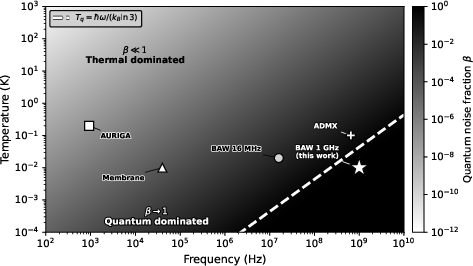
A key analytic result establishes a "thermal frontier": quantum enhancement becomes effective (β0) only when the system temperature falls below
β1
Below this boundary, quantum-origin noise is a dominant fraction and quantum techniques can provide order-unity strain sensitivity improvements; above it, thermal noise overwhelms, and quantum approaches yield only marginal improvements.
Figure 1: Quantum noise fraction β2 as a function of frequency and temperature, demonstrating the thermal frontier separating quantum- and thermal-dominated regimes for mechanical GW detectors.
Application to the High-Frequency Detector Landscape
A comprehensive analysis applies the β3 diagnostic to a broad class of GW sensors—including macroscopic resonant-mass ("bar") detectors, bulk acoustic wave (BAW) resonators, optomechanical systems, and interferometric platforms. The principal result is that all known high-frequency detectors based on mechanical tidal coupling (Mechanism A) remain deeply thermal noise dominated (β4) at frequencies below β5230 MHz for accessible cryogenic temperatures (β6 mK), thus sharply constraining the parameter space where quantum enhancement is impactful.
Interferometric (Mechanism C) detectors, with noise dominated by shot noise, naturally exhibit β7 independent of frequency, thus remaining well suited to quantum enhancement, a property already demonstrated by quantum squeezing advancements in LIGO. In contrast, electromagnetic cavity-based (Mechanism D, or A+D) detectors occupy an intermediate regime.
Concrete Realization: GHz BAW Quantum Detector and Projected Sensitivity
The paper proposes a millimeter-scale crystalline quartz BAW resonator, 1 GHz mechanical overtone, operated at dilution refrigerator temperatures (β8 mK) with ultrastrong Q (β9), read out via circuit QED transmon coupling. Under these conditions, β0, implying that quantum enhancement techniques—such as 10 dB phonon squeezing—can yield up to a factor of β1 improvement in strain sensitivity for a single element.
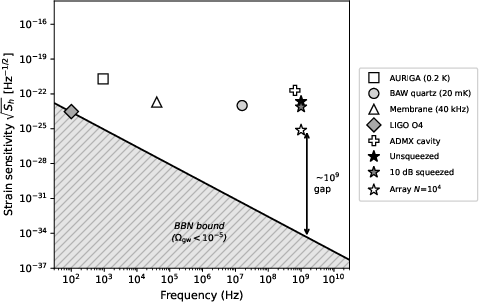
With detailed numerical modeling based on mode structure, drive/readout coupling, and bath-limited quantum measurement, the analysis finds that a single squeezed BAW element achieves a strain noise floor of β2. Scalable multiplexing to an array of β3 independent resonators reduces the strain noise floor by a further factor of β4, yielding β5.
Figure 2: Strain sensitivity of high-frequency GW detectors, highlighting the results for a single GHz BAW resonator (with and without squeezing) and an array of β6 squeezed elements versus established astrophysical targets.
Implications of the Sensitivity Gap: Fundamental and Practical Limits
Despite order-of-magnitude advances from quantum state engineering, the projected sensitivity of the most ambitious scenario (β7 squeezed BAW resonators) remains β8 above the strain required to probe cosmologically sourced stochastic GW backgrounds constrained by Big Bang nucleosynthesis. This gap is fundamentally classical; it arises from limitations in tidal coupling (diminishing overlap at high overtone number), finite resonator mass, and practical device scaling constraints. Quantum noise is no longer the bottleneck once β9 is reached; further substantive progress will necessitate breakthroughs in classical detector engineering—mass, coupling, or entirely new transduction mechanisms.
The analysis confirms that at lower frequencies (β0 MHz) mechanical detectors are even further from the quantum regime, with β1 orders-of-magnitude below unity; quantum resources are thus best reserved for the highest-frequency mechanical platforms or for optical/EM detection schemes.
Technical Assessment and Future Directions
The introduction of β2 as a universal diagnostic unifies the evaluation of quantum enhancement potential across detection modalities. It provides a transparent prescription for resource allocation: invest quantum metrological effort where β3 is significant, and focus on classical noise reduction otherwise.
Continued exploration of BAW and related hybrid quantum systems at GHz frequencies is justified, with technical challenges in mass scaling, quality factor engineering, and superconducting quantum-limited readout remaining important future directions. For the broader GW detection landscape, focus should remain on classical noise mitigation for Mechanism A platforms in the sub-GHz regime. For Mechanism C and D, quantum noise is and will remain dominant, indicating high scientific return on quantum resources.
Conclusion
This work establishes the quantum noise fraction β4 as the definitive criterion for the applicability and impact of quantum enhancement in high-frequency GW detection. It precisely identifies the thermal frontier separating quantum- and thermal-dominated regimes for mechanical sensors and quantifies the maximal benefit of quantum resources. State-of-the-art GHz BAW resonators with quantum readout can achieve substantial quantum enhancement; nonetheless, the dominant barrier to detection of cosmological backgrounds is classical. Accordingly, the path toward practical high-frequency GW astronomy demands both the adoption of quantum tools and the concurrent advancement of classical detector technologies.
“Emergent Mind helps me see which AI papers have caught fire online.”
Philip
Creator, AI Explained on YouTube
Sign up for free to explore the frontiers of research
Discover trending papers, chat with arXiv, and track the latest research shaping the future of science and technology.Discover trending papers, chat with arXiv, and more.