Noise budget of Cryogenic sub-Hz cROss torsion bar detector with quantum NOn-demolition Speed meter (CHRONOS)
Published 7 Apr 2026 in physics.ins-det, astro-ph.IM, and gr-qc | (2604.05840v1)
Abstract: CHRONOS is a proposed gravitational-wave detector designed to operate in the sub-Hz frequency range (0.1 to 10 Hz), a largely unexplored band due to strong noise sources that hamper ground-based detectors. It employs cryogenic operation, a cross torsion-bar configuration, a triangular Sagnac interferometer, and a speed meter readout scheme to overcome key noise limitations, targeting a strain sensitivity of $h \sim 10{-18} Hz{-1/2}$ around 2 Hz and a stochastic gravitational wave background of $Ω_{GW}$ approximately $2 \times 10{-3}$ at 2 Hz. Using analytical and interferometric simulations with FINESSE3, we evaluate the noise budget of CHRONOS and characterize the relative contributions of quantum, thermal, and environmental noise sources. Our results demonstrate that CHRONOS achieves competitive sensitivity at low frequencies. The feasibility of using CHRONOS in an earthquake early-warning system by detecting prompt gravity-gradient signals is also investigated, and is predicted to be faster by approximately 2.92 to 6.90 seconds within 40 km. These findings highlight the scientific potential of CHRONOS, bridging gravitational-wave astronomy and geophysical monitoring, and motivating further development of low-frequency detector technologies.
The paper presents a comprehensive noise budget analysis for CHRONOS, highlighting advanced methods to suppress quantum, thermal, and seismic noise across 0.1–10 Hz.
It employs analytic calculations and FINESSE3 simulations to project a strain sensitivity of ~10⁻¹⁸ Hz⁻¹/² at 2 Hz using a cross torsion-bar and Sagnac speedmeter design.
The study demonstrates CHRONOS's potential for dual applications in gravitational-wave astronomy and geophysics by enabling prompt gravity-gradient detection for earthquake early-warning.
Noise Budget Analysis and Multi-Physics Sensitivity of the Cryogenic sub-Hz cROss torsion bar detector with quantum NOn-demolition Speed meter (CHRONOS)
Introduction
The CHRONOS detector is a proposed cryogenic, sub-Hz gravitational-wave antenna that integrates a cross torsion-bar configuration, a triangular Sagnac interferometer, and a quantum non-demolition speed meter readout. The work provides a comprehensive noise budget for CHRONOS, targeting $0.1$–$10$ Hz frequencies—a band unprobed by current ground-based detectors due to dominant seismic, Newtonian, and thermal noise sources. The study incorporates both analytic and interferometric simulation approaches, leveraging FINESSE3, and addresses potential geophysical applications, notably earthquake early-warning systems via prompt gravity-gradient signal detection.
Detector Design and Target Sensitivity
CHRONOS is engineered to achieve a strain sensitivity of h∼10−18 Hz−1/2 at 2 Hz. Key design choices—cryogenic operation, cross torsion-bar geometry, and a Sagnac speedmeter topology—collectively target the suppression of thermal, seismic, and quantum back-action limits. The configuration structurally optimizes differential rotational mode sensitivity, while the speedmeter readout mitigates low-frequency radiation pressure noise through destructive quantum correlations. The system’s sensitivity projections at the 2.5 m scale delineate specific noise floor contributors across the 0.1-10 Hz range.
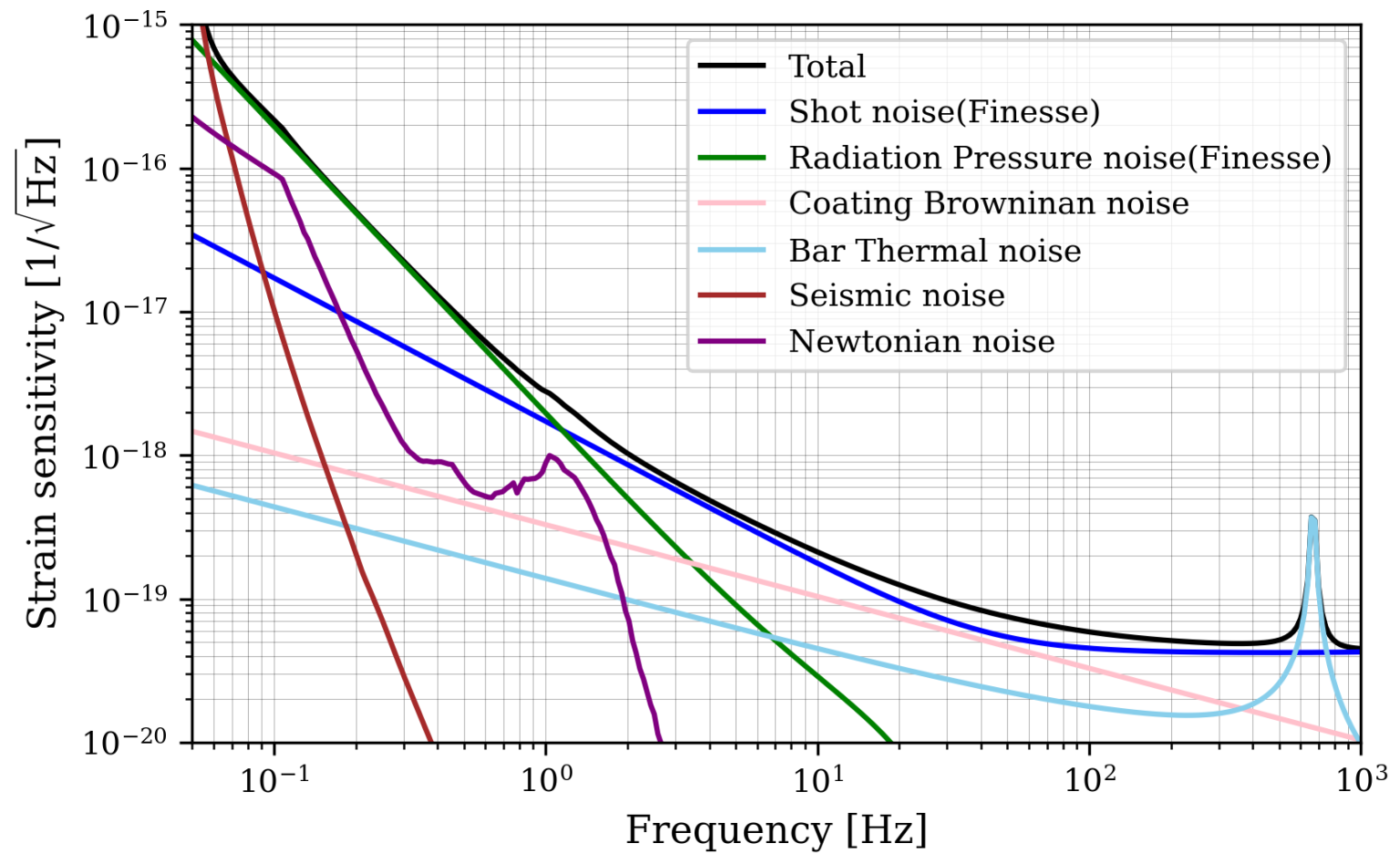
Figure 1: Projected strain sensitivity of optimized CHRONOS(2.5 m). Individual noise sources are shown with the overall sensitivity curve.
Quantum, Thermal, and Environmental Noise Decomposition
Quantum Noise
Shot noise, defining the high-frequency sensitivity floor, arises from the photonic counting statistics at the detection photodiode. Radiation pressure noise, dominating below 2 Hz, results from quantum fluctuations in photon momentum imparted to test masses. The Sagnac speedmeter approach substantially cancels this effect at low frequencies.
Thermal Noise
Coating Brownian noise is constrained by the mechanical losses of dielectric mirror coatings, scaling with T, motivating cryogenic operation. The amplitude spectral density, Scoat, incorporates geometric, elastic, and loss factors. Torsion-bar thermal noise, significant at sub-Hz, emerges from thermally driven fluctuations in the torsional mode shapes. These are parametrized by effective mechanical loss angle, moment of inertia, and bar geometry.
Seismic and Newtonian Noise
Seismic noise, typically dominant below 1 Hz, is modeled using measured ground-displacement spectra and suspension yaw transfer functions. CHRONOS relies on both active and passive isolation to attenuate this noise. However, gravitational coupling from surface Rayleigh waves—Newtonian noise—persists irreducibly below a few Hz. This prompts the necessity for direct subtraction techniques or underground installation for further mitigation.
Multi-Axis Sensitivity Performance
The aggregate sensitivity of CHRONOS at 2.5 m baseline, as depicted in Figure 1, exhibits quantum noise limits above 5 Hz, thermal noise limitations in the transitional 1–10 Hz regime, and dominant bar thermal plus Newtonian noise at sub-Hz. The sensitivity budget explicitly quantifies the frequency-dependent transition between quantum and classic limits. The methodology for simulation (using FINESSE3) ensures robust mapping between physical noise models and expected strain readout.
Prompt Gravity-Gradient Detection for Earthquake Early-Warning
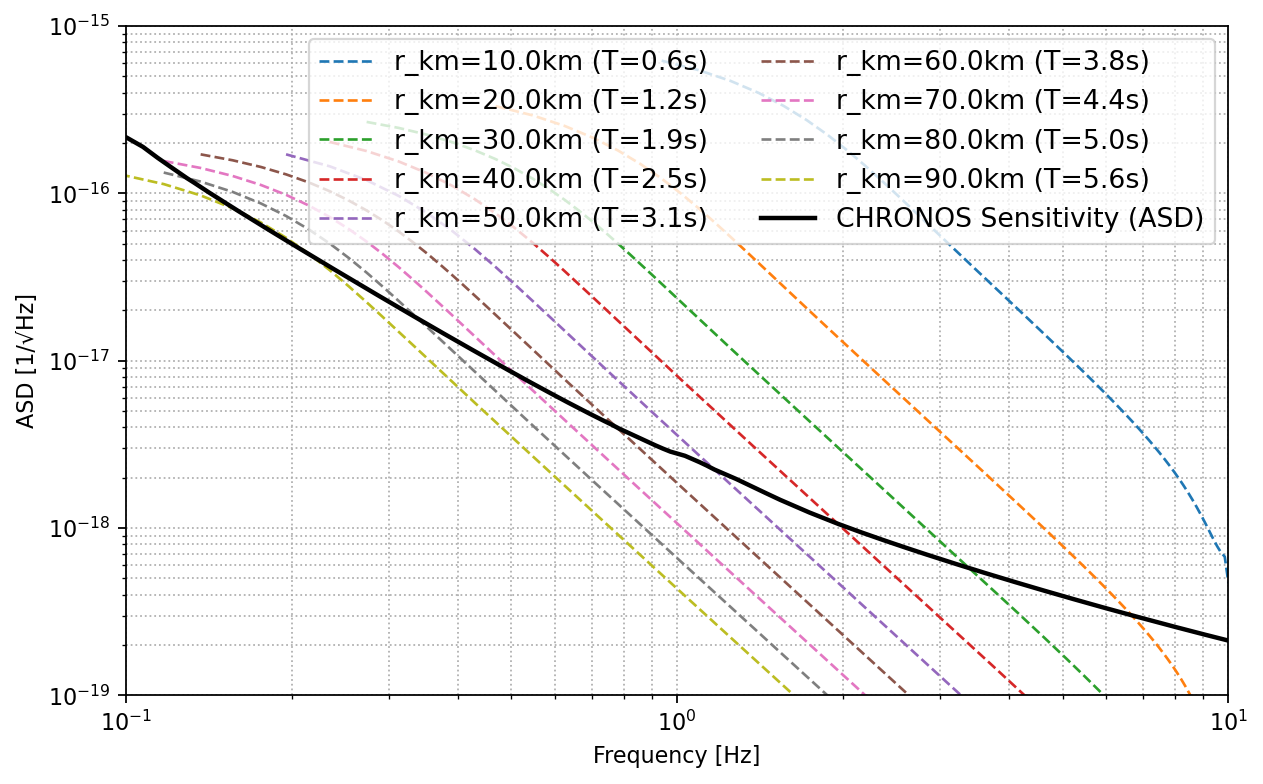
CHRONOS’s multi-degree-of-freedom design facilitates the detection of prompt gravity-gradient perturbations from seismic events—the so-called "Newtonian signals" which precede conventional seismic P-wave arrivals. These are modeled as fourth-order time integrals over the moment function and scale as r0−5 with distance from the quake centroid. For events with moment magnitude Mw 5.2, the ASD of prompt gravity signals exceeds the detector’s noise floor at distances up to 90 km, entering a regime of robust detectability.
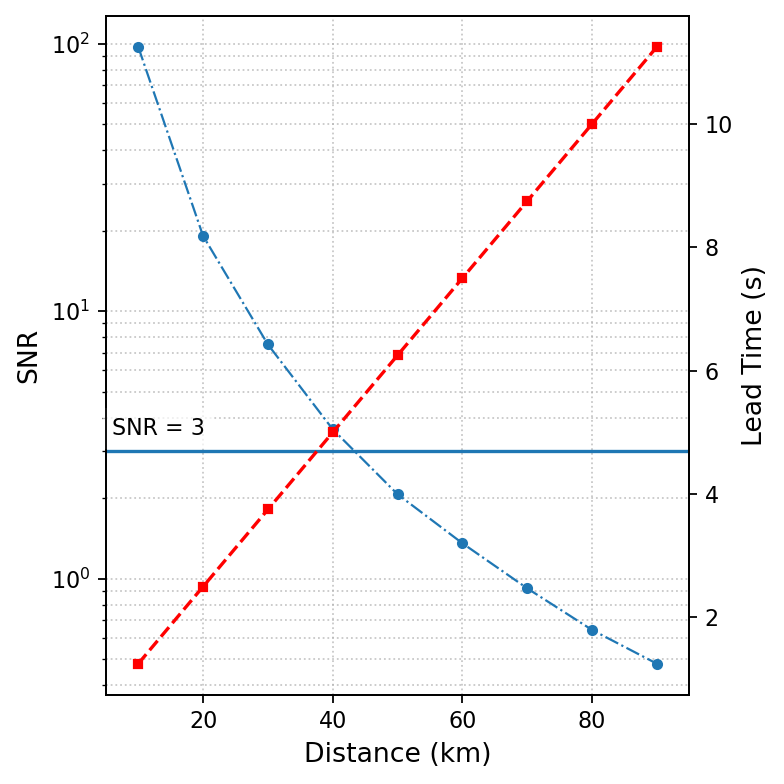
Figure 2: (a) Sensitivity of CHRONOS overlaid with Mw 5.2 prompt gravity-gradient signals at varying source-detector distances, (b) SNR and lead-time advantage versus distance. SNR >3 indicates reliable detectability.
The calculated signal-to-noise ratio shows that, at 40 km, an Mw 5.2 event is detectable with SNR = 3.62, yielding 2.9–6.9 seconds advance warning over traditional seismometry for plausible P-wave velocities. Hence, CHRONOS could substantiate a hybrid observatory paradigm, bridging gravitational-wave astrophysics and terrestrial geophysics, and providing unique datasets for both communities.
Implications and Future Directions
The CHRONOS analysis substantiates the possibility of entering the sub-Hz gravitational-wave observation window with ground-based instrumentation by combining advanced noise reduction strategies. This parameter space is crucial for capturing intermediate-mass and primordial compact binaries, as well as continuous stochastic backgrounds. The adaptability for prompt seismological gravity sensing demonstrates practical cross-disciplinary utility, contingent on reliable Newtonian noise subtraction and possibly networked CHRONOS deployments.
The thermal noise and Newtonian noise mitigation approaches delineated here will inform future third-generation detector designs. The next research phase will likely focus on prototyping, site characterization (especially for Newtonian noise), and optimization of cryogenic suspension systems. The intersection of fundamental physics instrumentation with geophysical application domains (e.g., rapid disaster warning) is expected to motivate new funding and collaboration models.
Conclusion
CHRONOS establishes a comprehensive roadmap to sub-Hz interferometric gravitational-wave detection, highlighting explicit noise budgets, achievable sensitivity benchmarks, and pioneering seismological applications. It provides a methodological and conceptual template for future low-frequency terrestrial observatories and motivates continued R&D into quantum noise reduction, thermal engineering, and Newtonian noise estimation. The results suggest significant gains for both astronomy and geophysics, provided engineering challenges are met.
“Emergent Mind helps me see which AI papers have caught fire online.”
Philip
Creator, AI Explained on YouTube
Sign up for free to explore the frontiers of research
Discover trending papers, chat with arXiv, and track the latest research shaping the future of science and technology.Discover trending papers, chat with arXiv, and more.