Topology of black hole thermodynamics: A brief review
Published 28 Apr 2026 in gr-qc and hep-th | (2605.00037v1)
Abstract: Recent explorations of topological aspects in black hole thermodynamics have achieved unprecedented progress. By utilizing topological numbers, different black hole systems can be categorized into distinct universality classes. This universal classification is particularly evident in thermodynamic limits, offering valuable insights for developing a comprehensive quantum gravity framework. This review highlights the latest advancements in this field. Specifically, we outline fundamental topological frameworks underlying black hole solutions, critical points, Davies points, and the Hawking-Page phase transition. For each scenario, we calculate the associated topological numbers and analyze their physical significance. Furthermore, we explore the practical implications arising from this research.
The paper introduces a topological classification of black hole thermodynamics using Duan's φ-mapping theory to elucidate phase transitions and stability.
It demonstrates a universal scheme to differentiate black hole solutions across various ensembles and geometric configurations based on winding numbers.
The study shows topological invariants remain robust under parameter variations, offering new insights for quantum gravity and gravitational wave analyses.
Topological Methods in Black Hole Thermodynamics
Introduction
This review, "Topology of black hole thermodynamics: A brief review" (2605.00037), provides a comprehensive synthesis of recent advancements in the intersection of topological analysis and black hole thermodynamics. The work details how topological numbers, particularly winding numbers arising from Duan's ϕ-mapping topological current theory, facilitate a robust classification scheme for black hole solutions, critical points, Davies points, and Hawking-Page phase transitions. By examining the zeros of vector fields constructed from thermodynamic potentials, the paper establishes universal and local topological invariants that capture the essential thermodynamic character of black hole systems. This approach clarifies the underlying structure of phase diagrams, allows for the differentiation between various black hole classes, and reveals universal properties shared by broad groups of black holes.
Topological Current Framework for Black Hole Thermodynamics
The review begins by formalizing the role of topological currents and charges in black hole spacetimes using Duan's ϕ-mapping theory. The central construction involves assigning a vector field ϕ whose zeros in the thermodynamic parameter space identify critical thermodynamic features, such as phase transitions or black hole solutions. The superpotential and the resulting topological current jμ are formulated to be conserved, and the integral of its zeroth component yields the topological charge W. This integer-valued invariant underpins the classification scheme for black hole thermodynamics.
For instance, winding numbers assigned to zeros of ϕ distinguish stable from unstable solutions, with sign and multiplicity correlating to qualitative thermodynamic features.
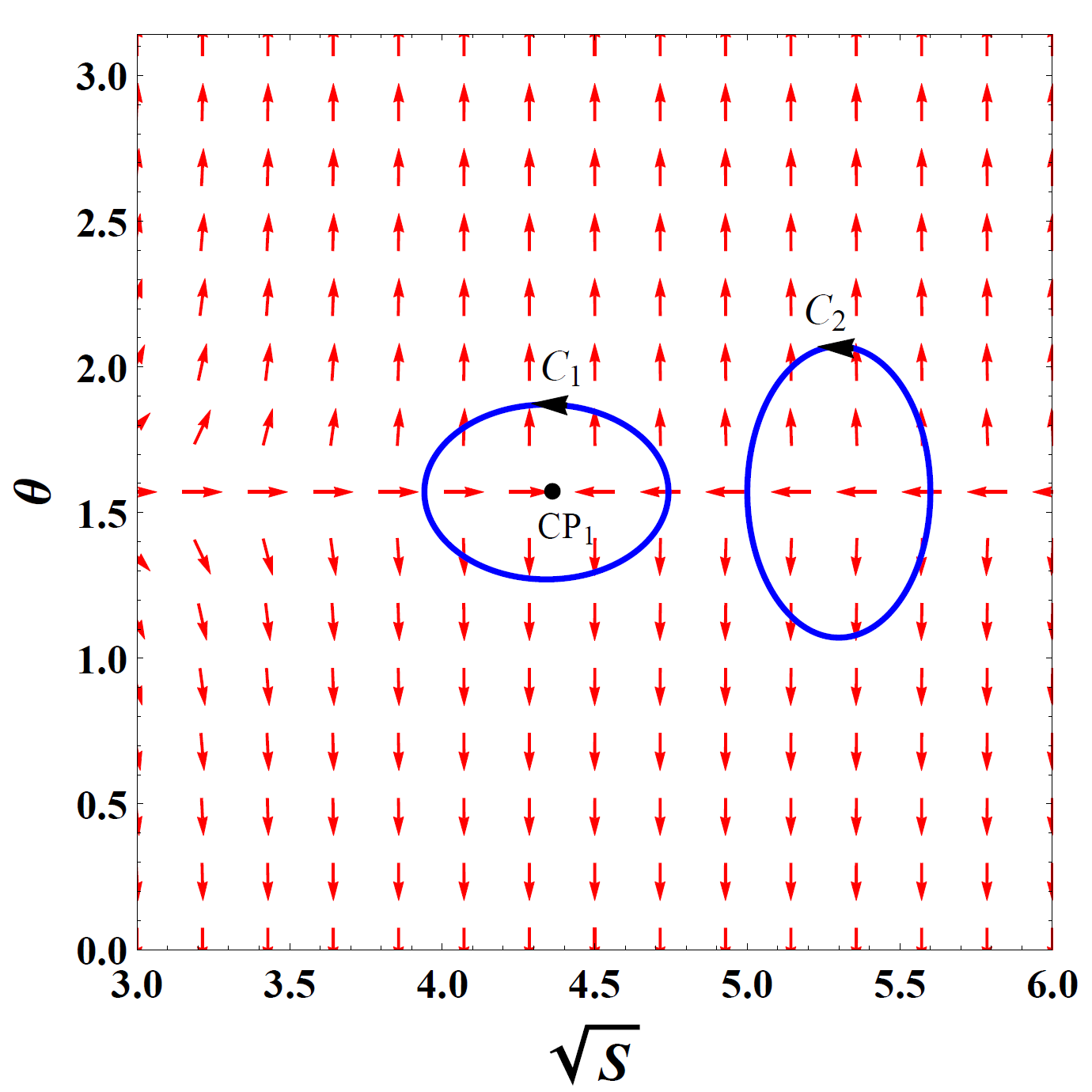
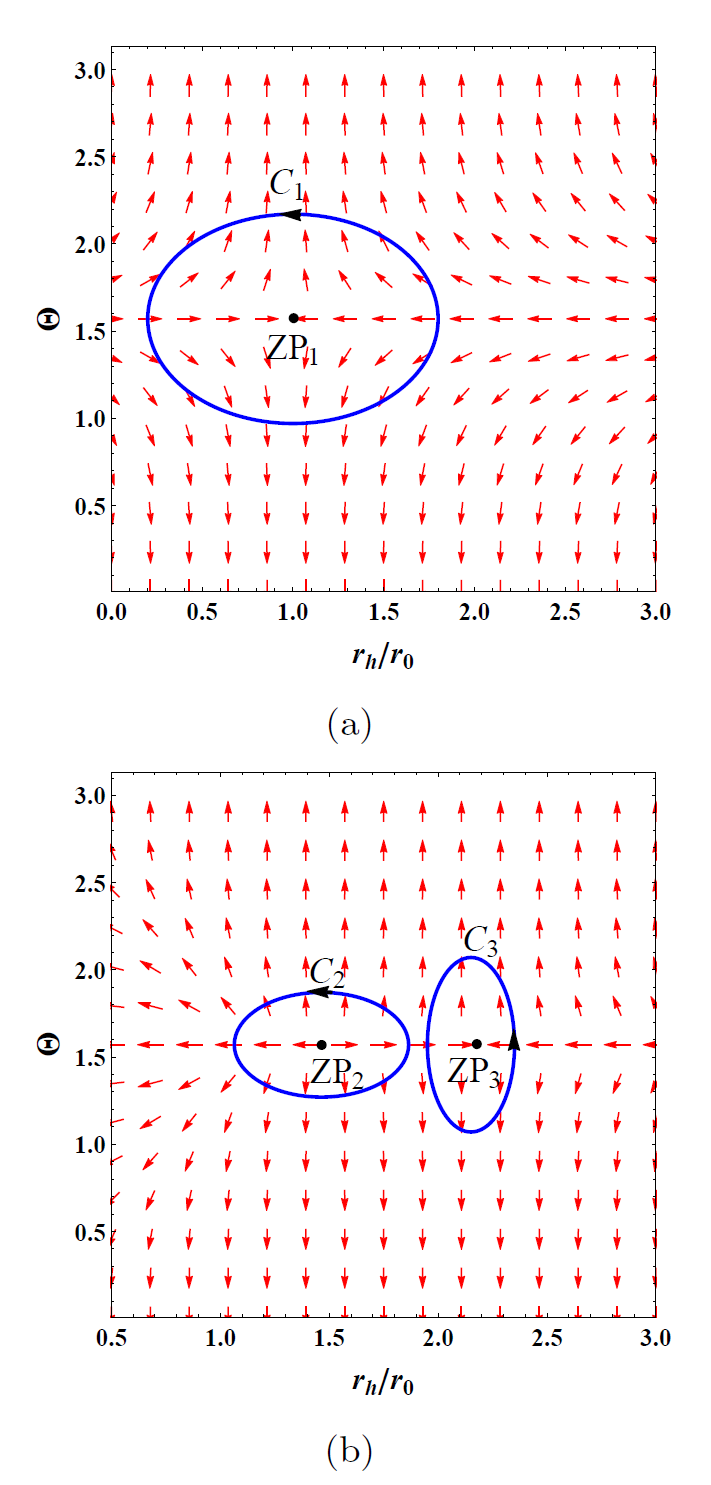
Figure 1: The red arrows represent the vector field n on a portion of the S-θ parameter space for charged AdS black holes, with zeros indicating critical points.
Topological Classification of Critical, Davies, and Hawking-Page Points
The application of the topological current proceeds with explicit constructions for:
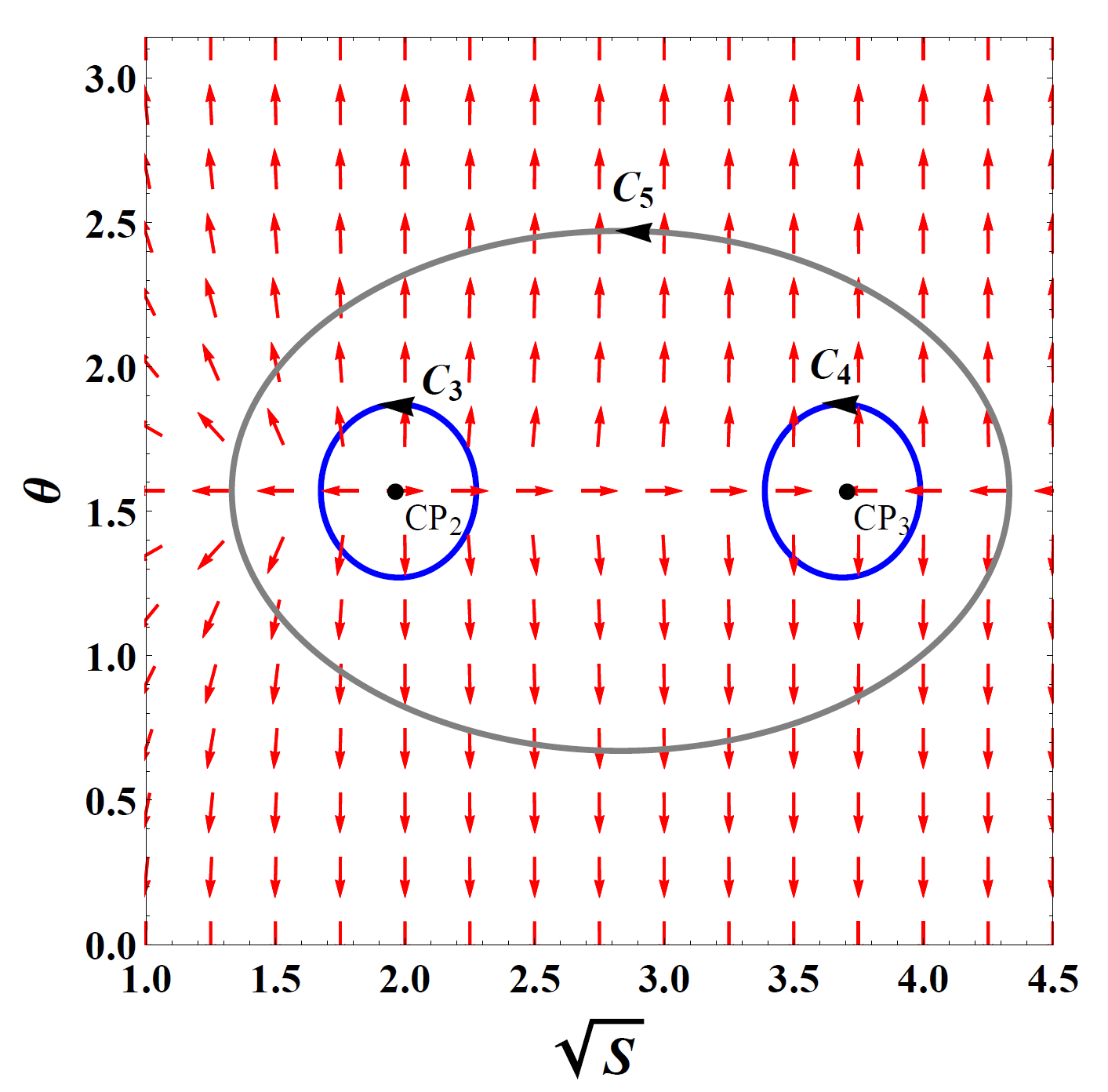
Critical Points: By constructing a thermodynamic vector in the space of entropy and an auxiliary angle, the zeros correspond to critical points in phase diagrams, and their winding numbers (w=±1) distinguish conventional from novel critical points. Explicit vector fields for RN-AdS and Born-Infeld-AdS black holes demonstrate that different black holes can be topologically distinguished by their critical behavior.
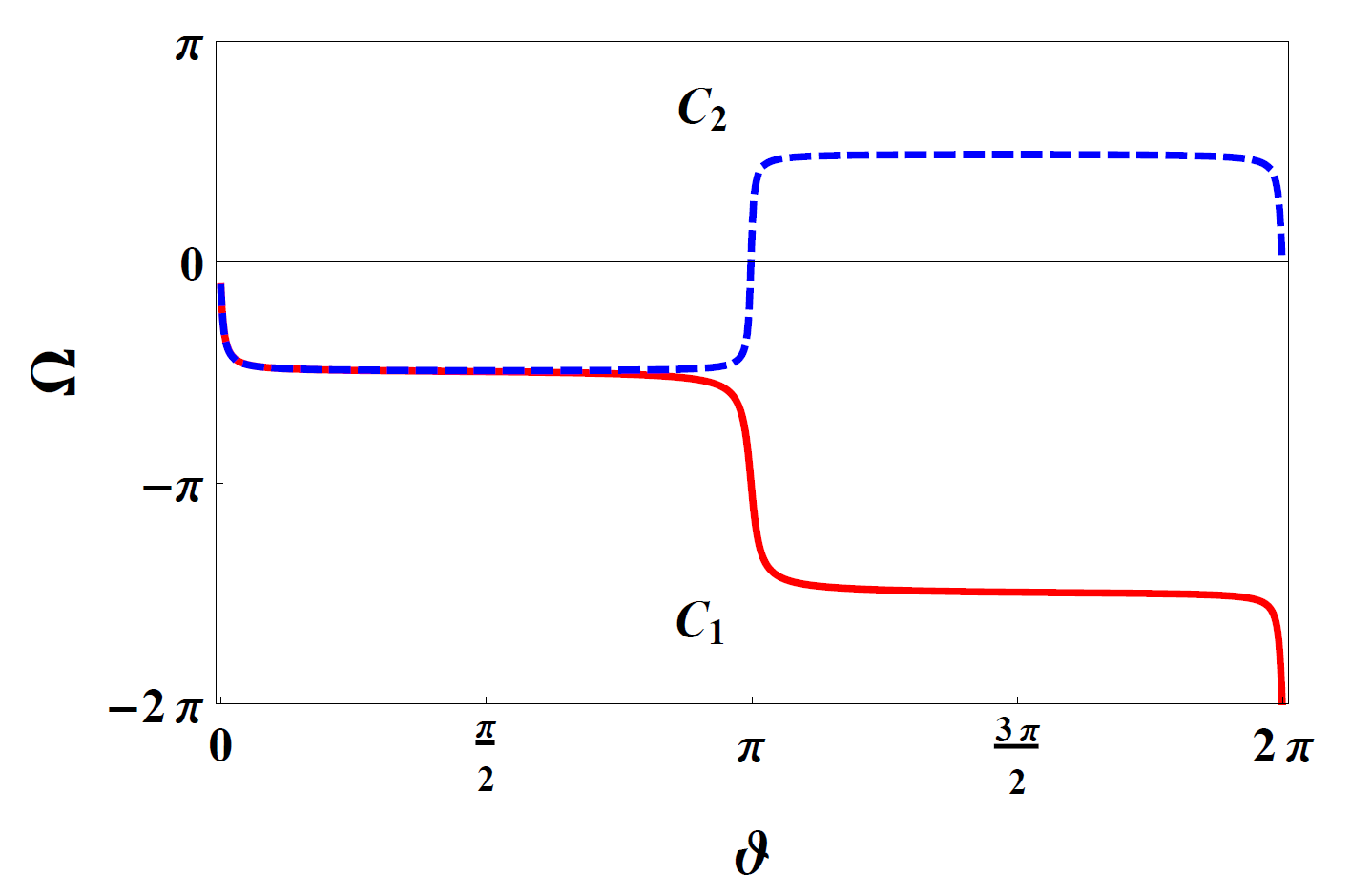
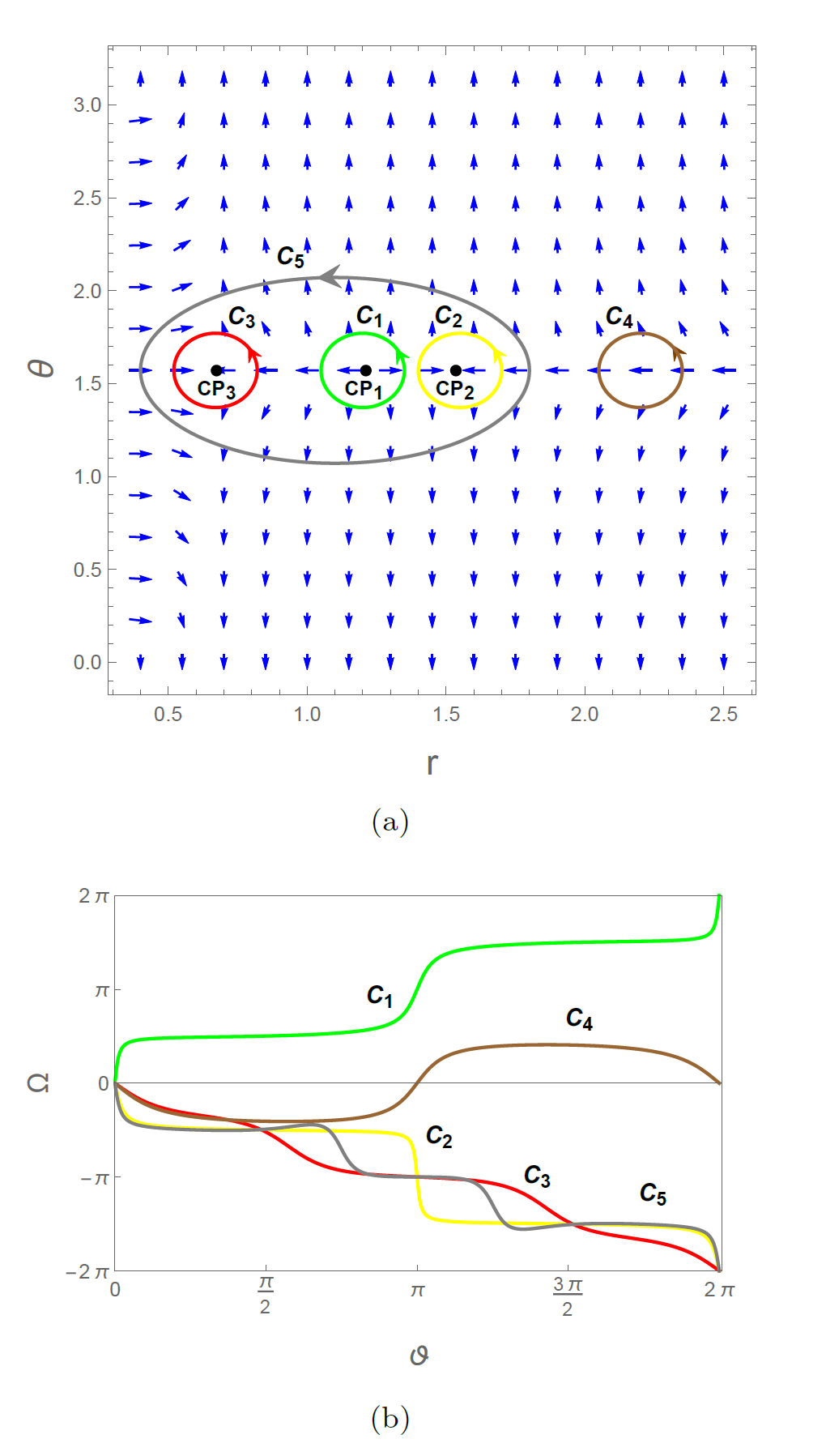
Figure 2: ϕ0 vs ϕ1 for closed parameter space contours ϕ2 (enclosing a critical point) and ϕ3 (not enclosing a critical point), revealing the difference in accumulated winding.
Figure 3: Vector field for the BI-AdS black hole, showcasing two critical points with opposite winding, enclosed by tailored contours.
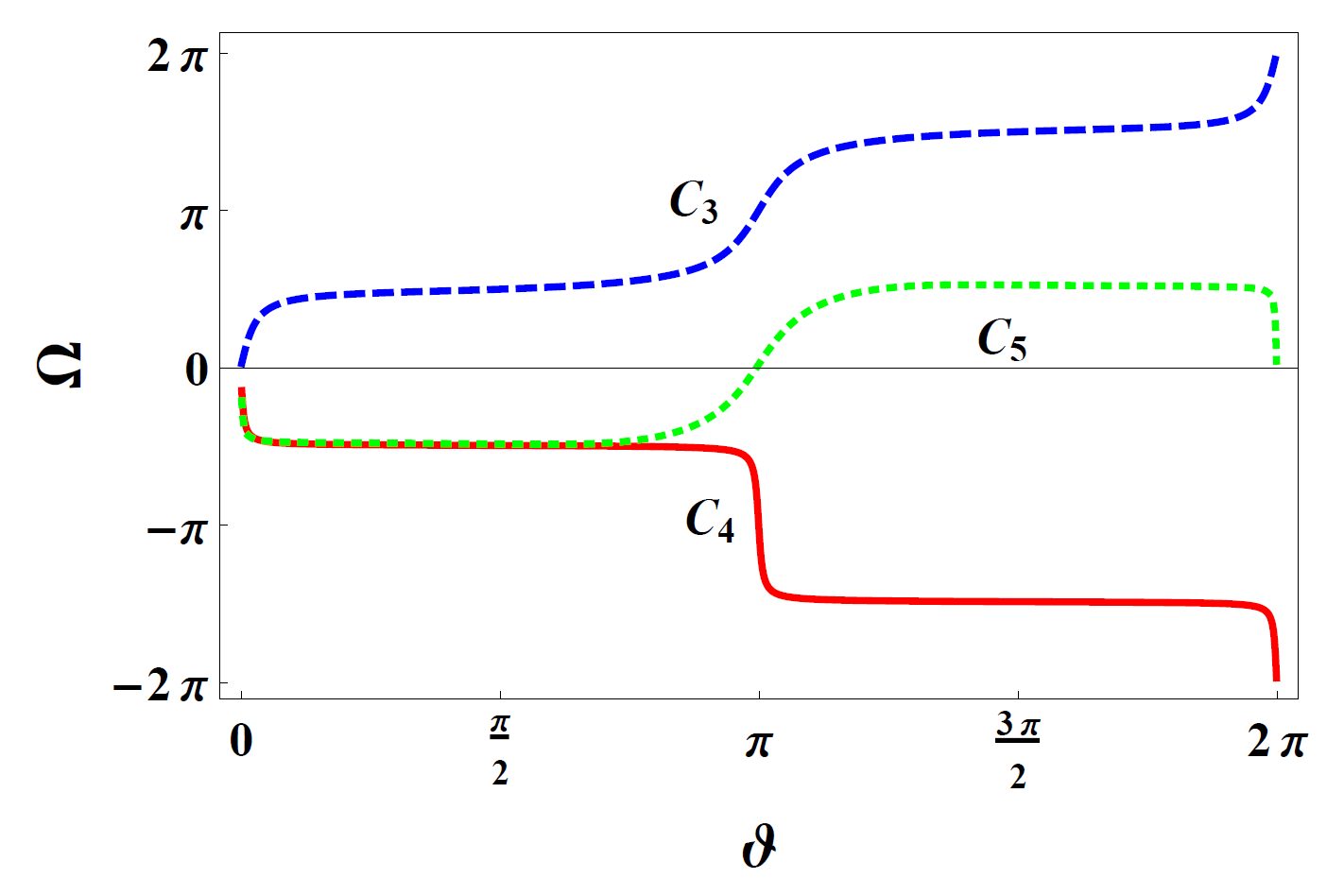
Figure 4: The ϕ4 curve for different contours demonstrates that enclosing different numbers and arrangements of zero points changes the net winding, and thus the topological classification.
Davies Points: At heat capacity divergences, the topological signature is provided by using the inverse temperature as a thermodynamic potential; the winding number is used to assign a topological meaning to the Davies transition.
Hawking-Page Phase Transition: By employing the generalized free energy as a function of black hole parameters and ensemble temperature, the phase transition between pure radiation and large AdS black holes is interpreted topologically—its existence linked to vector field zeros.
Black Hole Solutions as Thermodynamic Defects: Reformulating the Einstein equations as conditions for zeros of a generalized free energy, the local and global stability of black holes are assigned a topological interpretation, with the global topological number invariant under parameter variation (e.g., charge, cosmological constant).
Figure 5: Vector field ϕ5 on the ϕ6-ϕ7 plane for a six-dimensional charged Gauss-Bonnet black hole, with multiple critical points (defects) manifesting as zeros.
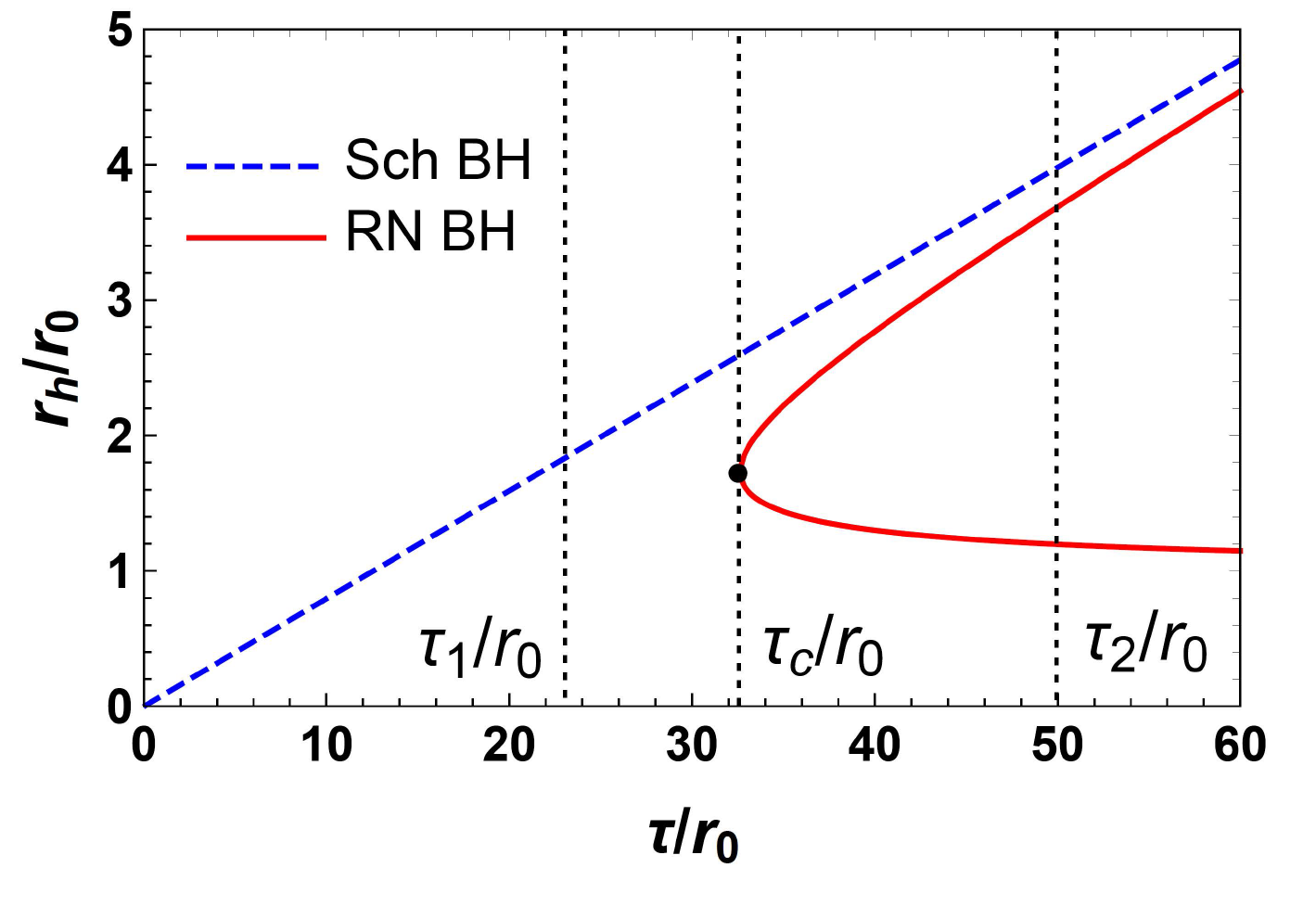
Figure 6: The unit vector field for Schwarzschild and RN black holes; black dots denote zeros corresponding to black hole solutions, contours enclose these, revealing their winding numbers.
Features and Invariance of Topological Numbers
A salient result is the robustness of the total topological number ϕ8 under continuous deformation of black hole parameters such as charge, angular momentum, or cosmological constant, except in explicitly constructed counterexamples. For rotating and higher-dimensional AdS black holes, the topology may change as the underlying phase structure changes fundamentally, e.g., the appearance of new branches or the elimination of extremal configurations.
The review summarizes cases including C-metric, NUT spacetimes, regular black holes, varied statistical mechanics entropies, and different thermodynamic ensembles, emphasizing:
Ensemble Dependence: Topological classification can depend on ensemble (canonical vs. grand-canonical), reflecting the ensemble-specific phase structure.
Non-Extensive and Corrected Entropies: For most modifications (R\'enyi, Barrow, Sharma-Mittal entropies), the topological number remains unchanged, with exceptions indicating sensitivity to underlying entropy structure.
Multiple Defect Curves: The presence of multiple, disconnected collections of zeros ("defect curves") does not alter the total topological charge.
Parameter Dependence and Exceptions: Nearly all parameters leave ϕ9 invariant; however, certain exceptional black holes in supergravity manifest explicit ϕ0-dependence of ϕ1.
Figure 7: Defect curves in the ϕ2-ϕ3 plane for Schwarzschild and RN black holes, with intersection points corresponding to the existence and number of black hole solutions.
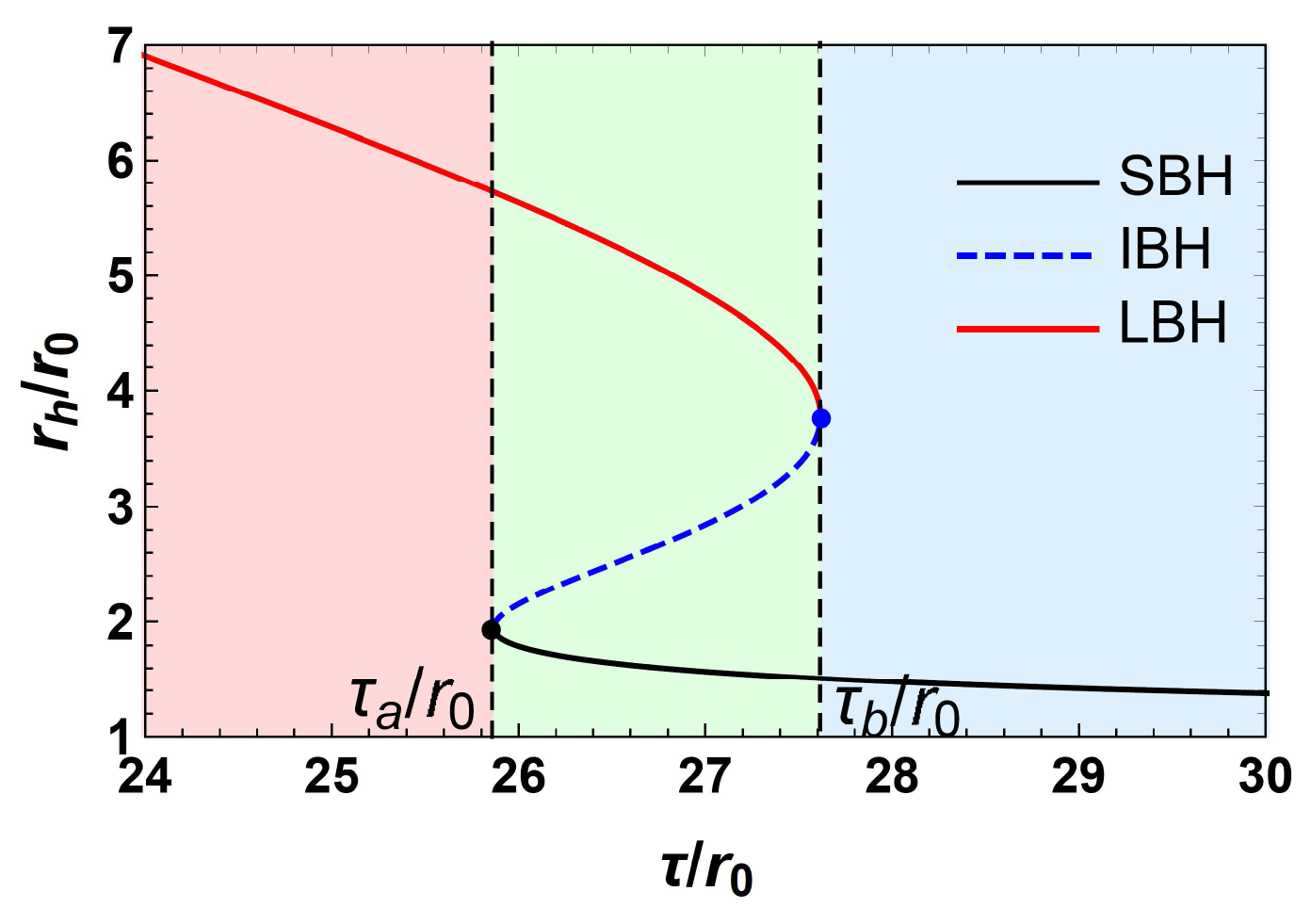
Figure 8: For the RN-AdS black hole, multiple solution branches correspond to different thermodynamic phases; the topological number remains invariant across qualitative changes in the defect structure.
Universal Topological Classification Scheme
The most significant theoretical implication is the discovery of a universal classification of black holes into topological classes characterized by four possibilities: ϕ4, ϕ5, ϕ6, and ϕ7. This categorization is dictated by the sequence and sign of winding numbers at the smallest and largest possible black holes (in horizon radius).
ϕ8: Single unstable branch dominates both small and large black hole limits (e.g., Schwarzschild black hole).
ϕ9: Stable small but unstable large black holes at extremal limits (e.g., typical RN black holes).
jμ0: Unstable small but stable large black holes appear (e.g., Schwarzschild-AdS).
jμ1: Stable branches dominate at both ends.
This scheme captures key universal thermodynamic behaviors in all temperature and size limits, providing a concise taxonomy for all known and several new classes of black holes.
Broader Implications and Future Directions
The abstraction of thermodynamic phase structure into topological invariants has profound consequences for quantum gravity. Topological numbers may serve as stable, renormalization group-invariant quantities in a future quantum gravity classification scheme. The insensitivity of the topological number to black hole microphysics (except in controlled exceptional cases) suggests that topology captures core features shared across semiclassical and quantum regimes.
The explicit connection between winding number and local thermodynamic stability offers a diagnostic tool for phase transitions in complex black hole systems, particularly in higher-curvature and string-inspired gravity, or when considering quantum/statistical corrections.
Looking forward, the extension to include quantum microstructure, dynamical topology change in black hole coalescence or evaporation, or holographic/topological dualities represents promising avenues of research. The universality and stability of topological classification may find utility in gravitational wave analyses, astrophysical black hole tests, and the study of emergent spacetime in quantum information-theoretic approaches.
Conclusion
This review consolidates a formal and rigorous topological classification methodology for black hole thermodynamics, linking winding numbers and topological charges to core properties of black hole phase diagrams and solution spaces. The constructed universal classification sheds light on the robust, parameter-invariant features of black hole thermodynamics and opens new perspectives for the systematic study of gravitational systems via topological invariants. Its implications reach beyond classical thermodynamics, offering expansive utility in the examination and future development of quantum gravity frameworks.
“Emergent Mind helps me see which AI papers have caught fire online.”
Philip
Creator, AI Explained on YouTube
Sign up for free to explore the frontiers of research
Discover trending papers, chat with arXiv, and track the latest research shaping the future of science and technology.Discover trending papers, chat with arXiv, and more.