- The paper introduces MCI that synergizes symbolic reasoning and metaheuristics to autonomously discover interpretable governing equations.
- The approach employs Abstract Syntax Trees to regularize logical complexity and enhance explainability while reducing parameter count.
- Empirical evaluations demonstrate MCI’s superiority over DNN and traditional symbolic regression methods with robust extrapolation and lower errors.
Machine Collective Intelligence for Explainable Scientific Discovery
Introduction
The paper "Machine Collective Intelligence for Explainable Scientific Discovery" (2604.27297) introduces Machine Collective Intelligence (MCI), a novel computational paradigm that synthesizes symbolic reasoning and metaheuristics for autonomous scientific equation discovery. The paradigm advances beyond the limitations of deep neural networks (DNNs) and the constraints of existing symbolic regression frameworks. MCI orchestrates a population of LLM-based reasoning agents, collectively evolving symbolic hypotheses, leading to discovery and consolidation of governing equations for scientific systems across deterministic, stochastic, and unknown dynamics. The approach emphasizes explainability, OOD generalization, and parameter condensation, marking a significant advancement toward interpretable AI-driven scientific discovery.
Foundations in Computational Intelligence
Traditional connectionism approaches—primarily DNNs—excel at function approximation within empirical distributions but fail to yield interpretable or extrapolatable equations due to their black-box nature with millions of parameters. Symbolic regression, rooted in symbolism, produces human-readable mathematical expressions but struggles to capture highly nonlinear relationships without an expansive symbol set or domain-specific knowledge. Recent advances in LLM-driven symbolic regression improve regression accuracy but remain bounded by the pretrained knowledge of backbone LLMs, restricting applicability in domains without explicit prior encoding.
MCI integrates symbolism’s logical reasoning and metaheuristic’s population-based exploration. By fully leveraging the knowledge propagation and accumulation strategies inherent to metaheuristics, MCI enables discovery that extends beyond the myopia of single-agent inference. This integration realizes collective intelligence: multiple agents generate, critique, and refine symbolic hypotheses, collectively evolving toward optimal, explainable governing equations.
Architectural and Methodological Innovations
Canonical Representation via Abstract Syntax Trees
MCI departs from linear symbolic program representations, employing abstract syntax trees (ASTs) as canonical structures for scientific knowledge. ASTs provide structured formalism, elucidating essential logical flows by abstracting away execution-irrelevant syntactic details, which effectively regularizes logical complexity and facilitates quantitative explainability assessment. Equations with lower AST depth and fewer free parameters are prioritized, aligning with minimum description length principles for enhancing intelligibility and minimizing overfitting.
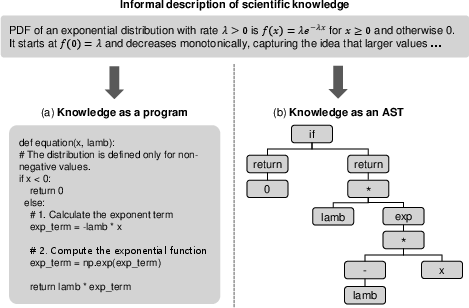
Figure 1: Conceptual comparison of program-based and AST-based representations, with ASTs enabling hierarchical quantification of logical complexity and explainability.
Symbolic Reasoning Pipeline
MCI’s symbolic reasoning process consists of initialization, complexity-aware evaluation, knowledge accumulation, and AST generation. Initialization comprises agent-group formation, problem specification, and hypothesis setup. Agents generate initial equations, which are parsed into ASTs.
Complexity-aware evaluation jointly assesses prediction error (SSE over ground-truth observations) and explainability (inverse AST depth and parameter count), formalized by a discovery score. The best agent’s equation and analysis are shared in a collective knowledge tuple, feeding domain-specialized insights back into the population. Each agent subsequently generates new candidate equations using structured LLM prompts incorporating both local and global contexts. The iterative pipeline enables progressive refinement toward optimal equations.
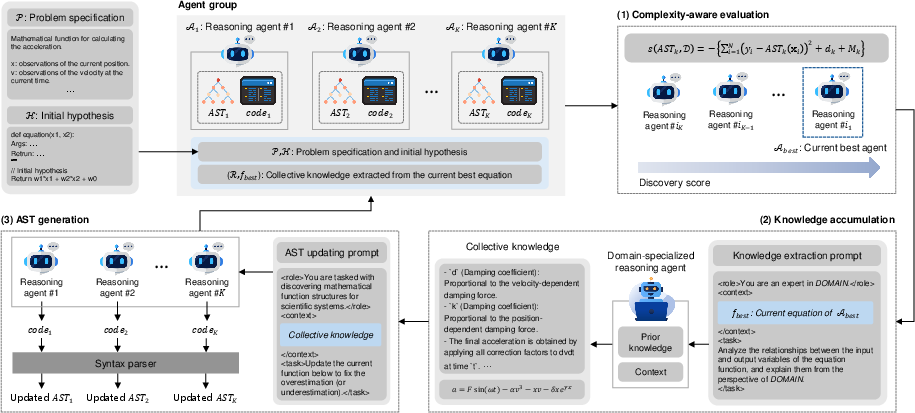
Figure 2: The symbolic reasoning workflow in MCI, delineating agent initialization, evaluation, knowledge accumulation, and AST-guided refinement.
Empirical Evaluation and Analysis
Benchmark Selection and Experimental Setup
Ten symbolic regression benchmarks spanning physics, chemistry, and biology were employed, comprising varied functional forms, uncertainty levels, and theoretical grounding. MCI was compared against GPlearn, PySR, and LLM-SR, as well as an ablation variant (MSI) isolating the effect of collective intelligence. Mixtral:8x7b served as the backbone LLM for all agents, ensuring open-source reproducibility.
Symbolic Regression Accuracy
MCI achieved WMAPE <0.1 across all benchmarks, with reductions of 29.92–99.99% in generalization error relative to LLM-SR. Conventional symbolic regression approaches and LLM-SR failed to reconstruct governing equations for tasks involving substantial nonlinearity or domain uncertainty, particularly when the pretrained LLM knowledge was inapplicable (e.g., NOMC reactor). MCI consistently reconstructed the essential structure of governing equations, evidencing both robustness and explainability.
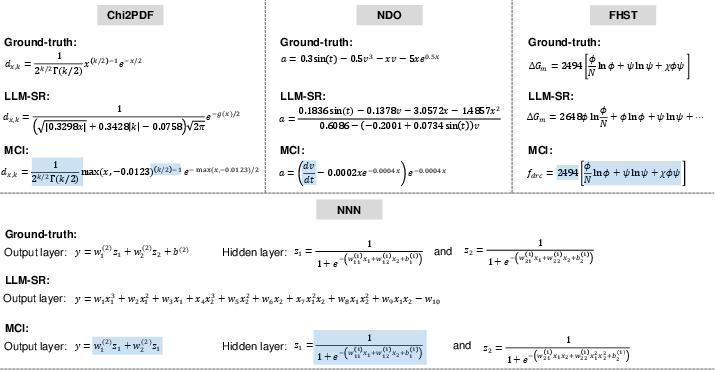
Figure 3: Comparison of ground-truth and MCI-discovered equations for Chi2PDF, NDO, NNN, and FHST, illustrating structural fidelity to analytical forms.
MCI demonstrated superior extrapolation capability under OOD conditions, maintaining WMAPE <0.1 where DNN and LLM-SR achieved only interpolation. Absolute errors for MCI remained stable across extreme input ranges, in contrast to rapid error escalation observed in LLM-SR and DNN. This performance is directly attributed to MCI's collective intelligence and structural prioritization via ASTs.
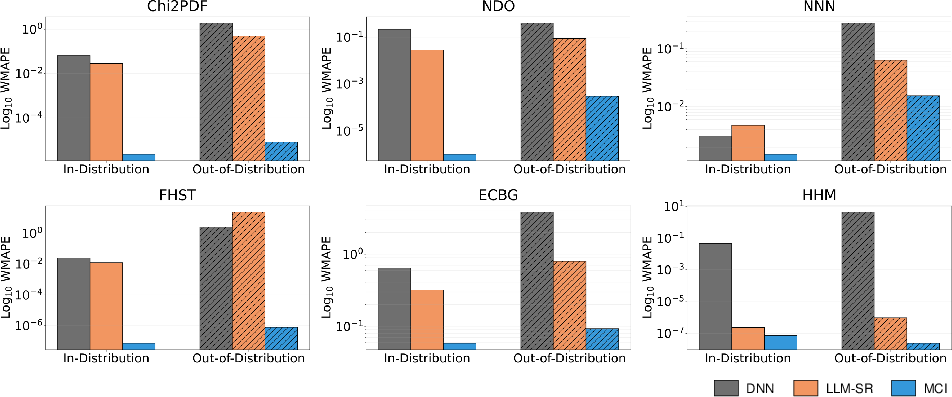
Figure 4: WMAPE under OOD conditions for DNN, LLM-SR, and MCI across six scientific benchmarks, illustrating MCI’s superior extrapolation robustness.
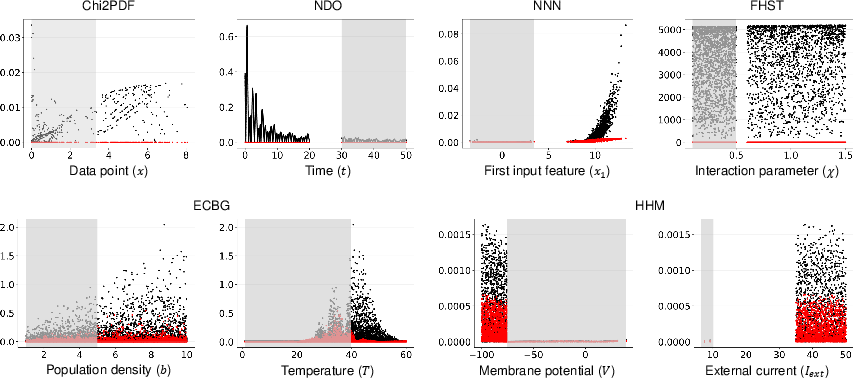
Figure 5: Input-dependent absolute prediction errors comparing LLM-SR and MCI, highlighting MCI's consistent error profile even for OOD samples.
Ablation Studies
Collective intelligence was isolated by comparing MCI to MSI, revealing significant reductions (39.42–99.99%) in generalization error and increased robustness to initial seeding. The AST representation was further validated via comparison with its absence, demonstrating faster OOD error convergence and avoidance of excessive equation complexity.
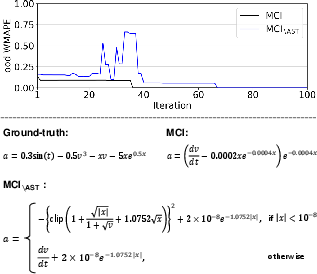
Figure 6: OOD error convergence and equation complexity for MCI versus the variant without ASTs, underscoring AST regularization’s critical role.
Structured LLM Prompting
MCI utilizes structured prompts to direct agent reasoning for code generation, analysis, and AST update, enabling systematic synthesis of symbolic knowledge from empirical observations and domain-specific contexts.
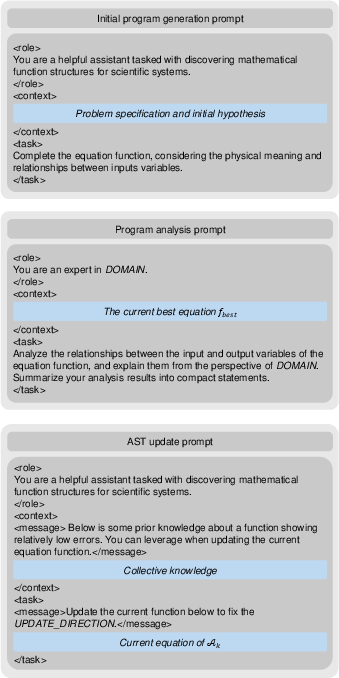
Figure 7: Schema of LLM prompt structures for program generation, equation analysis, and AST revision in MCI’s population-based reasoning pipeline.
Implications and Future Directions
Practical and Theoretical Impact
MCI offers substantial reductions in model parameter scale, distilling solutions from 105–106 DNN parameters into $5$–$40$ interpretable parameters per equation. The pipeline facilitates robust discovery even for systems outside backbone LLM knowledge, addressing a core limitation in scientific AI. Practically, this enhances scientific workflow transparency, supports hypothesis generation in under-characterized domains, and improves OOD applicability essential for physical, chemical, and biological modeling.
Theoretically, MCI establishes a framework for integrating population-based evolutionary methods with structured symbolic reasoning, advancing beyond combinatorial enumeration and myopic agent limitations. Future directions include tailoring knowledge propagation schemes, expanding agent domain specialization, and further exploration of collective intelligence architectures to accelerate convergence and augment interpretability.
Conclusion
Machine Collective Intelligence as proposed in "Machine Collective Intelligence for Explainable Scientific Discovery" (2604.27297) constitutes an authoritative advance in scientific equation discovery. By fusing symbolism, metaheuristics, and collective reasoning, MCI achieves scalable, explainable, and extrapolatable symbolic regression in diverse scientific domains. The empirical results and methodological innovations presented provide a foundation for further research into population-based explainable AI frameworks for autonomous scientific discovery.

