- The paper introduces a novel quantum feature selection framework using HUBO and DCQO on trapped-ion hardware, capturing higher-order correlations efficiently.
- The paper encodes the feature selection problem as an Ising model with one-, two-, and three-body interactions derived from mutual information metrics.
- The paper demonstrates significant improvements in accuracy, F1-score, and ROC-AUC over classical methods, validating the robustness of quantum optimization using trapped-ion processors.
Quantum Feature Selection via Higher-Order Binary Optimization on Trapped-Ion Processors
Introduction
This paper addresses the longstanding challenge of feature selection (FS) in machine learning, proposing a quantum-enabled framework built upon Higher-Order Unconstrained Binary Optimization (HUBO). Conventional FS techniques often operate intractably in high-dimensional settings and neglect complex multivariate dependencies. Quadratic Unconstrained Binary Optimization (QUBO) methods have enabled quantum approaches but inherently restrict modeling to one- and two-body terms, limiting capture of higher-order correlations. In contrast, this work formulates FS directly as a HUBO problem, incorporating explicit three-body interactions derived from mutual information. Optimization is realized via digitized counterdiabatic quantum optimization (DCQO) on trapped-ion hardware, specifically IonQ Forte, and evaluated against reference classical methods.
The FS problem is encoded in the Ising framework, associating each feature with a binary spin variable. The Hamiltonian is constructed as:
H(Z)=i∑hiZi+i<j∑JijZiZj+i<j<k∑KijkZiZjZk+C
where hi quantifies feature relevance, Jij represents pairwise redundancy suppression, and Kijk penalizes over-selection of correlated triplets, all computed from mutual information metrics. This formulation allows direct representation of higher-order dependencies without resorting to quadratization, significantly increasing modeling expressiveness.
To ensure sparsity and suppress trivial all-inclusive solutions, structured linear penalties are applied to the one-body coefficients, modulated via a hinge-type thresholding function. Optimization of Htot is executed using DCQO, exploiting hardware-native all-to-all connectivity to resolve long-range interactions efficiently.
The quantum solution workflow is schematized below.
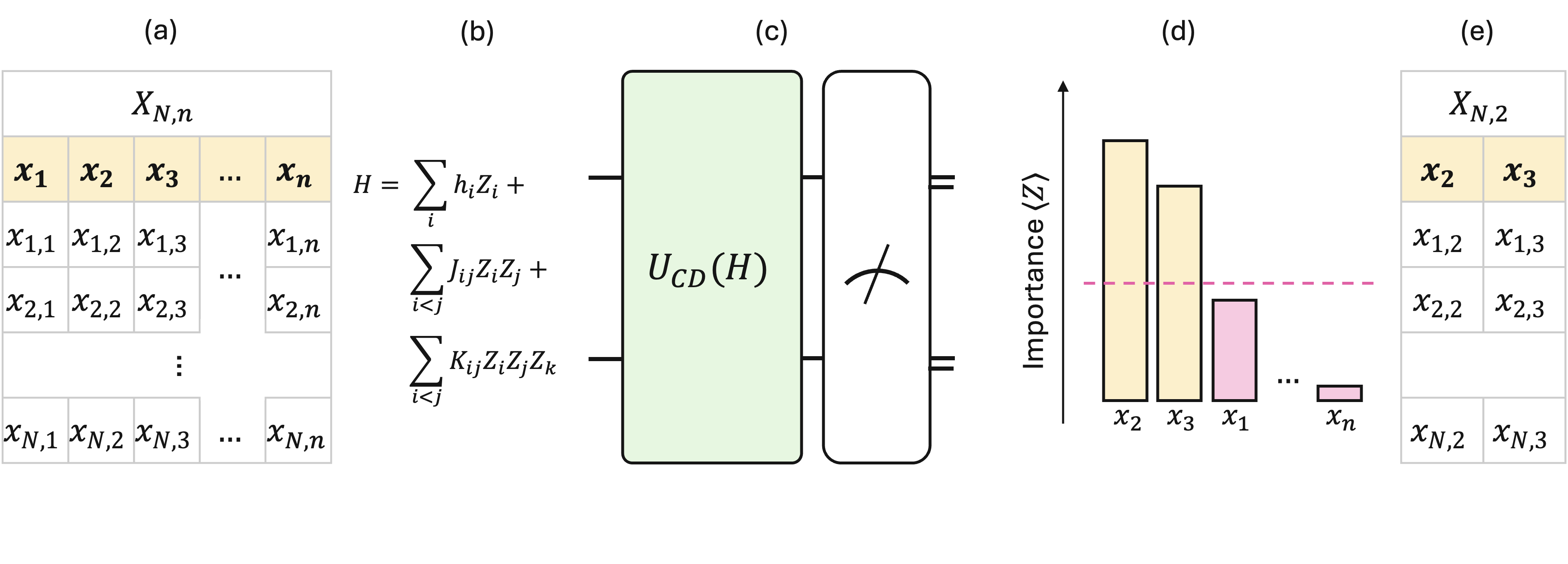
Figure 1: Quantum feature selection pipeline leveraging HUBO; mutual-information statistics inform Hamiltonian coefficients, which are sampled via DCQO and post-processed to yield feature importance scores.
Experimental Design and Implementation
Benchmark experiments are conducted on two datasets:
- Gallstone UCI dataset: 319 samples, 38 clinical attributes, binary classification.
- Spambase dataset: 4,601 email instances, 57 lexical/structural features, spam detection.
Due to processor constraints (32-qubit limit), preselection is performed using mutual information ranking.
Quantum circuits are executed on IonQ Forte (32 qubits, ~1,000 two-qubit gates per instance, 2,000 shots per circuit). Hardware is underpinned by Yb+ ions and an optical architecture utilizing acousto-optic deflectors for high-fidelity, individual-ion addressing. The quantum sampling protocol retains the lowest-energy fraction of measurement outcomes (ρ), and features are selected according to thresholded inclusion probabilities (δ).
Gallstone Dataset
Feature inclusion probabilities show tight correspondence between IonQ Forte hardware and noiseless simulations, demonstrating hardware reliability for HUBO sampling.
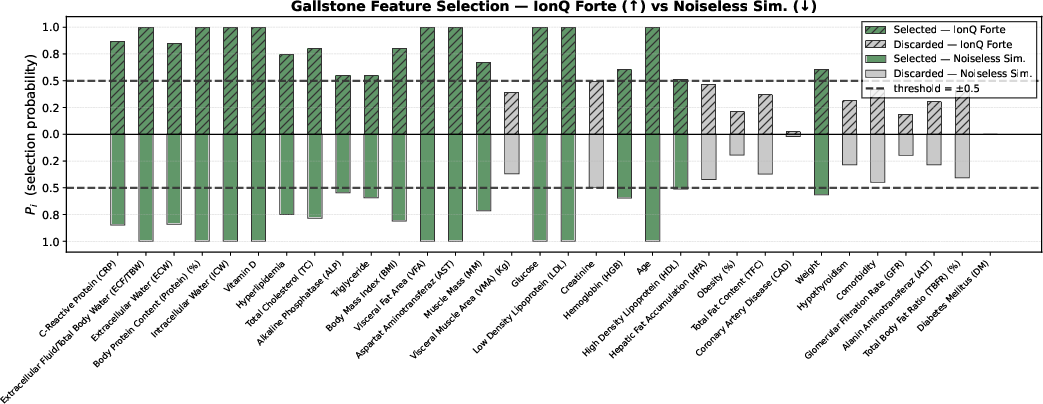
Figure 2: Comparison of feature inclusion probabilities for Gallstone dataset between IonQ Forte hardware (top) and noiseless simulation (bottom), highlighting concordance in selected feature distributions.
A sweep over selection threshold τ yields optimal ROC-AUC at τ=0.525, matching or exceeding classical performance.
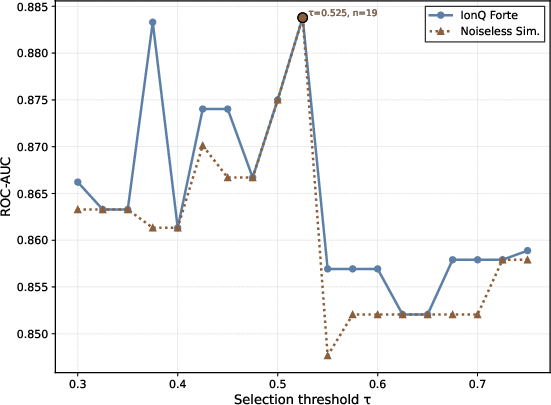
Figure 3: ROC-AUC for Gallstone dataset as a function of FS threshold, contrasting IonQ Forte and simulation outcomes; annotated with subset sizes at high-performance configurations.
Key quantitative results: IonQ Forte reduces dimensionality from 32 to 19 features, achieving accuracy of 0.79, F1-score of 0.79, and ROC-AUC of 0.88, outperforming PCA and SelectKBest baselines on all metrics.
Spambase Dataset
The pipeline for FS via low-energy post-selection is detailed below.
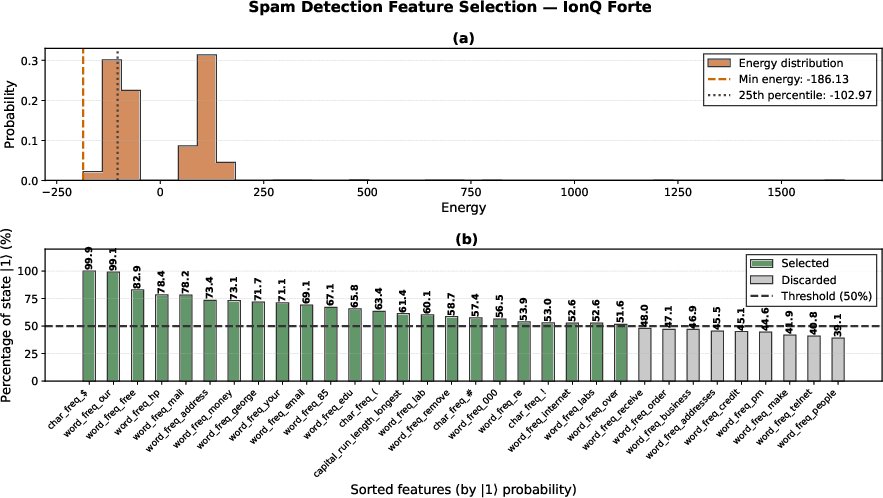
Figure 4: Spambase feature selection: low-energy states filtered to ρ=25%, producing sorted feature inclusion probabilities; selection threshold applied to yield final subset.
Quantum-selected subsets (IonQ Forte, 23/32 features) attain accuracy of 0.9475, F1-score of 0.9464, and ROC-AUC of 0.9836, with slight improvements over all-feature models and outperformance of classical baselines.
Strong Numerical Findings and Claims
- Quantum FS achieves dimensionality reduction with competitive or superior predictive performance versus classical baselines.
- HUBO-based FS outperforms methods based solely on univariate relevance (SelectKBest), directly illustrating the value of higher-order interaction modeling.
- Trapped-ion hardware reliably implements complex HUBO Hamiltonians, with qualitative agreement between quantum and simulation sampling in the presence of hardware noise.
Implications and Future Outlook
Theoretically, explicit higher-order modeling broadens the scope of FS, enabling selection of non-trivial feature combinations capturing multivariate dependencies inaccessible to quadratic techniques. The observed performance superiority demonstrates tangible benefit in real-world medical and textual classification tasks. Practically, model-independence—arising from the statistical nature of cost function construction—renders the approach robust and adaptable across application domains.
Hardware implications are significant: trapped-ion processors, by virtue of all-to-all qubit connectivity and scalable gate architectures, are optimally matched to HUBO and related quantum combinatorial optimization tasks. As future ion-trap systems scale to greater qubit counts and improved fidelities, quantum FS will extend naturally to larger dimensionalities and more complex feature landscapes, where classical wrappers and embedded methods are infeasible. Integration of advanced DCQO variants (e.g., bias-field-enhanced) promises further algorithmic versatility.
Conclusion
This work establishes a quantum feature selection framework leveraging HUBO, mutual-information-derived higher-order coefficients, and DCQO execution on trapped-ion hardware. The method delivers competitive, and in several cases superior, FS performance while reducing model dimensionality and capturing intricate multivariate dependencies. The results endorse quantum optimization as a practical pathway for model-independent, scalable FS in machine learning pipelines, anticipating broader impact as quantum hardware matures.

