- The paper develops a novel algorithmic proof of the Jordan Curve Theorem using a sweepline-based trapezoidal decomposition to construct interior regions.
- It leverages recursive extension mechanisms and Zorn’s lemma to ensure maximality and uniqueness in forming the boundary equivalent to the original curve.
- The method accommodates pathological cases and paves the way for higher-dimensional generalizations in algorithmic topology.
A Proof of the Jordan Curve Theorem via Sweepline Algorithmic Trapezoidal Decomposition
Introduction and Context
The manuscript "A proof of Jordan curve theorem based on the sweepline algorithm for trapezoidal decomposition of a polygon" (2604.26812) presents a novel, algorithmic-topological approach to one of the cornerstone results in topology: the Jordan Curve Theorem (JCT). Unlike the classical topological proofs, the developed approach leverages concepts from computational geometry, specifically generalizing the sweepline algorithm for trapezoidal decomposition, to build an algorithmically grounded proof applicable directly to all Jordan curves, not merely polygonal curves or their discrete approximations.
This essay provides a technical summary and analysis of the foundational constructs, the recursion and extension mechanism, the use of Zorn’s lemma, and the implications for computational geometry and algorithmic topology. The exposition highlights the central structural results, the intricate handling of infinite recursion trees, and the broader significance for extending algorithmic reasoning to topological regularity results.
Sweepline Decomposition: Core Algorithmic Constructs
The sweepline paradigm is adapted from polygonal decompositions to arbitrary Jordan curves by defining the primitive as a horizontal sweep H(t), where t is a horizontal segment disjoint from J. The sweep's action collects all maximal open vertical segments sp through points p∈t, yielding regions int(H(t)) bounded by a piecewise-vertical Jordan curve Kt, which combines arcs from J and algorithmically generated vertical segments corresponding to discontinuities. This construction immediately provides interior-exterior decomposability for Kt even with countably many vertical discontinuities, making it robust to highly pathological Jordan curves.
The essential generalization is the mechanism to compose horizontal sweeps by “extending” a sweep on a vertical segment (portion of the artificial boundary) with a new horizontal sweep, recursively constructing larger swept interiors and new boundary curves by “gluing” along segments corresponding to those vertical boundaries. This induction is central for building up the topology of the entire interior region—replacing classical polygonal approximation convergence with a direct, algorithmic recursive extension.
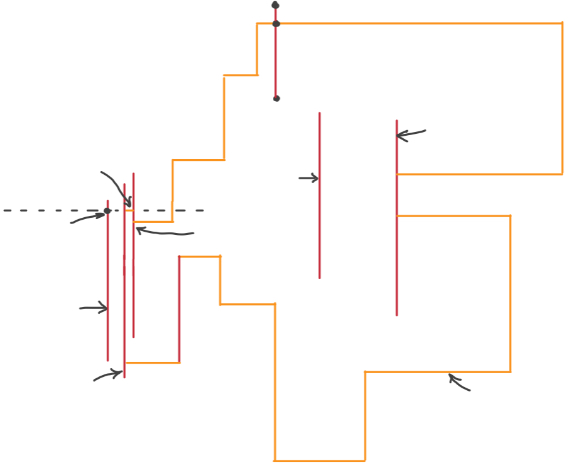
Figure 1: Geometric cases for the proof that ∣W(r)∣=1; illustration of unique limiting segment formation in rays.
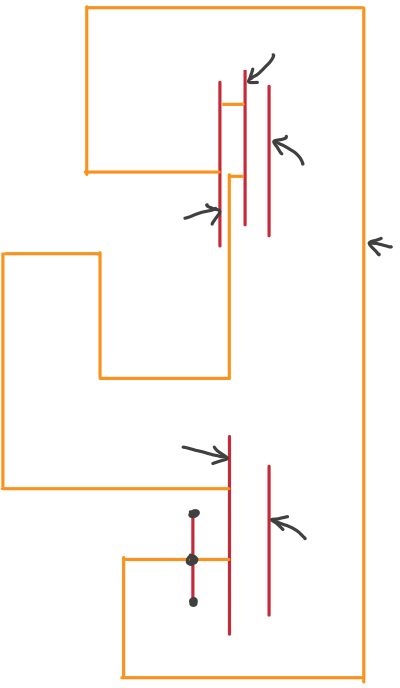
Figure 2: Further geometric cases for the uniqueness of the limiting segment in a sweepline ray.
Structure Theorems for Rays and Trees
A critical mathematical device is the characterization of recursion chains (rays) in the sweepline construction. Each infinite path in the extension tree corresponds to a sequence of sweeps, and the sweep boundaries converge to a limiting segment t0, which is either a point on t1 (terminating ray) or a positive-length open segment (non-terminating). The manuscript proves (Lemma: tunnel lemma; subsequent structure lemmas) that each ray has a unique limiting segment; further, any non-terminating ray corresponds, up to interior equivalence, to a finite ray by adding an appropriate sweep which absorbs the entire segment.
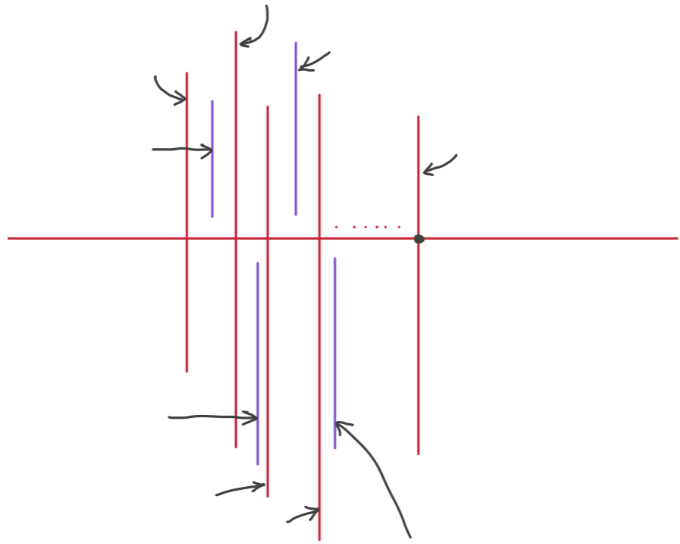
Figure 3: Proof structure for non-trivial limiting segments in a ray—the impossibility of an infinite distinct limiting sequence in the recursion tree.
The sweepline algorithm's recursion structure is thus captured as an infinite rooted tree, where children at each node correspond to countably many possible horizontal sweep extensions along boundary verticals. The region covered by the algorithm is the union of all interiors swept, and the boundary in the limit is shown to be a piecewise-vertical Jordan curve, possibly with countably infinite (but no non-terminating) artificial verticals under maximality.
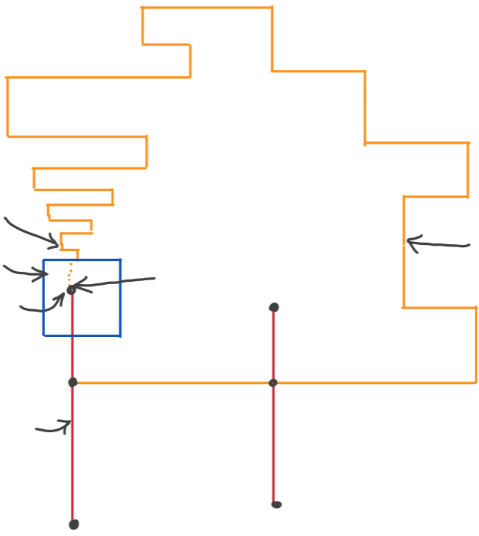
Figure 4: For a terminating ray, the mapping t2 is one-to-one: limiting segments collapse to a unique point on t3.
Zorn’s Lemma and Existence of Maximal Sweeps
A technically sophisticated aspect is the use of Zorn’s lemma to guarantee the existence of a maximal sweepline algorithm t4, defined as a recursion tree that cannot be further extended by addition of legal horizontal sweeps. The construction involves ordering all sweepline algorithms by extension and verifying that every chain has an upper bound (via careful measure-theoretic arguments on interiors), permitting the invocation of Zorn's lemma.
Maximality directly implies that no vertical segment remains on the artificial boundary: any such segment would admit further extension, contradicting maximality. Thus, the boundary of the interior generated is precisely the original Jordan curve t5. This provides an algorithmically constructive proof of the existence of a bounded, open, connected set with t6 as boundary, distinct from previous topologically abstract approaches.
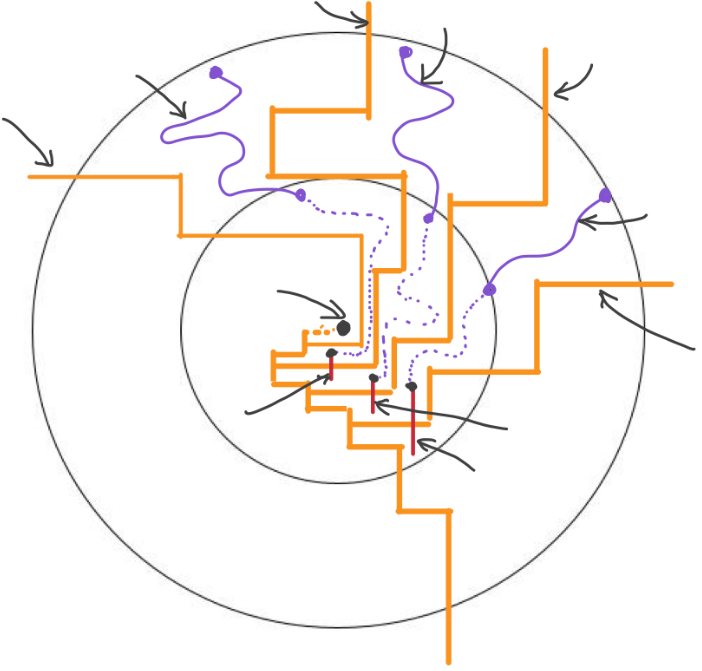
Figure 5: The global map t7 from t8 to the interior boundary is continuous and injective; the sweepline tree structure ensures all boundary segments are exhausted and match t9 in the maximal case.
Handling Pathologies and Ensuring Robustness
The proof addresses classical complications of Jordan curves (such as intersection with vertical lines being uncountable, as with fractals or Cantor-type constructions) by working directly on the continuum, not via polygonal approximation. All open segments in the interior construction are shown to be finite, ensuring an inductive closure compatible with arbitrary rectifiable or non-rectifiable curves.
Equivalence classes of open segments—connected by rectilinear paths in the exterior—classify the plane's open sets, and the sweep mechanism avoids reliance on concepts like winding numbers or polygonal convergence, thus offering an alternative approach amenable to algorithmic formalization and potential automation.
Implications and Future Developments
This approach provides a framework for algorithmic topology, distinct from computational topology. Instead of merely analyzing discrete approximations, the proof uses algorithmic invariants (sweepline recursion, artificial boundary management, tree maximality) to establish topological separation directly on the continuum. The recursion tree's structure hints at applicability beyond two dimensions, suggesting possible higher-dimensional generalizations (e.g., replacing sweeplines with sweep planes).
The proof exposes the fundamental connection between infinite process reasoning, algorithm termination principles (generalized by Zorn's lemma), and classical topological existence. From a computational perspective, the construction is non-effective in the sense of requiring infinite trees, potentially realizable only in “infinite time Turing machines,” but the topological information it manages is highly explicit and constructive at each step.
The extension to treating general pathologies—Curves with wild behavior or highly nontrivial intersection sets with lines—is built in, indicating the framework’s robustness.
Conclusion
This algorithmic proof of the Jordan Curve Theorem (2604.26812) establishes, by sweepline recursion and maximal extension, the existence and uniqueness of the interior and exterior regions bounded by an arbitrary Jordan curve, with the region’s boundary given precisely by the original curve. The algorithmic nature of the construction marks a shift from classical topology to an explicit, stepwise, computationally motivated approach, revealing deep connections between combinatorial-geometric intuition and topological regularity. The methodology is strong enough to encompass pathological cases, uses Zorn’s lemma for handling infinite recursion, and admits possible extensions to higher-dimensional topological theorems. This work situates itself as a foundational result for further explorations in algorithmic topology and the interface between computational geometry and classical mathematical analysis.