- The paper demonstrates that cross-temporal memory reasoning, using intermediate transition frames and bidirectional propagation, significantly improves semantic change detection.
- The paper introduces exemplar construction and adaptive fusion of patch-wise and global predictions, achieving high IoU and F1 scores on multiple benchmarks.
- The paper equips change detection with global-local adaptive rectification to effectively resolve patch inference artifacts and ensure coherent segmentation across diverse scenes.
MemOVCD: Training-Free Open-Vocabulary Change Detection via Cross-Temporal Memory Reasoning and Global-Local Adaptive Rectification
Introduction and Motivation
Open-vocabulary change detection (OVCD) in remotely sensed imagery targets the identification and semantic classification of changes between bi-temporal co-registered images without restricting the target concepts to predefined classes. Addressing this problem in a training-free setting is particularly challenging due to the diversity of potential semantic queries and the requirement for robust generalization across scenes and temporal gaps. Recent pipelines leveraging vision foundation models—such as SAM, DINO, and CLIP—have demonstrated feasibility but are hindered by weak temporal coupling: bi-temporal images are processed independently, and cross-timestamp interactions are limited to a late comparison stage, impeding semantic reasoning and robust change interpretation.
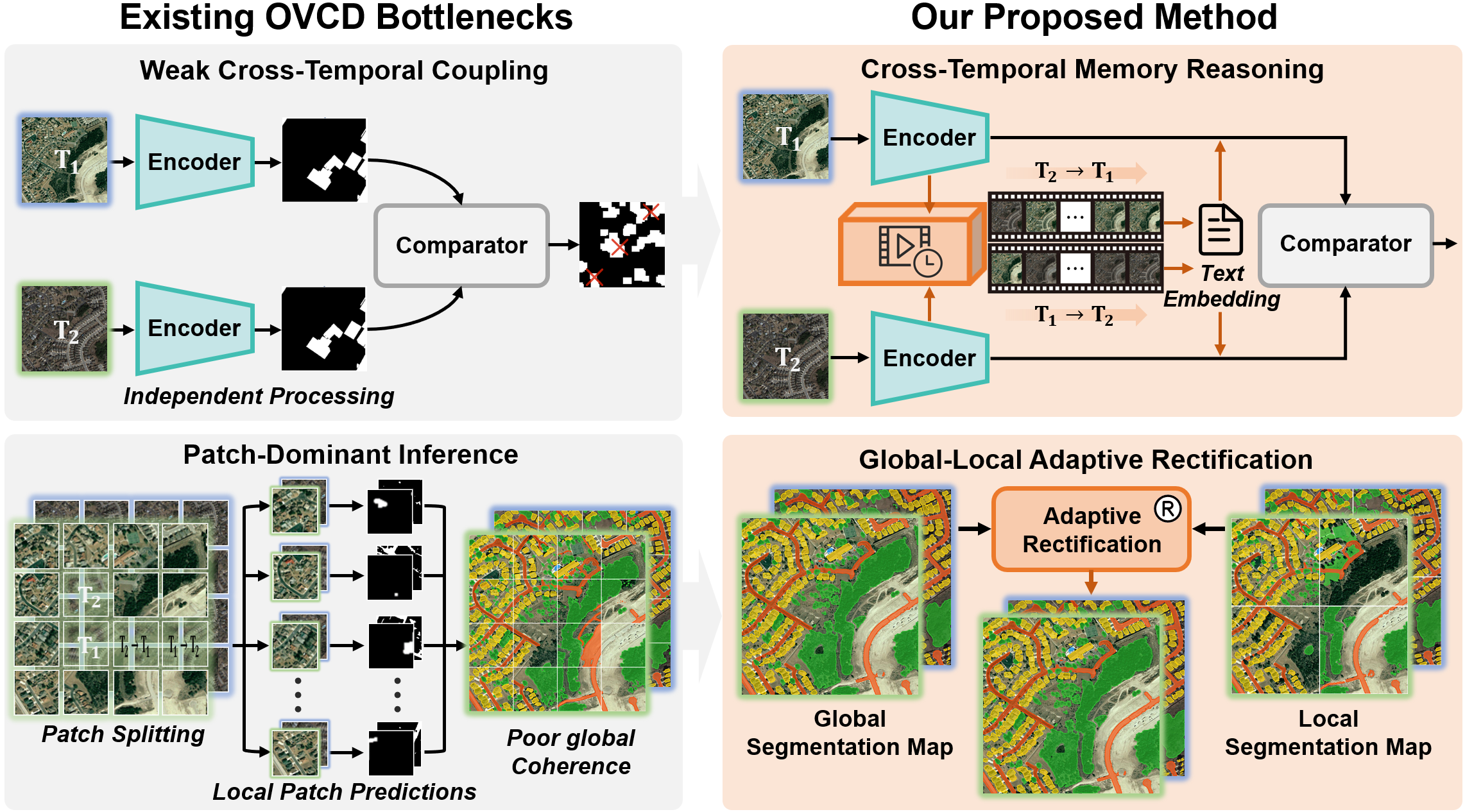
Figure 1: Illustration of the main motivation—existing methods suffer from insufficient cross-temporal coupling, limiting semantic differentiation between genuine changes and spurious appearance variations.
Additionally, the widespread use of patch-dominant inference for high-resolution scenes introduces global semantic discontinuities and spatial artifacts, resulting in incomplete or fragmented change masks. MemOVCD addresses these limitations by reframing OVCD as a temporally coupled reasoning problem and introducing a framework that integrates cross-temporal memory propagation and adaptive fusion of local and global predictions.
Methodology
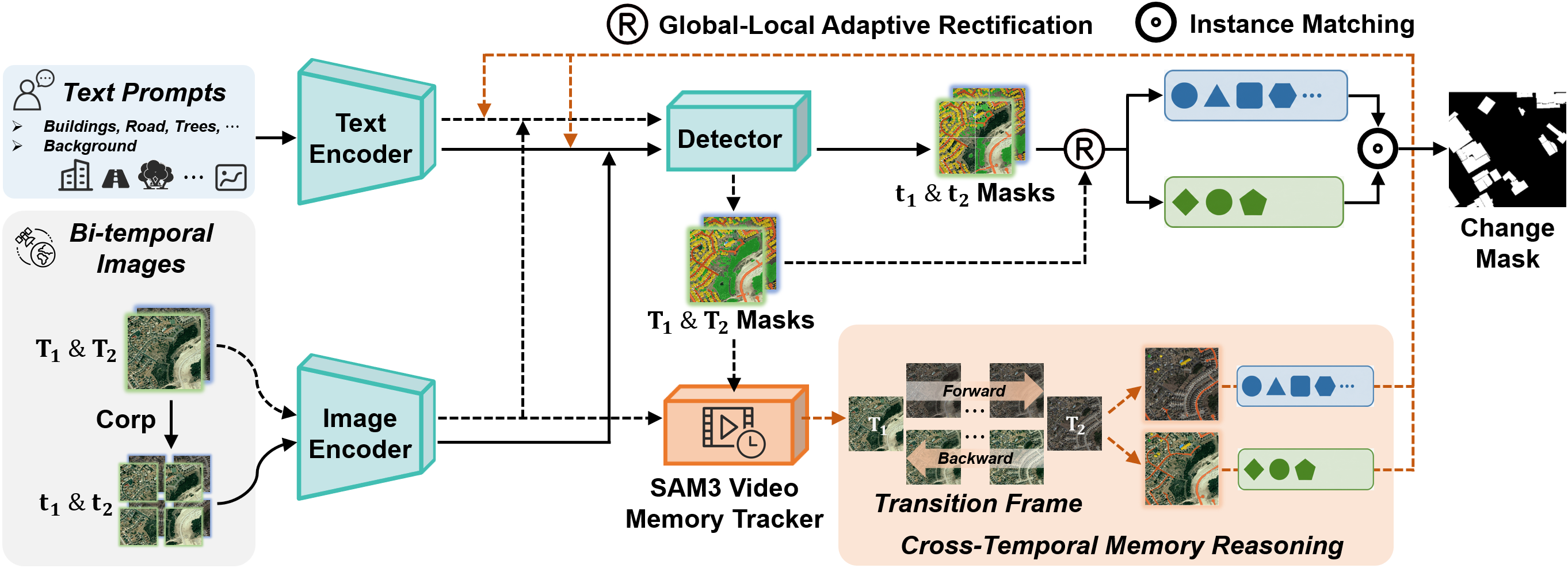
Figure 2: Overview of the MemOVCD pipeline, which comprises cross-temporal memory reasoning and global-local adaptive rectification for open-vocabulary change detection.
MemOVCD reformulates bi-temporal change detection as a two-frame tracking problem. By leveraging SAM 3’s native memory mechanism, the model aggregates semantic evidence bidirectionally across both timestamps, enforcing a cross-temporal coupling during semantic feature extraction. The pipeline includes:
- Histogram-Aligned Transition-Frame Bridging: Instead of direct feature propagation, MemOVCD stabilizes memory by generating intermediate transition frames via histogram alignment and linear blending. This process generates smoother temporal transitions, reducing artifacts from abrupt appearance changes (e.g., seasonal or illumination shifts).
- Bidirectional Propagation: Starting with coarse query-specific masks, the system propagates masks in both forward and backward directions across the temporal bridge, using the propagated hypotheses to extract reliable temporally invariant regions.
- Exemplar Construction and Prompting: Stable regions are pooled and aggregated into a visual exemplar. This exemplar is then concatenated with query text tokens to enhance open-vocabulary segmentation with temporally conditioned category priors.
Global-Local Adaptive Rectification
Patch-wise local inference is prone to missing global structure and inducing fragmentation, particularly for extended or weak-boundary categories. MemOVCD addresses this via:
- Component-Adaptive Fusion: The system merges global and local logit maps by analyzing their spatial alignment using connected component analysis. Components insufficiently covered by local inference are rectified by global-view logits, with fusion weights adaptively determined by component-level local coverage ratios.
- Hierarchical Inference: The pipeline maintains local detail through patch inference while recovering spatial coherence and completeness by incorporating image-wide predictions only where necessary, minimizing unnecessary over-smoothing of fine-grained changes.
Inference Pipeline Design
MemOVCD conducts sequential inference in the following stages:
- Global Initialization: Acquisition of coarse segmentation masks conditioned on the query.
- Cross-Temporal Prompting: Bidirectional memory reasoning using transition frames and mask propagation.
- Logit Computation: Patch-wise and global-view unary potentials are computed and merged.
- Adaptive Rectification: Component-wise fusion reconciles local and global predictions for spatially consistent final masks.
- Instance Decoupling and Change Decoding: Final change masks are produced by matching and merging instance-level predictions across timestamps.
Experimental Results
MemOVCD is evaluated on five public benchmarks—LEVIR-CD, DSIFN, S2Looking, BANDON, and SECOND—covering both building and land-cover semantic change detection tasks.
- Performance: On LEVIR-CD, MemOVCD achieves IoUc=72.5 and F1c=84.1, outperforming competing training-free and even training-requiring paradigms. It similarly leads on S2Looking and BANDON, and is competitive on DSIFN.
- Ablation Analysis: Removing cross-temporal memory reasoning, adaptive rectification, or global refinement consistently degrades performance, confirming the complementary necessity of each module.
- Sensitivity to Bridging: A moderate number of (K=3) transition frames optimizes performance, substantiating the need for, but also the limits of, intermediate state augmentation.
- Robustness: MemOVCD generalizes across diverse scenes, benefiting from bidirectional propagation (asymmetric change cases), and achieves improved spatial consistency due to its rectification mechanism.
Implications and Future Directions
MemOVCD demonstrates that explicit cross-temporal memory propagation, supported by intermediate appearance alignment and adaptive rectification, enables training-free open-vocabulary change detection to rival or exceed previous supervised approaches. This approach points to several theoretical implications:
- Temporal Coupling Supersedes Post-Hoc Comparison: Conditioning semantic feature extraction on both timestamps produces more robust representations, especially under appearance shifts and large temporal gaps.
- Modular Global-Local Fusion as a Remedy for Patch Artifacts: The fusion approach balances detail with global consistency—a likely blueprint for future high-resolution semantic segmentation in remote sensing.
- Training-Free Generalization: Reliance on foundation model priors and zero-shot prompting are practical for rapid domain adaptation; such architectures are increasingly relevant as satellite imagery scales.
Looking forward, the principle of temporally coupled reasoning and adaptive multi-scale fusion could extend to more complex multi-temporal settings, fine-grained semantic change tracking, or general video-based open-vocabulary tasks. Improving the generation of transition frames and exploring more expressive temporal priors may yield further gains in robustness and generalization.
Conclusion
MemOVCD defines a new state-of-the-art in training-free open-vocabulary change detection for remote sensing applications. By integrating cross-temporal memory-driven reasoning with global-local adaptive rectification, it achieves superior semantic and spatial consistency, outperforming prior zero-shot and training-heavy pipelines. This framework paves the way for highly adaptable, query-driven monitoring systems in earth observation, resilient to diverse scenes, categories, and temporal shifts.