- The paper introduces a homogeneous infrared spectral atlas of 1675 ultracool dwarfs using continuous 0.75–5 μm coverage from SPHEREx, breaking degeneracies in atmospheric modeling.
- It employs a two-tier approach combining grid-based χ² minimization with Bayesian nested sampling to estimate atmospheric parameters, bolometric luminosities, and evolutionary tracks.
- The study validates SPHEREx spectra against JWST data, providing precise calibrations for metallicity diagnostics and insights into substellar evolutionary trends.
The SPHEREx Ultracool Dwarf spectral Atlas (SUDA): Homogeneous Atmospheric and Evolutionary Characterization of Ultracool Dwarfs
Overview and Motivation
The SPHEREx Ultracool Dwarf spectral Atlas (SUDA) introduces a comprehensive, homogeneous dataset of 1675 ultracool dwarfs, leveraging the unprecedented 0.75–5 μm spectral coverage provided by SPHEREx Quick Release 2 (QR2). The continuous wavelength domain is key to robust atmospheric characterization and breakage of long-standing degeneracies in the modeling of low-mass stellar and substellar objects, providing direct bolometric flux measurements unattainable in prior, non-uniform samples. The study combines spectral fitting (SAND, ATMO2020++ grids), accurate bolometric luminosity determinations, and evolutionary tracks (C23) to derive radii, masses, ages, and empirical gravity estimates for this population, delivering a high-precision reference for population-level atmospheric and evolutionary studies.
Data Acquisition, Assembly, and Validation
The SUDA sample derives from an astrometrically matched cross-referencing of the UltracoolSheet catalog with SPHEREx QR2 spectral products, resulting in 1675 sources after rigorous S/N, photometric consistency, and contamination filtering. Crucially, SPHEREx spectra's absolute and relative flux scales were validated via direct comparison with JWST NIRSpec observations for three representative brown dwarfs, revealing flux consistency to within 1.4–4.0% (Figure 1).
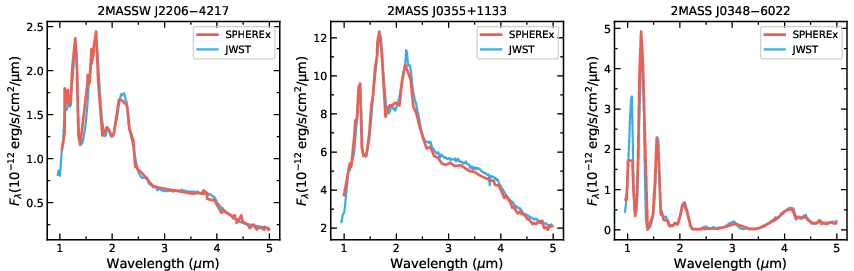
Figure 1: Comparison between SPHEREx and JWST spectra of three representative brown dwarfs, confirming the fidelity and flux calibration of SPHEREx QR2 data over 1–5 μm.
This agreement establishes the reliability of SPHEREx for broad, empirical characterization, justifying downstream atmospheric and physical parameter inference on this large population.
Spectral Modeling Methodology
A two-tier methodology is employed for atmospheric parameter estimation:
- Grid-based χ² minimization: Initial parameter estimation utilizes the SAND and ATMO2020++ atmospheric model grids, both spectrally convolved to match device resolution (R=40–130), with optimization for low-Teff sources (ATMO2020++ preferred for Teff≤1300 K).
- Bayesian Nested Sampling: These solutions are refined by UltraNest, delivering robust posteriors and uncertainties on Teff, logg, [M/H], and flux scale, with priors tightly constrained by the grid-fit.
Bolometric Flux and Luminosity Determination
Bolometric fluxes are computed by direct integration of the observed spectrum augmented by best-fit model extensions beyond observed coverage. For sources with reliable parallax data, bolometric luminosity (Lbol) is derived via the standard distance-luminosity relation; for those lacking parallax, Lbol is inferred from atmospheric parameters using an XGBoost regressor trained on the parallax sample. A crossmatch analysis with the literature benchmark catalog [2023ApJSanghi] demonstrates an extremely low mean offset (0.014 dex for parallax-based, 0.080 dex for ML-based) and tight MADs, affirming the method's fidelity.
Evolutionary Parameter Estimation
Mass, age, and evolutionary gravity are interpolated from the C23 substellar cooling models, using the observed Teff and inferred radii. Radii are derived directly from the flux scaling and parallax for the parallax subset. The SUDA objects populate the appropriate evolutionary loci in the Teff–R space (Figure 2), validating the consistency of the sample with theoretical expectations across the brown dwarf and ultracool regime.
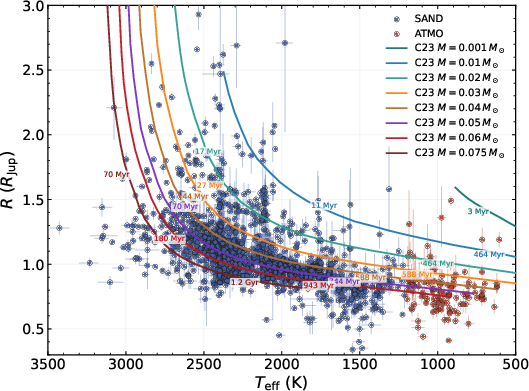
Figure 2: Radius vs. Teff0 for SUDA sources, illustrating evolutionary trends and model congruence across the sample as compared to C23 evolutionary tracks.
A systematic offset is found between atmospheric and evolutionary Teff1 in the 1700–2500 K regime (median Teff21.1 dex lower for atmospheric fits), attributed to degeneracy between surface gravity and metallicity at SPHEREx spectral resolution (Figure 3).
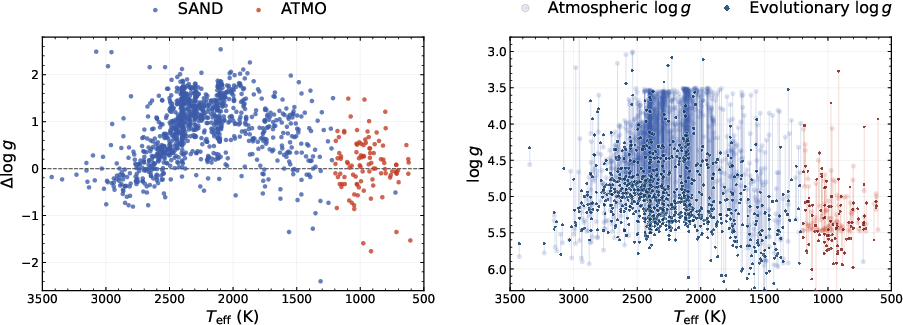
Figure 3: Direct comparison between atmospheric and evolutionary Teff3 for objects with parallaxes, highlighting systematic gravity offsets in the L-dwarf temperature range.
Empirical Spectral Atlas
The empirical atlas is constructed by binning spectra in Teff4–Teff5 space (using atmospheric and evolutionary estimates, respectively), with each bin containing the normalized median spectrum of at least five sources. The atlas contains 52 bins and spans Teff6–3000 K, with gravity dependence only weakly manifest except at the lowest temperatures. This resource enables direct, data-driven mapping of observed spectral morphology to physical parameter space and serves as a future reference for model validation and spectral classification.
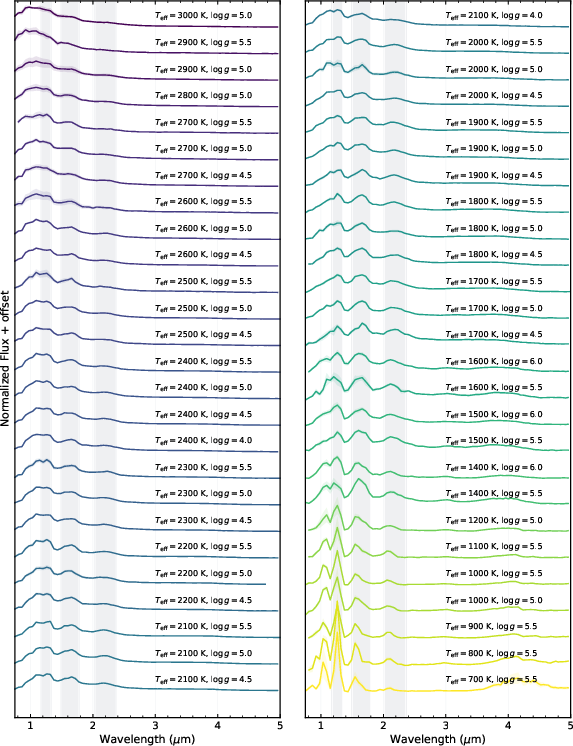
Figure 4: Empirical SUDA spectral atlas showing median normalized spectra ordered by Teff7 and Teff8, encapsulating the morphological diversity across ultracool dwarfs.
Molecular Index Trends
Four major molecular indices (HTeff9O, CHTeff≤13000, CO, COTeff≤13001) are computed for the sample, serving as diagnostics for Teff≤13002, chemistry, and metallicity. HTeff≤13003O and CHTeff≤13004 indices track cooling and the L/T transition, showing steep enhancements between 1300–1100 K. CO and COTeff≤13005 rise below 1500 K, peaking near 1000 K, with COTeff≤13006 displaying strong sensitivity to [M/H] in the 800–1300 K range. Comparing observations with SAND and ATMO2020++ models demonstrates that dispersion in CO/COTeff≤13007 indices is largely explained by metallicity, and ATMO2020++ models reproduce the observed index behavior more faithfully in the carbon-bearing domains (Figure 5).
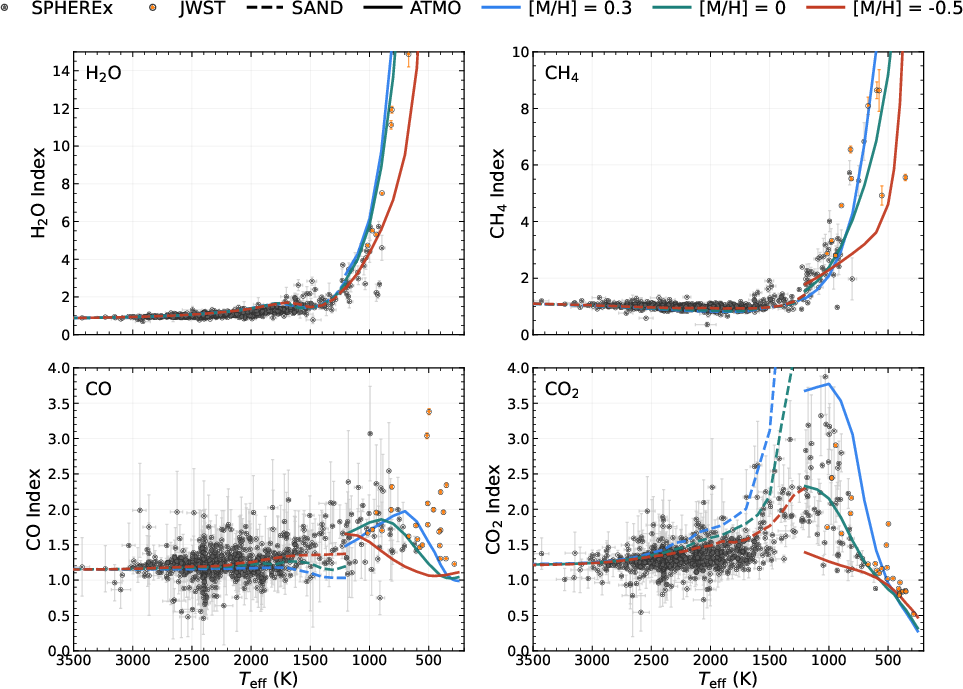
Figure 5: Molecular index trends for HTeff≤13008O, CHTeff≤13009, CO, and COTeff0 as a function of Teff1, with model tracks overlaid and metallicity dependencies illustrated.
These index behaviors empirically validate trends expected from atmospheric chemistry and mixing, reinforcing the dataset's suitability for metallicity and chemical diagnostics.
Machine Learning Luminosity Regression
For parallax-free objects, an XGBoost regressor is trained to map Teff2 to Teff3 using the parallax sample as ground truth, achieving an out-of-fold MAE Teff4 dex. This approach generalizes previous empirical magnitude relations, is robust to multimodal parameter dependencies, and preserves the accuracy required for evolutionary modeling.
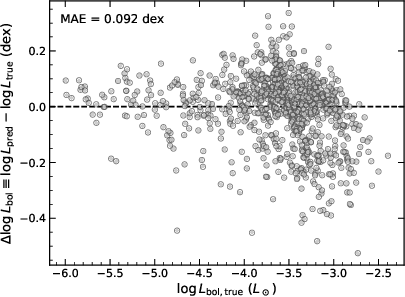
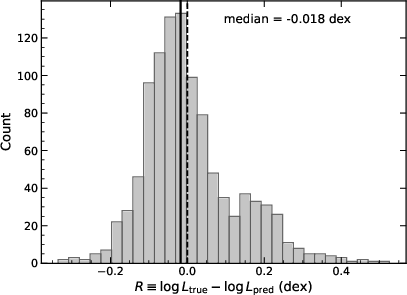
Figure 6: Prediction performance and error distribution of the XGBoost regressor for Teff5 estimation from atmospheric parameters, confirming high fidelity for the no-parallax subset.
Implications and Future Applications
SUDA establishes a new baseline for ultracool dwarf atmospheric and evolutionary analysis, providing a statistically powerful, homogeneously derived set of parameters that can serve multiple research lines:
- Model Calibration: The empirical atlas enables testing and refinement of atmospheric forward models and retrievals across the L, T, and Y sequence, particularly in the mid-infrared regime where model–data tension has persisted.
- Metallicity Diagnostics: The COTeff6 index trend establishes a scalable spectroscopic proxy for metallicity in brown dwarfs, supporting population synthesis and galactic archaeology.
- Substellar Evolution: Cohesive mass-age determinations from uniform cooling tracks advance studies of the brown dwarf mass function, formation environments, and the star/brown dwarf boundary.
- Exoplanetary Benchmarking: The dataset interfaces with interpretations of directly imaged exoplanets, particularly for comparative atmospheric science in the low-mass, cool regime.
The systematic offset in atmospheric vs. evolutionary gravity parameters underscores the need for higher-resolution or longer-wavelength spectral inputs to fully disentangle Teff7 and [M/H]. Nevertheless, SUDA will inform the selection, calibration, and validation of future high-sensitivity infrared surveys (e.g., Roman, Rubin, and other JWST-class data streams) for population-scale substellar astrophysics.
Conclusion
The SUDA sample constructed from SPHEREx QR2 data constitutes the most homogeneous and comprehensive infrared spectral atlas for ultracool dwarfs to date, enabling robust physical parameter estimation, evolutionary modeling, and empirical atmospheric diagnostics across 0.75–5 μm. The methodology demonstrates that high-fidelity population studies are now practical due to all-sky low-resolution spectroscopy with continuous spectral coverage. SUDA's empirical and model-derived resources will remain a foundational dataset for substellar astrophysics, model calibration, and comparative atmospheric studies, bridging the gap between targeted deep observations (e.g., JWST) and wide-field survey science.