- The paper demonstrates that accurate modeling of galaxy morphologies significantly reduces systematic shear bias affecting cosmological inference.
- It employs a robust two-stage fitting procedure and vine copula-based multivariate modeling to inject realistic, redshift- and magnitude-dependent morphologies into simulations.
- The augmented simulations closely match observed COSMOS distributions, ensuring calibration precision within sub-percent error margins.
Introduction
The control of systematic errors is a central challenge for precision cosmology with weak gravitational lensing. The Euclid Wide Survey (EWS), with its high resolution and wide coverage, facilitates robust constraints on cosmological parameters but demands sub-percent accuracy in the calibration of shear measurements. Central to this calibration is the use of synthetic image simulations, which must reproduce observed galaxy populations and morphologies to avoid multiplicative bias in shear estimation that would propagate into cosmological inference. The study “Euclid preparation. Refining input galaxy shape distributions for shear calibration simulations” (2604.26684) develops an advanced framework for learning and injecting realistic galaxy morphology distributions from Euclid data into simulations underpinning shear calibration, and quantitatively analyzes the sensitivity of shear bias to morphology modeling.
Data Acquisition and Morphological Measurement
The methodology initiates with the construction of a robust reference catalogue from deep Euclid imaging of the COSMOS field. The survey area is segmented into tiles, with careful masking for stars, ghosts, and bright artefacts, preserving ∼2.2 deg2 of high-fidelity galaxy imaging and ∼1.3 million detected galaxies (Figure 1).
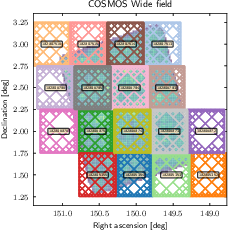
Figure 1: The COSMOS field as observed by Euclid, with MER tiles at EWS depth, HEALpix indices, and underlying galaxy density.
A two-stage model-fitting procedure is adopted. Detected sources from SExtractor are modeled with SourceXtractor++, using both single-Sérsic and bulge-disk (double-Sérsic) profiles. Joint fitting techniques mitigate blending-induced biases, especially in crowded fields, resulting in more noise-like residuals for jointly-fitted groups (Figure 2).
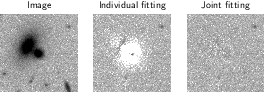
Figure 2: Residuals from joint fitting (noise-like) versus individual fitting (structured, with over-correction for the fainter galaxy).
Photometric redshifts from COSMOS2020 are cross-matched to supplement morphological measurements with spectral information, enabling tomographic conditioning of the morphology distribution.
Image Simulations: Physical Realism and Fidelity
The simulated images are built using the Flagship galaxy mock as a baseline for clustering, with the goal of replacing its parametric morphology with empirically-learned distributions. Simulations utilize Galsim, with input PSF models constructed from matching Euclid data (Figure 3), and encompass realistic stellar densities, PSF convolution, and noise characteristics informed by the true exposure time distribution (Figures 7 and 8).
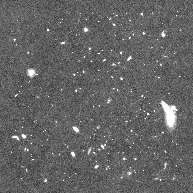
Figure 3: Representative simulated COSMOS tile, gray-scaled; outer edges are source-free to suppress border effects; round sources are PSF-dominated stars.
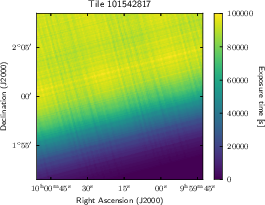
Figure 4: Variation of exposure time across a MER tile, impacting source depth and noise properties.
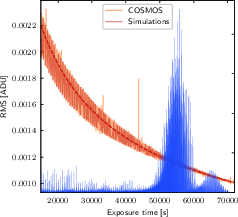
Figure 5: Exposure time and RMS background distribution across field of view, with fitted relations used in simulations.
Morphology Augmentation: Multivariate Modeling and Conditional Sampling
The core innovation is an augmentation pipeline that injects realistic, redshift- and magnitude-dependent morphologies into the Flagship catalogue (Figure 6). Multi-variate dependencies between ellipticity, half-light radius, and Sérsic index are modeled via vine copulae (following [SKiLLS]), enabling conditional draws based on magnitude, redshift, and survey depth.
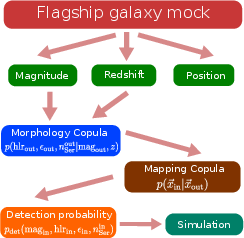
Figure 6: Overview of the Flagship augmentation scheme using copulae and a neural network for morphology injection probability.
A mapping copula, trained on simulated input-output parameter correspondences (Figure 7), inverts the effects of PSF convolution and blending, permitting accurate translation from measured to input morphology distributions, including in the blended regime.
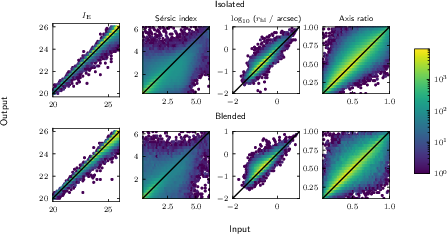
Figure 7: Scatter plots comparing input and recovered morphology parameters, with isolated and blended populations distinguished.
Incompleteness, especially relevant at the faint end, is modeled by a neural network classifier trained to predict detection probability as a function of morphology and observing conditions (Figure 8). This enables a weighted injection scheme that controls for selection effects, ensuring that measured distributions from simulations match observed histograms, irrespective of detection biases.
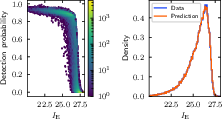
Figure 8: Left: Empirically-determined detection probability as function of magnitude. Right: Magnitude histogram weighted by detection probability.
Magnitude weighting is performed as a function of exposure time (Figure 9) to adjust for spatially-varying survey depth.
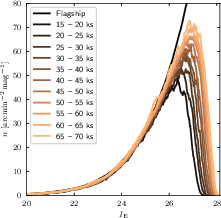
Figure 9: Magnitude distributions as a function of exposure time: longer exposures recover fainter sources.
Sensitivity Analysis: Requirements on Morphology Modeling
The robustness of the approach is quantified via a suite of dedicated sensitivity simulations (Figure 10). By perturbing parameters (mean, dispersion, kurtosis) of the input morphology distributions, the response of the multiplicative shear bias is measured using the LensMC estimator. The analysis demonstrates that the allowed systematic error in the mean ellipticity for DR3-level requirements is at the 1% level, while for the half-light radius and Sérsic index deviations of a few percent can be tolerated.
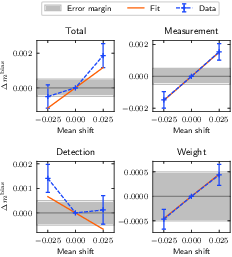
Figure 10: Change in multiplicative bias as a function of mean ellipticity shift, with contributions from measurement, detection, and weighting bias.
Simulations with the empirically-learned and augmented morphologies closely reproduce core observed morphology distributions (Figures 14, 16, and 17), including number density, half-light radius, and ellipticity, across magnitude bins and in tomographic redshift slices (Figure 11). This is not the case for simulations relying on the unmodified Flagship morphologies, which display significant disagreement in the ellipticity distribution.
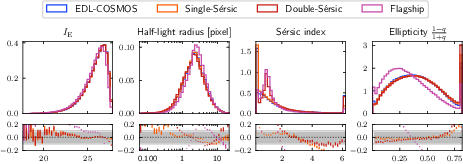
Figure 12: Comparison of normalized core parameters between real data and image simulations, for augmented and Flagship input.
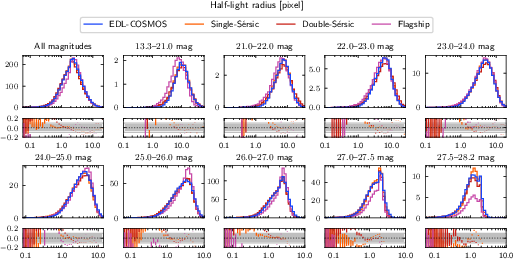
Figure 13: Half-light radius distributions in simulation and data, showing per-bin agreement within 10%.
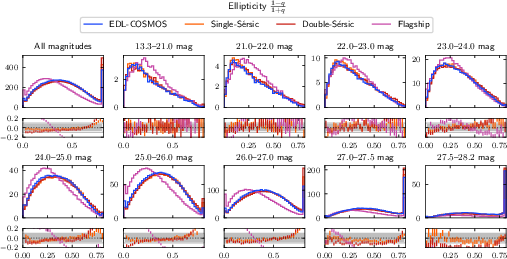
Figure 14: Ellipticity distributions matched to data for augmented simulation, significant deviation for Flagship input.
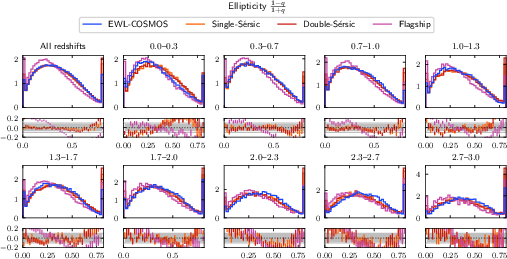
Figure 11: Ellipticity distributions in redshift bins, demonstrating tomographic modeling capability.
Critically, the impact on the resulting shear bias is at the percent level—a shift comparable to a factor of five beyond Euclid’s nominal error budget—when unmodified Flagship morphologies are used. Conversely, the copula-augmented simulations are demonstrated to satisfy the precision requirements for all key morphological parameters except, marginally, for the mean half-light radius and Sérsic index, for which remaining discrepancies are attributed to second-order effects in PSF modeling.
Implications and Future Prospects
This work provides a systematic blueprint for bridging the gap between observed galaxy morphologies and calibration simulations required for cosmic shear cosmology with Euclid. The explicit demonstration of percent-level shifts in multiplicative shear bias—far exceeding the budget—when simulation morphology is not accurately matched to observations, underscores a critical systematic for both Euclid and analogous future wide-field imaging surveys ((2604.26684), see also [Henk2017], [Cropper_2013], [Massey_2013]). The use of copula-based multi-variate modeling, coupled to per-object injection weights derived from neural network-based detection models, constitutes a scalable and statistically-robust paradigm for simulation-based calibration.
Metacalibration and direct data-driven calibration schemes may further reduce sensitivity to model specification, but will still benefit from accurate forward models that match blending and selection effects. The methodology outlined in this study is extensible: inclusion of spectral bands and expansion of the reference area to other Euclid ancillary fields will enable improved tomographic and redshift-dependent calibration. Future development will also entail improved PSF modeling, application to additional shear measurement algorithms (e.g., Metacalibration), and wider adoption for calibration pipelines in next-generation weak lensing cosmology.
Conclusion
"Euclid preparation. Refining input galaxy shape distributions for shear calibration simulations" (2604.26684) establishes a robust, data-driven framework for simulating realistic galaxy morphologies in the context of weak lensing shear calibration. The augmentation of mock catalogues with multi-variate morphology distributions derived from deep Euclid observations, coupled with explicit modeling of selection effects, enables calibration simulations that satisfy the sub-percent accuracy demands of Euclid cosmology. The findings decisively demonstrate that uncorrected input morphology models induce unacceptable systematic errors in multiplicative shear bias and that empirical correction is necessary for credible cosmological inference. This work provides one of the foundational components of the Euclid shear calibration program and charts the path for ongoing and future mitigation of simulation-based systematics.