- The paper quantifies the degradation in dark energy constraints, showing that lens redshift means must be calibrated to ≤0.004(1+z) to recover 80% of performance.
- It employs Monte Carlo and Fisher forecasts to assess systematic biases from shifts in the redshift mean and variations in the distribution width.
- The study defines clear thresholds for Euclid DR1, streamlining redshift calibration in multi-probe analyses and guiding future survey designs.
Impact of Redshift Distribution Uncertainties on Joint Photometric Galaxy Clustering and Weak Lensing Cosmological Analysis in Euclid DR1
Introduction
The Euclid mission aims to enable high-precision cosmological inference through the combination of photometric galaxy clustering, cosmic shear, and galaxy-galaxy lensing—the so-called 3×2pt analysis. The accuracy of tomographic redshift distributions, particularly for the galaxy samples used as lenses in clustering measurements, is a critical source of systematic uncertainty, yet the requirements for the photo-z accuracy of lens galaxies have not been previously specified with the same rigor as for the source (shear) sample. This work provides a comprehensive investigation of how uncertainties in the mean and width of lens redshift distributions propagate to cosmological parameters, quantifies the resulting loss of constraining power, and establishes requirements for redshift calibration in Euclid Data Release 1 (DR1).
A robust theoretical modelling framework is adopted for the analysis: galaxy clustering is computed using the angular correlation function w(θ) with bias and redshift-space distortions, galaxy-galaxy lensing is modelled via cross-correlations of lens galaxy positions and source galaxy shears, and cosmic shear is captured via tomographic two-point functions. All calculations include advanced treatments such as point-mass marginalization for galaxy-galaxy lensing and the mitigation of baryonic and nonlinear bias through scale cuts. Systematic effects considered include multiplicative and additive shear bias, magnification bias, and intrinsic alignments (modelled with a non-linear alignment model and redshift-dependent amplitude).
Redshift distributions for both sources and lenses are derived from the Euclid Flagship simulation, using six equipopulated tomographic bins per sample, with realistic magnitude limits. The redshift range for both is $0.2
Figure 1: Normalized redshift distributions for source (top) and lens (bottom) galaxies from the Flagship simulation for a DR1-like configuration.
Monte Carlo and Fisher-matrix based approaches are employed for cosmological forecasts, utilizing CosmoSIS and CosmoCov. The parameter space includes standard ΛCDM and w0waCDM cosmological parameters, galaxy bias, and nuisance parameters for IA, photo-z errors, and shear calibration.
Marginalization over Redshift Distribution Uncertainties: Loss of Constraining Power
A primary result concerns how marginalization over uncertainties in the mean (Δz) and width (σz) of the lens n(z) degrades the constraining power on dark energy parameters. The loss is quantified using the Figure of Merit (FoM) for w0–wa and Ωm–$0.2
Figure 2: Cosmological posteriors for $0.2
Fisher forecasts corroborate these results and allow rapid exploration of parameter dependence. The constraining power falls off steeply when the mean redshift uncertainty exceeds $0.2Λ0 relative to Λ1, degradation is minimal for values typical of spectroscopic calibration, consistent with the strong correlation between uncertainties in the mean and width from such approaches.
Biases from Incorrect Redshift Distribution Modeling
Complementary runs perturb the adopted lens Λ2 by shifting the mean or stretching the width, without marginalizing over the associated nuisance parameters, to assess induced biases in cosmological parameter estimates. Key findings include:
- For the full 3×2pt Λ3CDM analysis, even a shift in the mean of 0.002(1+Λ4) in the lens Λ5 produces a bias Λ6 in Λ7 and Λ8, violating standard thresholds for acceptable systematic error budgets.
- Bias from Λ9 width is subdominant in joint analyses unless it is perturbed by an order of magnitude larger than allowed for the mean.
- For photometric clustering alone, both mean and width are comparably important; a 0.2% stretch in width impacts w0wa0 nearly as much as a 0.2% shift in the mean.
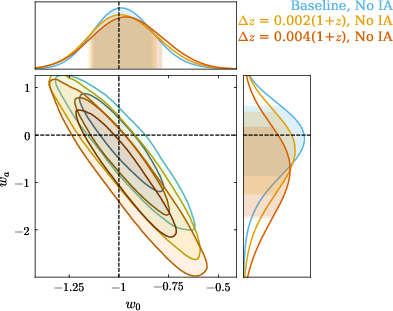
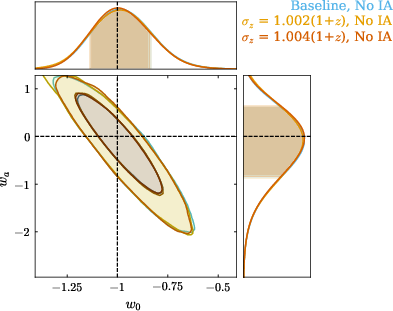
Figure 3: Impact of shifts (left) and stretches (right) in the lens w0wa1 on w0wa2–w0wa3 confidence contours; shifts dominate biases, width is only important when highly excessive.
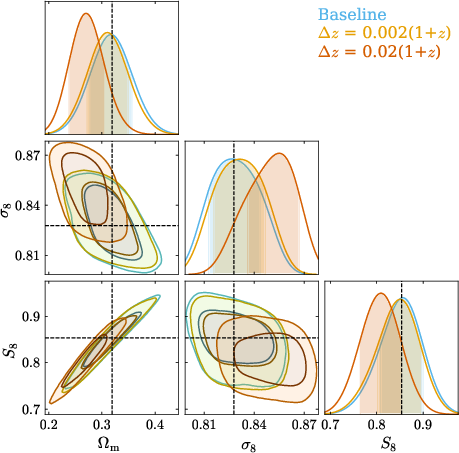
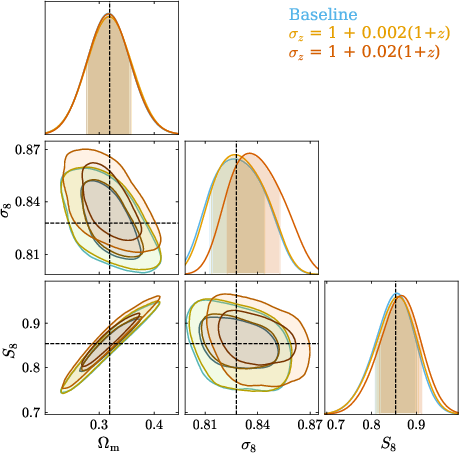
Figure 4: Biases on w0wa4, w0wa5, and w0wa6 for photometric clustering only; width and mean both significantly affect clustering-only analyses.
Implications for Survey Design and Future Developments
- Dominance of Mean Requirement: For joint 3×2pt (clustering + shear + galaxy-galaxy lensing) analyses, the critical requirement is the calibration of the mean of each lens w0wa7 to within w0wa8. The width is constrained implicitly by the mean in typical calibration scenarios.
- Width More Critical for Clustering-Only: Galaxy clustering and its observables, being less integrated over redshift, are more sensitive to the detailed width of w0wa9. Therefore, analyses that do not combine with shear/g-g lensing require more stringent control over both moments.
- Marginalization Suffices: Marginalizing over the mean with appropriate priors suffices to guard against bias and excessive degradation, providing a practical approach for cosmological inference in the presence of realistic redshift uncertainties.
- DR3 Outlook: With larger DR3 datasets and improved spectroscopic coverage, the data will self-calibrate nuisance parameters more effectively, allowing weaker priors (up to Δz0) before significant degradation of cosmological constraints occurs (see also [Blot25], [canas2025euclid]).
Conclusion
This analysis provides the first quantitative requirement on lens photo-z calibration for Euclid DR1: the mean of each lens galaxy tomographic bin must be known to Δz1 accuracy. This ensures biases on cosmological parameters remain below Δz2 and preserves at least 80% of the Δz3–Δz4 figure of merit in the critical 3×2pt analysis. The result that width becomes negligible when the mean is accurately calibrated simplifies operational requirements and highlights the value of joint probe analyses. For Euclid DR1, the galaxy clustering redshift calibration is not the limiting factor on cosmological power, so long as the more stringent source sample requirements are met. Future surveys with even greater calibration samples will benefit further, with the dominant challenge remaining the control of source sample photo-z systematics.
Overall, the work defines clear, achievable thresholds for DR1, directly informs analysis pipelines for upcoming Euclid cosmological analyses, and offers a unified framework for propagating redshift calibration uncertainties in multi-probe large-scale structure inference.
References
- Euclid Collaboration: Bertmann et al., "Euclid preparation. Impact of redshift distribution uncertainties on the joint analysis of photometric galaxy clustering and weak gravitational lensing" (2604.00805).
- Euclid Collaboration: Castander et al., "Euclid - V. The Flagship galaxy mock catalogue: A comprehensive simulation for the Euclid" [EuclidSkyFlagship].
- Dark Energy Survey Collaboration: Porredon et al., "Dark Energy Survey Year 3 results: Cosmological constraints from galaxy clustering and galaxy-galaxy lensing..." [Porredon2022].
- Blot et al., "Euclid preparation. Cosmology Likelihood for Observables in Euclid (CLOE). 6: Impact of systematic uncertainties on the cosmological analysis" [Blot25].
- Ca~nas-Herrera et al., "Euclid preparation: Cosmology Likelihood for Observables in Euclid (CLOE). 3. Inference and Forecasts" [canas2025euclid].