- The paper establishes an exact functional relation among secular coefficients that unifies key aspects of the RG procedure in ODE analysis.
- It presents a rigorous method for eliminating spurious secular growth and explicitly relates bare and renormalized amplitudes via a one-parameter group structure.
- The approach applies to both semisimple and nilpotent systems, offering a constructive resummation technique for long-time asymptotics in nonlinear dynamics.
Functional Relations in Renormalization Group Methods for Ordinary Differential Equations
Overview
"Functional relations in renormalization group methods for a class of ordinary differential equations" (2604.01744) develops a systematic perturbative framework for ODEs based on renormalization group (RG) methods. The central innovation is an exact functional relation among the so-called secular coefficients arising from naive perturbation expansions, applicable to systems with semisimple and nilpotent linear parts, as well as to higher-order scalar ODEs. This relation unifies core aspects of the RG procedure, including the construction of renormalized amplitudes, the autonomous RG equation, explicit secular-term resummation, and invertibility between bare and renormalized quantities.
RG Perturbation and Secular Growth in ODEs
Perturbation theory for ODEs frequently produces spurious secular terms—Fourier modes whose amplitudes grow polynomially with time—when resonance between linear and nonlinear dynamics is present. The RG formalism systematically eliminates such terms and recasts the dynamics in terms of slowly varying, renormalized amplitudes whose evolution is governed by the RG equation. The authors consider first-order systems
dtdy=My+εV(ε,e±it,y),
where M is either semisimple or nilpotent, and V is polynomial in y and Laurent-polynomial in exponentials.
A formal power-series solution is written as
yj(ε,t)=k≥0∑εkm∈Z∑fj,m(k)(t)eimt,
with unique secular coefficients Pj,m(ε,t,A) ensuring the term-by-term solution matches specific normalization conditions at each perturbative order. The paper emphasizes these coefficients' universal functional interrelation.
Exact Functional Relations and Group Structure
A pivotal result is the discovery of an explicit functional relation among secular coefficients:
Pj,m(ε,t,A)=Pj,m(ε,t−s,A(ε,s,A))
where A denotes the renormalized amplitudes, constructed as resonant secular coefficients. This relation encodes several features:
- The set {A(ε,t,⋅)}t∈R forms a one-parameter group under composition.
- The RG equation for the evolution of renormalized amplitudes arises as an infinitesimal generator of this group structure.
- The expansion can be explicitly resummed to remove secular divergences at all orders in ε.
- The transformation between bare and renormalized amplitudes is invertible and constructive.
This group property is encapsulated by the closure relation
M0
implying the dynamical flow for amplitudes can be viewed as a formal Lie group action.
Application to Semisimple and Nilpotent Systems
Two principal cases are addressed:
Semisimple Case
For diagonalizable M1, the standard RG reduction applies. The functional relation yields an autonomous RG equation:
M2
and the renormalized expansion is
M3
where all secular terms are coherently resummed.
The correspondence between bare and renormalized amplitudes follows
M4
Nilpotent Case
For nilpotent M5 (Jordan block), the unperturbed part is highly degenerate, and the RG equation appears at zeroth order, reflecting the absence of slow-fast separation. The expansion and group properties persist with polynomial carriers in M6 rather than exponentials.
Secular coefficients satisfy analogous functional and inversion relations, and the RG equation for the amplitudes takes the form
M7
truncated at appropriate order for each M8.
Generalization to Higher-order Scalar ODEs
For scalar M9th-order ODEs,
V0
expanding in exponentially modulated polynomials uncovers a similar group-theoretic functional relation among secular components and thus among the associated renormalized amplitudes. The RG equation governing their evolution then emerges as a system of autonomous higher-order ODEs, with slow manifold reduction and resummation of secular terms.
Explicit Example: Non-autonomous Coupled ODE
One illustrative example is the two-dimensional, non-autonomous system
V1
in which the secular coefficients and their recursive determination up to high orders are shown explicitly. The derived RG equations for renormalized amplitudes encode the slow flow and admit reduction to polar coordinates, yielding
V2
(Figures 1 and 2).
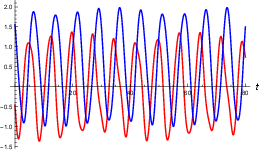
Figure 1: The real part (red) and the imaginary part (blue) of V3 for the non-autonomous two-dimensional system showing the perturbation-induced deformation of trajectories.
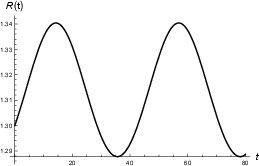
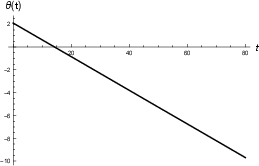
Figure 2: The time evolution of the renormalized amplitude V4, representing the modulus, under the RG-reduced system.
A comparison of direct integration with the RG-resummed solution demonstrates precise phase-and-amplitude tracking (Figure 3).
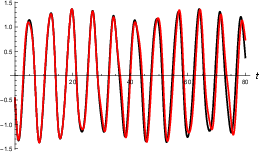
Figure 3: Red: V5 from direct integration; Black: V6 from the RG-based renormalized expansion, showing agreement up to nontrivial time scales.
Analytical and Algebraic Structure
The functional approach bypasses elaborate diagrammatic or recursive arguments typical in RG computations, replacing them with algebraic identities and autonomous ODEs for secular coefficients. It clarifies the symmetry and compositional algebra underlying RG reduction, particularly the group structure and invertibility, independent of truncation order.
A further point is that for autonomous perturbations, the RG system is brought to normal form, and, in the nilpotent case, the correspondence with slow manifold/center manifold reduction is explicit.
Implications and Outlook
The analytic machinery developed applies to a broad class of ODEs, covering classical models such as Van der Pol, Mathieu, Duffing, and Rayleigh equations, and enabling systematic extension to coupled oscillatory systems, higher-order equations, and difference-differential frameworks. The explicit, all-orders, constructive relations for secular coefficients provide concrete, algorithmic access to resummed solutions and allow for rigorous study of resonances and their impact on long-time asymptotics.
Theoretically, the results elucidate the deep algebraic structure behind the RG procedure for ODEs, highlighting the connection to formal Lie group actions on amplitude space. Practically, this structure enables efficient computation of reduced equations for multiscale and resonant systems and points toward generalizations in the direction of PDEs, stochastic systems, or discrete-time systems.
Conclusion
This work establishes that exact functional relations among secular coefficients encapsulate the essential content of the RG method for a wide class of ODEs. These relations provide closed-form, algebraic mechanisms for constructing RG equations, resumming secular divergences, and relating bare and renormalized amplitudes. The group structure revealed offers a principled basis for further study of perturbative reductions and dynamical systems with resonance or multiscale behavior. The framework is poised for application and extension to more complex systems, including those with spatial structure or stochasticity, and offers new tools for the analysis of asymptotics in nonlinear dynamics.

