- The paper demonstrates the equivalence between AC grid-forming and DC droop control by deriving identical inner current controller dynamics.
- It establishes a formal mapping between active power-frequency droop in AC systems and voltage-current droop in DC systems for decentralized power sharing.
- Simulation results validate the isomorphism in disturbance responses, supporting a unified control framework for hybrid AC/DC microgrid applications.
Introduction
The paper "Exploring Converter Control Duality in Microgrids: AC Grid-Forming vs DC Droop Control" (2604.26595) systematically investigates the duality between AC grid-forming (GFM) control and DC current–voltage (I–V) droop control, two paradigmatic decentralized control methodologies for voltage source converters (VSCs) in microgrids. The work conjectures and substantiates a structural isomorphism between their dynamic models, inner control architectures, power-sharing mechanisms, and disturbance responses, providing both theoretical and simulation-based verification. This unification has direct implications for harmonized control synthesis and interoperability in emerging hybrid AC/DC microgrid infrastructures.
Converter Modeling and Control Structures
The authors consider canonical VSC topologies for both AC and DC systems, leveraging small-signal modeling under switching-period averaging and linearization for analytical tractability. The AC case is formulated in the rotating dq reference frame, focusing on the d-axis dynamics, while the DC system is modeled via its single-phase analog.
The control architectures for both domains are carefully dissected. AC GFM control utilizes a cascaded dual-loop control structure—an inner inductor current loop and an outer terminal voltage loop—augmented with frequency-droop control for power sharing. The DC I–V droop approach adopts a single explicit current control loop, with bus voltage regulation and power sharing indirectly enforced via the droop mapping from voltage error to current reference. This foundational architecture is depicted in (Figure 1).
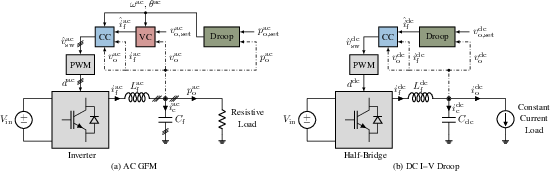
Figure 1: Source converters, controllers, and load models for (a) AC GFM and (b) DC I–V droop, including voltage, current, and PWM blocks.
The small-signal control block diagrams, critical for revealing structural duality, are summarized in (Figure 2).
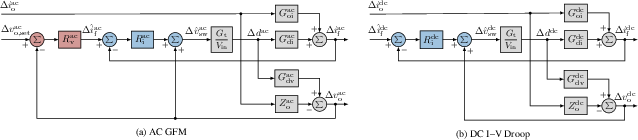
Figure 2: Small-signal control block diagrams for AC and DC source converters detailing converter, PWM, inner current, and outer voltage/droop control loops.
Inner Current Control and Small-Signal Isomorphism
By deriving and comparing the open- and closed-loop transfer functions for both converter types, the authors prove that, post-dq decoupling and focusing on a single axis, the inner current control design is identical. The transfer functions governing the current loops, including inductor and PWM dynamics, are shown to result in identical PI controller tuning formulas for both domains. This equivalence is foundational for the subsequent duality analysis and ensures that—given identical bandwidth allocation—the current tracking and regulation dynamics of both converters are matched. Simulation results confirm this theoretical equivalence with nearly indistinguishable time responses for reference current steps (Figure 3).
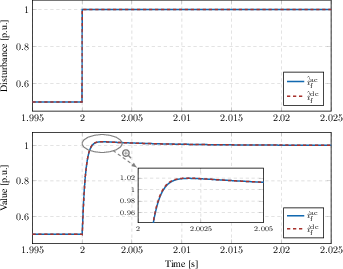
Figure 3: Step-response comparison of current controllers in AC and DC converters demonstrates dynamic equivalence.
Power Sharing Mechanism Duality
A central contribution of the paper is the unification of power-sharing mechanisms:
- AC GFM: Active power-frequency (P–ω) droop imitating the swing equation of synchronous machines, facilitating decentralized synchronization and power distribution.
- DC I–V Droop: Maps bus voltage deviation to inductor current setpoint, thereby effecting decentralized power sharing based on local voltage feedback.
A direct formal correspondence is established:
- AC system frequency deviation Δωac is the dual of DC bus voltage deviation Δvodc;
- Active power deviation Δpoac in the AC system corresponds to output current deviation Δiodc in the DC system;
- The AC swing equation’s inertia H is mapped to the DC output capacitance Cdc, and their damping/droop gains are equivalent.
This isomorphism is illustrated in (Figure 4), which juxtaposes the power-sharing loops. The analysis elucidates that, by proper bandwidth allocation and gain matching, the dynamic and steady-state behavior under disturbances (e.g., load steps) are also dual.

Figure 4: Duality in power-sharing: (a) AC GFM control and (b) DC I–V droop control block diagrams and signal mappings.
Disturbance and Dynamic Response Analysis
Disturbance analysis further validates the duality claim. For the AC system, a resistive load creates an active power disturbance; for the DC system, a constant current load disturbances the output current. Small-signal and time-domain analyses show that the response trajectories of the AC system frequency and DC bus voltage (considering the dual mapping) closely align under equivalent perturbations.
Simulation-based dynamic responses corroborate this, with nearly identical transient and steady-state behavior of their respective synchronization variables under disturbance, except for minor differences attributable to the AC system’s voltage controller action (Figures 6 and 7).
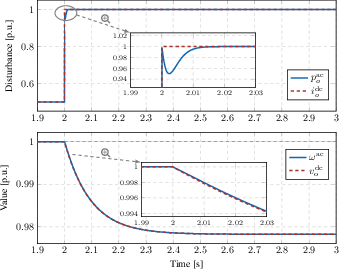
Figure 5: Response of AC frequency and DC voltage to matched output power/current disturbances.
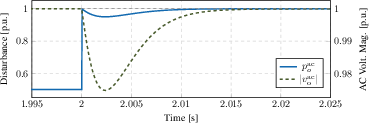
Figure 6: Terminal voltage dynamics for the AC converter during disturbance, illustrating the impact of voltage controller bandwidth.
Implications and Outlook
This unified framework enables porting of control design techniques, stability criteria, and tuning methodologies between domains, significantly reducing complexity in hybrid AC/DC microgrid deployments. Notably, the results support the use of DC droop controllers to provide grid-forming-like behavior in DC systems within bandwidth constraints, augmenting their flexibility for future grid applications. The explicit formalization of duality also facilitates the systematic co-design of controllers for mixed AC/DC systems and aids in standardization efforts for control protocols.
In the theoretical domain, the foundation established by structural and functional duality points toward the possibility of universally-applicable passivity and small-signal stability analysis tools, as well as device-level black box diagnostic approaches equally valid in AC and DC domains.
Conclusion
The paper rigorously demonstrates the analytical and empirical duality between AC GFM and DC I–V droop control at both small-signal and system levels, establishing a direct isomorphism in device dynamics, control loop structures, and power-sharing principles. These results provide a technical basis for harmonized control frameworks and potentiate simplified, stable operation of hybrid or cross-coupled microgrids, with immediate significance for the synthesis and interoperability of converter-dominated power systems.
References
- "Exploring Converter Control Duality in Microgrids: AC Grid-Forming vs DC Droop Control" (2604.26595)