- The paper introduces a three-stage pipeline that leverages LLMs for rule generation, budget-aware failure recovery, and zero-shot object scoring without expert intervention.
- It demonstrates that LLM-driven techniques can match or exceed manual baselines, achieving a success rate improvement of up to +0.117 on MazeNamo benchmarks.
- The study highlights limitations at scale due to context window constraints and proposes future work on longer-context models and refined rule distillation methods.
LLM-Flax: Generalizable Robotic Task Planning via Neuro-Symbolic Approaches with LLMs
Introduction and Motivation
LLM-Flax addresses the longstanding barriers in deploying neuro-symbolic planners for challenging robotic task domains. Classical planners offer soundness but often scale poorly in the presence of large object sets and intricate relational structure. Recent neuro-symbolic approaches alleviate this by using GNNs to filter relevant objects and supplementing symbolic planning with expert-authored relaxation and complementary rules. However, transferring such systems to a new domain requires extensive manual authoring of these rules and domain-specific GNN training—both substantial sources of engineering bottleneck.
The LLM-Flax framework proposes to eliminate all domain-expert and labeled-data requirements in neuro-symbolic planning, leveraging recent advances in LLM capabilities for structured reasoning, PDDL comprehension, and code synthesis. The system is structured as a three-stage pipeline, each stage removing a distinct source of manual knowledge, and is deployable on unseen domains using only a raw PDDL domain file.
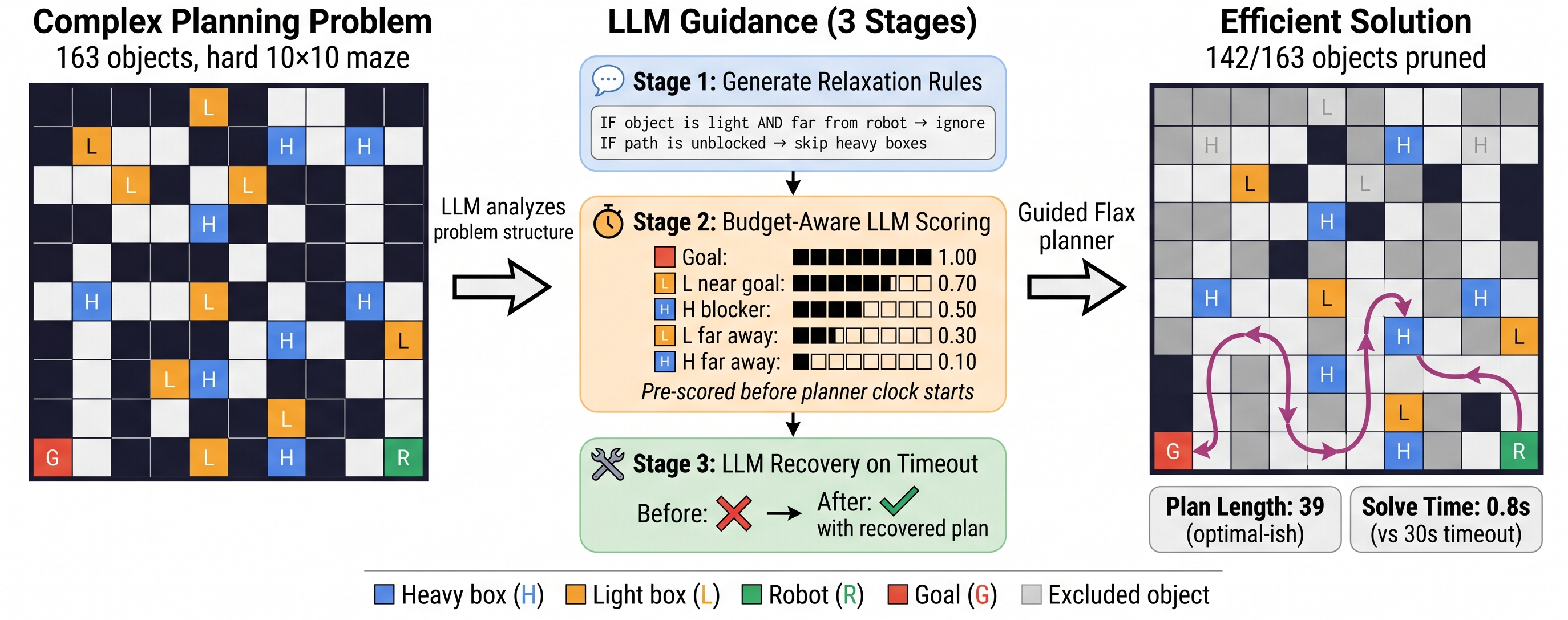
Figure 1: High-level LLM-Flax pipeline—Stages 1–3 collectively enable deployment on a novel domain with no manual rule engineering or GNN training.
System Architecture
The LLM-Flax architecture extends the Flax neuro-symbolic planner by inserting LLM-driven modules at three key stages. Stage 1 automates rule generation; Stage 2 introduces budget-aware, LLM-guided failure recovery; Stage 3 replaces the domain-specific GNN object scorer with an LLM-based zero-shot alternative.
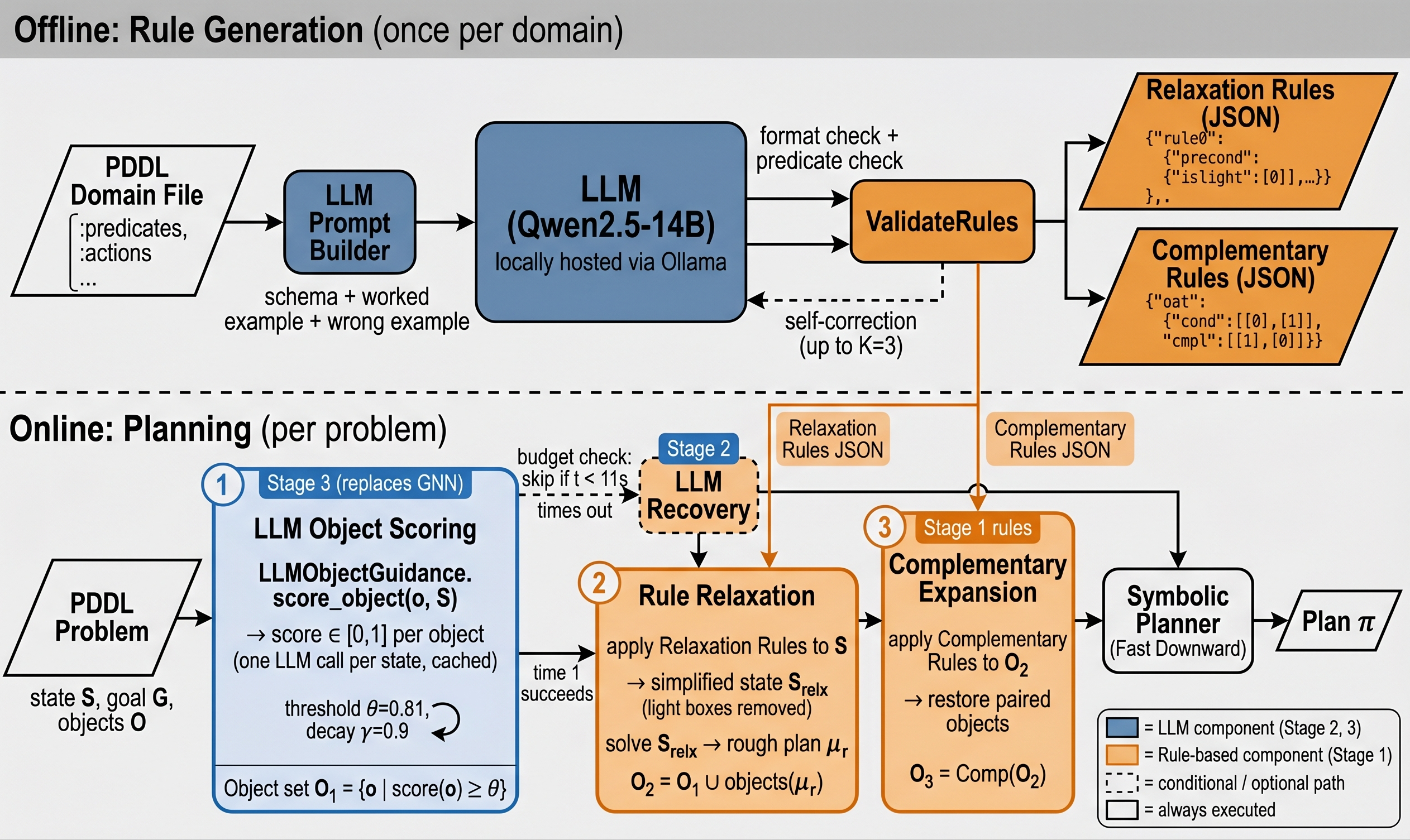
Figure 2: System architecture. (Left) Stage 1 generates rules from the PDDL file via LLM prompting and validation. (Center) The three-step planning loop is retained. (Right) Stage 2 enables budget-aware LLM recovery, and Stage 3 replaces the domain-trained GNN scorer with a zero-shot LLM scorer.
Stage 1: LLM Rule Generation
Relaxation and complementary rules are automatically generated from the domain PDDL via structured prompting of an open-source LLM (Gemma3-12B), with mechanisms for format validation and self-correction. Deduplication and predicate filtering post-processing steps ensure only structurally and semantically valid JSON rule assignments are yielded.
Crucially, the LLM-generated rules for the canonical MazeNamo domain are structurally identical to those manually authored by experts for relaxation, and richer (including additional semantically valid complementary rules) than those in the baseline for complementary expansion. Empirical analysis confirms the LLM-extracted relaxation rules are optimal in both coverage and expressiveness for this domain.
Stage 2: LLM-Guided Failure Recovery
Conventional neuro-symbolic systems—when their neural-guided object pruning fails—resort to heuristic fallback that lacks semantic reasoning about the cause of failure. LLM-Flax instead inserts an LLM-guided diagnostic and recovery module. When object pruning fails (because necessary objects are omitted), the LLM is queried to suggest candidate additions, given the current state, goal, and object sets. This is governed by a latency-aware, feasibility-gated budget policy that preempts LLM calls if time constraints cannot be satisfied, ensuring that critical downstream planning is not starved of time—a failure mode that prior policies encountered.
Stage 3: LLM-Based Zero-Shot Object Scoring
The final manual knowledge bottleneck is the need for hundreds of domain-specific training instances to train the GNN object scorer. LLM-Flax replaces this with an LLM module that, given the goal and a subset of state facts, assigns importance scores to all objects zero-shot. To achieve practical inference, the state-to-score prompt is capped at 80 grounding facts, and caching is used to amortize LLM cost per problem instance.
Limitations emerge for large domains—context window and inference latency restrict effectiveness, particularly on “expert” scale benchmarks.
Empirical Evaluation
Evaluation is performed on the MazeNamo benchmark suite across eight grid-based robotic manipulation and navigation tasks of varying combinatorial hardness (10×10, 12×12, 15×15 grids; easy–expert). Metrics include success rate (SR), average planning time, and average plan length.
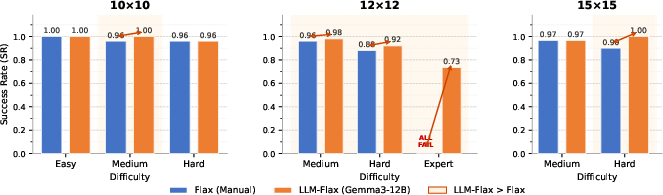
Figure 3: Success rate versus task difficulty and grid size; LLM-Flax matches or outperforms manual rules throughout, most strikingly on previously unsolvable navigation-heavy “expert” instances.
Main Results
LLM-Flax consistently matches or exceeds the manually engineered rule baseline on all eight benchmarks, improving success rate by +0.117 averaged across the suite (SR 0.945 vs. 0.828). For difficult tasks (e.g., 12×12 Expert), manual baselines completely fail (SR 0.000), while LLM-Flax attains SR 0.733; on 15×15 Hard, LLM-Flax achieves SR 1.0 versus manual’s 0.9. The additional complementary rules induced by the LLM are found to be semantically useful in reducing failures from omitted structural dependencies, though some over-inclusion can inflate problem size and timeouts at expert scale.
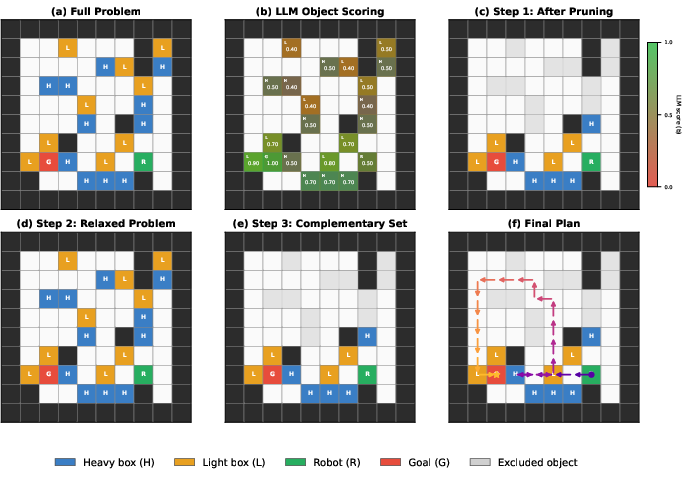
Figure 4: Pipeline visualization for a 10×10 hard task: (a) raw instance, (b) LLM-scored objects, (c) post-threshold pruning, (d) relaxation, (e) complementary expansion, (f) plan found.
Ablation studies demonstrate that LLM-driven failure recovery (Stage 2) is neutral—neither improving nor degrading robustness—so long as the feasibility-gated budget policy is in effect. Omission of budget gating in earlier versions resulted in catastrophic performance regressions due to relaxation step starvation.
When Stage 3 fully eliminates GNN supervision, performance remains feasible but degrades at large scale (SR 0.72 for 12×12 Hard, but drops to 0.20 for 15×15 Hard) due to context window and prompt limitations. Attempts to improve stage 3 with chain-of-thought or fact selection techniques further degrade performance due to longer LLM latencies, exposing a fundamental bottleneck.

Figure 5: Compact success rate heatmap. Only LLM-Flax configurations achieve high SR on navigation-heavy and large-scale benchmarks, outperforming both manual and GNN-only baselines.
LLM Rule Quality and Model Sensitivity
Detailed analysis reveals that Gemma3-12B, the primary LLM used, produces structurally and semantically correct rules matching manual configurations. Other models (Qwen2.5-14B, Llama3.1-8B, Mistral-7B) have varying quality: some are over-conservative, generate spurious or invalid rules, or hallucinate predicate names. High success rates are tightly coupled with the LLM’s ability to parse and generalize from PDDL signatures.
The rule validation and self-correction pipeline is shown to be essential: without it, LLMs produce unusable outputs even with the most capable models. Post-processing—such as deduplication and out-of-domain predicate dropping—remains necessary for robust deployment across domains.
Practical and Theoretical Implications
LLM-Flax demonstrates that open-source LLMs can reliably infer the essential neuro-symbolic structure required for combinatorial task planning with only formal PDDL input, removing the need for manual concept engineering and supervised learning. This fundamentally shifts the paradigm for domain adaptation, eliminating the primary labor bottleneck in deploying neuro-symbolic planners on new domains. The framework inherently supports zero-shot generalization to new domains, with empirical results indicating that PDDL naming conventions suffice for robust rule extraction in STRIPS-style settings.
On larger or more permutation-rich domains, LLM context window limitations or inference budgets emerge as the principal performance constraints. This points to immediate research directions: adoption of longer-context LLMs, improved prompt compression, or online pruning of over-inclusive rule sets.
The budget-aware failure recovery scheme highlights the necessity of latency-conscious, preemptive resource allocation in LLM-integrated planning systems—a design principle that will become more central as LLM inference costs and variable planning horizons intersect in mixed-symbolic/LLM stacks.
Future Directions
Addressing context window bottlenecks in LLM-based object scoring (e.g., models with architecturally supported 32k+ token windows) would unlock higher-dimensional problems. Exploring few-shot fine-tuning on small state-goal trace corpora, or integrating rule distillation mechanisms to prune over-inclusive LLM-generated complementary sets, are also promising avenues.
Generalization was confirmed only on MazeNamo; systematic evaluation across diverse STRIPS-style domains such as DifficultLogistics and SokomindPlus remains essential. Extending the framework’s methodology to domains with predicate overloading or weak naming conventions would further substantiate cross-domain applicability.
Conclusion
LLM-Flax removes the three primary sources of manual engineering in neuro-symbolic planning: hand-crafted rule authoring, scripted failure recovery, and problem-specific GNN training. By leveraging PDDL-aware, open-source LLMs and robust validation pipelines, it enables immediate deployment to new domains at expert-level performance for small/medium problem instances.
Empirical results show universal parity or improvement over manual baselines, with strong gains on navigation-heavy and large-horizon tasks. Although context/window-driven degradation emerges at the largest scales for zero-shot LLM scoring, the overall findings establish LLM-based neuro-symbolic planning as a practical, domain-agnostic solution for real-world robotic task planning.
Future work targeting LLM context scaling, rule quality control, and extension to less formalized representations has the potential to further advance general-purpose, out-of-the-box planning systems.