- The paper introduces directional curvature and extends superquadraticity to define precise criteria for medial axis reachability of singularities.
- It establishes necessary and sufficient conditions for when singular points of definable sets lie in the closure of the medial axis.
- The work employs o-minimal techniques and shape functions, offering insights applicable in computational geometry and singularity theory.
Introduction and Problem Statement
This work addresses the geometric and analytic properties of the medial axis MX of a closed, definable subset X⊂Rn, with particular focus on singularity reaching phenomena. The medial axis, which consists of points in Rn admitting more than one closest point in X, is a fundamental object in geometric modeling, pattern recognition, and singularity theory. The central problem is the precise characterization of points in the intersection MX∩X, i.e., singularities "reached" by the closure of the medial axis.
The authors extend the toolkit for studying MX by introducing the notion of directional curvature in naturally chosen "camber directions" and by generalizing the concept of superquadraticity beyond the smooth category, providing necessary and sufficient conditions for the reaching of singularities by the medial axis.
Foundational Definitions and Geometric Framework
Let X⊂Rn be closed and definable in a polynomially bounded o-minimal structure. The set of points with more than one closest point, the medial axis, is denoted as
MX:={a∈Rn∣#m(a)>1}
where m(a):={x∈X∣∥a−x∥=d(a,X)} is the (possibly multivalued) nearest-point map.
A key challenge is understanding under what geometric or analytic conditions a singularity x∈X satisfies X⊂Rn0; that is, when is the singularity "detectable" or "reachable" by X⊂Rn1\mathscr{C}2X⊂Rn2M_X,</sup>compellinganalysistofocusonpointsoflowerregularity.</p><p>Acrucialgeometricinvariantisthe<strong>Peano<ahref="https://www.emergentmind.com/topics/tangent−cone"title=""rel="nofollow"data−turbo="false"class="assistant−link"x−datax−tooltip.raw="">tangentcone</a></strong>X \subset \mathbb{R}^n$3 and the associated normal cone $X \subset \mathbb{R}^n$4, providing the set of directions relevant for probing the tangency and "flatness" of $X \subset \mathbb{R}^n$5 at $X \subset \mathbb{R}^n$6. The authors introduce the notions $X \subset \mathbb{R}^n$7 (the $X \subset \mathbb{R}^n$8-singular locus) and $X \subset \mathbb{R}^n$9 (the set of $\mathbb{R}^n$0-regular but $\mathbb{R}^n$1-singular points), partitioning the locus of potential reaches by $\mathbb{R}^n$2.
Superquadraticity, Directional Curvature, and General Curvature
The paper extends the notion of superquadraticity—a condition previously understood for hypersurfaces—to arbitrary codimensions and singular points, thereby covering broader geometric settings. For a germ $\mathbb{R}^n$3, superquadraticity is measured via a growth function $\mathbb{R}^n$4 comparing the normal component's distance to the tangent plane as a function of the tangential distance, with the critical slope governed by exponents $\mathbb{R}^n$5 such that $\mathbb{R}^n$6 as $\mathbb{R}^n$7.
To operationalize this in arbitrary dimension and at singular points, the authors define:
- Directional curvature $\mathbb{R}^n$8 along a "camber direction" $\mathbb{R}^n$9, quantifying the optimal exponent $X$0 such that the germ of $X$1 around 0 is contained in a $X$2-directional sector where the $X$3-component is bounded by $X$4, with $X$5 in the orthogonal complement of $X$6.
- General curvature $X$7, the minimal exponent such that the $X$8-component (in a suitable coordinate splitting) is $X$9 for $\overline{M_X}\cap X$0 near 0.
It is demonstrated that $\overline{M_X}\cap X$1, coupling the various directional curvatures to a global invariant (Theorem \ref{theta}). Superquadraticity corresponds to $\overline{M_X}\cap X$2, generalizing previous results for hypersurfaces.
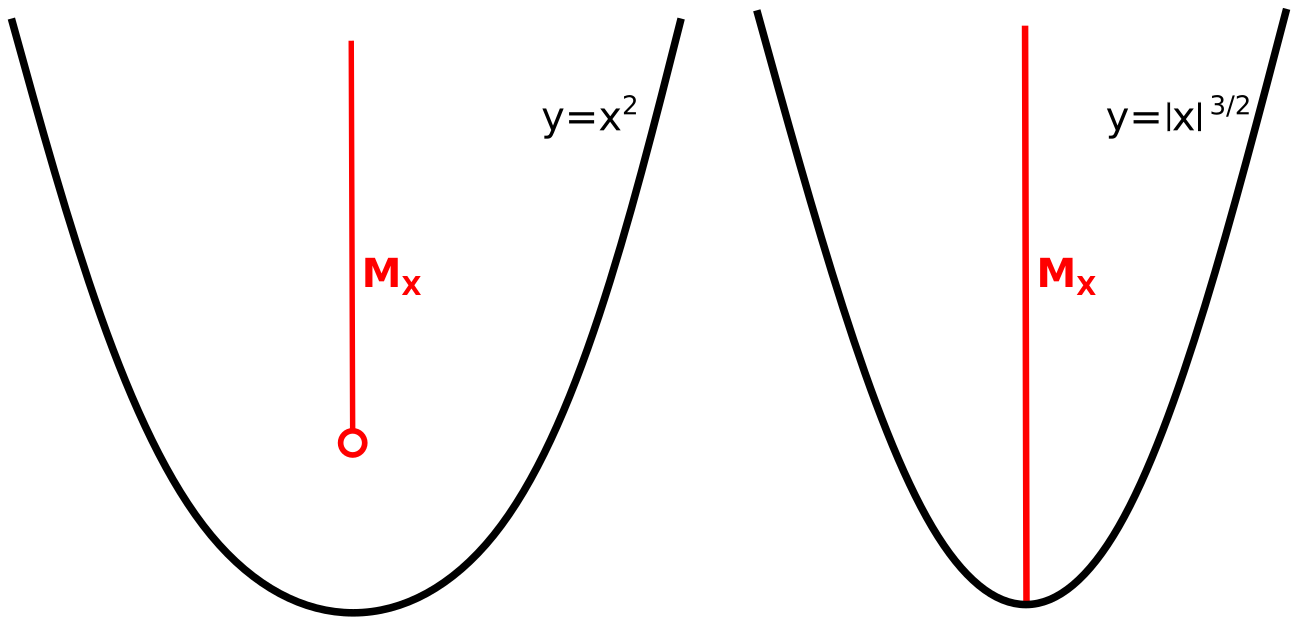
Figure 1: Unlike the parabola, the curve $\overline{M_X}\cap X$3 is only $\overline{M_X}\cap X$4-smooth (not $\overline{M_X}\cap X$5-smooth) at the origin, illustrating the type of singularity where $\overline{M_X}\cap X$6 can reach the origin.
For regular points, the Nash Lemma guarantees that $\overline{M_X}\cap X$7 avoids neighborhoods of points with non-degenerate second-order tangency ($\overline{M_X}\cap X$8). Singular points and certain degenerate regular points remain potential targets for $\overline{M_X}\cap X$9.
The study provides a refined criterion for reachability: if there exists a camber direction $M_X$0 at $M_X$1 such that $M_X$2, then $M_X$3 (Theorem \ref{kierunek}). Equivalently, $M_X$4 is sufficient for reachability in the germ. The proof exploits definable selection and \L ojasiewicz inequalities, leveraging o-minimality to extract precise exponents.</p>
<p>The <strong>reaching radius</strong> $M_X$5, together with its directional and limiting variants, is also invoked as an analytic characterization: $M_X6holdsgenerally,butthedirectionalcurvatureframeworkyieldsmoregeometricinsight.</p><p><imgsrc="https://images.emergentmind.com/paper−images/2604−26490/horizontallyfilled.png"alt="Figure2"title=""class="markdown−image"loading="lazy"></p><p><pclass="figure−caption">Figure2:Thenecessityofhorizontalfillingfortheplanecase;ontheleft,theoriginisnotachievablebyM_X$7 if $M_X$8 is horizontally filled, while on the right, the origin is achievable otherwise.
Plane Case: Sharp Criteria and Separation at the Critical Slope
In the planar case ($M_X$9), the authors present sharp results under mild "horizontal filling" conditions. If $X\subset \mathbb{R}^n$0, then $X\subset \mathbb{R}^n$1; if $X\subset \mathbb{R}^n$2, then $X\subset \mathbb{R}^n$3 (Theorems \ref{plane geq 2} and \ref{plane <2}). The proofs use constructive geometric arguments involving tangent disks to the branches of $X\subset \mathbb{R}^n$4 and separations provided by the associated curvature exponents.
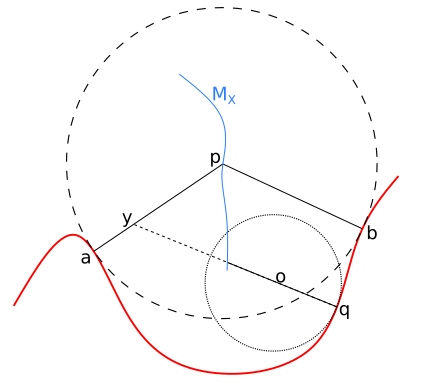
Figure 3: Illustrates the central set and the geometric locus where $X\subset \mathbb{R}^n$5 may approach the origin in the planar filled case.
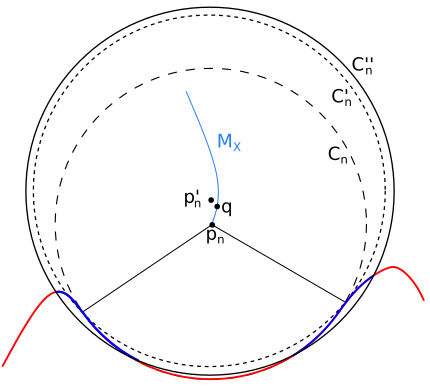
Figure 4: Configuration of mutually disjoint medial balls in the planar setup, establishing constraints on $X\subset \mathbb{R}^n$6 and sequence convergence.
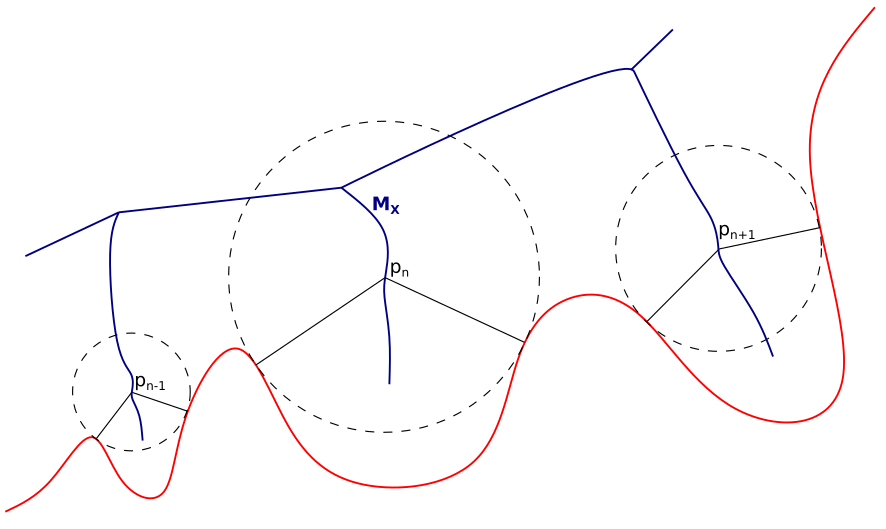
Figure 5: Shows covering geometry and exclusion of origin reachability by $X\subset \mathbb{R}^n$7 in the paraboloid-bound case ($X\subset \mathbb{R}^n$8).</p></p>
<h2 class='paper-heading' id='higher-dimensional-cases-and-limitations'>Higher Dimensional Cases and Limitations</h2>
<p>Extension to higher dimensions reveals subtleties not present in the planar case. The authors provide counterexamples (Proposition \ref{higher geq 2}) demonstrating that, for $X\subset \mathbb{R}^n$9, non-superquadraticity ($M_X := \{ a \in \mathbb{R}^n \mid \# m(a) > 1 \}$0) does not universally prevent $M_X := \{ a \in \mathbb{R}^n \mid \# m(a) > 1 \}$1 from accumulating at the origin. The construction leverages a union of cones and specific cuts, with $M_X := \{ a \in \mathbb{R}^n \mid \# m(a) > 1 \}$2 still "glued" at the origin in directions not present in $M_X := \{ a \in \mathbb{R}^n \mid \# m(a) > 1 \}$3, indicating that the interaction between geometry and the medial axis is more intricate in higher dimensions.
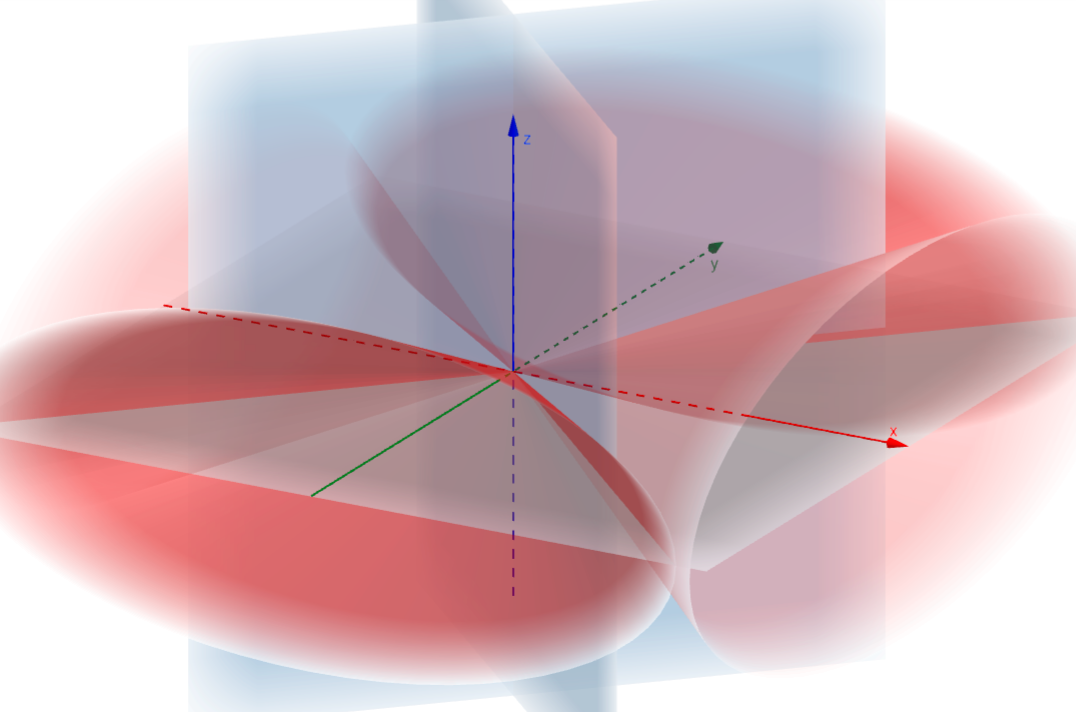
Figure 6: Depicts a three-dimensional configuration where $M_X := \{ a \in \mathbb{R}^n \mid \# m(a) > 1 \}$4 reaches the origin due to nontrivial global geometry, despite superquadraticity in local sections.
The authors formalize shape functions $M_X := \{ a \in \mathbb{R}^n \mid \# m(a) > 1 \}$5, measuring the extremal displacement in direction $M_X := \{ a \in \mathbb{R}^n \mid \# m(a) > 1 \}$6 for points at Euclidean distance $M_X := \{ a \in \mathbb{R}^n \mid \# m(a) > 1 \}$7 from the origin along the tangent cone. The order of vanishing of these functions at the origin directly recovers the relevant curvature invariants, systematically organizing the possible geometric germ types.
Furthermore, the proofs clarify the relationship between the order of growth of the normal component functions and the geometry detected by $M_X := \{ a \in \mathbb{R}^n \mid \# m(a) > 1 \}$8, drawing on selection theorems and the structure theory of definable sets.
Implications and Future Directions
This work provides comprehensive necessary and sufficient criteria—expressed via explicit curvature exponents—for when singularities of definable sets are reached by their medial axes, resolving open problems in the analytic and subanalytic, o-minimal context. The introduction of directional curvature, with explicit computation via shape functions, equips singularity theory with discriminants accessible for automated and algorithmic checking, especially pertinent in computational geometry or singularity classification.
The paper demonstrates that, at least in tame geometric settings, the reachability of singularities by $M_X := \{ a \in \mathbb{R}^n \mid \# m(a) > 1 \}$9 is governed by fine analytic data (curvature exponents), with clear phase transitions at the critical value $m(a):= \{ x \in X \mid \|a-x\| = d(a,X) \}$0. For higher dimensions, the necessity of global geometric hypotheses is highlighted, suggesting further possible research into topological obstructions, stratification effects, and the role of filling conditions.
Conclusion
The authors' framework systematically generalizes the theory of the medial axis and its interaction with singularities, incorporating directional and general curvature as precise quantitative invariants in the tame geometry category. The theorems unify and extend prior scattered results, clarify the structure of attainable singularities, and lay the groundwork for further investigations in higher codimension and dimension, as well as in algorithmic applications to medial axis computation in semialgebraic and subanalytic contexts.

