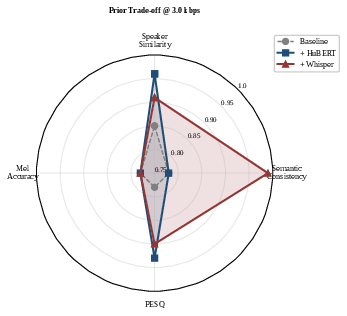
- The paper demonstrates that using frozen semantic priors with a dynamic alpha-adjust module yields a ~10% reduction in WER at low bitrates.
- It compares HuBERT and Whisper priors, highlighting HuBERT's acoustic fidelity and Whisper's effectiveness in lowering phonetic hallucinations.
- It introduces a bitrate-aware regulation strategy, defining a 'semantic retirement' boundary above 6 kbps to balance intelligibility and naturalness.
The Role and Boundaries of Semantic Priors in Ultra-Low-Bitrate Neural Speech Coding
Introduction
The compression of speech signals at ultra-low bitrates (≤1.5 kbps) challenges conventional neural codecs, whose information capacity becomes insufficient for preserving both intelligibility and acoustic quality. The main bottleneck transitions from spectral distortion minimization to the preservation of higher-level linguistic structure, resulting in what the authors term "semantic collapse." This paper systematically interrogates the mechanisms, limits, and benefits of frozen high-capacity semantic priors within neural codec pipelines, notably HuBERT and Whisper, and introduces the SPG-Codec framework to dynamically regulate their influence as a function of bitrate (2604.26296).
Methodology: SPG-Codec Framework
The SPG-Codec system augments a conventional convolutional encoder-decoder codec backbone—akin to SoundStream/EnCodec—with an additional semantic constraint module and a bitrate-aware regulation strategy.
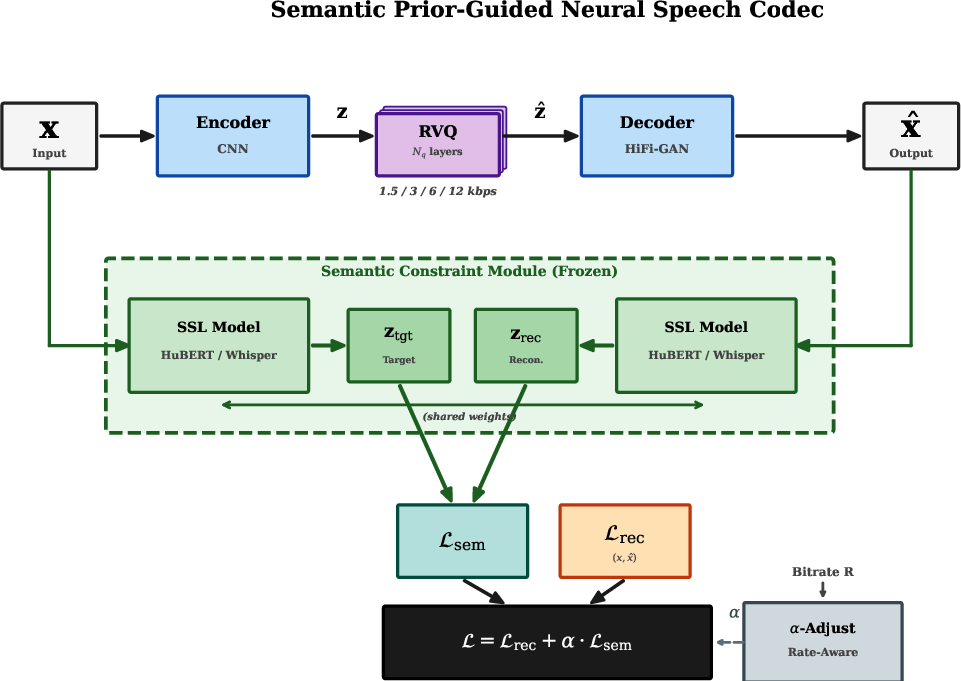
Figure 1: The SPG-Codec architecture with a frozen Semantic Constraint Module and dynamic α-Adjust for per-bitrate semantic weight tuning.
This architectural extension enables controlled integration of self-supervised (HuBERT) or ASR-derived (Whisper) semantic priors. Crucially, the alpha-Adjust module dynamically scales the gradient contribution of the semantic loss based on the instantaneous bitrate, directly addressing the phenomenon coined "Semantic Retirement".
Backbone and Scalable Quantization
The core neural codec employs residual vector quantization (RVQ) for variable bitrate control, feeding a GAN-based decoder (HiFi-GAN) for waveform synthesis. The framework allows selection of the number of quantizers Nq per input, directly regulating average bitrate.
The frozen priors inject high-level semantic representations, extracted by passing both the codec input and output through either HuBERT or Whisper. The semantic L1 loss between layer-normalized internal representations Φ quantifies semantic mismatch. Notably, the priors are not updated during codec training, avoiding information leakage or task contamination.
Bitrate-Aware Regulation
Empirically, the semantic loss exhibits differentiated utility across the bitrate spectrum, which the authors formalize as the "Semantic Retirement" boundary. A dynamic weighting strategy α(R) peaks for low-bitrate regimes and decays for higher bitrates, preventing gradient conflict between reconstruction and semantic objectives.
Key Results
Semantic Retirement Phenomenon
Introducing semantic priors achieves strong improvements in intelligibility at 1.5 kbps, manifesting as a ∼10% relative reduction in WER. However, effects diminish rapidly with increasing bitrate, yielding negligible benefit above 6 kbps and, in some cases, degrading naturalness due to over-smoothing.
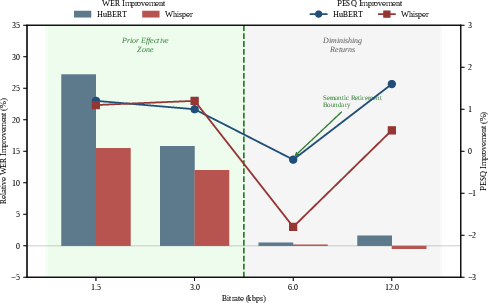
Figure 2: Large gains from semantic priors at low bitrates (≤3 kbps) vanish above 6 kbps, illustrating the "Semantic Retirement" phenomenon.
This boundary underscores a task- and compression-dependent tradeoff: semantic priors are most valuable when bottlenecks are severe and become redundant as bandwidth suffices for acoustic detail transmission.
Detailed Prior Analysis: Acoustic vs. Semantic
The choice of prior is consequential:
Robustness to Noise and Hallucinations
Whisper-based semantic guidance confers marked resilience against noise. Under low SNR, WER increases less sharply than for naive codecs or HuBERT-based variants, reflecting the ASR model's invariance to nonlinguistic variability.
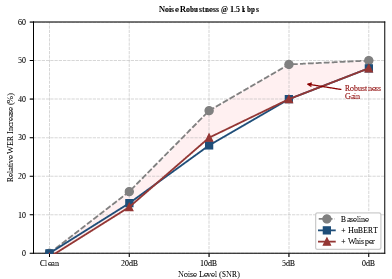
Figure 4: Semantic priors, especially Whisper, cap WER growth under noise perturbation.
Phonetic hallucination rates at 1.5 kbps are reduced by 26% absolutely when adopting Whisper, confirming its utility as an anti-hallucination constraint for generative codecs.
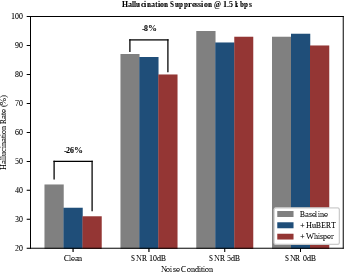
Figure 5: Whisper prior reduces clean-condition hallucination rates by 26% at 1.5 kbps.
Dynamic Prior Regulation
Over-regularization with fixed semantic weight incurs degraded perceptual quality. An inflection, or "sweet spot," emerges at α=0.05−0.1, for which WER and PESQ are jointly optimized; excessive α (≥0.2) induces over-smoothing and lower fidelity.
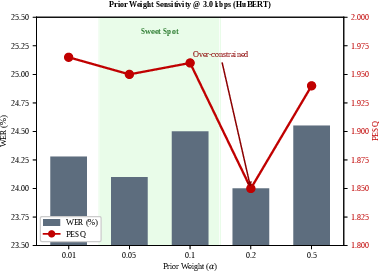
Figure 6: There is a clear performance optimum for regulation weight α0; beyond this, quality deteriorates.
Implications and Outlook
The core finding—a sharp semantic retirement boundary at 6 kbps—generalizes across neural codec architectures and aligns with the empirical limits reported for tokenized speech LLMs. The detailed tradeoff analysis between acoustic-centric and linguistic-centric priors provides prescriptive guidance for codec designers optimizing for intelligibility vs. timbral quality under variable network and deployment conditions.
Bitrate-aware prior regulation is crucial to avoid gradient interference, especially as codecs migrate to multitask frameworks (e.g., TTS, Speech Synthesis) or integrate directly with SpeechLLMs. The anti-hallucination and robustness benefits of high-level priors, notably ASR-trained ones like Whisper, signal their value for real-world telecommunication and generative tasks exposed to channel distortions or unseen speakers.
There is an evident pathway toward extending end-to-end optimization with large-scale flow-matching or diffusion models, leveraging the diagnostic tools and findings from this work to probe and push codec capacity further.
Conclusion
This paper provides a comprehensive, quantitative exploration of the role and limits of frozen semantic priors in ultra-low-bitrate neural speech coding. By formalizing and characterizing the semantic retirement phenomenon, contrasting acoustic and semantic prior behaviors, and advancing dynamic bitrate-aware regulation strategies, it delineates both the practical boundaries and the utility sweet spots for semantic guidance in speech codecs. These findings will inform the design of the next generation of robust, flexible generative speech coding systems.