Spotlight, priorsketching and Bayesian approximation error paradigms
Published 29 Apr 2026 in math.NA | (2604.26254v1)
Abstract: A way to lower computational cost in large scale inverse problems and problems depending on poorly known model parameters is to replace the detailed model by an approximate one. Inverse problems are typically ill-posed, and the model discrepancy introduced by using approximate models often shows up in the computed solutions as disturbing artifacts or blurring. In this article, we consider two methods of addressing certain types of modeling errors, the Bayesian approximation error (BAE) method and linear algebraic spotlight inversion to suppress clutter in the computational model by orthogonal projections. Through the process of analyzing the two approaches, we show that they turn out to be closely related but not equivalent, and we highlight a connection to sketching schemes in randomized linear algebra. The similarities between the methods and their successful suppression of most of the clutter effects is elucidated with two computed examples, one addressing of X-ray tomography and the other electrical impedance tomography.
The paper's main contribution is demonstrating that spotlight inversion is a limiting case of Bayesian approximation error, unifying them under a common framework to mitigate modeling uncertainty.
It introduces priorsketching, a novel randomized approach using Bayesian priors to efficiently construct projection operators and approximate error covariances.
Numerical experiments in X-ray tomography and electrical impedance tomography validate the methods, showing significant artifact suppression and reduced computational cost.
Spotlight, Priorsketching, and Bayesian Approximation Error Paradigms: A Technical Analysis
Introduction
The paper "Spotlight, priorsketching and Bayesian approximation error paradigms" (2604.26254) examines the interplay between computational efficiency and solution accuracy in large-scale inverse problems, especially in the presence of significant model uncertainties. It systematically compares and connects the Bayesian approximation error (BAE) method and the spotlight inversion technique, articulating their theoretical underpinnings and practical implications, with a novel introduction of "priorsketching"—a randomized linear algebraic approach informed by Bayesian priors.
Bayesian Approximation Error Paradigm
The BAE framework addresses inaccuracies that arise from replacing high-fidelity forward models with computationally feasible surrogates—either through dimensionality reduction or by fixing poorly known nuisance parameters. Within the Bayesian formalism, the error induced by such approximations is modeled as an additive random quantity with priors elicited from the joint distribution of the original and reduced model parameters.
Given a forward model f∗ and its surrogate f, the approximation error M=f∗(X)−f(Z) is incorporated in the likelihood, with its mean and covariance estimated from sample-based priors. A Laplace approximation is usually employed for computational tractability. This yields an augmented data model:
B=f(Z)+M+E
where M is Gaussian with data-driven mean and covariance.
The MAP estimator for the reduced parameter z takes the form:
This approach is effective in mitigating artifacts due to modeling error, as demonstrated in numerical experiments.
Spotlight Inversion
Spotlight inversion is rooted in linear algebraic projections for clutter suppression. Considering a linear inverse system with the variable of interest partitioned as x=[x1;x2], where x2 represents nuisance parameters, the model
b=A1x1+A2x2+e
is projected orthogonally onto the complement of f0's range. Denoting by f1 the corresponding projector, only the signal from f2 remains in the reduced system:
f3
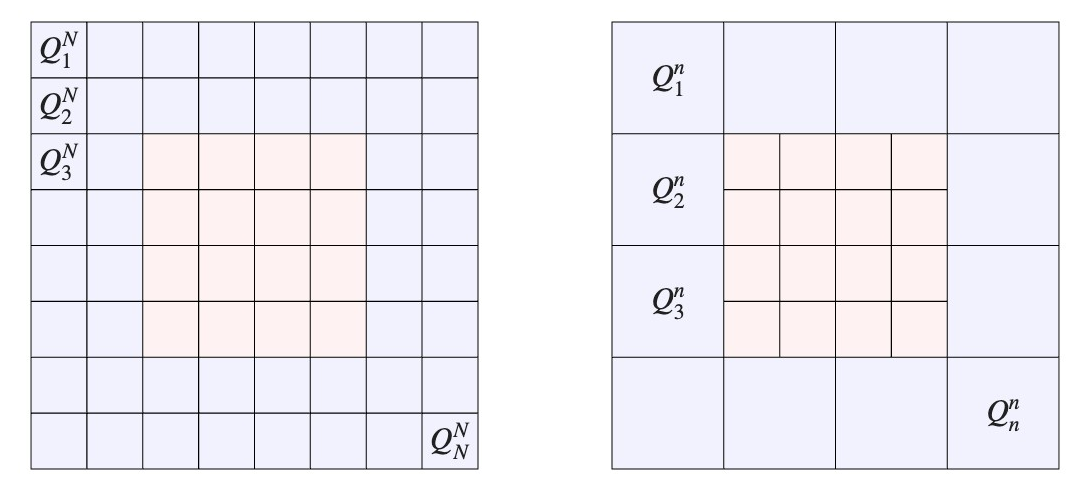
Figure 1: A schematic picture of coarsening, with the spotlight region f4 (pink square) handled at fine resolution.
(Singular vector truncation or randomized low-rank sketching can replace f5 when the range is not full-rank). This operation and its variants are computationally efficient, especially for high-dimensional parameter spaces with a clear separation between primary and nuisance parameters.
Priorsketching and Connections to Randomized Numerical Linear Algebra
Spotlight inversion and BAE share structural similarities: both suppress the effect of modeling error (or clutter) via projection. The work makes an explicit connection to randomized numerical linear algebra by introducing priorsketching, where sketching matrices are not generic but are sampled according to the Bayesian prior of the nuisance component, focusing the range approximation onto physically/plausibly relevant subspaces.
The estimation of the ‘clutter’ covariance f6 can be formulated by sketching with samples f7:
f8
This approach allows efficient projector and covariance construction, particularly with non-Gaussian priors and physically constrained variables (e.g., positivity).
Analytical Connections between the Approaches
The paper rigorously details how spotlighting is a limiting case of BAE, where the eigenvalues associated with the approximation error’s principal directions are sent to infinity, leading to full suppression in those subspaces. In the BAE framework, the likelihood penalizes data mismatch in the dominant eigensubspaces of the modeling error covariance less stringently, whereas the spotlight method discards them entirely.
Numerical Experiments
X-ray Tomography Example
The first application considers 2D fanbeam X-ray tomography, wherein the region of interest f9 is discretized finely and the outer regions coarsely, yielding a reduced forward model.
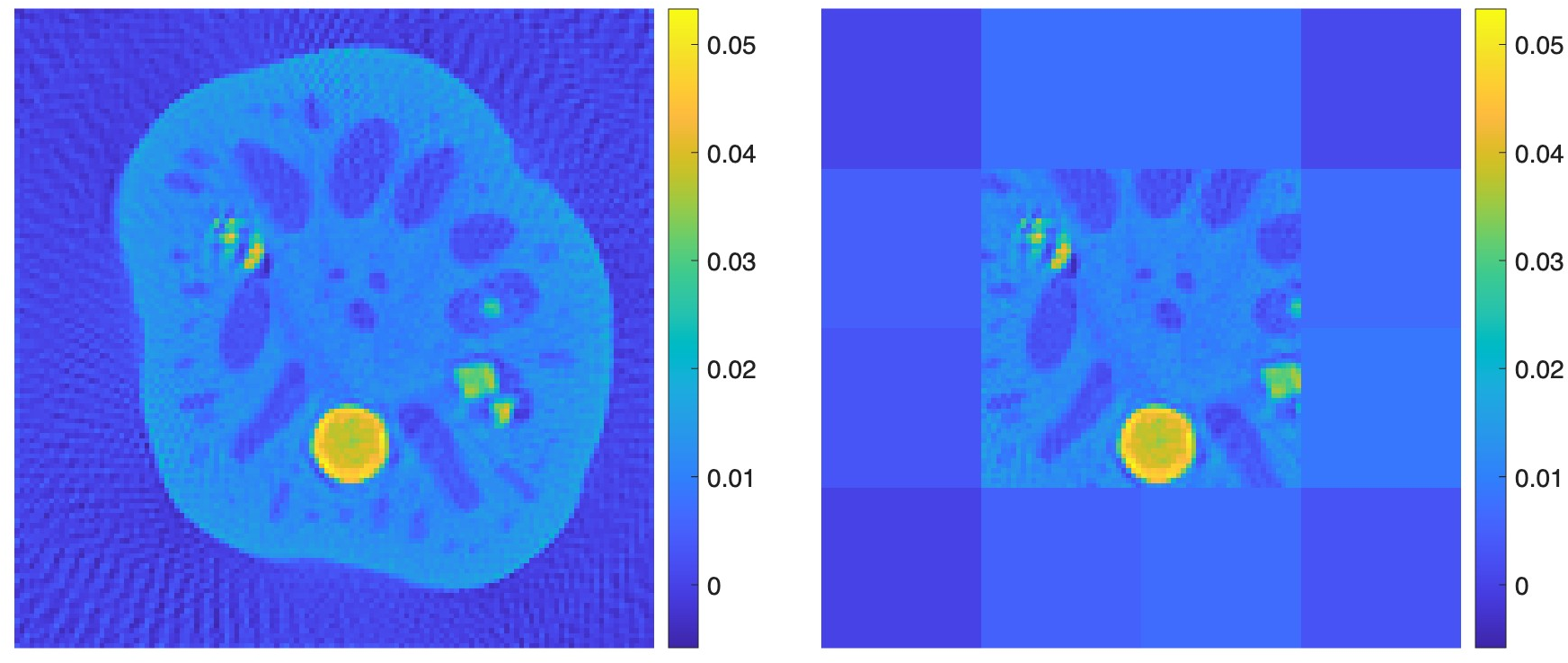
Direct inversion using the surrogate model, without approximation error compensation, yields significant blurring and halo artifacts in the region of interest.
Figure 2: Reference (right) vs. naive reconstruction without error compensation (left); absence of error modeling results in notable artifacts.
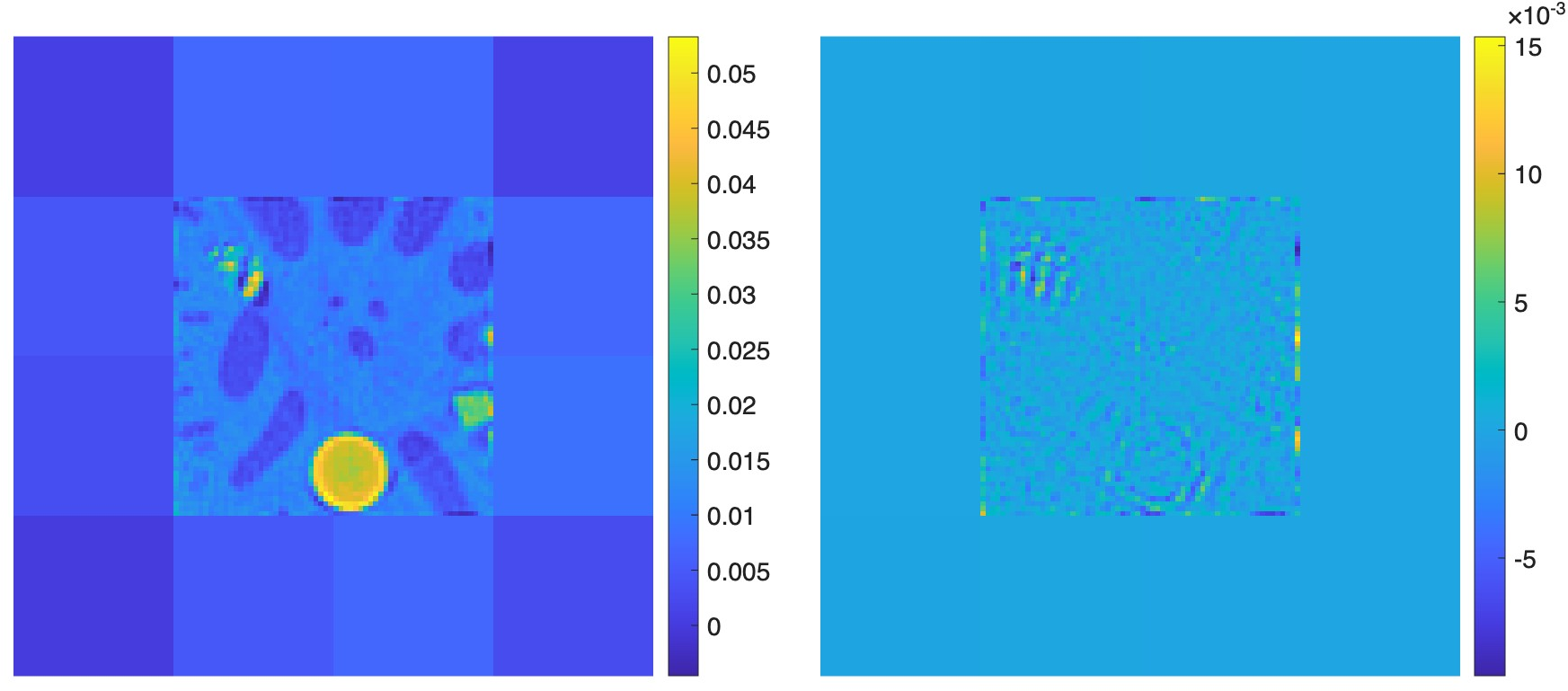
Incorporating the BAE model, with approximation error statistics generated from a logit-Gaussian prior and non-negativity constraints, reduces reconstruction error by an order of magnitude.
Figure 3: Reconstruction using BAE, showing substantial suppression of artifacts.
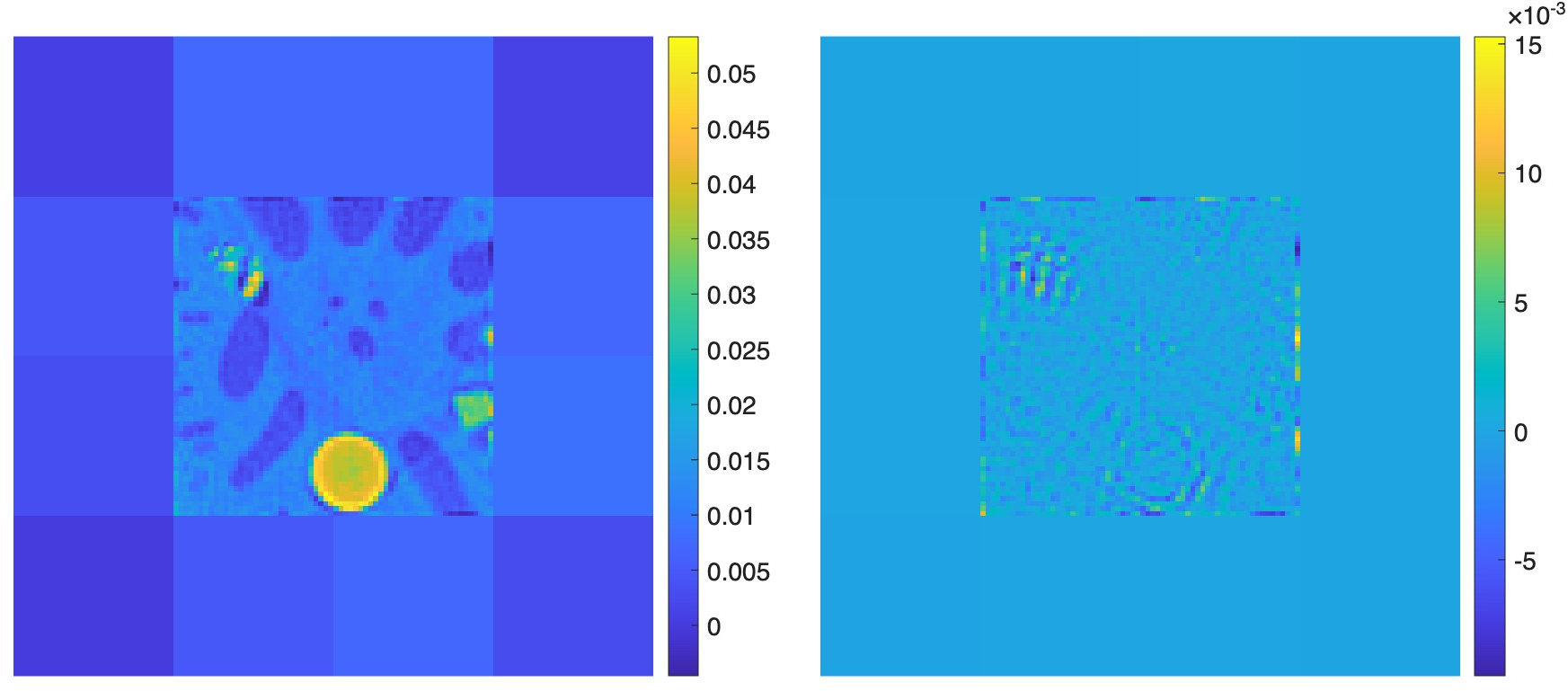
Spotlight inversion, using priorsketching for projector construction, achieves nearly identical error reduction without directly inverting dense error covariances.
Figure 4: Spotlight solution with priorsketching, matching BAE performance but at lower computational cost.
Electrical Impedance Tomography Application
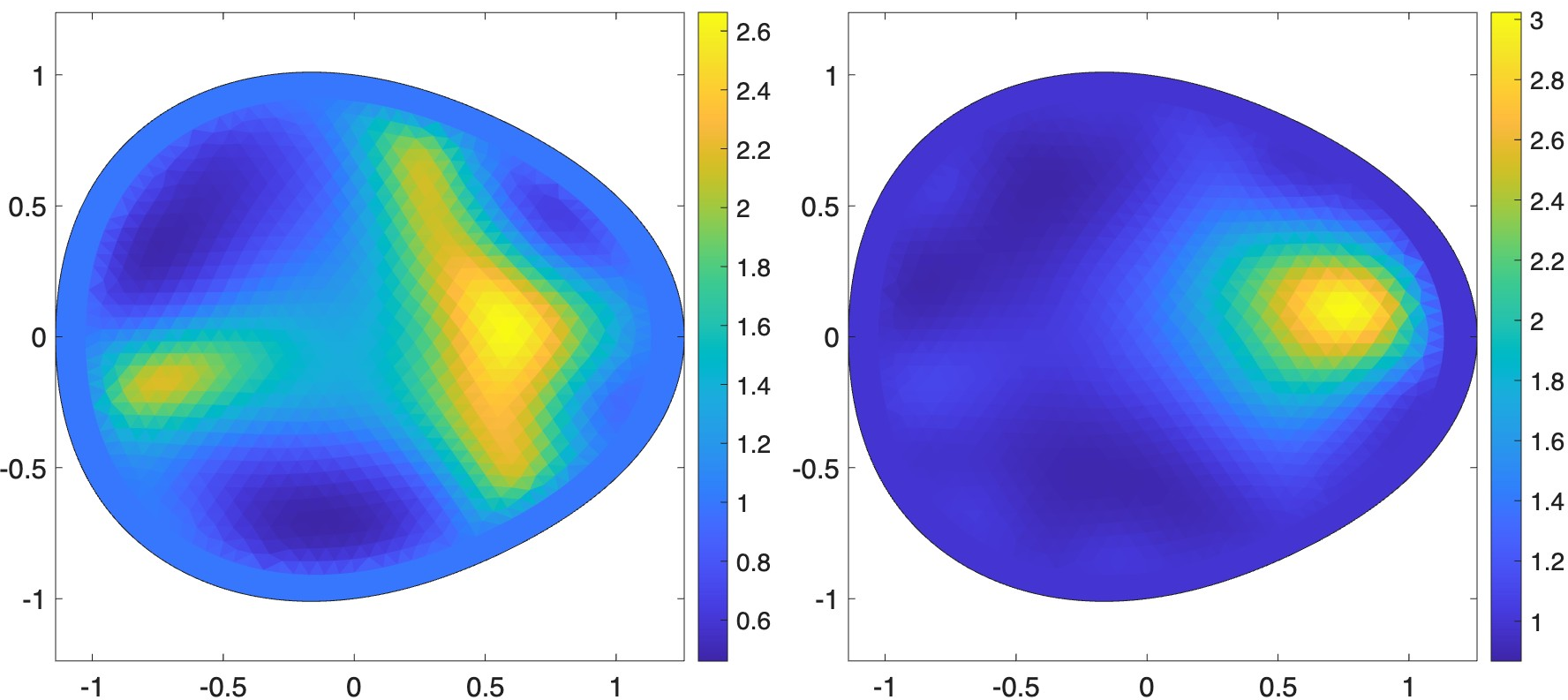
For nonlinear EIT with unknown domain boundary, the spotlight approach leverages priorsketching to construct projections that efficiently suppress error stemming from geometric uncertainty. Even with as few as five draws from the prior over the nuisance (domain shape), the projection method robustly eliminates geometry-induced artifacts while matching reference solution contrast.
Figure 5: Left: EIT reconstruction ignoring approximation error, showing strong geometry-induced artifacts; Right: spotlight-based projection (using only five priorsketching samples) yields high-fidelity recovery.
Implications and Future Directions
The formal bridge established between BAE and spotlight/priorsketching underscores the value of mixing Bayesian inferential structure with randomized numerical methods, enabling robust reduction of model-induced artifacts in high-dimensional inverse problems. Theoretical implications extend to optimal low-rank approximations in Bayesian linear inverse settings and interpreting (prior-informed) sketching methods as regularization.
Practically, the priorsketching-inspired spotlight approach is highly scalable and easily deployable in nonlinear and/or constrained inverse problems, such as positive conductivity estimation in EIT. It obviates the need for full covariance estimation, instead leveraging physically interpretable priors for targeted low-rank noise subspace construction.
Further research may advance adaptive, data-driven priorsketching strategies and extend the framework to fully nonlinear and non-Gaussian regimes; deeper integration with Hessian-based sketching and iterative BAE updating is also promising. The limiting behavior between BAE and projection approaches in noisy, high-dimensional settings merits rigorous analysis.
Conclusion
This work meticulously analyzes and connects two model error compensation techniques—Bayesian approximation error and spotlight inversion—opening the space for prior-informed, randomized sketching methods (“priorsketching”) in inverse problems. The unified framework enhances reconstruction accuracy under model uncertainty, preserves computational efficiency, and sets a foundation for future algorithmic and theoretical developments in high-dimensional Bayesian inversion, particularly for scenarios with severe nuisance parameter dominance or non-Gaussian priors.