- The paper presents an exact analytic solution for the nonequilibrium steady states of multi-mode bosonic systems with continuous O(N) symmetry.
- It demonstrates that coherent parametric driving induces robust quantum limit cycles and limit tori, reducing phase noise below the traditional Schawlow–Townes limit.
- The work extends quantum many-body models by enabling precise control of non-Gaussian entanglement and symmetry-broken dynamics in open quantum systems.
Quantum Limit Cycles with Continuous Symmetries: Exact Solutions and Many-Body Extensions
Introduction and Motivation
The paper "Quantum limit cycles with continuous symmetries from coherent parametric driving: exact solutions and many-body extensions" (2604.25864) identifies a route to realizing dissipative quantum limit cycles that simultaneously feature continuous internal symmetries and the absence of incoherent driving. This development overcomes a prevailing assumption that O(N)- or U(1)-symmetric quantum limit cycles necessitate additional environmental dissipation, as encountered in standard lasers or the quantum van der Pol oscillator. The result is a formulation of a general class of multi-mode bosonic systems, driven coherently via parametric drives, exhibiting O(N) symmetry, and uniquely admitting exact analytic solutions for their nonequilibrium steady-state (NESS), together with a rich set of dynamical and entanglement properties.
Model Construction and Symmetry Considerations
The core system comprises N bosonic modes, each subject to identical Kerr-type nonlinearities and coherent two-photon (parametric) driving. Critically, while a single mode with parametric drive only has a residual Z2 symmetry, the multi-mode variant retains an O(N) symmetry arising from invariance under orthogonal rotations in mode space when nonlinearities and drive amplitudes are perfectly balanced. For two modes (N=2), this symmetry is SO(2), equivalent to the familiar U(1). An antisymmetric hopping term, proportional to an arbitrary real antisymmetric matrix K, couples the modes but leaves the steady state invariant due to commutation with the O(N) generator.
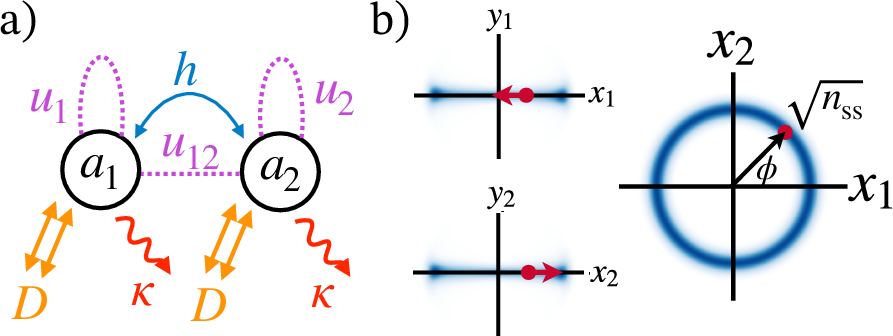
Figure 1: Minimal two-mode realization with self- and cross-Kerr interactions, antisymmetric hopping, coherent parametric drive, and photon loss; (b) displays the steady-state Wigner and joint quadrature distributions forming a ring in phase space.
This construction forms the basis for a new class of quantum limit-cycle models wherein the interplay between coherent driving, nonlinearity, and dissipation generates persistent oscillatory dynamics with continuous symmetry, eliminating the additional quantum noise from incoherent pumping.
Semiclassical and Quantum Dynamics: Phase Diagram
In the semiclassical limit (large occupation), the system exhibits the emergence of a stable attractor manifold defined by the constraint x12+x22=nss (for N=2), which forms a ring in phase space. The dynamics on this ring is governed by a Goldstone mode associated with the broken continuous symmetry, with persistent phase rotation at a frequency set by the antisymmetric coupling. For general N, the attractor generalizes to an SN−1 sphere, with N−1 gapless directions.
A remarkable advance here is the exact analytic solution for the NESS at arbitrary photon number and for all N. The system shows a nonequilibrium phase transition at a critical drive strength Z20 (with Z21 the dissipation rate): below this, the steady state is trivial; above it, there is symmetry breaking and limit-cycle or toroidal dynamics.
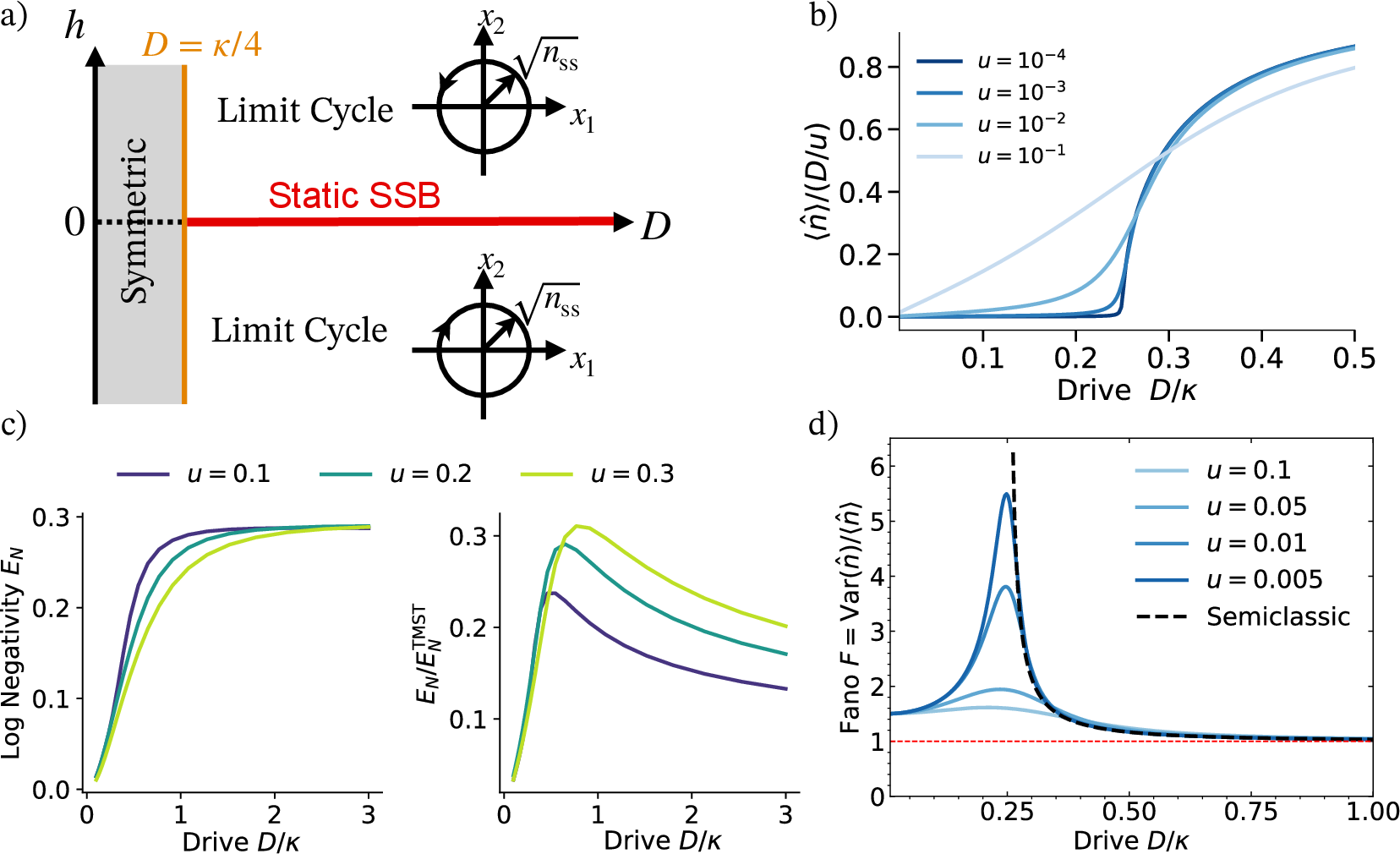
Figure 2: (a) Phase diagram showing distinct symmetry-broken and symmetric phases; (b) order parameter scaling and transition; (c) steady-state entanglement; (d) photon-number Fano ratio versus drive.
Deep in the limit-cycle phase, the steady-state photon number, entanglement, and amplitude fluctuations are all computable from the exact NESS. The transition is second order with critical exponent Z22, consistent with mean-field expectations.
Steady-State Entanglement and Non-Gaussianity
Even with large occupation, the quantum steady state exhibits persistent, non-Gaussian intermode entanglement. For Z23, log-negativity Z24 provides a quantifiable measure; notably, Z25 increases with drive strength before saturating at a finite value that, while smaller than an equivalent thermal two-mode squeezed state (TMSS), is nevertheless nonzero and robust in the semiclassical regime. All intermode Gaussian covariances vanish, indicating the entanglement derives exclusively from higher-order correlations.
For general bipartitions (e.g., in the Z26 normal mode basis), the behavior differs: Z27 peaks near threshold and saturates at a lower value. This highlights basis dependence and the critical role of non-Gaussianity in the steady-state structure.
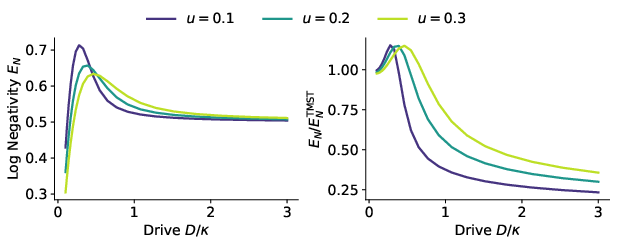
Figure 3: Log-negativity and its ratio to a thermal two-mode squeezed state in the Z28 partition.
Phase Diffusion and Quantum Noise Suppression
Phase diffusion along the attractor manifold arises from quantum noise. Critically, the use of coherent driving suppresses pump-related noise, resulting in a phase diffusion constant Z29—and hence laser linewidth— which can be reduced by a factor of two compared to the traditional Schawlow–Townes limit. Specifically, in the vicinity above threshold, the minimized linewidth is N=20. Amplitude (photon number) fluctuations, as quantified by the Fano ratio, increase near threshold, but deep in the classical regime achieve nearly Poissonian statistics.
Higher-Dimensional Dynamics and Quantum Limit Tori
For N=21, the antisymmetric coupling introduces multiple rotational axes on the attractor manifold, resulting in persistent oscillations with generally incommensurate frequencies: quantum limit tori (rather than limit cycles), whose geometry is set by the ranks and structure of N=22.
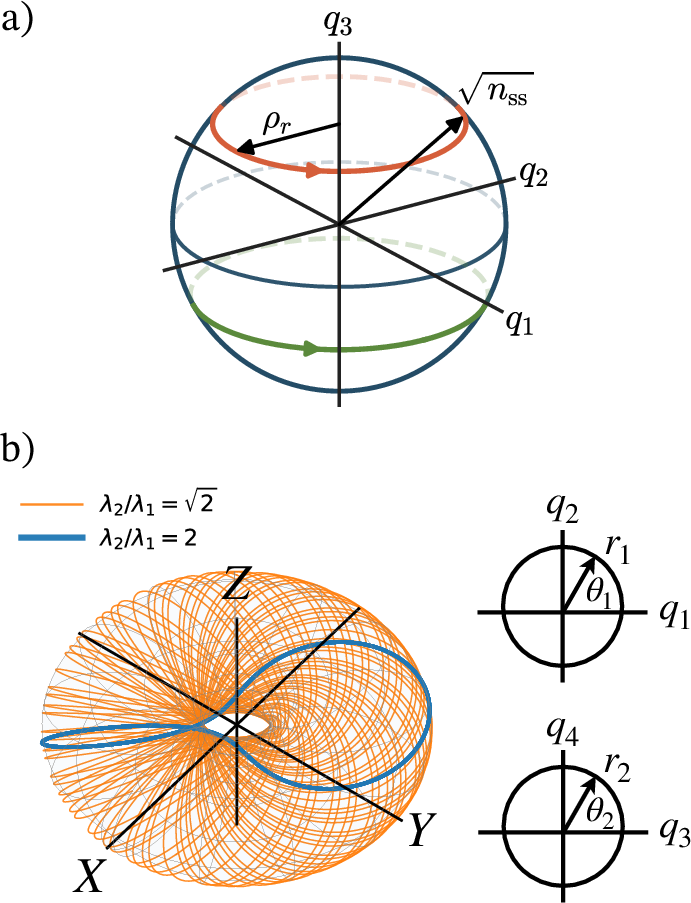
Figure 4: (a) Attractor manifold for N=23 in the block-diagonalized basis; (b) stereographic projection of a Clifford torus and illustration of quasiperiodic versus periodic orbits.
In the presence of quantum noise, there is slow diffusion both along angular (phase) directions and among amplitudes (radius partitioning among the N=24 rotation planes), described by a full diffusion matrix on N=25. This generalizes the single phase-diffusive Goldstone mode of N=26 to a richer many-body setting.
Robustness and Symmetry-Breaking Perturbations
Small symmetry-breaking perturbations (e.g., imbalanced Kerr nonlinearities) deform the O(N) (or U(1)) symmetry, generating phase-locking terms in the effective equations of motion. The system then shows a finite range of persistent oscillatory (limit cycle/tori) behavior, with phase-locking dominating at high drive strength or strong symmetry breaking. Thus, the symmetric coherently driven limit cycle functions as a parent model for a large class of previously studied parametrically driven systems, including those motivated by time-crystal and supersolidity physics.
Practical and Theoretical Implications
This work drastically expands the set of tractable, exactly-solvable, non-equilibrium quantum models exhibiting both strong quantum correlations (e.g., entanglement, non-Gaussianity) and continuous dynamical symmetry. It clarifies how coherent parametric driving—ubiquitous in contemporary platforms such as superconducting circuits and quantum optics—supports symmetry-protected limit cycles and higher-dimensional generalizations. The suppression of quantum phase noise below the Schawlow–Townes bound is particularly relevant for quantum metrology and the development of ultrastable light sources, including those with strong multimode quantum entanglement.
The methodology offers a blueprint for engineering coherent, multimode dissipative quantum phenomena, with immediate implications for quantum synchronization, phase entrainment, and controlled generation of multimode non-classical light.
Conclusion
Coherently driven, O(N) symmetric bosonic systems enable the coexistence of continuous symmetry, robust limit cycle or toroidal dynamics, and reduced quantum noise, in a framework admitting exact analytic treatment. The interplay of symmetry, nonlinearity, and coherent dissipation sets new paradigms for open quantum system engineering—applicable across quantum optics, quantum information, and out-of-equilibrium many-body physics. Future directions include the analysis of quantum synchronization, exploration of output field quantum correlations, and extensions to non-Gaussian measurement and feedback protocols.