- The paper demonstrates that hybrid quantum walks, integrating a dynamic coin operator and Pontryagin's minimum principle, systematically outperform QAOA for combinatorial problems.
- It establishes that the expanded Jordan-Lie algebra structure enables coherent superposition of multiple computational trajectories, offering enhanced optimization capabilities.
- Numerical experiments on Max-Cut and Maximum Independent Set problems reveal that HQW achieves improved convergence, accuracy, and robustness compared to traditional methods.
Hybrid Quantum Walks, Optimal Control, and Jordan-Lie Algebraic Structures for Combinatorial Quantum Optimization
Introduction and Motivation
This work establishes a new variational quantum algorithmic paradigm by generalizing the Quantum Approximate Optimization Algorithm (QAOA) through the introduction of Hybrid Quantum Walks (HQW). Critically, the HQW ansatz enables coherent superposition of multiple computational trajectories within a circuit layer, in sharp contrast to QAOA’s restriction to a single, fixed evolution path. By integrating a quantum "coin" degree of freedom with controllable dynamics, the authors exploit Pontryagin's minimum principle to demonstrate that the optimal coin operator is generically non-static, and rarely coincides with the conventional Pauli-X gate.
The analysis is grounded in a rigorous study of the underlying dynamical Lie algebra (DLA), showing that HQW circuits generate a full Jordan-Lie algebra—incorporating both the commutator and anti-commutator (Jordan) products—thus strictly enlarging the reachable set of quantum unitaries compared to QAOA. Numerical experiments on canonical combinatorial problems, including Max-Cut and Maximum Independent Set (MIS), confirm that HQW delivers improvements in convergence, accuracy, and robustness over QAOA, particularly in scenarios where the Jordan product of the problem Hamiltonians exhibits significant negativity.
Framework: From QAOA to Hybrid Quantum Walks
In QAOA, the quantum ansatz is constructed as an alternating sequence of problem and mixer Hamiltonian evolutions—parameterized by angles γ and β—precluding the superposition of distinct evolution paths. The HQW formulation, in contrast, operates in an extended Hilbert space Hc⊗Hp with an explicit coin subsystem (Figure 1), allowing the protocol to superpose, per circuit layer, all possible trajectories generated by different choices of driving Hamiltonians.
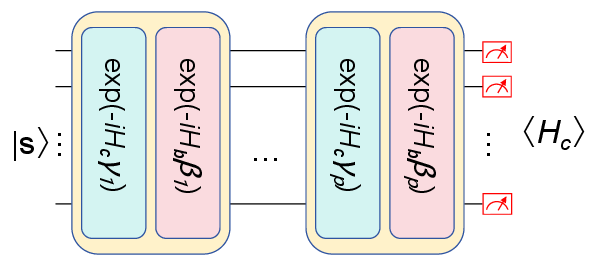
Figure 2: Schematic of a p-layer QAOA circuit, alternating problem and mixer unitaries with a fixed path structure.
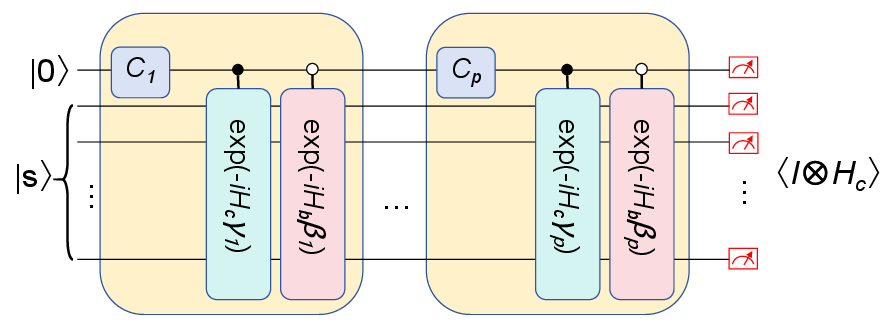
Figure 1: Schematic of a p-step HQW circuit; a coin qubit coherently controls interleaving between multiple Hamiltonian evolutions, generating superpositions of computational trajectories.
Critically, QAOA is subsumed as a special case of HQW, corresponding to the choice of a static Pauli-X coin with deterministic trajectory selection. The HQW path-summing structure confers higher representational capacity, as established both algebraically and numerically.
Optimal Coin Construction via Pontryagin's Minimum Principle
The coin operator in each HQW layer represents a nontrivial variational degree of freedom. Applying Pontryagin's minimum principle (PMP) to quantum control, the authors derive the governing equations for the optimal coin, which maximize expected solution quality. The analysis reveals that the optimal strategy generically requires time-dependent rotation axes, dictated by instantaneous "sensitivity vectors" in the coin space.
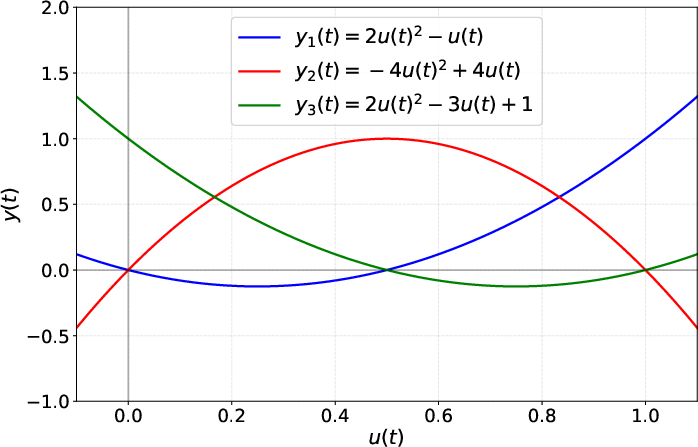
Figure 3: Functional dependence of control coefficients y1(t), y2(t), y3(t) on the control parameter u(t) in the time-dependent Hamiltonian; each regime corresponds to a different dynamical role within the circuit, including coin operations and Hamiltonian-driven evolution.
The optimal HQW implementation therefore leverages adaptive coin operations interleaved with Hamiltonian dynamics. Importantly, this framework admits practical gradient-based optimization, as the objective is smooth and efficiently differentiable with respect to coin parameters.
Dynamical Lie Algebra and Jordan-Lie Structure
A central contribution of the work is the elucidation of the HQW and QAOA circuit expressivities through their DLAs.
The DLA for standard QAOA is generated solely by the Lie closure of the problem and mixer Hamiltonians. In HQW, however, the coin subsystem induces a DLA structure of the form su(2)⊗LQ⊕Ic⊗KQ, where β0 is the full Jordan-Lie algebra generated by β1, encompassing both commutators and anti-commutators. This yields a strictly higher-dimensional algebra for HQW than for QAOA, strictly containing the latter’s DLA.
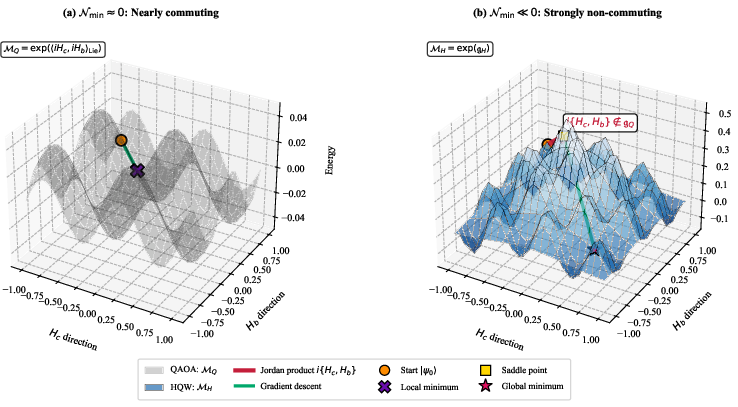
Figure 4: Geometric illustration of the role of the Jordan product in expanding the HQW reachable set; when the minimal Jordan negativity is large, the HQW manifold enables movement in directions inaccessible to QAOA, escaping suboptimal regions.
The additional algebraic structure, especially the presence of directions corresponding to the Jordan product β2, provides HQW with "transversal" directions in state space that are inaccessible to QAOA, with direct implications for expressivity and optimization landscape topology.
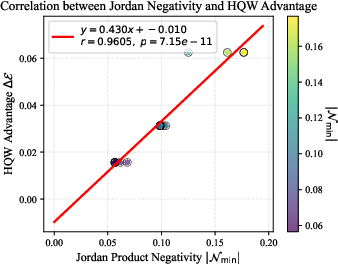
Figure 5: Strong empirical correlation between the magnitude of Jordan negativity and HQW’s observed performance advantage across problem instances. A larger Jordan negativity predicts greater HQW improvement.
The negativity of the Jordan product, β3, is introduced as a quantifier of the non-commuting, incompatible structure of the problem and mixer Hamiltonians. HQW circuits, by virtue of coherent path superposition, are able to exploit precisely these algebraic incompatibilities—reflected in negative Jordan products—to achieve improved approximation ratios and convergence rates. QAOA, restricted to commutator-generated directions, cannot traverse state-space regions associated with large Jordan product negativity, leading to intrinsic performance limitations.
The correspondence between Jordan negativity and HQW benefit is supported both algebraically and through a direct empirical correlation, positioning Jordan negativity as an actionable metric for ansatz selection and algorithmic resource assessment.
Numerical Experiments: Max-Cut and Maximum Independent Set
Comprehensive numerical benchmarking on both Max-Cut and MIS problems strongly supports the theoretical claims.
- Robust performance: HQW outperforms QAOA in nearly all tested graph instances, with higher win rates and lower mean energy errors under both average and best-initialization reporting.
- Scaling with problem density: The margin of improvement afforded by HQW increases with instance complexity (e.g., edge density), consistent with the hypothesized role of Hamiltonian incompatibility.
- Essential role of path superposition: Reordering QAOA parameters to mimic HQW does not replicate the observed advantage; explicit coin-mediated path superposition is required.
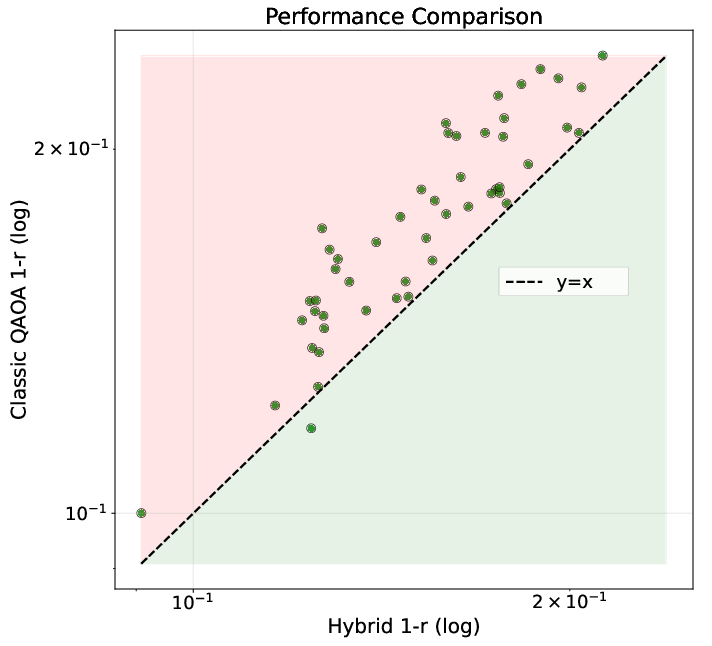
Figure 6: Scatter plot demonstrating HQW’s systematic improvement in optimal solution proximity over QAOA, across random 8-vertex Max-Cut instances.
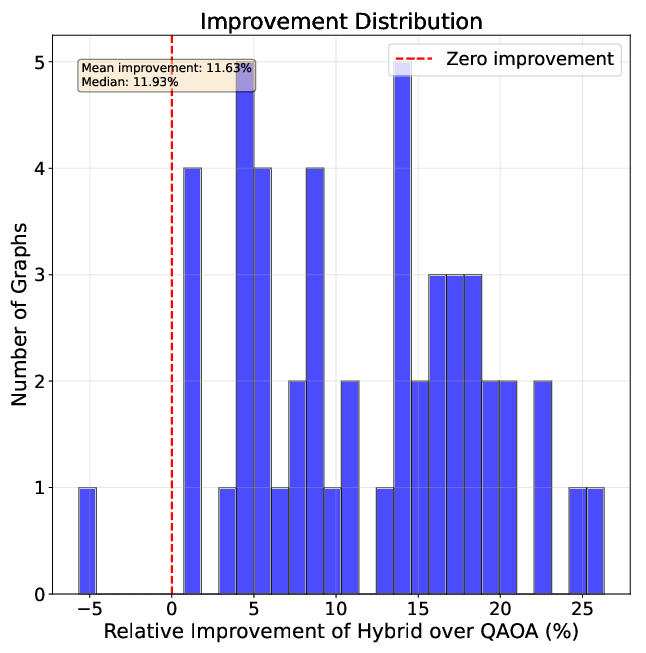
Figure 7: Distribution of HQW’s relative improvement over QAOA, reinforcing robust performance advantages in average-case approximation ratios.
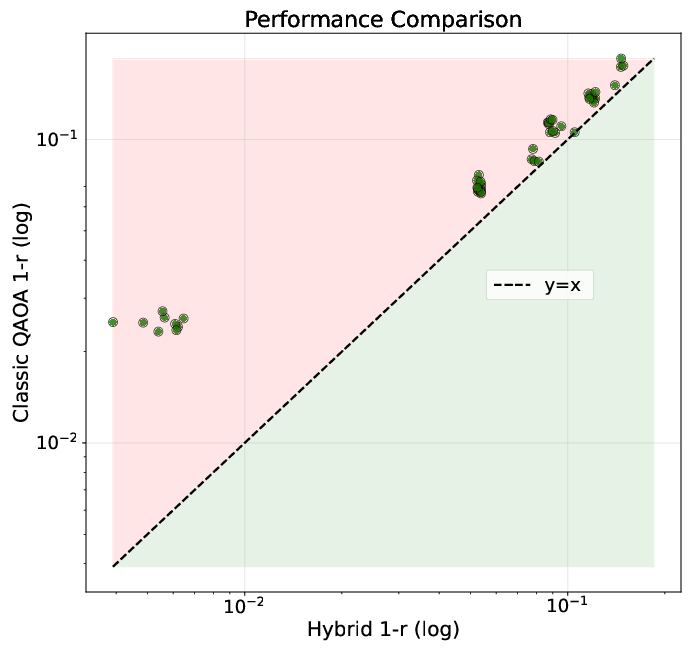
Figure 8: HQW’s advantage remains (and grows) in higher-density graphs; scatter plot for graphs with 24–28 edges.
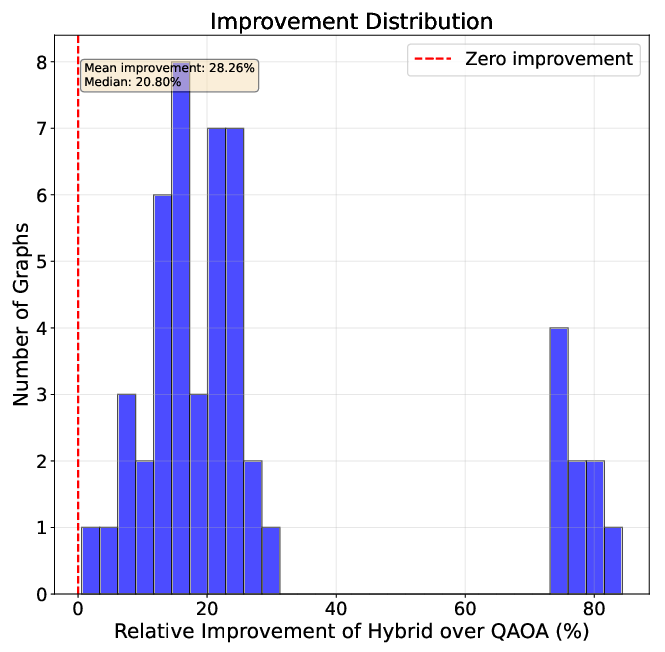
Figure 9: HQW’s relative improvement distribution for denser 8-vertex graphs, highlighting increased benefit with greater Hamiltonian complexity.
Additional figures in the paper detail results for larger graphs, alternative combinatorial problems, and direct probes of the coin operator’s contribution.
Implications and Future Directions
The demonstration that HQW circuits can systematically outperform QAOA and its parameter variants, underpinned by a rigorous algebraic framework, has multiple key implications:
- Practical Protocol Selection: Jordan product negativity can be computed for candidate problems to predict when HQW-type ansatz will outperform conventional QAOA.
- Design of New Algorithms: The identified advantage intrinsically linked to Jordan-Lie algebraic structures provides a guiding principle for constructing future quantum optimization protocols—namely, to activate and exploit transversal (Jordan-product-mediated) state-space directions.
- Scaling and Hardware Realization: While analytical parameterizations of optimal coins are complex, the HQW framework is compatible with variational optimization, supporting near-term experimental investigations.
Further research is warranted into scaling behavior for larger system sizes, the impact of real-device noise, generalization to problems with more than two Hamiltonians, and the possibility of analytical lower bounds relating Jordan negativity to performance gaps.
Conclusion
This work rigorously advances the design and understanding of variational quantum algorithms for combinatorial optimization by introducing a hybrid quantum walk strategy capable of path superposition, optimizing over dynamic coin operators using optimal control theory, and leveraging the enhanced expressive power of the full Jordan-Lie algebra. Numerical experiments and theoretical analysis jointly confirm the practical and structural superiority of HQW circuits relative to their QAOA progenitors, establishing a formally grounded path-superposition paradigm as an advantageous trajectory for future quantum optimization research.

