- The paper introduces a novel QUBO formulation and quantum annealing approach to select non-redundant, class-relevant feature maps in CNNs.
- It leverages gradient magnitude and cosine similarity to assess feature importance and geometric diversity, yielding focused attribution maps.
- Quantitative evaluations demonstrate improved class disentanglement and reduced accuracy drops compared to traditional methods like GradCAM.
Quantum Annealing-Based Feature Map Selection for Interpretable CNNs
Introduction
This work presents a structured approach to post-hoc interpretability of convolutional neural networks (CNNs) for image classification, leveraging quantum annealing (QA) for feature map (FM) selection. The proposed method reformulates FM selection as a quadratic unconstrained binary optimization (QUBO) problem and exploits the quantum annealing paradigm to efficiently traverse the exponentially large solution landscape. Unlike typical feature selection, which operates at the input level, this protocol targets hidden representations in the final convolutional layer, aiming to isolate class-relevant, non-redundant FMs. The resulting bit-string selection provides insight into the mechanisms underlying specific predictions by promoting both FM importance (via gradient magnitude) and geometric diversity (via cosine similarity). The performance is benchmarked against prominent explainability methods, GradCAM and GradCAM++, showing favorable trade-offs in both class disentanglement and quantitative metrics.
The method encodes the selection of positive-contributing FMs as a binary optimization problem. For a trained CNN, an image yields Nf FMs at the terminal convolutional layer; FMs with positive global pooled gradients are retained as candidates. The elements of the QUBO Hamiltonian are defined using:
- Linear term: Encodes FM importance, normalized from the global average-pooling of class-relevant gradients.
- Quadratic term: Encodes geometric redundancy using pairwise cosine similarity, penalizing selection of redundant FMs.
The resulting Hamiltonian is
H^QUBO=(1−β)21pq∑Jpqn^pn^q+βp∑hpn^p,
where Jpq captures FM redundancy and hp the normalized FM importance. The parameter β controls the trade-off, which is set empirically (β=0.7 favors importance).
Quantum annealing is initialized with a uniform superposition over all FM subset configurations. A time-dependent Hamiltonian interpolates between the driver and QUBO Hamiltonians. Sampling from the annealed ground state yields bit-strings, encoding selected FM subsets whose forward pass activation maps serve as explanation masks.
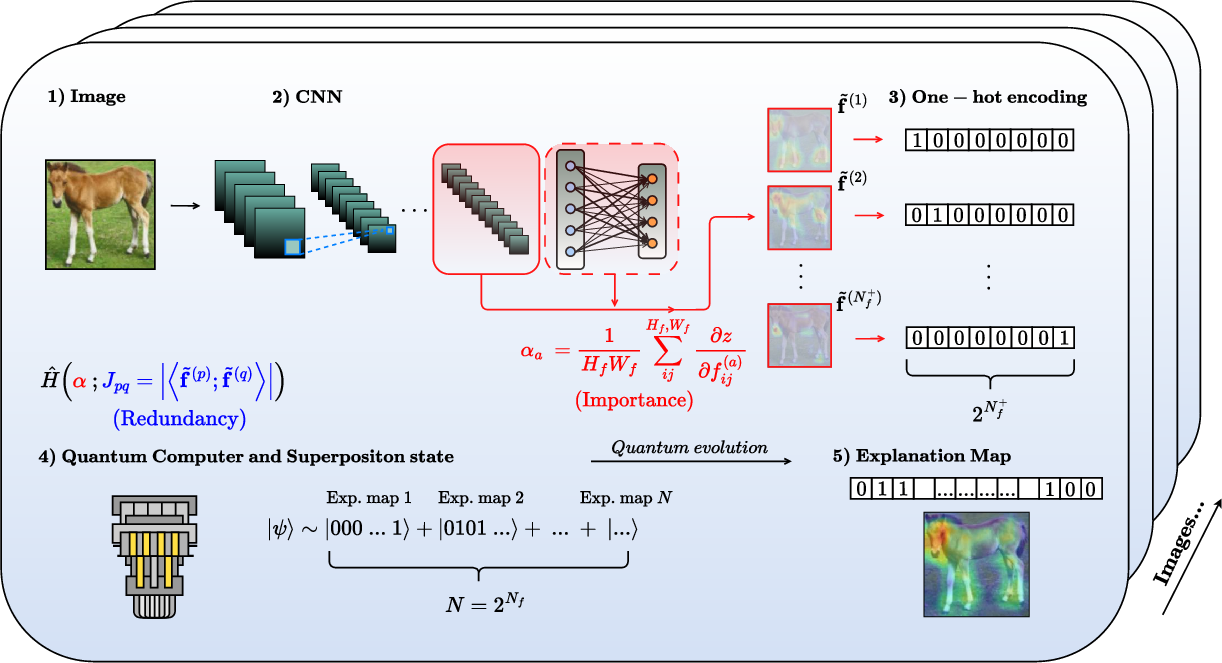
Figure 1: Schematic of the QA-based FM selection pipeline, from image input through FM extraction, QUBO construction, quantum evolution, and final bit-string sampling.
Evaluation of Class Disentanglement and Benchmarking
Disentanglement is examined through class-class correlation maps, calculated as the Bhattacharyya coefficient between FM activation distributions for pairs of classes. The QA protocol demonstrably yields sparser off-diagonal correlations compared to classical simulated annealing (SA), indicating improved feature exclusivity and class separation.
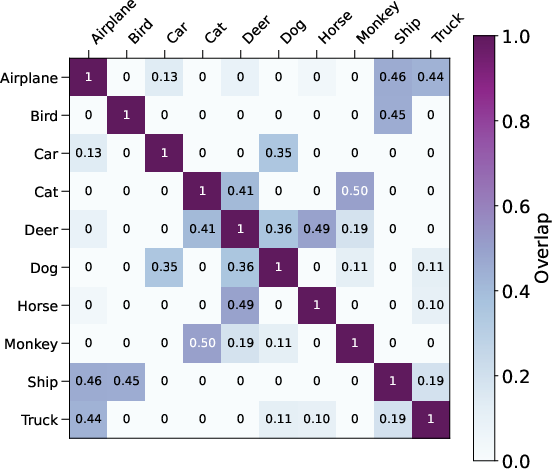
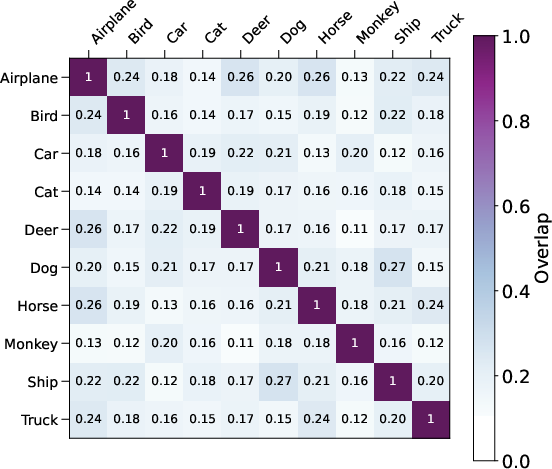
Figure 2: Class-class correlation matrix for the FM subsets determined via QA and SA, highlighting the reduction in overlap across classes with the quantum protocol.
Qualitative assessment via explanation maps shows that the QA-based method often omits spurious or less relevant regions highlighted by GradCAM and GradCAM++, supporting a claim for more focused, discriminative feature selection.
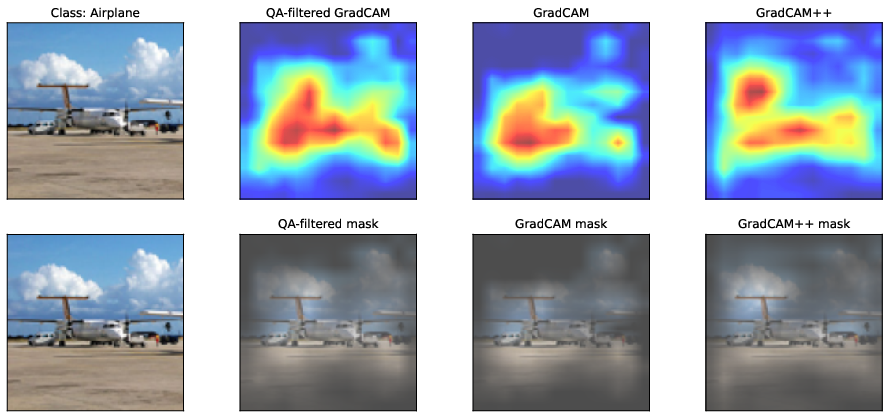
Figure 3: Representative visualizations comparing GradCAM, GradCAM++, and QA-fGradCAM, illustrating concentrated attribution to class-relevant spatial regions.
Quantitative metrics are computed using the Average Drop %, reflecting the change in model confidence when the explanation mask is applied. For a reduced FM setting (Nf=16), the quantum protocol yields an average drop (10.6%) lower than GradCAM (17.6%) and GradCAM++ (13.2%), demonstrating that the selected FM subsets sufficiently preserve class evidence. At full network scale (H^QUBO=(1−β)21pq∑Jpqn^pn^q+βp∑hpn^p,0), however, performance degrades without appropriate H^QUBO=(1−β)21pq∑Jpqn^pn^q+βp∑hpn^p,1 tuning or additional regularization.
Analysis of Quantum Annealing Dynamics
Physical analysis of the QA protocol focuses on the minimum energy gap H^QUBO=(1−β)21pq∑Jpqn^pn^q+βp∑hpn^p,2 during evolution, controlling adiabaticity and sampling fidelity. Across the STL-10 dataset, H^QUBO=(1−β)21pq∑Jpqn^pn^q+βp∑hpn^p,3 is generally large (order H^QUBO=(1−β)21pq∑Jpqn^pn^q+βp∑hpn^p,4 in energy units), supporting feasibility of efficient annealing within modest time scales. Fidelity analyses show that for H^QUBO=(1−β)21pq∑Jpqn^pn^q+βp∑hpn^p,5 (total evolution time), ground state recovery is robust across class and FM subset size, with degradation in more strongly diabatic regimes as expected by Landau-Zener scaling.
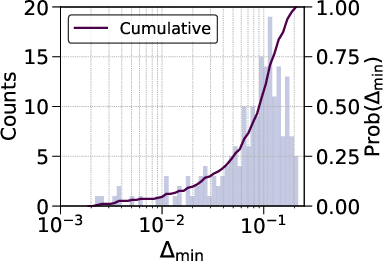
Figure 4: Distribution of minimum energy gaps H^QUBO=(1−β)21pq∑Jpqn^pn^q+βp∑hpn^p,6 over sampled test instances, with cumulative probability indicating resilience against exponentially vanishing gaps.
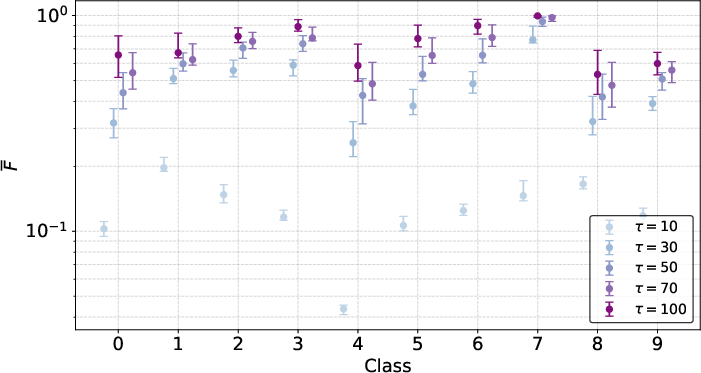
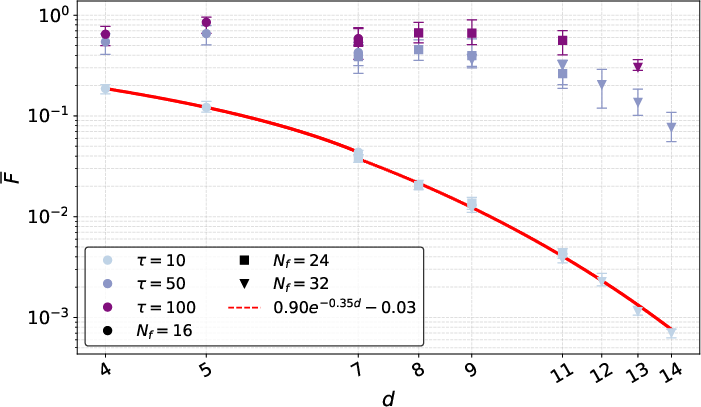
Figure 5: Median fidelity H^QUBO=(1−β)21pq∑Jpqn^pn^q+βp∑hpn^p,7 as a function of class and filtered FM number H^QUBO=(1−β)21pq∑Jpqn^pn^q+βp∑hpn^p,8, with breakdown showing transition from diabatic to adiabatic regimes for increasing H^QUBO=(1−β)21pq∑Jpqn^pn^q+βp∑hpn^p,9.
The Ising couplings Jpq0 exhibit approximately Gaussian statistics. As per the Sherrington-Kirkpatrick model, the optimization landscape is not generically hard, remaining tractable under the typical couplings induced by deep CNN feature statistics. The average minimum gap scales inversely with the FM subset size (Jpq1), implying polynomial scaling of annealing time—favorable for practical implementation.
Discussion and Implications
The QA-based FM selection algorithm generalizes the intuition of XAI attribution by isolating subsets of high-importance, geometrically non-redundant FMs. The approach exposes class- and task-relevant representations, as evidenced by improved class disentanglement and quantitative attribution metrics. This dual-objective QUBO design provides a controllable trade-off (via Jpq2) between focusing on the strength of evidence and mitigating redundancy—a property less explicit in aggregate-gradient methods.
The device-inspired simulation and subsequent analyses suggest that QA can be a practical tool for post-hoc interpretability, provided the problem Hamiltonian retains a favorable gap structure. While current NISQ devices may limit the physical size of feasible problems, further hybridization or hardware improvements should broaden applicability to large-scale models (full ResNet, modern architectures). The unsupervised nature and flexibility of the method allow application at arbitrary network depths, offering a principled way to probe semantic progression through layerwise FM overlap analysis.
Parallelization and hierarchical extension to generative or unsupervised models is straightforward, and inclusion of cardinality or group-lasso–type constraints may further control bias-variance characteristics of explanations. Reverse-mode selection (maximizing redundancy) can be employed for other attribution paradigms.
Conclusion
This work demonstrates that quantum annealing enables scalable and interpretable FM selection in CNNs by effectively solving the constrained QUBO formulation of the attribution problem. By linking importance and geometric diversity at the representation level, the protocol advances the state-of-the-art in post-hoc XAI, achieving superior class disentanglement and lower attribution-induced accuracy drops under proper hyperparameterization. Physical analysis supports the feasibility and reliability of the method for practical problem sizes. As access to quantum hardware improves, this methodology may become broadly applicable, deepening theoretical understanding of DL models and enhancing practical trustworthiness in critical deployment scenarios.