- The paper challenges the belief that ghost degrees of freedom imply continuous energy spectra by presenting integrable counterexamples.
- The authors use separability theory and WKB analysis to rigorously derive conditions under which discrete spectral levels accumulate or remain isolated.
- Results suggest potential extensions to non-integrable systems and field theories, impacting stability studies in quantum mechanics.
Summary of "Quantum mechanics with a ghost: Counterexamples to spectral denseness" (2604.21826)
Context and Motivation
The paper challenges the prevailing folklore in fundamental physics that quantum systems containing ghosts—degrees of freedom with negative kinetic energy—must necessarily possess a dense or continuous energy spectrum, as a consequence of Hamiltonian unboundedness. It focuses on integrable point-particle systems, canonically quantized with opposite-sign kinetic terms and nontrivial interactions. By leveraging separability theory, the authors construct counterexamples demonstrating the existence of discrete eigenvalue spectra and rigorously analyze the conditions for the presence of spectral accumulation points.
Canonical Quantization and Model Structure
The considered quantum Hamiltonian is of the form
H=2px2−2py2+V(x,y)
with canonical quantization mapping px↦−iℏ∂x and py↦−iℏ∂y. The stationary Schrödinger equation is defined on L2(R2,dxdy), retaining Hermiticity by adherence to the standard measure.
The potentials are chosen to exhibit Z2 reflection symmetries and permit an additional constant of motion. The authors employ confocal (elliptic--hyperbolic) coordinates and further map to separable variables (α,β), with underlying Liouville-type integrability. This facilitates analytic tractability and explicit construction of polynomial subclasses.
Separability and Spectral Analysis
By virtue of separability theory and explicit transformation of the kinetic operator, the Schrödinger equation splits into two decoupled one-dimensional eigenvalue problems:
−2ℏ2ϕ′′(α)+[f(u(α))−Eu(α)2]ϕ(α)=λϕ(α)
−2ℏ2χ′′(β)+[g(v(β))+Ev(β)2]χ(β)=λχ(β)
where f and g are polynomials in confocal coordinates determined by the system's integrable structure. The separated potentials are confining, ensuring discrete spectra.
Energy quantization then proceeds by imposing the matching condition px↦−iℏ∂x0 for eigenvalues indexed by integers px↦−iℏ∂x1 and px↦−iℏ∂x2. The uniqueness of solutions for every px↦−iℏ∂x3 pair is ensured by monotonicity properties derived from the Hellmann--Feynman theorem.
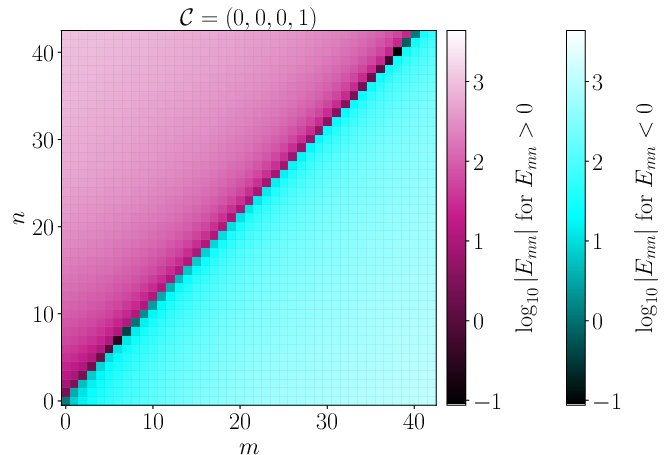
Figure 1: A generic example (px↦−iℏ∂x4) illustrating discrete energy levels px↦−iℏ∂x5 in the px↦−iℏ∂x6 plane, with sparsity increasing for large indices away from the diagonal.
Asymptotic Accumulation and Spectral Density
The analysis employs WKB asymptotics to investigate spectral accumulation, specifically along diagonal sequences px↦−iℏ∂x7 in the px↦−iℏ∂x8 lattice. The authors derive explicit expressions for action differences and show that the presence or absence of accumulation points is governed by cancellation of odd powers in the polynomial potential functions. By recursive tuning of coupling parameters, they exhibit cases with exactly one accumulation point (px↦−iℏ∂x9) and others where accumulation is entirely absent.
The distinction is formalized via asymptotic expansions, leading to two scenarios:
- Case (i): Single Accumulation Point—If only the lowest odd-power term survives, levels accumulate at py↦−iℏ∂y0 along the diagonal sequence.
- Case (ii): No Accumulation—If higher-order odd terms are canceled, spectral density remains finite and accumulation is avoided.
Numerical results corroborate this analytic classification, and the accumulation behavior is visualized for several parameter choices.
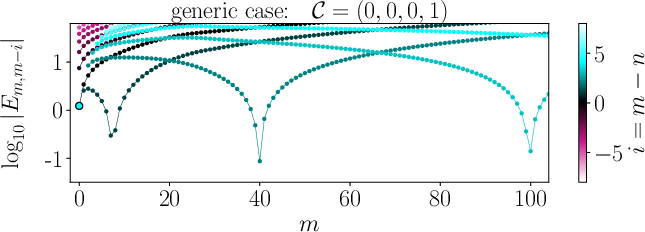
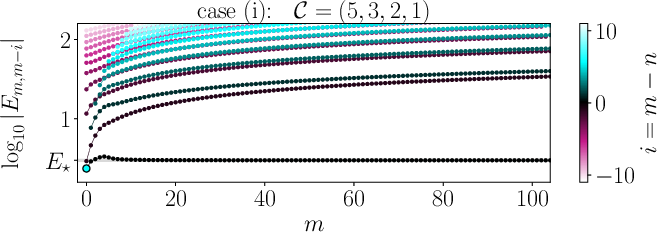
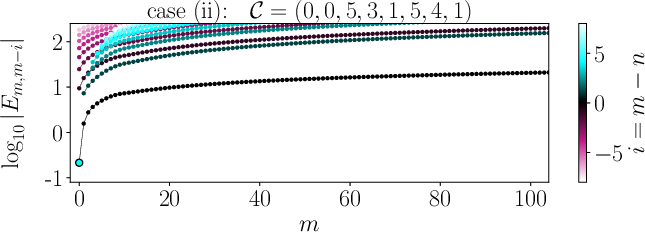
Figure 2: Energy levels py↦−iℏ∂y1 along diagonal sequences, demonstrating the generic case, the presence of a unique finite accumulation point, and the absence of accumulation, respectively.
Implications and Future Directions
These results undermine the widespread assertion that ghost degrees of freedom result in a dense quantum energy spectrum. Instead, spectral denseness is shown to rely on detailed dynamical properties and coupling structures, rather than purely on kinematic Hamiltonian unboundedness.
The authors' canonical quantization contrasts with approaches utilizing py↦−iℏ∂y2-symmetric or non-Hermitian frameworks, and their constructions are distinct from bi-Hamiltonian extensions. The analysis also suggests the possibility of extending these spectral properties to non-integrable and field-theoretic settings, referencing recent advances in the stability of classical field theories with ghosts.
Further investigation is required to resolve generic cases where accumulation cannot be conclusively excluded and to understand the behavior in broader classes of ghostly systems, potentially including non-integrable dynamics and interacting field models.
Conclusion
The paper rigorously constructs quantum mechanical systems with ghosts and demonstrates, through analytic separability and WKB analysis, the existence of discrete, non-dense spectra and conditions for accumulation points. These findings provide counterexamples to the widespread assumption linking ghostly dynamics to inevitable spectral denseness and lay the groundwork for ongoing research in quantum stability and spectral theory for systems with indefinite kinetic energy signatures.