- The paper extends the Sakawa-Shindo algorithm for OCPs with discrete delays, proving convergence and first-order optimality conditions.
- It employs a sequential quadratic Hamiltonian approach with adaptive regularization to ensure robust, monotonic cost reduction.
- Simulations on delayed epidemiological models demonstrate rapid epidemic suppression using optimized NPI and vaccination strategies.
Sakawa-Shindo Algorithm for Optimal Control of Time-Delay Systems: Theoretical Analysis and Applications to Epidemiology
Introduction
Optimal control problems (OCPs) governed by delay differential equations (DDEs) arise in a variety of domains, most notably in epidemiological modeling, where incorporating delays is necessary to capture incubation periods, immunity waning, and intervention response lags. Unlike delay-free OCPs, DDE OCPs pose significant analytical and computational challenges due to the infinite-dimensional nature of their state space. The Sakawa–Shindo (SS) algorithm, originally developed for delay-free systems, is based on Pontryagin’s Minimum Principle (PMP) and iterative refinement of the control via Hamiltonian dynamics. This paper introduces an extension of the SS algorithm—termed ESSA—that handles arbitrary numbers of discrete state delays and rigorously analyzes its theoretical properties. The authors provide convergence guarantees, present an implementation framework, and demonstrate the method’s utility in optimal intervention and vaccination planning for delayed epidemiological models (2604.25279).
The authors consider an OCP governed by a general DDE with k discrete delays: x˙(t)=f(t,x(t−h0),…,x(t−hk),u(t)),x(t0+θ)=ϕ(θ), θ∈[−h,0],
where x∈Rn, u∈U⊂Rm (compact, convex), and the cost is: J(u)=∫t0Tℓ(t,x(t−h0),…,x(t−hk),u(t))dt.
The time-delayed arguments complicate both state propagation and the derivation of necessary optimality conditions. They do, however, admit generalizations of the PMP, involving functional Hamiltonians and advanced co-state equations as detailed in the paper.
The Extended Sakawa-Shindo Algorithm (ESSA)
Algorithmic Structure
ESSA iteratively generates control sequences based on the delayed PMP. At each iteration, given the current control and trajectory, the following steps are executed:
- Forward integration: Simulate the state using the DDE and current control.
- Backward integration: Propagate the co-state dynamics, which include advanced arguments due to delays.
- Update via augmented Hamiltonian minimization: The control is updated at each time step by minimizing an augmented, strictly convex Hamiltonian that encodes regularization and enforces a trust-region-like property for robust convergence.
This structure amounts to a sequential quadratic Hamiltonian (SQH) method for delay systems, replacing the trust-region parameter with a regularizing matrix to maintain step-size control.
Termination and Convergence
Under broad regularity and convexity assumptions on f and ℓ, the authors establish:
- Finite termination: The algorithm stops after a finite number of steps once the L2 norm of the control update falls below a prescribed threshold.
- Asymptotic first-order optimality: The limit points of the sequence of controls satisfy the delayed PMP.
- Convergence of subsequences: Subset convergence to piecewise constant admissible controls, which are minimizers of the delayed Hamiltonian, is ensured.
- Cost decrease: Each iteration yields monotone reduction of the cost, provided the regularization is sufficiently strong.
The rigorous proofs leverage stepwise Grönwall estimates, Carathéodory solution theory for DDEs, and functional analyticity of the delayed Hamiltonian.
Implementation: Discretization and Regularization
The practical realization of ESSA involves time discretization (piecewise constant controls) and finite-difference solution of both DDE state and adjoint equations. The regularization (via the matrix Ci) is adaptively increased if necessary to enforce reduction of the cost at each iteration. Bounds are derived on the inter-iteration control change in both L2 and x˙(t)=f(t,x(t−h0),…,x(t−hk),u(t)),x(t0+θ)=ϕ(θ), θ∈[−h,0],0 norms, and explicit formulas for update steps are provided in terms of projections onto the admissible control set.
Application to Delayed Epidemiological Control
SIRV and SIDARTHE-V with Delays
Epidemic control applications are the focus of the numerical experiments. The authors formulate delayed SIRV and SIDARTHE-V models, where delays represent incubation periods and immunity build-up after vaccination. Two main control variables are considered: non-pharmaceutical intervention (NPI) intensity and vaccination rate.
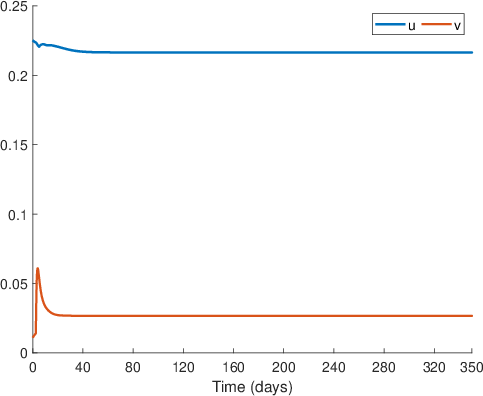
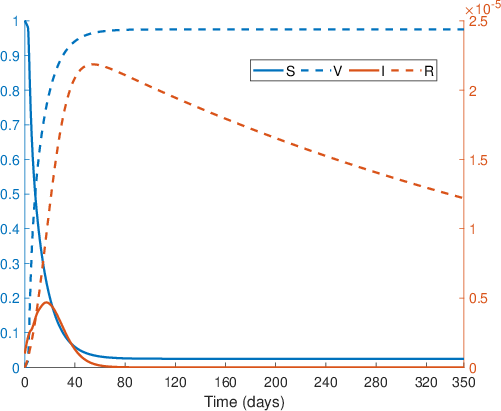
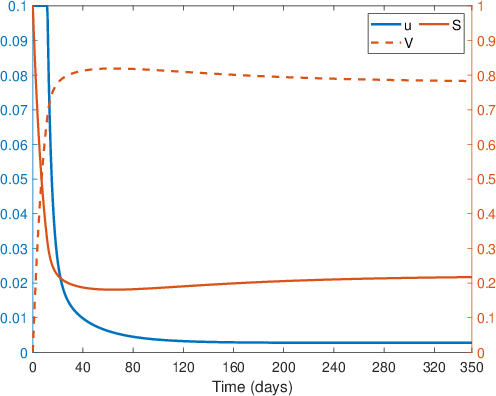
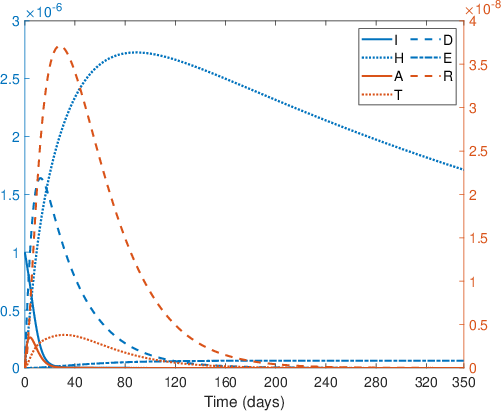
Figure 1: Leftmost two panels illustrate optimal controls for a delayed SIRV model; rightmost panels depict delayed SIDARTHE-V state/control trajectories under ESSA.
The OCP cost functionals encode weighted penalties on infections, control effort, and terminal infection levels. Simulations demonstrate that the ESSA-computed strategies produce:
- Rapid epidemic suppression under stringent NPI policies, with subsequent transition to vaccination-dominated control when it is cost-effective.
- Aggressively activated controls when infection penalties dominate, enforcing high vaccine coverage and fast outbreak resolution despite significant delays and immunity waning.
The control trajectories saturate bounds when indicated by cost structure and relax as the system approaches disease-free states.
Theoretical and Computational Implications
Theoretical implications:
The extension of SS-type algorithms to delay systems provides a constructive method for first-order necessary conditions in infinite-dimensional control systems. The framework is robust to model complexity, ensures practical termination, and offers numerically tractable convergence guarantees. Results here reveal that the structure of classical minimum principles and supporting iterative schemes persists under time delay generalization, which is pivotal for application domains such as biology, engineering, and economics where delays are ubiquitous.
Computational implications:
The piecewise constant grid approach readily adapts to epidemic-scale models and hybridizes with direct multiple-shooting or collocation methods. Regularization provides robustness in stiff regimes, and cost monotonicity accelerates convergence even for large delay values and high state dimensions.
Practical implications:
ESSA yields optimal vaccination and NPI strategies that are sensitive to the time-scale and efficacy of interventions and vaccination, providing actionable policy guidance under uncertainty, delay, and resource constraints. The monotone cost reduction property is crucial for deployment in real-time or receding-horizon frameworks (e.g., model predictive control for pandemic management).
Future Directions
Potential extensions include:
- Distributed and heterogeneous delays (relevant for meta-population/multi-region models or networked control).
- Incorporation of uncertainty quantification (considering parametric noise or data-driven model inference).
- Synthesis with distributed or hierarchical control strategies, relevant for collaborative epidemic management or other large-scale systems.
- Generalization to Nash/differential games in the presence of delays for modeling strategic multi-agent interventions.
Conclusion
This work provides a rigorous extension and comprehensive analysis of the Sakawa-Shindo algorithm for OCPs with arbitrary discrete delays, addressing a key challenge in applied control theory. The proposed ESSA framework is theoretically sound, computationally robust, and readily applicable to complex domains such as epidemiology, where the control of delayed processes is critical for optimal intervention strategy design (2604.25279).