- The paper introduces TA-CQR, a method that allocates tail probabilities to minimize prediction interval length while ensuring prescribed marginal coverage.
- It rigorously characterizes the conditional oracle interval across symmetric, asymmetric, and multimodal regimes using quantile regression.
- Simulation and real-data studies confirm that TA-CQR yields shorter intervals compared to equal-tailed methods without compromising coverage.
Introduction and Motivation
This paper addresses the placement of endpoints for prediction intervals within the split-conformal prediction framework under the constraint that only a single connected interval may be reported at a prescribed marginal coverage level 1−α (2604.25202). The central insight is that, after marginal validity is ensured, the lower-tail allocation τ—the proportion of miscoverage probability assigned to the lower tail—should be tuned to select the shortest conditional interval achieving conditional mass at least 1−α. This perspective generalizes the equal-tailed conformalized quantile regression (CQR) anchor, which fixes τ=α/2 regardless of asymmetry in the conditional distribution, allowing for data-adaptive asymmetry through tail-allocation conformalized quantile regression (TA-CQR).
Population Target and Oracle Quantile Geometry
The main theoretical contribution is a rigorous characterization of the conditional oracle interval under the single-interval reporting constraint. At each covariate value x, the shortest interval with conditional mass at least 1−α is shown to be parameterized by a lower-tail allocation τ∗(x) minimizing core length Lτ(x)=q1−α+τ(x)−qτ(x). The population geometry is governed by conditional quantile curves and exhibits three distinct regimes:
- Symmetric Conditional Law: The optimal allocation is τ∗(x)=α/2, recovering the equal-tailed CQR anchor.
- Unimodal Asymmetry: The oracle interval coincides with the highest-density region (HDR) when a unique mode exists, yielding τ∗(x) at the intersection where conditional densities at endpoints match.
- Disconnected Highest-Density Sets: If the conditional HDR is disconnected, any connected interval covering τ0 inevitably incurses a connectedness penalty proportional to the measure of low-density valleys between modes.
This geometry is foundational for justifying TA-CQR as a direct endpoint-quantile estimator, separate from center-radius methods and fully nonparametric conditional density estimators.
Methodology: Tail-Allocation CQR
The TA-CQR estimator proceeds in three main phases:
- Training: A family of conditional quantiles τ1 is estimated on the training set using monotonic quantile regression to guarantee well-behaved intervals.
- Grid Search: For each τ2, the grid τ3 is searched to select the τ4 that minimizes the estimated interval length, τ5.
- Split-Conformal Calibration: Additive nonnegative split-conformal correction is performed on a calibration set, generating intervals
τ6
Exact finite-sample marginal coverage is inherited from the split-conformal framework for any data-adaptive allocation.
Length Control and Theoretical Results
A core technical advance is the calibrated length oracle inequality. The decomposition is as follows:
- Grid Approximation: The cost due to searching τ7 on a finite grid is bounded by the grid mesh times a local Lipschitz constant on core length.
- Quantile Estimation: Supremum norm error of the estimated quantiles on a fixed grid is directly propagated to the final interval length.
- Calibration Sampling: The order statistic used for calibration inflates interval length by an asymptotically negligible quantity, τ8.
The main oracle inequality for the aggregate (integrated over τ9) reported interval length is:
1−α0
Here, 1−α1 represents the truncated oracle, and the terms explicitly quantify grid, estimation, and calibration sampling errors.
When the oracle allocation is away from the equal-tailed anchor, any core-length advantage persists through the conformal calibration step, provided the calibration radii for TA-CQR and CQR are sufficiently close. This is formalized in a transfer theorem, yielding statistical guarantees for aggregate performance improvement over equal-tailed CQR when the density geometry favors asymmetric allocation.
Simulation Studies
Extensive simulation studies in one-dimensional heteroscedastic and multimodal settings compare TA-CQR to equal-tailed CQR, CoCP, CIR/CIR+, CHR, and CTI (hull). Empirical coverage is consistently controlled across methods.
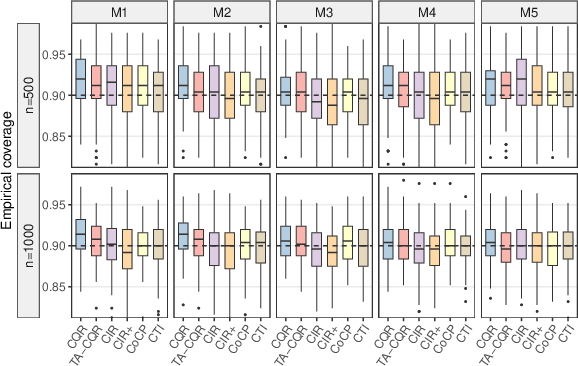
Figure 1: Empirical coverage over 100 simulation replicates for mechanisms M1--M5 at 1−α2, with the reference line at nominal coverage (1−α3).
Notably, TA-CQR consistently yields shorter prediction intervals relative to equal-tailed CQR in settings M1--M3 without compromising coverage.
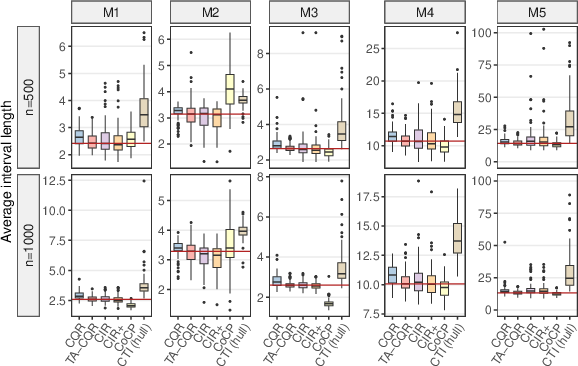
Figure 2: Average interval length for mechanisms M1--M5, showing that TA-CQR frequently minimizes average interval length among conformal methods with comparable coverage.
In complex tail regimes (M4--M5), competitive methods such as CoCP or CIR/CIR+ may achieve shorter intervals, but the coverage-length tradeoffs are straightforwardly quantified, with TA-CQR maintaining robust validity.
Real-Data Evaluation
The Project STAR dataset is used to benchmark TA-CQR and comparators in a realistic educational setting. Results demonstrate that when the conditional oracle is close to equal-tailed, TA-CQR behaves comparably to CQR in both coverage and length metrics.
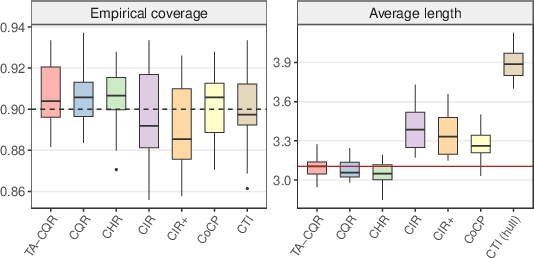
Figure 3: Real-data comparison of empirical coverage and average length on Project STAR over multiple splits; the methods demonstrate tightly clustered results near the nominal target.
TA-CQR’s interval length typically matches or slightly outperforms that of CQR and CHR, while length advantages may be more muted in practice when the conditional distribution is not highly asymmetric.
Practical and Theoretical Implications
The tail-allocation paradigm shifts focus from arbitrary anchoring of conformal intervals to direct estimation of the shortest valid interval for the conditional distribution and prescribed coverage. Practically, this enables modular integration with any endpoint-quantile estimation method and preserves exact marginal coverage without restrictive parametric assumptions. The framework also clarifies when connectedness penalties must be incurred and offers precise guidance for method selection when set-valued or multi-interval reporting is possible.
Theoretically, the decoupling of calibration and core-placement error provides explicit control on excess-length, facilitating direct comparisons with alternative approaches (e.g., center-radius, set-valued, or histogram-based conformal estimators). Extensions that combine tail allocation with localization or adaptive weighting schemes are natural subsequent steps to further enhance coverage adaptivity.
Conclusion
The paper provides a comprehensive population and sample theory for conformal prediction interval placement using the tail-allocation principle. The TA-CQR method operationalizes optimal conditional quantile placement given a split-conformal validity constraint, yielding a procedure that is theoretically sound, interpretable, and sharply characterized in terms of core and calibration errors.
This establishes a principled direction for the design of marginally valid prediction intervals in regression, particularly when interval reporting is mandated. Extensions to groupwise or feature-based allocation rules, alternate calibration schemes, and localized algorithms remain promising directions for future research, with potential impacts on uncertainty quantification for high-dimensional and structured data.