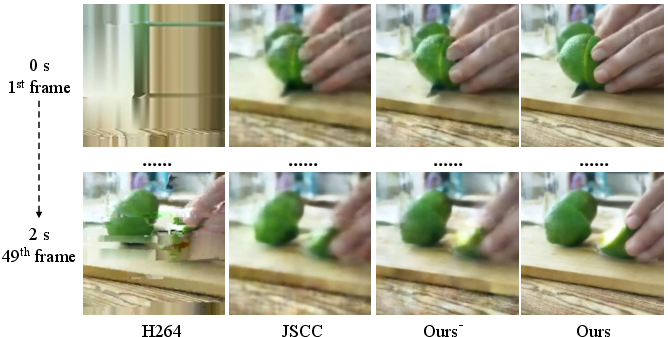
- The paper demonstrates a GSC pipeline that achieves 2.5 dB higher PSNR and 19% better MS-SSIM compared to conventional JSCC under severe error rates.
- It integrates a three-stage semantic encoder with LDPC FEC and a conditional diffusion model decoder to recover high-fidelity video even with over 80% block error rates.
- The framework outlines optimal quantization and error correction strategies, promoting robust direct-to-satellite video transmission from low-power devices.
High Error Tolerance in Satellite Video Transmission via Generative Semantic Communication
Introduction
The paper "Enabling High Error Tolerance in Satellite Video Transmissions by Generative Semantic Communication" (2604.25184) systematically addresses the challenge of robust video uplink transmission from user devices to ground stations over low Earth orbit (LEO) satellites under severe low-SNR regimes. Unlike prior works that emphasize downlink or static image scenarios, this work formulates and implements an end-to-end generative semantic communication (GSC) pipeline tailored for the characteristic high bit error rates and sporadic connection quality intrinsic to direct satellite relays, especially for rich high-dimensional data like video.
GSC System and Channel Modeling
The proposed system situates a user transmitting a sequence of video frames through a satellite relay channel. The semantic encoder integrates a hierarchical stack: a pre-trained video encoder, a neural latent encoder, and an LDPC encoder to yield compact, error-robust semantic information (SI) blocks, which are subsequently modulated (QPSK) and relayed (amplify-forward) over a deep-fading, shadowed-Rician channel. At the receiver, a generative semantic decoder—implemented as a conditional diffusion model—reconstructs the original video given error-corrupted SI.
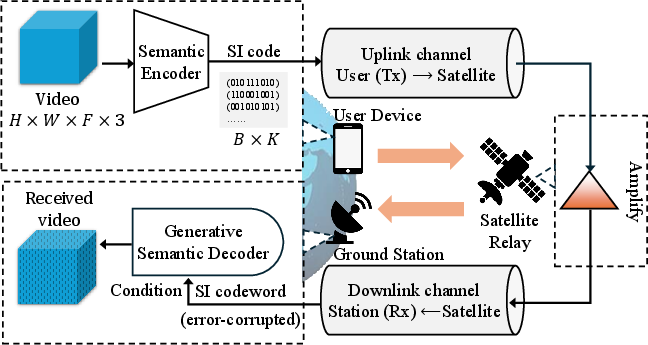
Figure 1: GSC system for video transmission via satellite relay.
A distinctive theoretical contribution is the channel abstraction and error modeling, which supports analysis of SI degradation, block error rates (BLER), SNR distributions as a function of user-satellite distance, and their impact on video reconstruction quality. The satellite link model is rigorously parameterized per 3GPP and DVB-S2 standards, incorporating path loss, antenna gains, and code rate.
Semantic Encoder and Generative Decoder Design
The semantic encoder leverages a three-stage pipeline: (1) A pre-trained video encoder achieves domain generalization and compressive representation; (2) A quantized latent encoder (small Q) parametrized by trainable neural layers maps encoded features into discrete SI vectors; (3) An integrated LDPC encoder ensures forward error correction for each SI block. Crucially, the latent encoder-decoder pair is optimized at fixed code rate and block size, with quantization level Q and SI vector length M tuned for minimum video perceptual loss (VPL) under joint constraints. This architectural choice decouples video feature learning from FEC optimization, allowing both efficiency and adaptation to underlying channel conditions.
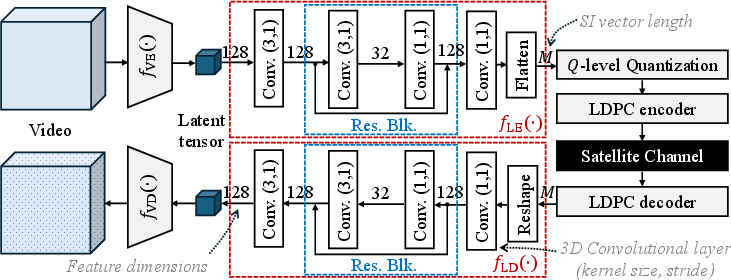
Figure 2: Neural model architecture of the latent encoder and decoder.
At the receiver, the generative decoder eschews full retraining by adopting an in-context low-rank adaptation (IC-LoRA) protocol atop a pre-trained video latent diffusion model. Conditioning is performed directly on the corrupted SI latent tensor, and only low-rank matrices are adapted, greatly reducing compute and data requirements. This enables the generative model to effectively reconstruct high-fidelity videos even from considerably deteriorated SI. Fine-tuning is performed using perceptually-motivated noise prediction losses in the latent space.
Evaluation and Empirical Results
Extensive simulation, leveraging reference video datasets and realistic LEO satellite channel parameters, demonstrates quantifiable advances. The core evaluation metrics include VPL, peak SNR (PSNR), and MS-SSIM, benchmarked against state-of-the-art Joint Source Channel Coding (JSCC) approaches and the H.264 + LDPC pipeline.
Spatial, temporal, and block-structural effects are analyzed as functions of quantization level, code rate, and block partitioning. The optimal Q varies with channel conditions: smaller Q is advantageous in extreme error regions (favoring block survival over expressivity), while larger Q provides better quality for less severe link distances. Visual results confirm semantic preservation in reconstructed frames despite heavy SI losses.
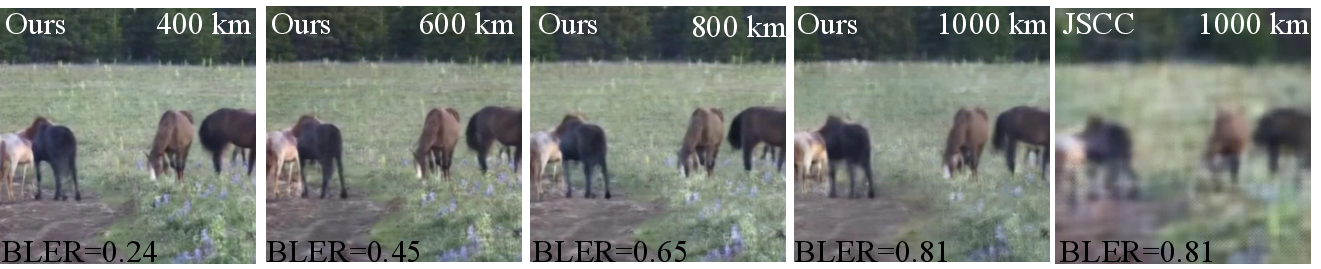
Figure 4: Reconstructed frames at different distance d.
Implications and Future Directions
This work extends the bounds of robust satellite video transmission by integrating advanced neural compression with communication-theoretic error correction and conditional generation. It provides a practical realization of generative semantic communication's error tolerance on real satellite channels, outperforming both classical and recent learning-based approaches under adverse link conditions. Significant is the demonstration of maintaining perceptual quality with block error rates over 80%, underscoring the translation of deep prior knowledge into communication resilience.
On the theoretical side, the framework informs the optimal allocation of quantization and FEC under varying channel/bandwidth constraints, and motivates spectral efficiency versus perceptual-fidelity trade-offs. Practically, it indicates the feasibility of direct-to-satellite video communication from low-power devices without sacrificing video usability, a critical requirement for remote area connectivity, IoT video sensing, and future NTN infrastructure.
Anticipated extensions include adaptation to dynamic bandwidth scheduling, joint cross-layer/physical-layer learning for end-to-end differentiability, and fully self-supervised adaptation regimes leveraging foundation video models as SI-priors. The modularity of the GSC pipeline also facilitates integration with multi-modal sensor streams and multi-user scenarios in satellite swarm architectures.
Conclusion
The proposed GSC system achieves robust, high-fidelity video transmission in LEO satellite uplink scenarios characterized by extreme channel errors. By exploiting generative models, optimized latent encoders, and strong FEC integration, the method outperforms prior JSCC and H.264-based approaches both quantitatively and qualitatively, sustaining semantic recognizability at unprecedented error rates. The design serves as an effective template for applying generative neural methods in practical semantic communications under severe capacity and reliability constraints.