- The paper introduces DBR, a dual-branch framework that mitigates shared-private branch imbalance to enhance multimodal sentiment analysis.
- It employs innovative modules—Temporal-Structural Factorization, Anchor-Guided Private Routing, and Bidirectional Rebalancing Fusion—to improve feature disentanglement.
- Empirical results on benchmarks like CMU-MOSI and MOSEI validate DBR’s effectiveness, achieving state-of-the-art improvements across multiple metrics.
Dual-Branch Rebalancing for Mitigating Shared-Private Branch Imbalance in Multimodal Sentiment Analysis
Introduction
The underlying challenge in Multimodal Sentiment Analysis (MSA)—the integration of linguistic, acoustic, and visual channels for robust affective inference—remains the handling of cross-modal heterogeneity. Traditional shared-private (SP) decomposition and cross-modal interaction protocols, while advancing the state of the art, implicitly assume that explicit factorization or stronger interaction is sufficient to address modal divergence. This work, "Mitigating Shared-Private Branch Imbalance via Dual-Branch Rebalancing for Multimodal Sentiment Analysis" (2604.25179), systematically exposes and formalizes a recurring failure mode in existing MSA pipelines: the shared-private branch imbalance phenomenon.
This essay provides a critical analysis of the empirical findings, architectural innovations, and experimental validations in this work, with an emphasis on the implications for future disentangled multimodal representation learning paradigms.
Characterization of Shared-Private Branch Imbalance
A salient empirical finding in the paper is that modality heterogeneity is not neutralized through SP decomposition but rather reallocated in a problematic manner: the shared branch disproportionately accumulates modality-dominant patterns, resulting in redundancy and evidence bias, while the private branch suffers progressive dilution—discriminative modality-specific features are homogenized through repetitive cross-modal interactions.
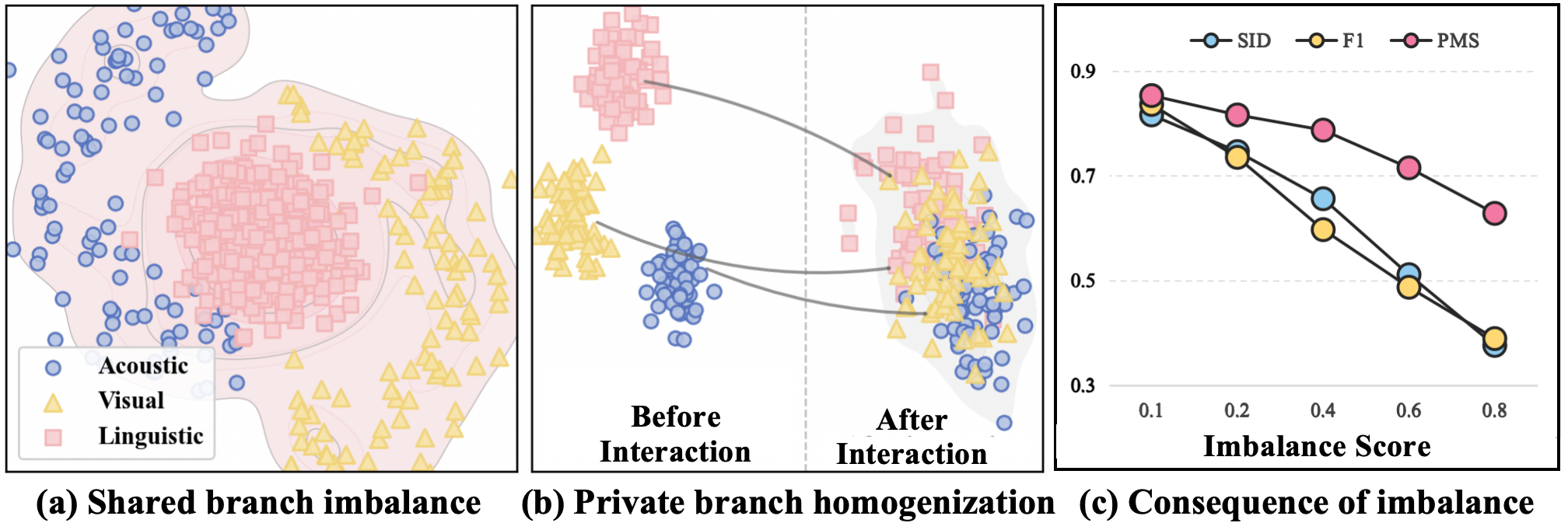
Figure 1: Branch imbalance induces redundancy in the shared branch, private-feature dilution, and consistent degradation in F1, Shared Information Diversity (SID), and Private Modality Separability (PMS).
Quantitative evidence demonstrates a monotonic decrease in F1, SID, and PMS metrics as sample-level branch imbalance increases, confirming degraded complementarity and downstream performance. This diagnosis provides unambiguous motivation for explicit correction mechanisms beyond mere architectural complexity or tuning of fusion strength.
Dual-Branch Rebalancing Framework (DBR): Architectural Overview
The DBR architecture extends a standard decoupling backbone with three targeted modules: (i) Temporal-Structural Factorization (TSF) in the shared branch, (ii) Anchor-Guided Private Routing (AGPR) in the private branch, and (iii) context-aware Bidirectional Rebalancing Fusion (BRF). The operational philosophy is delaying strong fusion, ensuring both branches are regularized for redundancy and specificity prior to final integration.
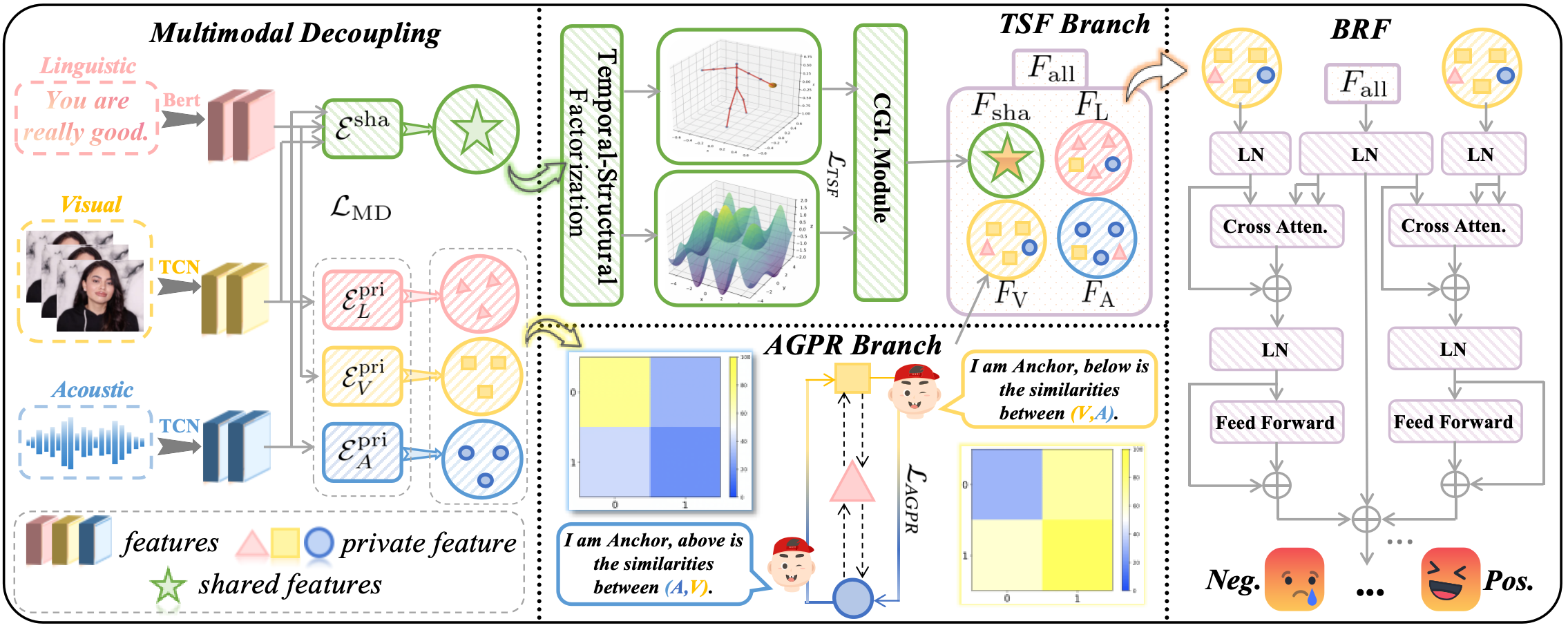
Figure 2: Overview of DBR: multimodal decoupling, TSF in shared, AGPR in private, and BRF for final context-aware fusion.
Multimodal Decoupling and Orthogonality Regularization
Initial per-modality streams are processed with BERT (linguistic) and TCNs (acoustic, visual), followed by shared and private encoders. SP orthogonality is promoted via decorrelation losses on off-diagonal cross-covariance, directly regularizing representation disentanglement at the feature level.
Temporal-Structural Factorization (TSF)
The TSF module separates temporal evolution (via BiLSTM) from structural dependencies (via per-modality multi-head attention) within the shared branch. Cross-stream gating yields adaptive fusion of these components, formally motivated by information bottleneck (IB) objectives which maximize label-relevant information while suppressing redundancy. Additional decorrelation losses on the temporal-structural axes and global alignment regularization further amplify diversity within the shared space.
Anchor-Guided Private Routing (AGPR)
AGPR introduces trainable anchor prototypes in each modality’s private space. Controlled cross-modal routing is realized via temperature-softmax of anchor-private cosine similarities, only selectively borrowing complementary private information (regulated by a tunable coefficient). Private-feature discriminability is enforced through anchor alignment and separation losses—prioritizing uniqueness over naive mixture.
Bidirectional Rebalancing Fusion (BRF)
After branch regularization, BRF fuses shared and private modality-wise representations via bidirectional cross-attention, capturing interdependencies between individual modalities and the global context. Gating for the final fused embedding explicitly integrates both local and global cues, ensuring the impact of cross-modality exchange is adaptively controlled.
Empirical Validation
On CMU-MOSI, CMU-MOSEI, and MIntRec benchmarks, DBR establishes new SOTA across all metrics: Acc-2, Acc-7, F1, MAE, and Pearson Corr. Acc-7 on MOSI increases by 2.18% over DLF; on MOSEI, DBR extends the lead by 1.6%.
Ablations and Analysis
Component ablations verify the essentiality of TSF, AGPR, and BRF—removal of AGPR, in particular, produces the largest performance drops, quantitatively confirming the centrality of discriminative private-feature preservation. Modality ablations revalidate the dominance of language in sentiment tasks, but both visual and acoustic cues contribute indispensable auxiliary information.
Sensitivity analysis reveals robustness to hyperparameter variations, and efficiency comparisons confirm that the architectural gains cannot be attributed to scaling alone—DBR achieves stronger results with only moderate computational overhead.
Representation Structure and Attention Analysis
t-SNE visualizations demonstrate ordered, continuous sentiment gradients only with the full DBR configuration, underscoring the preservation of regression-relevant structure.
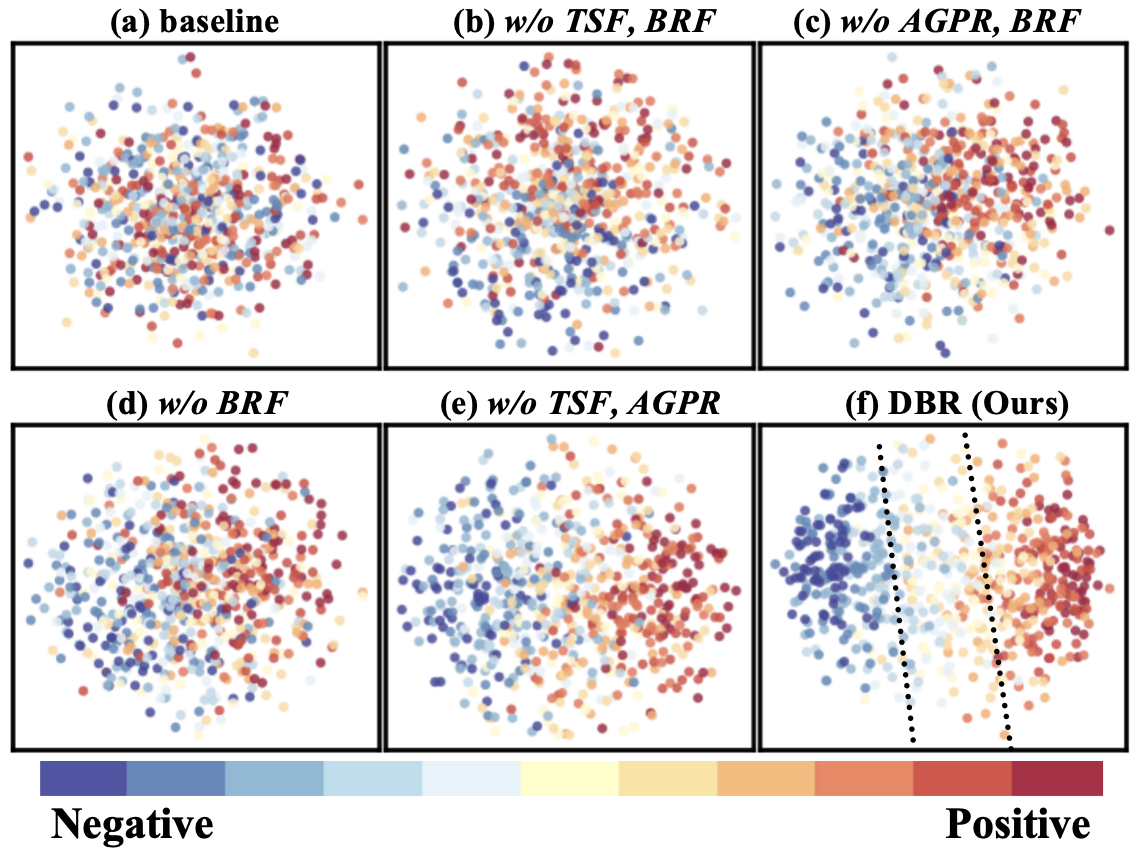
Figure 3: t-SNE visualization shows clear sentiment gradients and separation with DBR.
Attention weight analysis from BRF reveals systematic prioritization of private features, particularly linguistic, for emotional cues. The absence of AGPR induces a marked reduction in private attention weights, blurring modality-specific discriminability.
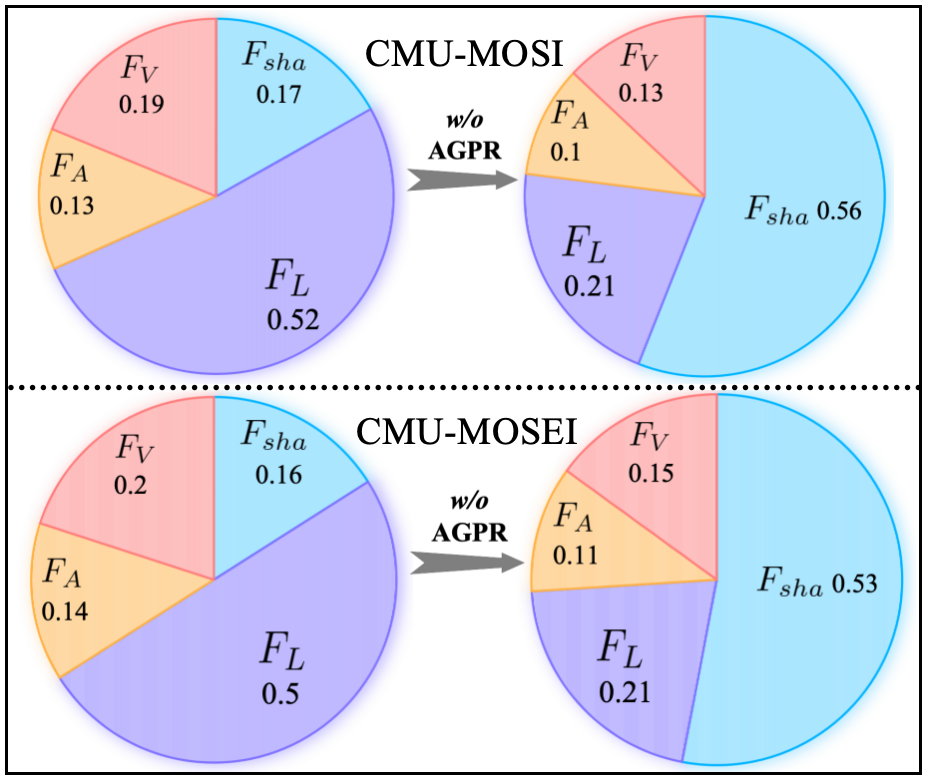
Figure 4: BRF assigns higher attention to private modality features (especially linguistic), and AGPR is crucial for this pattern.
Fusion weight visualizations align with measured contributions—BRF dominates, but both TSF and AGPR receive substantial, consistent weights, confirming their synergistic action for information diversity.
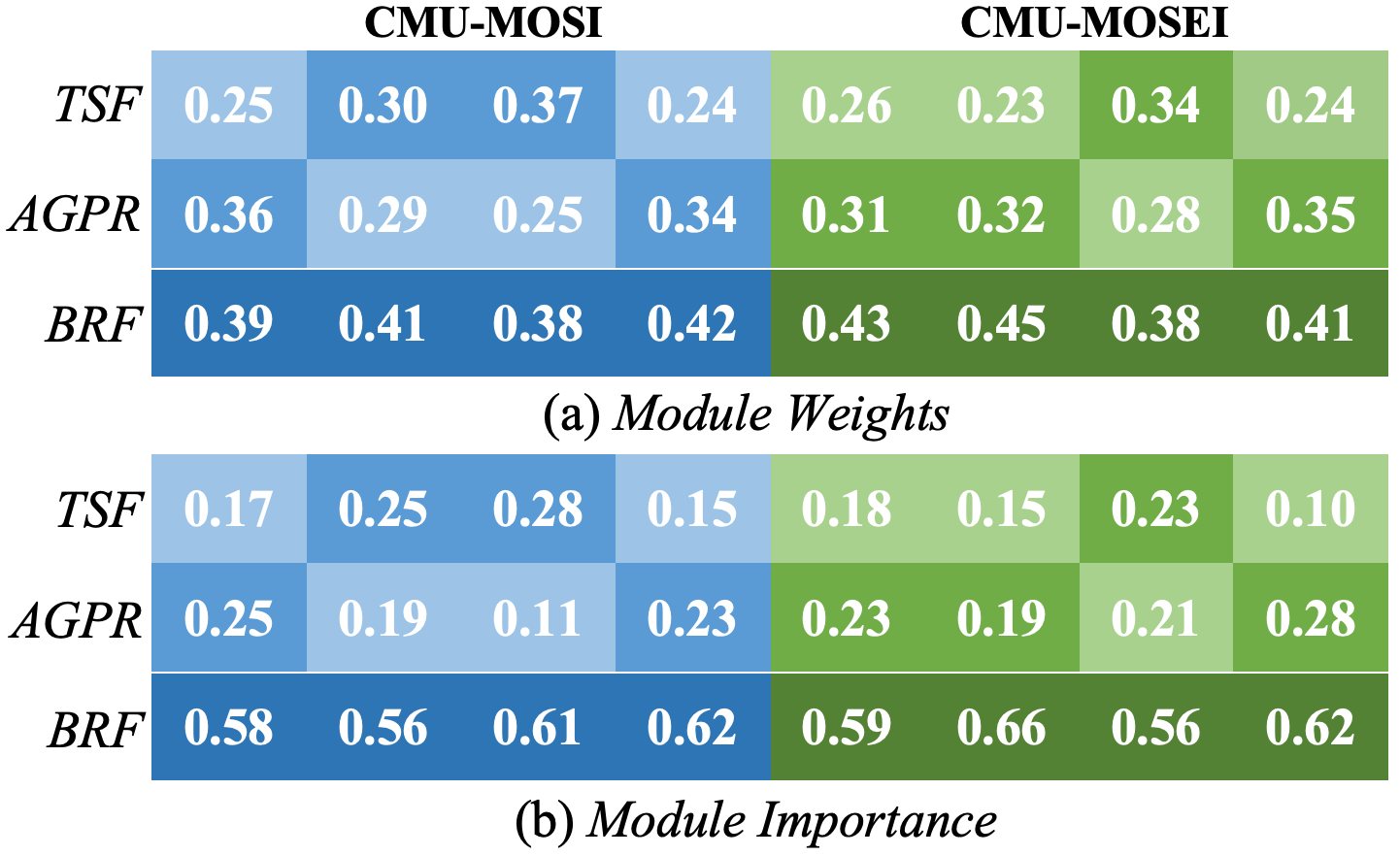
Figure 5: Fusion weights and contributions highlight BRF, TSF, and AGPR as critical for DBR's overall efficacy.
Theoretical and Practical Implications
DBR’s coordinated approach directly operationalizes the insight that merely factorizing shared and private evidence is not sufficient—without dedicated branch-specific regularization, redundancy and dilutive homogenization undermine expressive capacity. The explicit orthogonality and routing mechanisms offer a viable research direction for controlling representation drift in other multimodal or multi-view learning scenarios.
In practical terms, DBR is deployable with moderate computational requirements and is not sensitive to precise hyperparameter tuning, facilitating its adoption in real-world MSA systems. The attention patterns and representation visualizations provide interpretability, a key requirement in affective computing applications.
Limitations and Future Directions
Although DBR rectifies SP imbalance in classical trimodal sentiment analysis setups, extension to additional or highly heterogeneous modalities (e.g., physiological, tactile) and to open-vocabulary or weakly-supervised affective tasks are open challenges. The reliance on clean SP decomposition and per-modality encoders may also limit transferability to settings with significant missing data or unseen modalities.
Future research should examine adversarial scenarios where modality importance shifts dynamically, and the viability of meta-learned or context-adaptive regularization strengths. Deeper interaction with large pretrained models (e.g., LLMs, multimodal LMs) remains largely unexplored.
Conclusion
This work delivers a strong empirical and methodological advancement in MSA by precisely localizing and correcting the shared-private branch imbalance problem. Through targeted regularization—temporal-structural decoherence in the shared branch, anchor-guided private routing, and bidirectional fusion—DBR unlocks greater cross-modal complementarity and robust sentiment generalization (2604.25179). The paradigm and tools presented here are instructive for the next generation of multimodal representation learning frameworks.

