- The paper demonstrates that Hermitian coupling in weighted graphs overcomes algebraic phase obstructions, enabling universal realization of complex QL-bit states with real spectra.
- It employs synchronized mode reduction from block-coupled regular graphs to derive an effective 2x2 operator that precisely encodes arbitrary amplitude ratios.
- The work also shows discrete finite graph constructions with fourth-root edge weights, proving dense realizability of quantum-like states in the projective state space.
Universal Complex Quantum-Like Bits from Hermitian Weighted Graphs
Introduction
The paper "Universal Complex Quantum-Like Bits from Hermitian Weighted Graphs" (2604.23991) develops a rigorous structural and algebraic framework to realize quantum-like "bit" states (QL-bits) as exact two-level eigenstates of graph-supported operators. This work addresses the central inverse problem at the intersection of spectral graph theory and quantum information: under what conditions can a designed graph (with possibly complex or Hermitian edge weights) be engineered so that its global dynamics—on particular symmetric, synchronized subspaces—realize arbitrary complex qubit-like states, while retaining a physically meaningful, i.e., real and non-degenerate, spectrum? The paper's central contribution is a complete classification of the universality of such constructions, distinguishing models that fundamentally obstruct general complex superpositions from those whose internal structural features enable full quantum-like expressivity.
Synchronized Mode Reduction and Graph Construction
The QL-bit construction is rooted in block-coupled regular graphs. Two regular subgraphs GA and GB (with adjacency matrices A and B) provide synchronized all-ones eigenmodes VA and VB. By coupling these subgraphs through an algebraically regular bipartite block C, one arranges the full adjacency operator so that the synchronized sector (spanned by vectors constant on GA and GB) forms a two-dimensional invariant subspace. The reduction from the full graph dynamics to this subspace yields a precise 2×2 effective operator, completely determined by the chosen regularities and couplings.
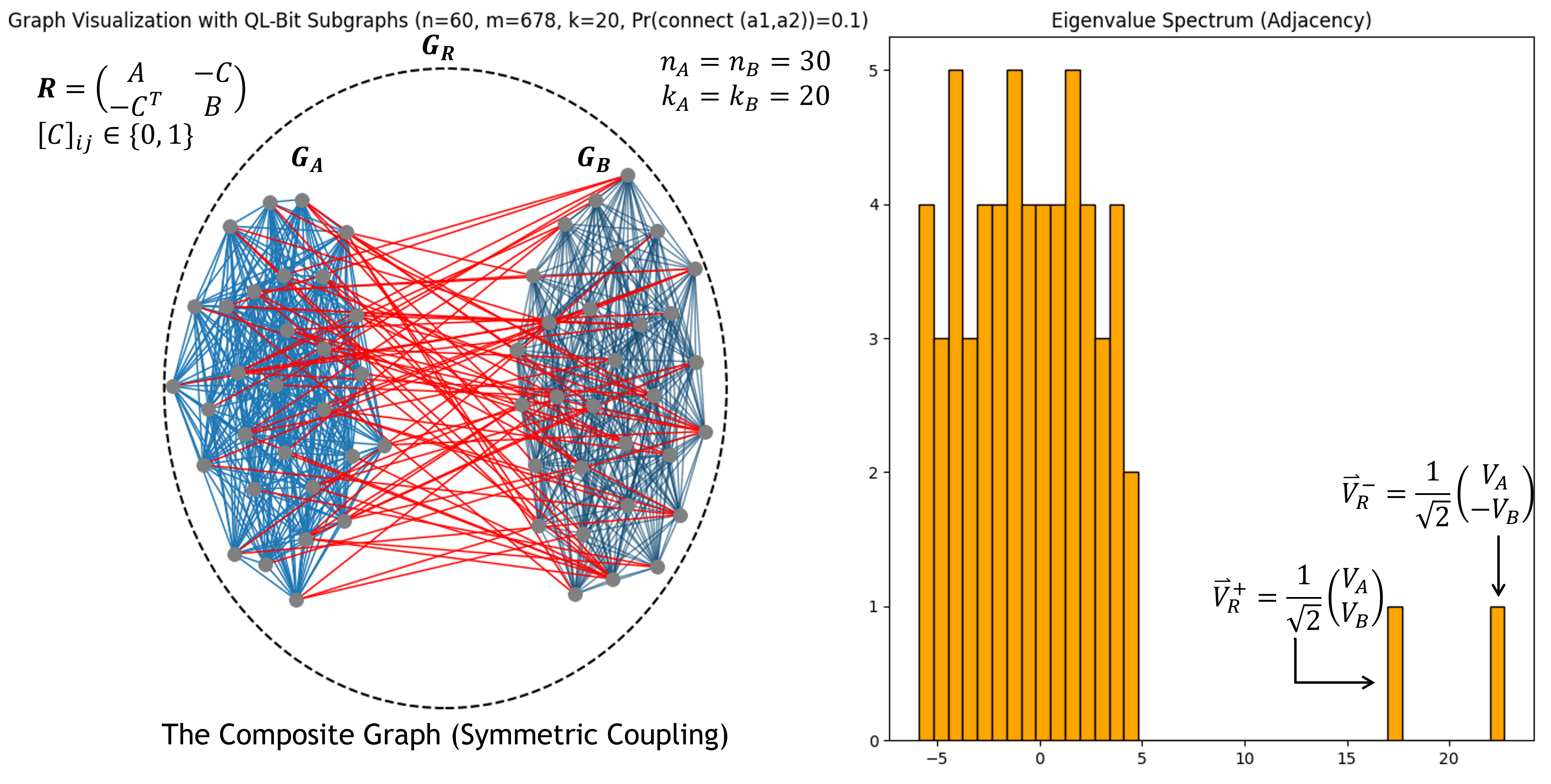
Figure 1: A QL-bit built from two regular subgraphs coupled by a bipartite block; symmetric and antisymmetric combinations GB0 span the relevant outlying eigenmodes.
The effective two-level basis is thus naturally labeled as GB1, and any normalized quantum-like state GB2 can be encoded by fixing the amplitude ratio GB3. The primary technical problem becomes: for a fixed target GB4, can the full graph-supported operator be constructed so that this state is an eigenvector with real spectrum, and is the corresponding sector isolated in the spectrum?
Universality Obstructions in Symmetric Complex Extensions
The paper proves that the most direct extensions of the original real-valued model—those with complex-symmetric coupling and real diagonals, or real-symmetric coupling with complex diagonal detuning—fail to realize arbitrary GB5 under the physically essential condition of a real spectrum. In the symmetric complex coupling model, the amplitude ratio is restricted by GB6 (i.e., GB7 must be real or purely imaginary), and in the real-coupling/complex-diagonal model by GB8 (i.e., GB9 or A0). Notably, generic complex phase relations, such as A1, are forbidden.
These obstructions are algebraic: they arise because the symmetric placement of a single complex degree of freedom fails to absorb the target phase. Both the explicit eigenvalue constraints and the induced parameterization reveal a residual condition on A2 that cannot be satisfied for all pure states.
Key technical claim: Neither complex-symmetric nor real-symmetric/complex-diagonal coupling supports universal realization of arbitrary complex QL-bits under a real spectrum requirement.
Hermitian Block Coupling and Universality Restoration
The central advance is the demonstration that replacing complex symmetry in the coupling by Hermitian structure—so the reduced A3 block has off-diagonal entries A4 and A5—removes the phase obstructions entirely. In this construction:
- For any target A6 (except basis vectors), any desired real eigenvalue, and any prescribed real spectral gap, there exist Hermitian effective parameters realizing A7 as an eigenvector with exactly the desired spectrum.
- The amplitude ratio A8 is encoded by the off-diagonal parameter A9 (with B0 real); the conjugation pairing in the Hermitian block ensures that the reality condition B1 is always satisfied.
This mechanism is robust: the symmetric subspace is a reducing subspace for the full Hermitian operator, ensuring orthogonal decoupling from non-synchronized modes and exact two-level dynamics unaffected by perturbations that preserve the synchronized structure.
Bold claim: Hermitian conjugate pairing is the minimal and most robust graph-theoretic mechanism supporting universal realization of arbitrary complex QL-bits with real two-level spectra.
Asymmetric and Directed Coupling Constructions
The work also establishes that relaxing off-diagonal symmetry and allowing independently tunable directed couplings (B2) similarly enables universal state synthesis: the two amplitudes in the B3 effective block can be set independently so that any ratio B4 is achievable. However, in this model, spectral guarantees (such as simplicity and decoupling of the desired two-level sector) are not automatic; the Hermitian structure remains preferable for physical stability and unambiguous eigenstate identification.
Discrete Realizations and Arithmetic Admissibility
Going beyond effective continuous parameterizations, the analysis addresses the realization of QL-bits in finite graphs with discrete edge weights. Specifically, it is shown that when couplings are restricted to the fourth roots of unity B5, every Gaussian-rational amplitude ratio B6 (modulo normalization) admits an exact finite weighted-graph construction. These finite models are constructed by decomposing the coupling into perfect matchings of the bipartite graph, aligning the arithmetic row and column sums with the prescribed effective parameters.
Strong result: Modulo global phase, the set of exactly realizable synchronized states is dense in the projective state space B7 for QL-bits with balanced Hermitian coupling.
Implications and Outlook
At a technical level, this work gives a complete universality taxonomy for block-reduced QL-bits. The fundamental outcome is that universal encoding of complex quantum-like states in graph-supported two-level sectors is not a simple consequence of increasing graph size or allowing complex weights, but is tightly governed by structural properties—specifically, Hermitian symmetry (conjugate pairings) in couplings or independently directed coupling mechanisms. These results substantially clarify the expressivity and design landscape for quantum-like, emergent-sectored models in networks.
Practical implications span the design of network-based quantum emulators, classical systems with engineered two-level quantum-like dynamics, and understanding the limitations of state synthesis via constrained physical interactions (where, e.g., only real or certain complex couplings are feasible). From a theoretical perspective, the density of discrete construction points toward the possibility of robust graph-theoretic state engineering and provides a path to generalize the approach to higher-level sectors (qudits), multiqubit analogs, or more intricate synchrony patterns.
Future developments are likely to focus on:
- Explicit algorithmic or constructive methods for synthesizing precise finite graphs with high-fidelity QL-bits for arbitrary B8.
- Extension to open system settings and non-Hermitian operators, where reality of spectra is nontrivial and may require additional structural symmetry or PT symmetry.
- Application of these principles to concrete quantum simulation architectures or in analog gravity/statistical physics models where network synchrony underpins emergent quantum-like sectors.
Conclusion
This study provides a unified algebraic and graph-theoretic understanding of universal state synthesis for complex QL-bits. The key insight is that real-spectrum universality requires more than arbitrary complexification; Hermitian symmetry (and, optionally, directed coupling) provides the precise mechanism by which arbitrary superpositions can be supported as isolated, physically meaningful states. Discrete constructions with finite phase alphabets, such as the fourth roots of unity, are dense in the pure-state landscape, demonstrating the practical attainability of universal QL-bit engineering within the framework of block-coupled regular graphs.
Reference: "Universal Complex Quantum-Like Bits from Hermitian Weighted Graphs" (2604.23991)