- The paper introduces a fluid antenna-enabled CUMA that aggregates only positive-phase ports, achieving cost-efficient multiuser uplink with a single RF chain per user.
- Analytical and simulation results show that increasing fluid antenna port density yields linear improvements in SINR and ergodic rates while reducing outage probability.
- The study demonstrates that deterministic phase aggregation outperforms traditional MRC and ZF in LoS-dominated, interference-prone satellite channels.
Fluid Antenna Enabled Compact Ultra Massive Antenna Array for Satellite Communications
Introduction and Motivation
Satellite communications remain indispensable for global coverage, critical infrastructures, and emergency communications. However, spectral scarcity and high launch/deployment costs restrict scalability and system performance, particularly in scenarios with dense ground user distributions and nonorthogonal multiple access (NOMA) requirements. Traditionally, Line-of-Sight (LoS) dominance and spatial correlation in satellite MIMO lead to poor multiplexing unless complex spatial or polarization strategies are adopted, with the downside of increased weight and deployment complexity.
This paper introduces the integration of Fluid Antenna System (FAS) technology with a Compact Ultra-Massive Antenna Array (CUMA) at the satellite, aiming to enable flexible, interference-robust, and cost-efficient multiuser uplink aggregation using single RF chains per user antenna. Unlike prior frame- or channel-level fluid antenna selection strategies (FAMA), CUMA leverages simultaneous port activation and coherent signal summation to achieve high beamforming gain and interference suppression even under pure LoS conditions where classical spatial filtering fails.
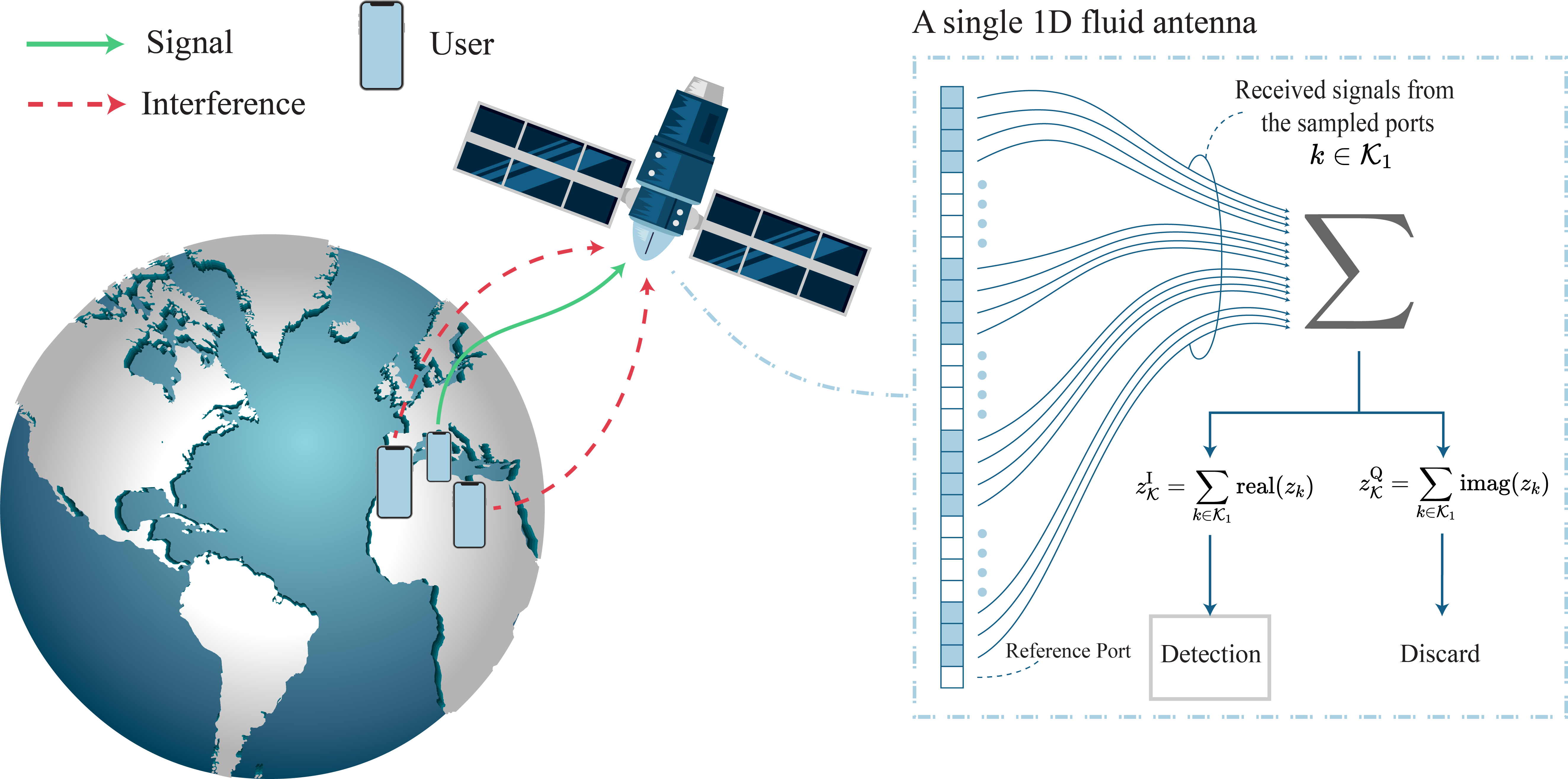
Figure 1: A conceptual uplink satellite communications system, where each fluid antenna employs many ports but only a single RF chain, serving multiple co-channel users via CUMA.
System Model and Analytical Framework
The satellite is equipped with U fluid antennas, each comprising K ports linearly distributed along a physical length Wλ. Each fluid antenna forms a receive aperture for a single user, with the "port density" μ=(K−1)/W per wavelength. All U ground users share the same time-frequency resource, resulting in strong multiuser interference.
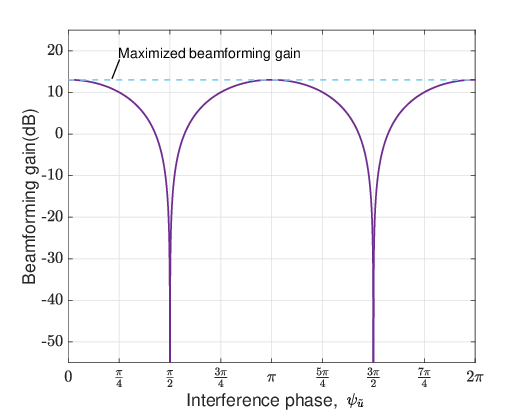
The key architectural innovation in CUMA is to exploit port-level phase information: only the ports with positive real components in the LoS channel are activated, coherently aggregating their in-phase contributions via a single RF chain. The resultant signal has deterministic structure, amenable to compact closed-form analysis, particularly under large μ (high port density). Analytical results include:
Port Density and Array Scaling
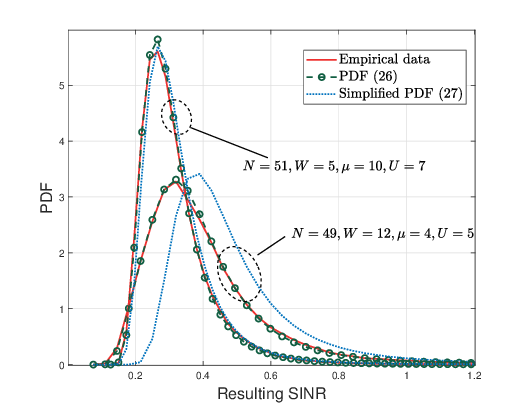
Analytical and simulation results demonstrate:
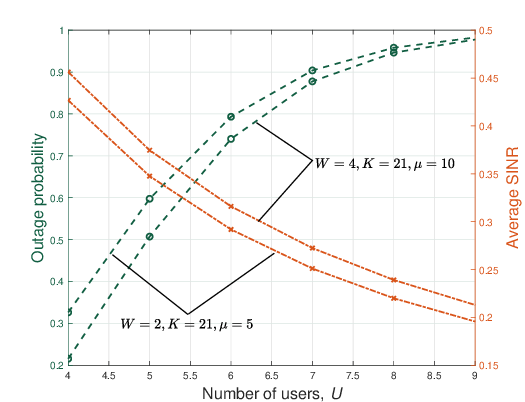
- SINR and Outage Probability Scaling: As the fluid antenna port density K0 increases, the average SINR and ergodic rate improve monotonically, while outage probability drops. This effect saturates at high K1 where the received signal power becomes asymptotically deterministic and interference is dominated by random user phases.
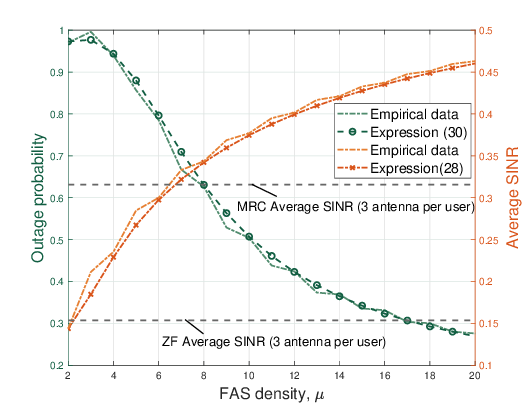
Figure 2: Outage probability and average SINR versus fluid antenna port density K2 (K3, K4, K5), illustrating rapid improvement with denser port deployment.
- Number of Ports (K6): SINR and ergodic rate scale linearly with K7 for fixed array length, emphasizing the beamforming power gain advantage of CUMA relative to classical approaches.
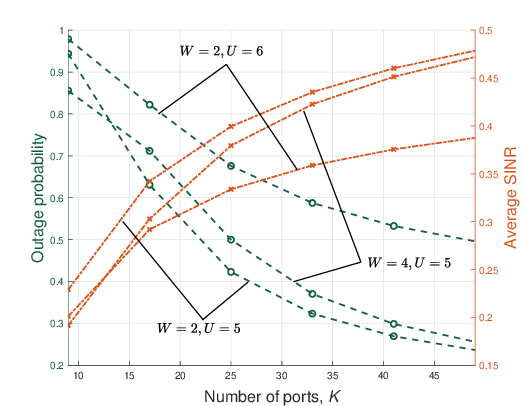
Figure 4: Outage probability and average SINR versus the number of ports K8 under varying K9 (array length) and user counts Wλ0.
Multiuser Interference and User Scaling
Comparison to Traditional Array Processing
- CUMA vs. MRC: Under LoS and dense user deployments, classical maximum ratio combining (MRC) cannot spatially separate users, as all impinge at near-identical angles. The paper provides closed-form conditions on Wλ4 under which CUMA’s absolute phase-based aggregation strictly outperforms MRC, both in interference- and noise-limited regimes.
- ZF Limitations: Zero-forcing is substantially less effective in these regimes due to noise amplification and the single-path channel model.
Wideband and Access Method Impact
- Wideband Regimes: With increasing bandwidth (Wλ7), ergodic rates of all architectures increase, but the noise-limited regime widens. Nonorthogonal CUMA (N-CUMA), which simultaneously serves all users on the same resource block, increasingly outperforms orthogonal CUMA (O-CUMA) as Wλ8 grows, due to the diminishing impact of interference relative to noise.
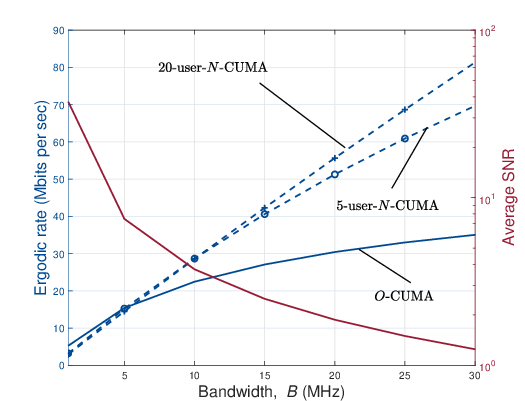
Figure 9: Ergodic rate and average SNR versus bandwidth Wλ9 for various user counts, evidencing that rate increases dominate even as SNR falls with bandwidth.
- User Scaling in Bandwidth-limited versus Noise-limited Regimes: At low port densities, increasing μ=(K−1)/W0 raises aggregate rates in the noise-limited regime thanks to multiplexing gains; at high port densities, interference dominates and limits returns from further user aggregation.
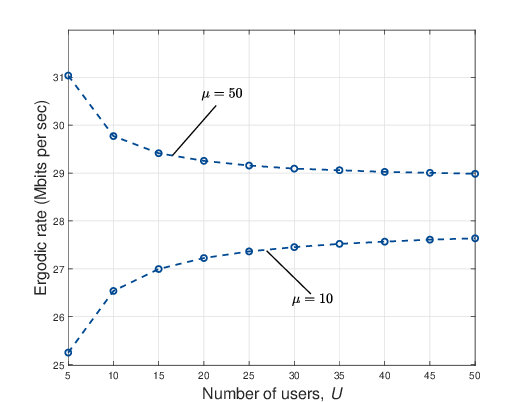
Figure 8: Ergodic rate versus user count μ=(K−1)/W1 for different μ=(K−1)/W2, highlighting the cross-over from noise- to interference-limited operation.
Theoretical and Practical Implications
- The analysis confirms that CUMA enables efficient multiuser uplink aggregation using a single RF chain per user antenna under compact, LoS-dominated satellite channel conditions.
- The system's performance becomes deterministic for sufficiently dense port deployment, allowing tight analytical control and system dimensioning.
- CUMA operates in absolute phase space, and thus can exploit deterministic geometric phase distinctions even when spatial angles overlap, unlike classical MIMO/MRC.
- Stochastic Dominance: The in-phase signal power distribution, for large μ=(K−1)/W3, first-order stochastically dominates the interference terms, ensuring strong reliability guarantees as port density grows.
- The approach reduces RF hardware requirements and the corresponding mass, which is of paramount importance in satellite payload design.
Future Outlook
The CUMA architecture with fluid antennas opens several promising avenues:
- Deployment in Millimeter-wave and THz Bands: The analytical framework and physical insights generalize to other environments where LoS dominates, such as terrestrial millimeter-wave and V2X.
- Extension to Arbitrary AoA Distributions: While this work focuses on compact user scenarios, extension to wide angular supports and hybrid scattering-LoS models is immediate.
- IRL/Prototype Validation: Hardware implementation of satellite fluid antennas and port management policies should be pursued, given demonstrated analytical and simulated performance gains.
- Dynamic NOMA/OMA Switching: Future work could optimize the access scheme dynamically based on measured SNR and interference statistics to maximize system utility.
Conclusion
This work establishes the fluid antenna-enabled CUMA as a highly effective, analytically tractable strategy for dense, interference-prone satellite uplink scenarios. CUMA leverages deterministic phase aggregation, achieving linear beamforming gain with port number, reduction in required RF chains, and robust performance in settings where classical MRC and ZF falter. The analytical framework directly empowers system designers to select array sizes and user access protocols to meet outage and capacity targets under practical satellite constraints.