- The paper introduces FAS-RSMA integration, using dynamic port reconfiguration and adaptive rate-splitting to drastically reduce outage probability and improve spectral efficiency.
- Methodology includes a comprehensive taxonomy and numerical analysis comparing FAS-RSMA with legacy NOMA/RSMA, showing orders-of-magnitude performance gains.
- Implications highlight enhanced multi-user beamforming, robust interference management, and versatile applications in ISAC, mMTC, satellite, and high-mobility networks.
Synthesis and Prospects of FAS-RSMA for 6G Networks
The convergence of Fluid Antenna Systems (FAS) and Rate-Splitting Multiple Access (RSMA) presents a compelling architectural direction for addressing spectral efficiency, massive connectivity, and reliability challenges in 6G wireless networks under imperfect CSIT conditions. This essay systematically reviews "Fluid Antennas Meet Rate-Splitting Multiple Access: A New Path Forward for 6G Networks" (2604.12621), focusing on the architectural taxonomy, the mechanisms behind the synergy of FAS and RSMA, key numerical results, application prospects, and open research challenges associated with the deployment of FAS-RSMA.
FAS-RSMA: Principles and Taxonomy
FAS enables dynamic reconfiguration of effective radiating positions within a constrained aperture via software-controllable physical mechanisms (liquid media, pixel arrays, metasurfaces), thus providing significant spatial DoFs and diversity even with limited hardware. RSMA simultaneously manages multi-user interference by splitting user data into common and private streams, decoded via SIC, offering greater reliability and adaptability compared to traditional OMA/NOMA approaches.
The paper categorizes FAS-RSMA schemes along deployment (BS-side/user-side/both), system objectives (achievable rate, OP, EE), and antenna configuration (SISO, MISO, MIMO), establishing baselines against FAS/FPA-NOMA and FPA-RSMA. The taxonomy illustrates that joint integration effectively leverages port reconfiguration to improve weakest-link reliability, rate fairness, and robust interference management.
Mechanism of Complementarity: FAS and RSMA
The synergy derives from mutually enhancing properties:
FAS alleviates channel limitations by strengthening the weakest effective links, enabling tighter bounds on common-stream rates, and widening the effective decoding margin across users. Dynamic port reconfiguration enhances spatial diversity and enables improved beamforming by adjusting the active array geometry according to instantaneous channel conditions. Agile FAS operation is especially beneficial in environments with high spatial correlation and channel non-stationarity (mobility, blockage).
RSMA's flexible interference management turns the additional DoFs provided by FAS into robust throughput and reliability gains, even under imperfect CSIT and stochastic user environments. The common-private message structure enables interference-aware signaling, minimizing the CSI requirements and accommodating noisy or delayed channel knowledge typical of high-mobility or satellite scenarios. Furthermore, RSMA supports multi-objective design (e.g., ISAC, secrecy, fairness) by allowing dynamic allocation between common and private streams.
Numerical Results: Outage and Spectral Efficiency
The paper delivers salient numerical demonstrations of FAS-RSMA superiority:
Outage Probability in Multi-user SISO
FAS-RSMA achieves orders-of-magnitude lower OP compared to FPA-RSMA and both FAS/FPA-NOMA baselines, with improved performance as the number of candidate FAS ports increases (N=10,20), confirming the benefit of spatial reconfiguration diversity even in single-transmit-antenna regimes.
SE in Multi-user MISO
FAS-RSMA surpasses all baselines in average sum-rate across SNR, with FAS-enabled port reconfiguration translating directly into channel gain enhancements and more effective multi-user beamforming—especially pronounced for RSMA compared to NOMA due to the improved exploitation of channel DoFs in the common-private stream framework.
Key strong numerical results:
- FAS-RSMA achieves steep OP decay and high spectral efficiency beyond traditional fixed-antenna RSMA implementations.
- Performance improvements scale with increasing FAS port count, supporting the conclusion that hardware-level DoFs can be efficiently converted to network-level throughput and reliability via RSMA.
Application Scenarios
The breadth of FAS-RSMA's applicability extends across high-impact 6G domains:
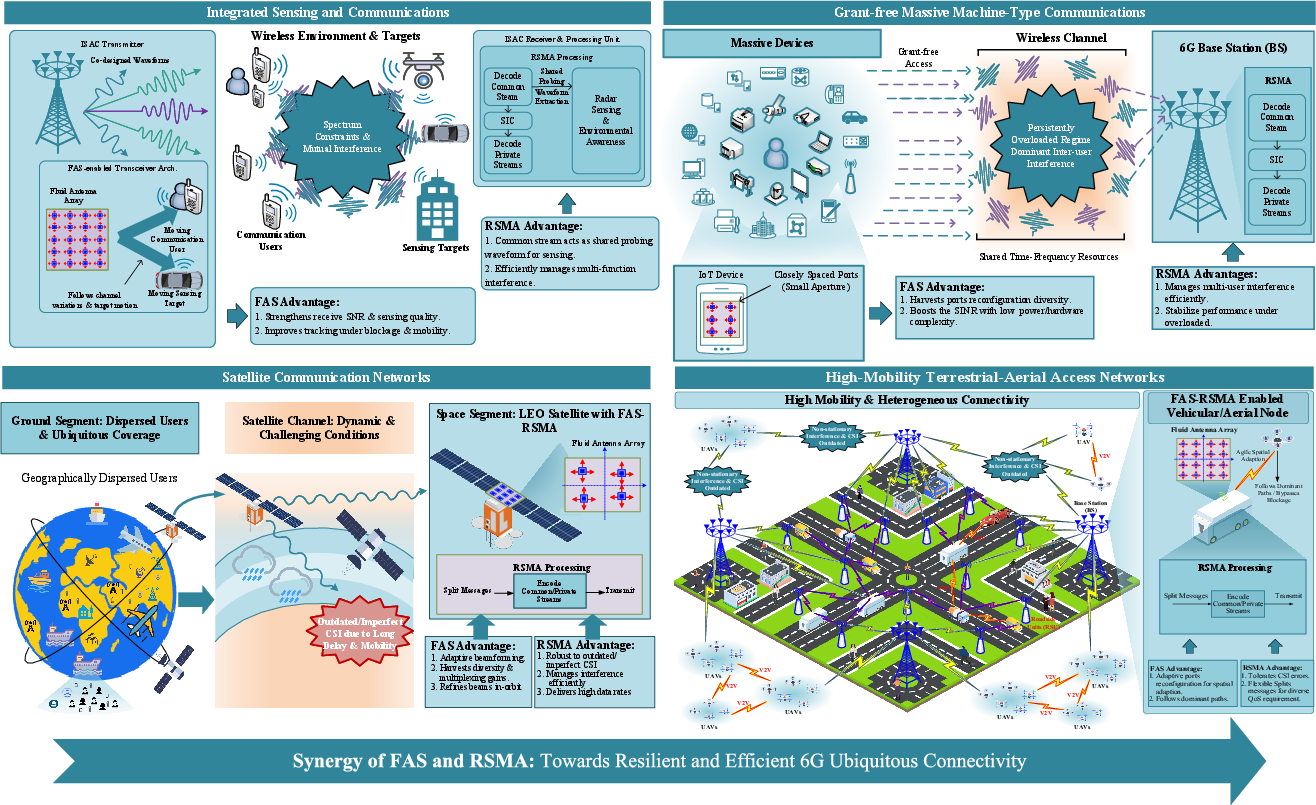
Figure 1: Potential applications of FAS-RSMA span ISAC, mMTC, satellite communications, and high-mobility terrestrial-aerial access networks, each leveraging complementary strengths in spatial adaptation and interference management.
- ISAC: Co-optimized waveforms for simultaneous communication and sensing, exploiting FAS agility and RSMA control of cross-function interference.
- mMTC: Grant-free, highly-overloaded regimes benefit from robust interference management and link-level adaptability with minimal hardware.
- Satellite Networks: Outdated CSIT and harsh fading conditions are mitigated via FAS-induced diversity and RSMA's tolerance to CSI inaccuracy.
- High-Mobility Networks: Vehicular and UAV contexts capitalize on port reconfiguration agility and resilient downlink access under fluctuating channel conditions.
Architectural and Implementation Challenges
Despite the clear performance benefits, practical FAS-RSMA realization is impeded by several obstacles:
- Joint Beamforming and Port Selection: Optimization is high-dimensional and strongly coupled (mixed-integer, nonconvex); scalable solutions may rely on two-timescale control, structured relaxations, or RL-driven policies for slow (port) and fast (beamforming) timescales.
- CSI Acquisition: The overhead of probing dense port configurations threatens scalability; reduced-dimension, spatially correlated channel estimation or compressive acquisition/training are necessary to keep pilot and feedback burdens tractable.
- Hardware Design: Determining port/radio budget, port layout under spatial correlation constraints, and enhancing RSMA receiver robustness to non-idealities (nonlinearities, quantization) are non-trivial in compact, cost-sensitive user terminals and satellites.
Conclusion
FAS-RSMA offers a model for next-generation multiple access that unites hardware-level spatial flexibility and signal-level interference control, combining the strengths of dynamic port reconfiguration and adaptive rate-splitting to meet 6G requirements of high throughput, reliability, and adaptability. Numerical findings substantiate its substantial gains over legacy benchmarks on both reliability and spectral efficiency fronts. Critical future work must focus on tractable control under joint position-precoder optimization, scalable low-overhead channel acquisition, and practical hardware architectures to facilitate deployment in diverse 6G environments. Continued research into FAS-RSMA is therefore vital for efficient, robust, and flexible 6G network design.