- The paper introduces DeepOPiraKAN, a novel PINN architecture that learns the full parameter-to-spectrum mapping in a unified model.
- It integrates random Fourier feature embeddings with residual-adaptive KAN blocks to stabilize training in stiff spectral regimes.
- The method accurately computes Kerr black hole quasinormal modes with relative errors as low as 10⁻⁶ for fundamental modes and 10⁻⁴ for higher overtones.
Introduction
The paper "Physics informed operator learning of parameter dependent spectra" (2604.23625) presents a new paradigm for solving parameter-dependent spectral problems by leveraging operator learning with a novel physics-informed neural network (PINN) architecture—DeepOPiraKAN. Spectral problems governed by differential operators are omnipresent across physics and engineering, yet their parameter-dependent nature and the necessity for high-precision computation over continuous parameter domains render traditional approaches computationally prohibitive, especially for repeated evaluations. As a stringent testbed, the authors target the computation of quasinormal modes (QNMs) of Kerr black holes—a problem of central importance for gravitational-wave astrophysics and one beset by strong parameter dependence and nontrivial spectral complexity.
DeepOPiraKAN Architecture
The central contribution is DeepOPiraKAN, a PINN-based neural operator designed for parameter-dependent spectral computations. DeepOPiraKAN addresses two primary obstacles in the extant literature: (1) representing the full parameter-to-spectrum mapping in a single, unified model rather than solving at isolated parameter points, and (2) achieving stable optimization dynamics, even in highly sensitive or stiff spectral regimes common in high overtone computations.
The architecture integrates three core components:
- Random Fourier Feature Embedding: Input coordinates are projected into a high-dimensional feature space, efficiently supporting multiscale function approximation and mitigating the spectral bias typical of PINNs.
- Residual Adaptive Kolmogorov-Arnold Network (PiraKAN) Blocks: Each block comprises three KAN layers supported by adaptive short residual connections controlled by trainable parameters α(l). These adaptive pathways enable gradual introduction of nonlinearity, suppressing pathological training dynamics and trivial solution mode collapse.
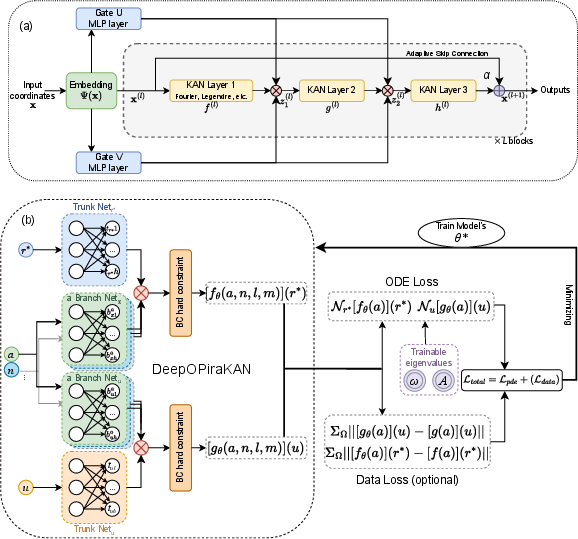
Figure 1: The DeepOPiraKAN architecture employs a multi-branch DeepONet with residual-adaptive KAN blocks and Fourier feature input embedding, enabling stable and accurate parameter-to-spectrum learning.
- DeepONet Framework: Both trunk and branch networks of DeepONet are instantiated using PiraKAN. The parameter-to-spectrum mapping thus learns over function space, with physical parameters (e.g., Kerr spin, overtone index) input as branches and space-time coordinates as trunks, allowing a single model to predict solution functions (eigenfunctions) and eigenvalues for arbitrary parameters.
Boundary conditions are incorporated as hard constraints on network outputs, and spectral values (eigenfrequencies and angular eigenvalues) are optimized post-training for targeted configurations, with the network weights frozen, ensuring stable and interpretable constraint satisfaction.
Application to Kerr QNM Spectroscopy
DeepOPiraKAN is benchmarked on the solution of the Teukolsky equation for Kerr black holes—a non-Hermitian, parameter-sensitive spectral problem. The architecture is trained to resolve subdominant QNM branches, focusing on (ℓ,m)∈{(2,0),(2,1)} and overtones up to n=7, across the full physically relevant spin parameter range.
The network achieves systematic and robust accuracy:
- Relative errors for the fundamental mode (n=0) are consistently O(10−6).
- For higher overtones, errors scale gradually to O(10−4), maintaining stability across the parameter domain.
- Accuracy is insensitive to spin parameter variations for fixed mode index, with minor degradation at high overtone number, primarily due to increasing numerical stiffness, not architectural limitations.
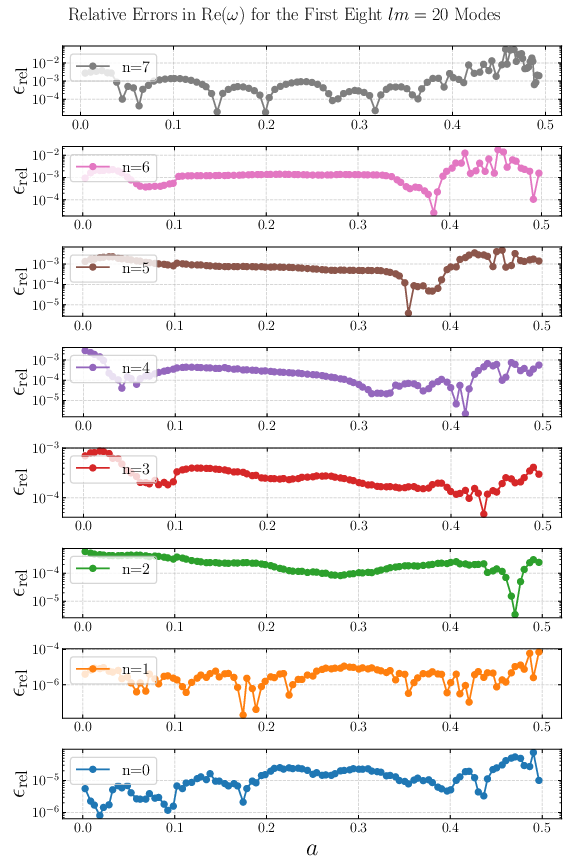
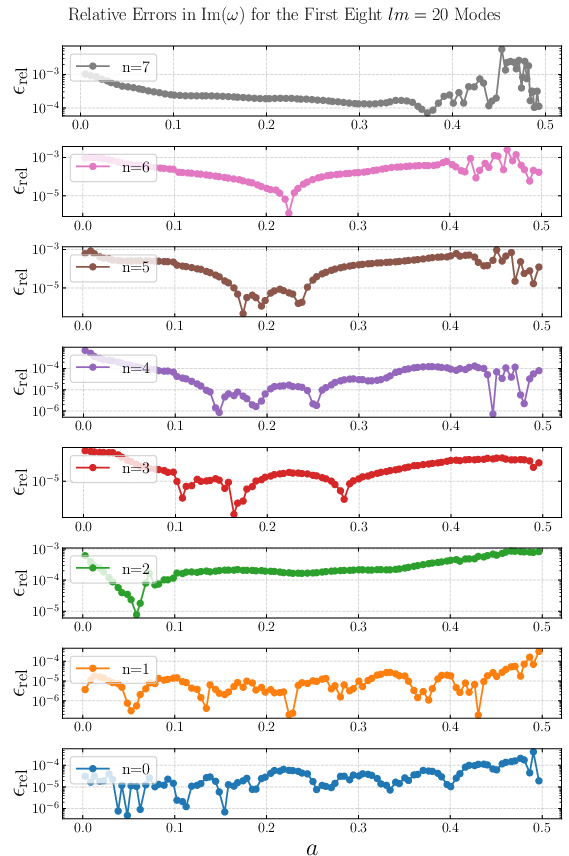
Figure 2: Relative accuracy for the first eight QNMs with (ℓ,m)=(2,0) as a function of spin compared to Leaver's method benchmarks.
Evaluation step resolution is a tunable parameter: increased steps (4×10³) yield improved convergence for stiff cases such as m=1 modes at high spins, with observed discontinuities being resolved by raising evaluation resolution rather than retraining.
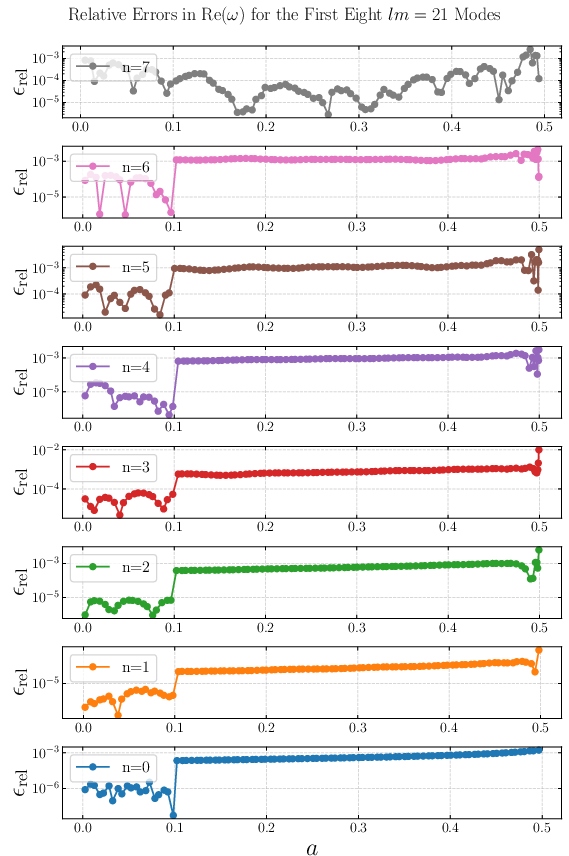
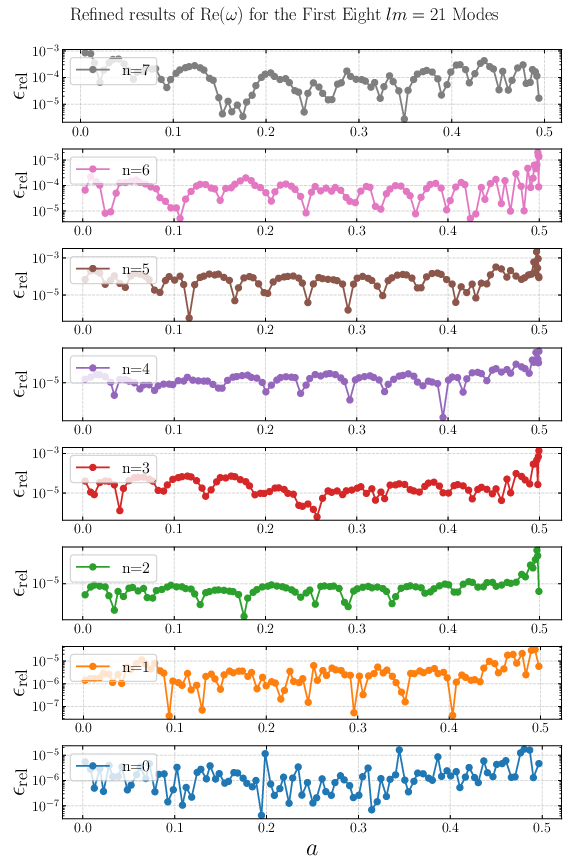
Figure 3: Real part accuracy for (ℓ,m)=(2,1) QNMs, showing increased evaluation steps (right panel) removes spin-dependent error discontinuities.
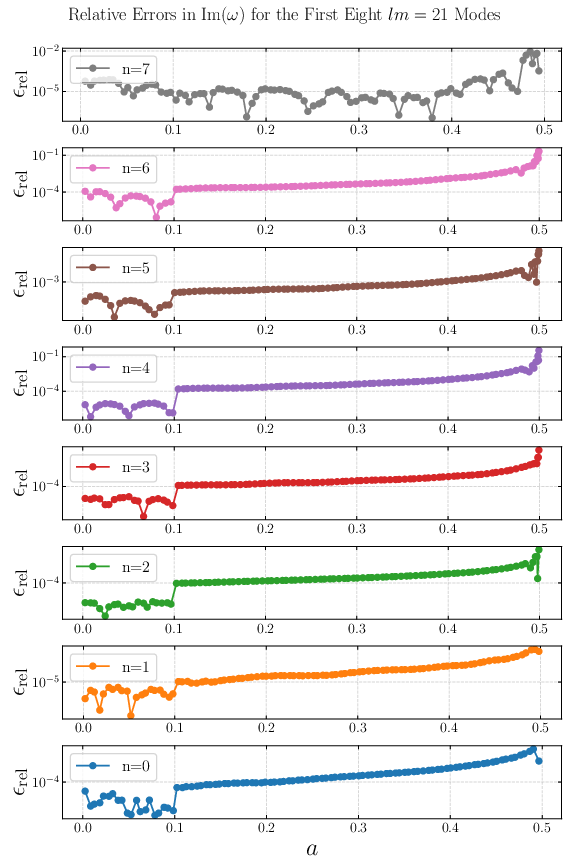
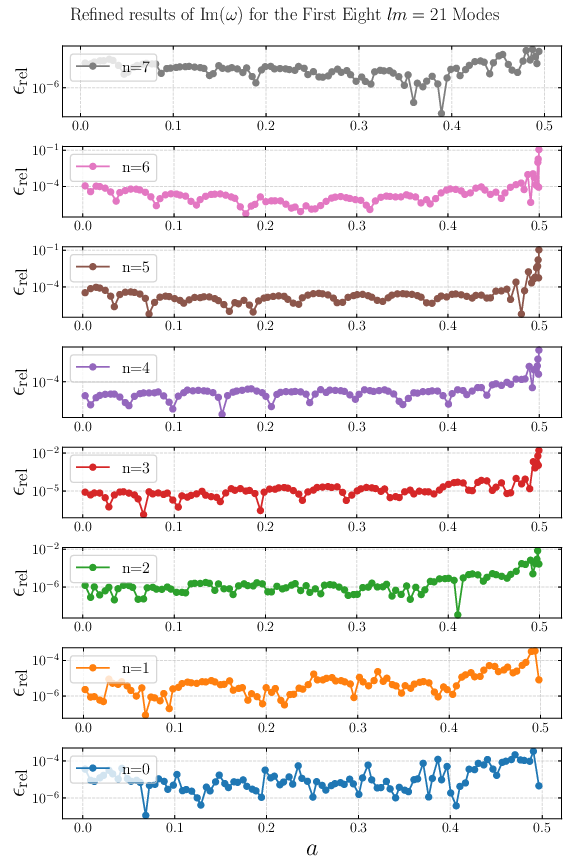
Figure 4: Imaginary part accuracy for (ℓ,m)=(2,1) QNMs, also benefiting from higher evaluation resolution.
Mean PDE loss (ℓ,m)∈{(2,0),(2,1)}0 monotonically decreases with higher evaluation steps, especially in stiff parameter intervals, quantifying the direct link between evaluation resolution and spectral prediction fidelity.
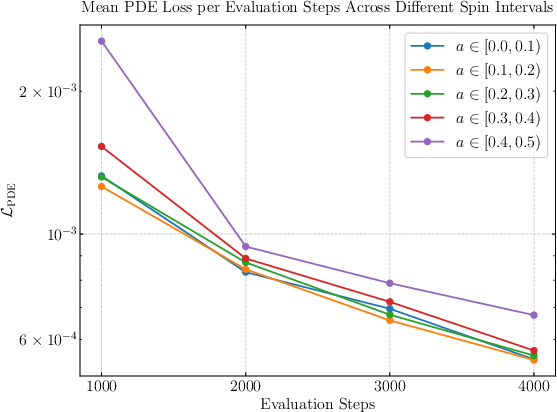
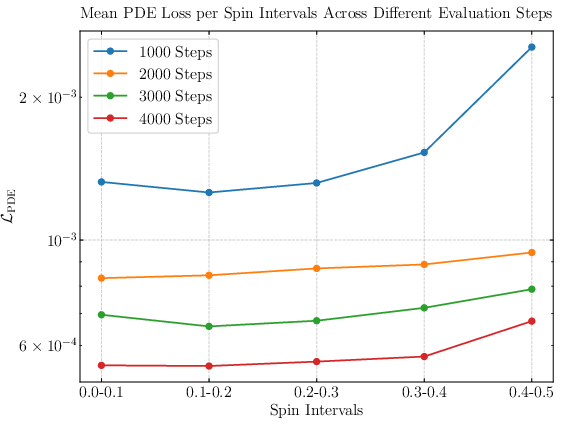
Figure 5: Mean PDE loss as a function of spin interval and evaluation steps for the (ℓ,m)∈{(2,0),(2,1)}1 mode, illustrating systematic improvement with increased evaluation resolution.
Numerical Results and Benchmarking
The performance of DeepOPiraKAN is systematically validated against Leaver’s continued fraction method, the numerical standard for QNM spectra. The network is trained using high-precision data over uniform parameter grids; during inference, only the spectral values (complex frequencies and angular eigenvalues) are fine-tuned for each parameter configuration, enabling orders-of-magnitude acceleration for large-scale parameter sweeps. The neural surrogate captures the functional hierarchy of the spectrum, rather than interpolating between isolated solutions.
Key empirical findings:
- For (ℓ,m)∈{(2,0),(2,1)}2 families considered, relative errors remain below (ℓ,m)∈{(2,0),(2,1)}3 for all overtones up to (ℓ,m)∈{(2,0),(2,1)}4; for fundamentals, below (ℓ,m)∈{(2,0),(2,1)}5.
- The architecture demonstrates robust transferability: no mode-specific retraining or architectural modification is required to achieve convergence across all parameter regimes, including those with strong spin-mode coupling.
- Computational acceleration is realized for large-scale waveform modeling relevant to LISA, Taiji, and other next-generation gravitational wave observatories.
Practical and Theoretical Implications
DeepOPiraKAN represents a practical shift toward operator-based spectral computation, enabling scalable, surrogate-based solutions for parameter-dependent eigenproblems encountered throughout physics, engineering, and computational science. Practically, such models can underpin real-time QNM template banks and ringdown signal analysis infrastructures for gravitational wave astronomy, addressing the stringent accuracy and efficiency demands of next-generation facilities.
Theoretically, the work demonstrates the efficacy of residual-adaptive architectures and operator-based neural surrogates for mitigating pathological training dynamics in PINNs and producing interpretable results in stiff PDE regimes. The modularity of the architecture allows replacement of functional bases (e.g., wavelets, polynomials) within the KAN paradigm for adaptation to other spectral problems. Importantly, the separation of learning and evaluation resolution enables predictable accuracy control at inference time, a desirable property absent from traditional PINN and pointwise eigensolver schemes.
Future directions include applications to more complex multi-parameter spectral problems (e.g., neutron star oscillations with realistic equations of state), extension to multi-field and multi-physics domains, and integration into multi-scale simulation workflows.
Conclusion
DeepOPiraKAN provides a robust, accurate, and computationally tractable architecture for parameter-dependent spectral problems, validated here on the challenging QNM spectrum of Kerr black holes. Its operator-level formulation, stability enhancements, and demonstrated empirical accuracy set a formal foundation for scalable PINN-based surrogate modeling in spectral analysis. The approach is anticipated to have wide applicability across domains where efficient, high-fidelity spectral mapping over parameter space is central.

