- The paper introduces the FIREFLY algorithm, enabling efficient Bayesian extraction of multiple gravitational wave ringdown quasi-normal modes from space-borne detectors.
- It leverages analytic marginalization of linear parameters to reduce a high-dimensional inference problem, achieving over 200x acceleration compared to traditional methods.
- The method provides statistically robust, scalable inference for high-SNR black hole mergers, facilitating stringent tests of general relativity and the no-hair theorem.
Efficient Bayesian Inference of Gravitational Wave Ringdown Multipole Modes in Space-Borne Detectors with FIREFLY
Introduction
The extraction of quasi-normal mode (QNM) spectra from gravitational wave (GW) ringdown signals is a crucial tool for probing black hole spacetime structure and testing general relativity via black hole spectroscopy. While current ground-based detectors have enabled detection and extraction of dominant QNMs in stellar-mass black hole coalescences, the advent of next-generation space-borne GW observatories (e.g., LISA, TianQin, Taiji) is anticipated to enable high-SNR observations of mergers involving massive black holes, potentially resolving multiple ringdown modes with high accuracy. However, the high-dimensional parameter space resulting from the inclusion of multiple QNMs necessitates algorithmic advances to render Bayesian inference computationally tractable in this regime.
This paper introduces the first Bayesian ringdown analysis pipeline for space-borne detectors employing the FIREFLY algorithm—previously validated for ground-based analyses—adapted for use with time-delay interferometry (TDI) observables relevant to space missions (2604.20914). The approach exploits the linear-Gaussian structure of the ringdown signal model, enabling analytic marginalization and efficient importance sampling. Strong numerical evidence for ∼200× acceleration over conventional approaches without accuracy loss is established, demonstrating the method’s scalability and extensibility.
The space-borne ringdown data analysis problem is formulated within the standard Bayesian framework. The GW signal h(t) after a black hole binary merger is modeled as a coherent sum of QNMs:
h(t)=ℓ,m,n∑Aℓmnexp(−t/τℓmn)cos(ωℓmnt+ϕℓmn),
supplemented by projection onto the detector response and formation of TDI observables. Here, the mode amplitudes Aℓmn and phases ϕℓmn encode the physical content, while the frequencies ωℓmn and damping times τℓmn depend on the remnant black hole mass and spin, or may be treated as free parameters for model-agnostic tests.
Critical to the acceleration is recognizing that the TDI observables retain linear dependence on the (Aℓmn,ϕℓmn) parameters under suitable reparameterization, and that under Gaussian noise, the likelihood function is quadratic in the signal residuals. FIREFLY leverages this by analytically marginalizing over linear parameters with flat priors, reducing the high-dimensional inference problem to efficient sampling of the remaining nonlinear degrees of freedom. Faithful reconstruction of the full posterior under the proper target priors is enabled via importance sampling, with the high-dimensional MC steps efficiently performed due to the underlying analytic structure.
Validation and Sampling Fidelity
An extensive simulation study is presented for a prototypical massive black hole binary with source-frame masses 4×10⁵M⊙ and 3.5×10⁵M⊙ at h(t)0, yielding h(t)1 and h(t)2. The TDI A and E data channels of TianQin are synthesized to a total SNR of h(t)3 including six QNMs, capturing both dominant and subdominant multipole/out-of-equilibrium modes.
Figure 1 depicts the posterior distributions for the QNM parameters produced by both conventional full-parameter sampling and FIREFLY-accelerated inference. The two methods yield nearly indistinguishable posteriors, as evidenced by both visual and quantitative metrics (including average normalized Wasserstein distances, all h(t)4 of a posterior standard deviation), validating the statistical faithfulness of the new method.
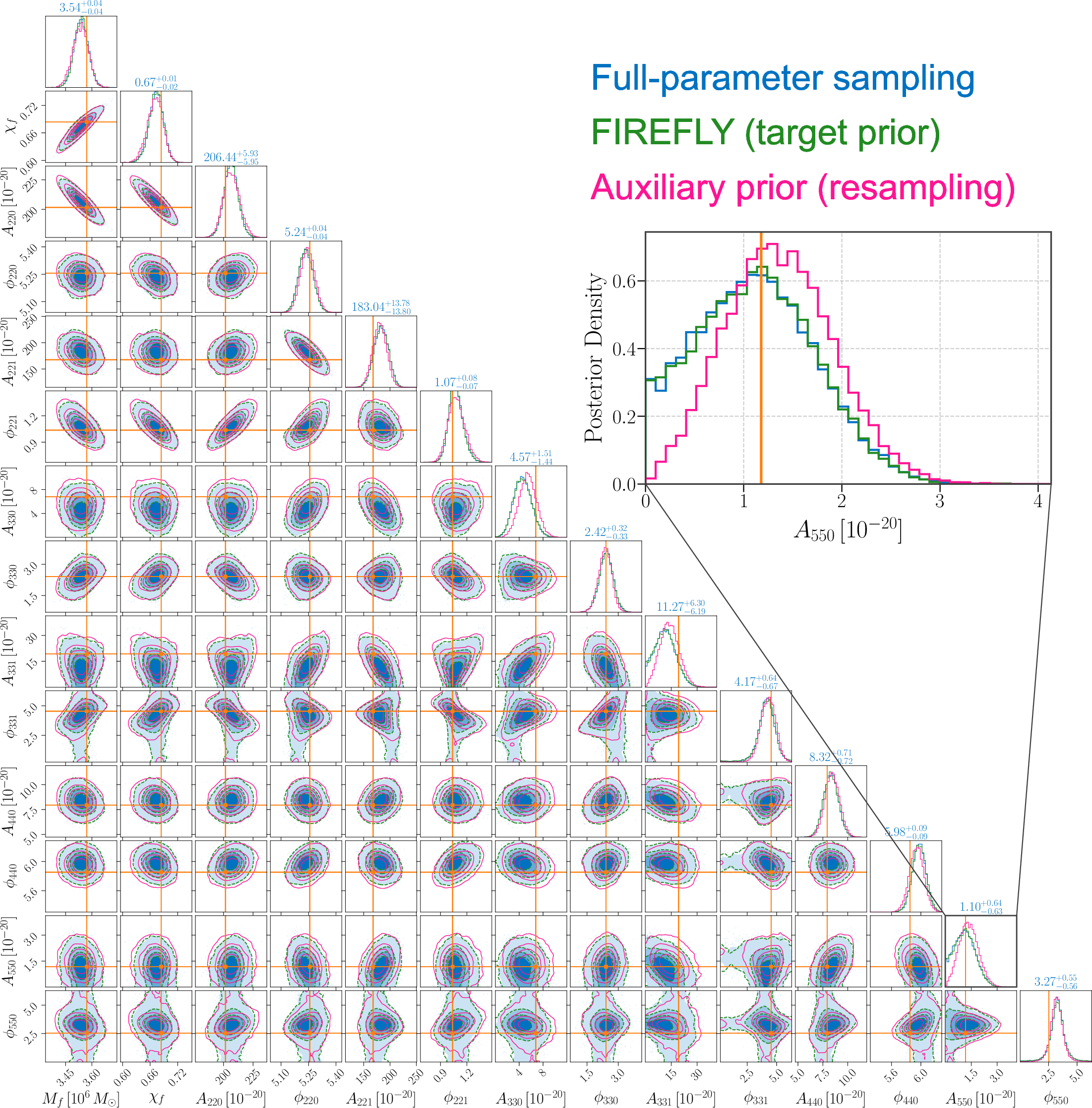
Figure 1: Posteriors in the ringdown analysis with six QNMs; contours compare full-parameter sampling (blue), FIREFLY (green), and auxiliary inference (pink), with the injected values shown in orange.
Computational Accelerations and Scalability
The computational efficiency of the FIREFLY pipeline is benchmarked against conventional approaches as a function of the number of QNMs included in the analysis. As illustrated in Figure 2, the time taken for full-parameter sampling grows steeply with the parameter space dimensionality—reaching hours for six QNMs—while the FIREFLY scheme exhibits only mild scaling, reducing wall-clock time from approximately 13 hours to 4 minutes for a six-mode analysis, a h(t)5 improvement. Comparisons are consistent across different nested samplers (dynesty, nessai).
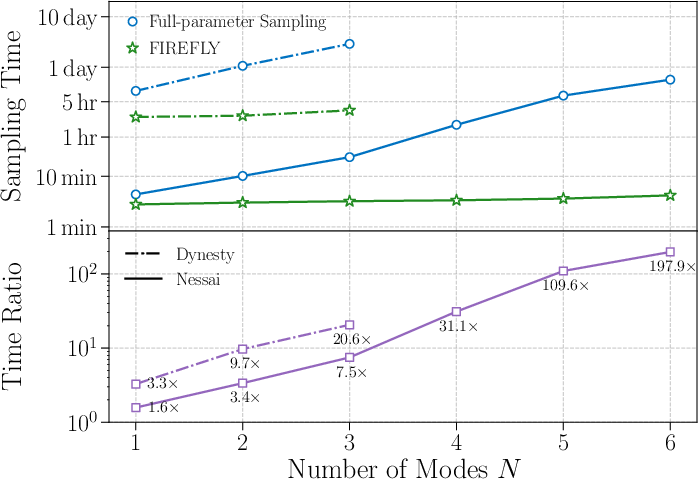
Figure 2: Sampling time for full-parameter sampling and FIREFLY as a function of the number of QNMs; ratios show massive acceleration especially at high h(t)6.
This scalability arises from the auxiliary analytical marginalization, which replaces the direct, exponentially-slow high-dimensional sampling step—especially crucial as future missions will demand the inclusion of overtone and non-dominant modes, both for SNR and to mitigate systematic biases.
Statistical Robustness
The detailed examination of quantile-quantile correspondence between FIREFLY and full-parameter sampling, shown in Figure 3 (for h(t)7) and subsequent figures for higher mode numbers, reveals no statistical degradation as dimensionality increases. The internal consistency (FIREFLY-to-FIREFLY and full-to-full) is commensurate with cross-method variability, strongly supporting the assertion that all speedup is gained without accuracy compromise.
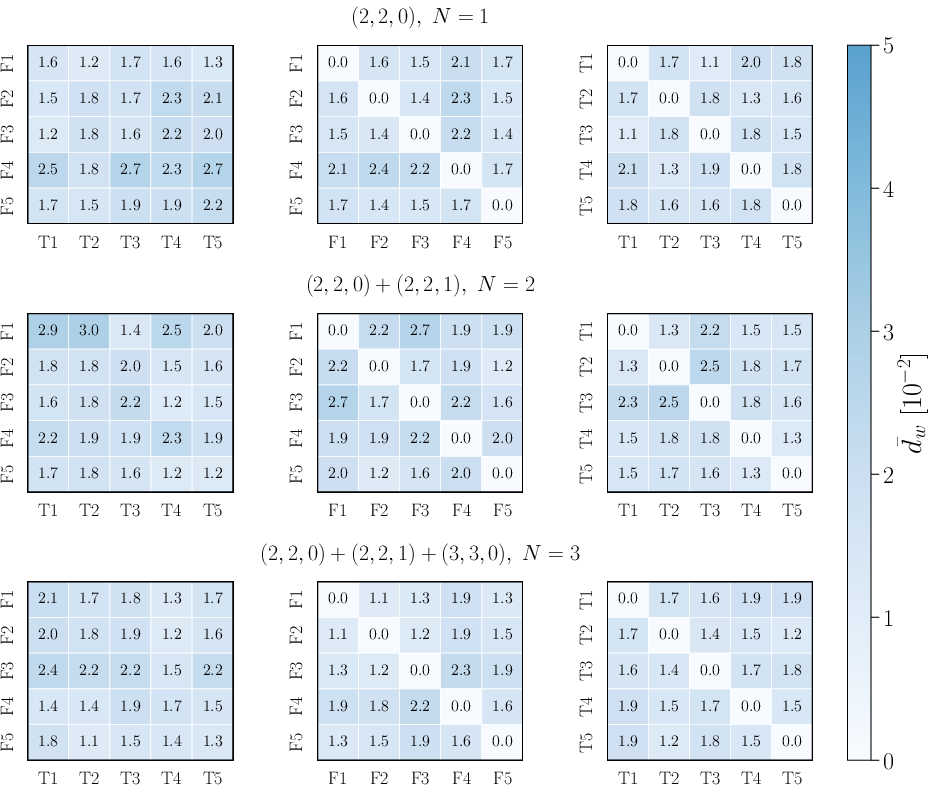
Figure 3: Averaged, normalized one-dimensional Wasserstein distances for posteriors of both methods (nessai sampler, h(t)8); cross-method and internal distances remain uniformly low (within 5\%).
Implications and Extensions
The results demonstrate that FIREFLY provides a robust and practical pathway for scalable, high-fidelity Bayesian inference of multi-mode black hole ringdown signals in the context of space-borne detectors. The method’s sound statistical interpretation makes it suitable for stringent tests of the no-hair theorem and the Kerr hypothesis with future high-SNR coalescences, as well as for searches for new physics beyond general relativity via deviations in QNM spectra.
Moreover, FIREFLY’s applicability extends beyond BH ringdowns—to other classes of GW sources (e.g., double white dwarfs, extreme-mass-ratio inspirals) where similar linear-Gaussian structures exist in the parameterization of the post-merger or inspiral waveform, especially in the context of space-borne detectors that facilitate high precision inference.
Conclusion
This work presents the first comprehensive adaptation and validation of the FIREFLY algorithm for multi-mode ringdown inference in space-borne GW detectors, achieving order-of-magnitude improvement in computational cost without compromising inference quality. The approach is statistically robust, demonstrably scalable in dimensionality, and readily generalizable to other source types and networks. These advances are expected to enable the realization of the spectroscopic potential of planned space GW observatories, with broad implications for fundamental physics, high-precision astrophysics, and strong-field gravity.

