- The paper introduces a hybrid diffusion-reactive framework that fuses diffusion denoising with real-time, observation-driven streaming control.
- It demonstrates that reduced DDIM steps and online streaming corrections enable high-frequency feedback and robust adaptation in contact-rich manipulation tasks.
- Empirical results across simulation and real-world experiments confirm TDP's superior performance over chunk-based generative policies under disturbances.
Motivation and Problem Statement
Visuomotor learning for dexterous robotic manipulation in contact-rich settings requires policies that reconcile high expressiveness (to model complex behaviors) and low-latency reactivity (to handle high-frequency feedback, contact uncertainty, and external disturbances). Contemporary imitation learning methods based on generative models, such as Diffusion Policy (DP) and Action Chunking Transformers (ACT), generate coherent, multimodal behaviors but predominantly operate in open-loop or receding-horizon, chunk-based execution modes. This naturally incurs delays in integrating feedback due to computationally expensive inference, producing brittle trajectories under model mismatch and disturbance. Classical robust control and tube Model Predictive Control (tube-MPC) address reactivity via feedback regulation but are not scalable to high-dimensional, contact-rich, and nonlinear robot dynamics.
This work proposes Tube Diffusion Policy (TDP), a hybrid generative/reactive policy learning framework that bridges diffusion-based imitation learning with feedback flow control, yielding robust, feedback-driven policies from demonstration data without explicit system identification.
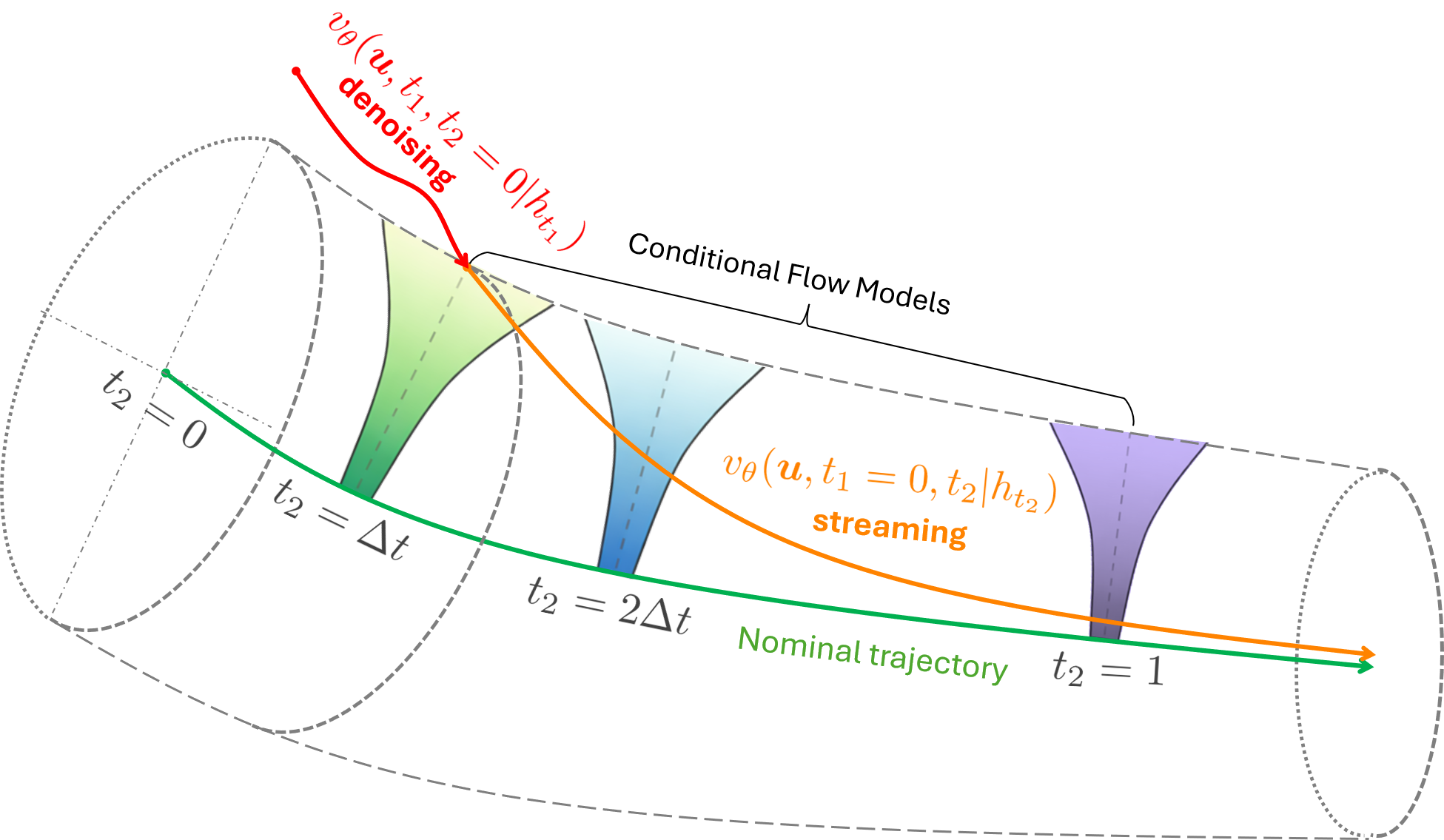
Figure 1: Overview of Tube Diffusion Policy (TDP), showing dual-phase (denoising and streaming) architecture with continual observation-driven feedback along the action tube.
Approach: Action Tubes via Diffusion and Streaming Flows
Dual-Time Policy Decomposition
TDP separates control into two coupled time-domain phases: (1) a diffusion-based denoising phase over an action chunk, and (2) a streaming phase that steers actions by integrating a learned, observation-conditioned velocity field. At horizon boundaries, diffusion denoising yields a chunk-level corrective action via multi-step inference, capturing nonlinear dynamics and contact effects. Within each chunk, streaming updates the action at each timestep under fresh observations by integrating in trajectory time, providing real-time, high-frequency feedback. This is formalized as learning both the diffusion generative process and the streaming vector field with a unified backbone.
During deployment, TDP initiates each action horizon with fast denoised generation, then executes step-wise corrections under updated sensory streams, effectively constraining execution to a tube centered around the nominal trajectory but allowing continuous correction against disturbance.
Policy Training
Demonstration episodes are segmented, and dense observation histories and action sequences are sampled. The network, a large conditional 1D U-Net, is trained with a joint objective: diffusion noise prediction for denoising, and direct regression of the streaming flow velocity field. The backbone is conditioned via FiLM by observation encoders (vision, tactile, and proprioception) and separated sinusoidal temporal embeddings for diffusion and streaming phases.
Stability and Theoretical Analysis
TDP’s stability follows from its hybrid design: streaming imitation yields high-frequency control under locally linearizable dynamics, with bounded drift due to imitation/model mismatch and disturbance. Periodic diffusion correction contracts the tracking error. The theoretical analysis establishes that, under Lipschitz dynamics and bounded errors, the closed-loop error is ultimately bounded and converges to zero in the limit of vanishing imitation and disturbance terms.
Empirical Validation
Toy Example: 1-D Point-Mass
TDP’s action tube structure is evaluated against chunk-based policies in a 1-D point-mass system. Under a mid-trajectory external disturbance, chunk execution diverges irrecoverably from the reference, while TDP successively corrects and maintains the system within a bounded tube around the nominal trajectory, ultimately reaching the target due to closed-loop feedback.
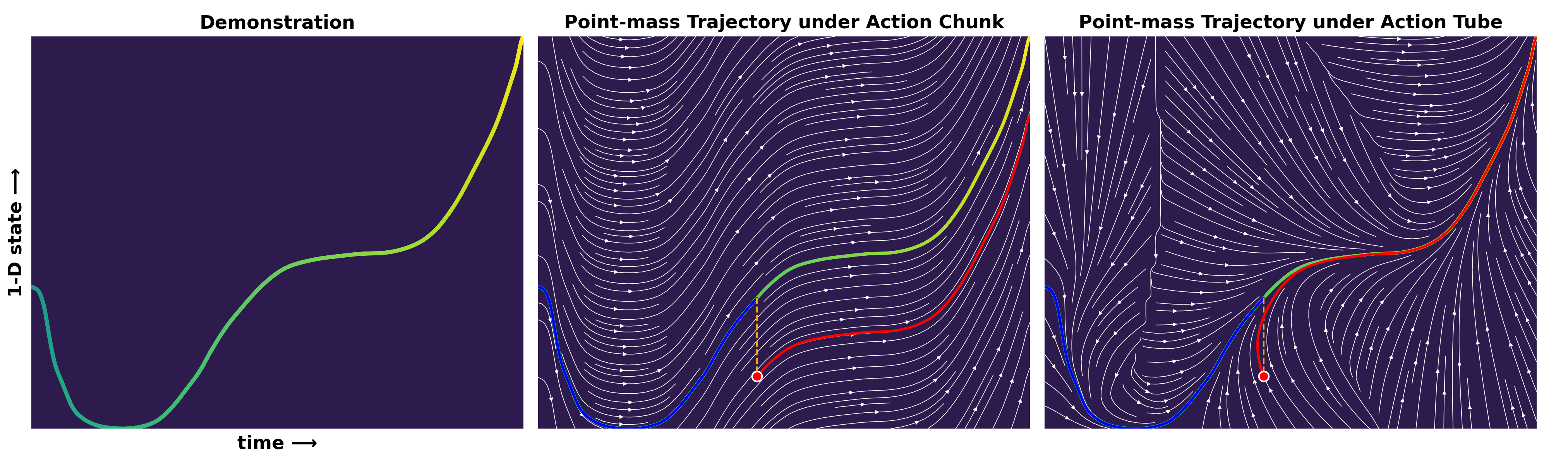
Figure 2: Visualization of action tube robustness in a 1D point-mass system; feedback correction in TDP guarantees recovery from disturbances.
Simulation Experiments: Push-T and Dexerous Manipulation
TDP surpasses state-of-the-art DP, Flow Matching, Streaming Flow Policy, and pure streaming ablations on the multi-modal Push-T benchmark and simulation-based dexterous manipulation tasks (stable grasping, on-table reorientation, and dish cleaning), consistently achieving higher success rates and lower step counts.
A critical finding is TDP’s maintenance of performance with drastically fewer DDIM denoising steps—as low as two—highlighting that chunk-level accuracy can be relaxed since intra-chunk reactivity from the streaming flow handles residual errors and disturbances. This yields a substantial reduction in policy inference latency, enabling much higher closed-loop control frequencies than DP.
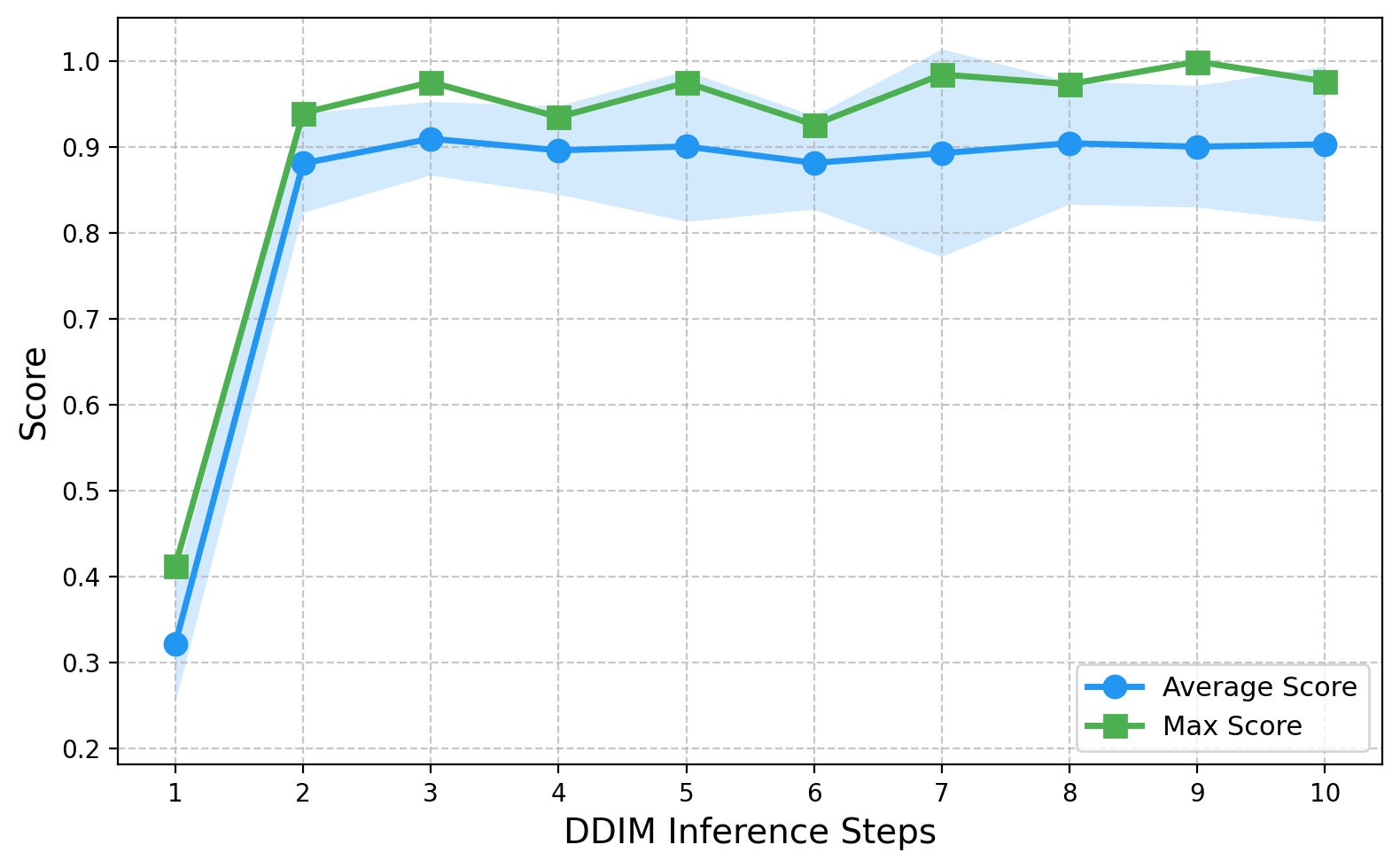
Figure 3: Ablation on number of DDIM denoising steps; TDP maintains strong performance with minimal denoising, unlike DP.
Data Collection and Engineering
Human demonstrations are acquired via teleoperation in both simulation and hardware, leveraging VR-based or motion capture systems for hand tracking, processed via unified retargeting modules for finger and arm kinematics.
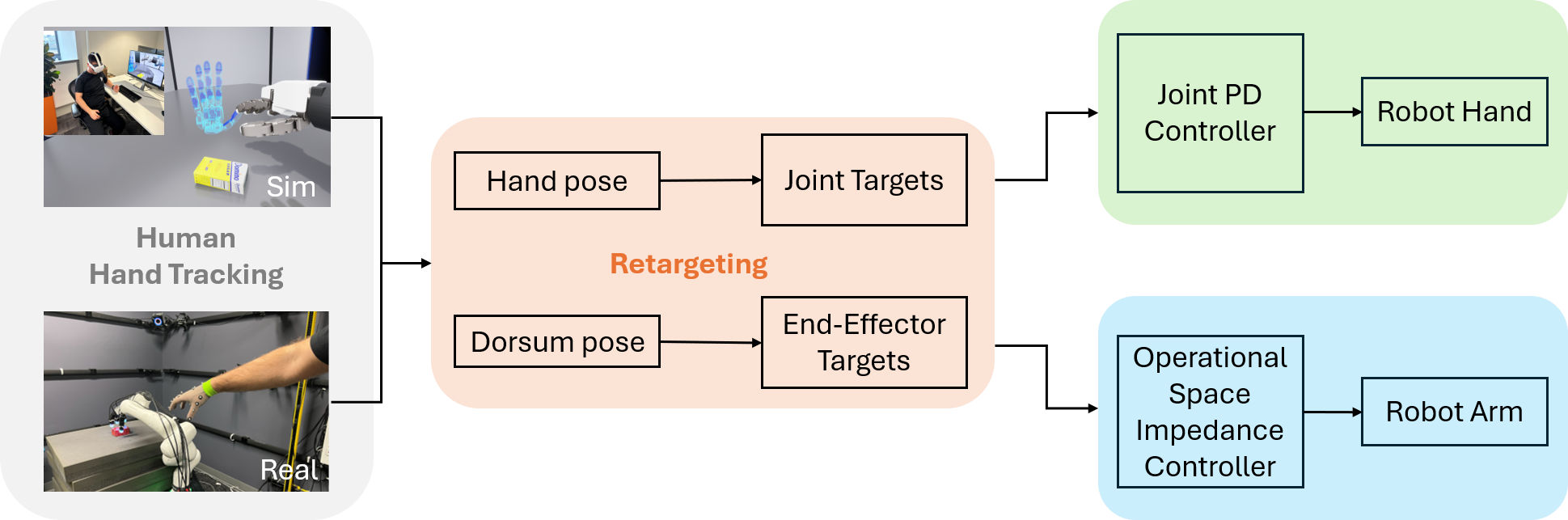
Figure 4: Teleoperation pipeline for collecting diverse, high-fidelity visual-tactile human demonstrations for both simulation and physical robots.
Real-World Robotic Manipulation
Physical experiments validate TDP’s robustness in dynamic, hard-to-model settings: on-table object reorientation and jar opening with the Allegro hand instrumented with high-dimensional tactile and visual feedback. In presence of external disturbances (e.g., finger bending or object displacement), TDP rapidly reacts and adapts, preserving task success, while DP (with identical chunks and inference constraints) exhibits delayed or failed adaptation due to open-loop action generation.
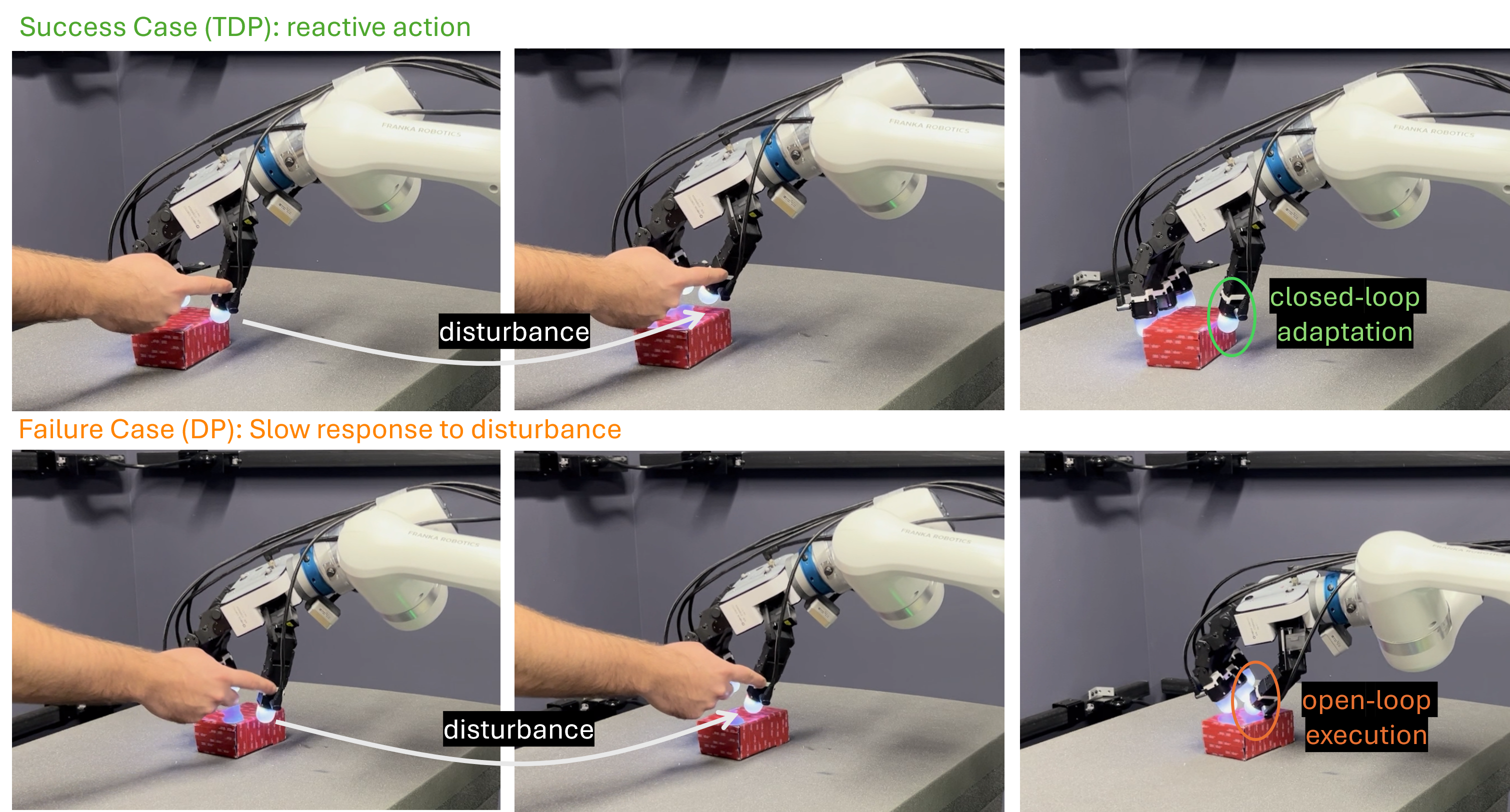
Figure 5: TDP’s rapid disturbance recovery compared to DP in on-table manipulation; TDP adapts within a few steps while DP fails.
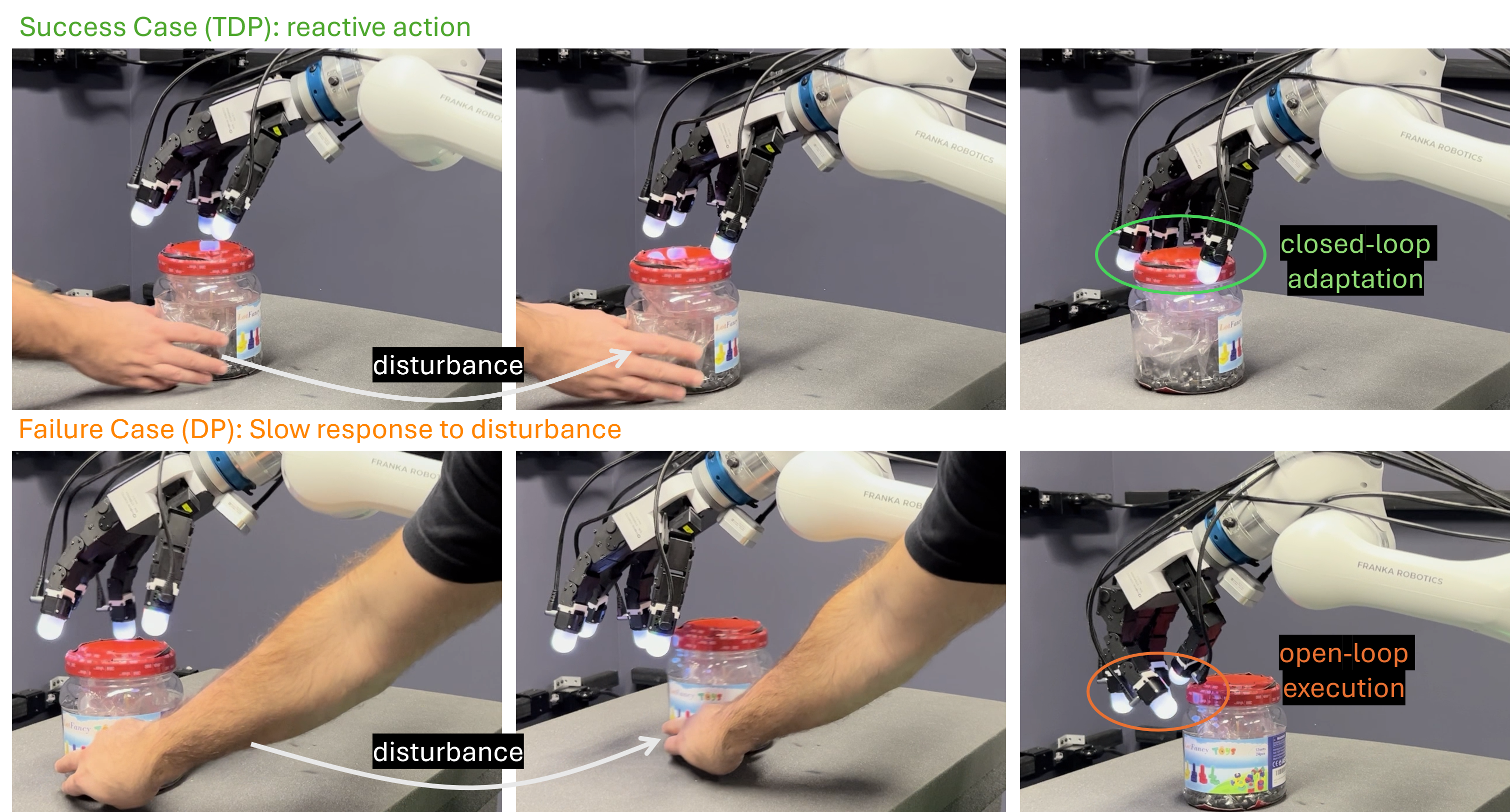
Figure 6: Disturbance response comparison in jar-opening; TDP tracks shifted object pose while DP remains stuck on obsolete action sequences.
Inference Efficiency and High-Frequency Control
Empirically, TDP enables closed-loop control at frequencies >100Hz in hardware with only three DDIM steps, a fourfold improvement over DP at equivalent hardware and batch sizes. Performance remains high even under extreme model misspecification, observation noise, and low inference budgets.
Discussion and Implications
TDP resolves the principal bottleneck of generative imitation learning for robotic control—namely, latency and lack of intra-chunk feedback—by embedding reactivity directly within the policy architecture through streaming vector fields conditioned on observation histories. Unlike prior approaches that offload closed-loop feedback to external controllers or latent-space planners, TDP structurally integrates high-frequency correction into the policy’s inference loop. The decoupling of chunk-level (nonlinear, global) and intra-chunk (linearized, local) control enables real-time robust adaptation in highly nonlinear and uncertain environments.
Notably, the relaxation of denoising accuracy requirements relaxes computational bottlenecks, expanding the applicability of diffusion-based policies to hardware with tight latency constraints. This is critical for closing the gap between sample efficiency, robustness, and deployability in contact-rich robotic settings.
Limitations and Future Directions
The methodology currently concatenates all sensory modalities without exploiting the structural properties (sparsity, asynchrony) of tactile signals, suggesting future directions in learned or structured tactile observation encoding. Further acceleration of the diffusion stage can adopt recent advances in single-step or distilled denoising. The action tube framework is broadly compatible with a range of generative or chunk-based policies, including pi_0 and VLA models, and could be incorporated as a general intra-chunk correction layer for open-loop planners. Extending the approach to hierarchical or language-conditioned planning pipelines is a promising avenue.
Conclusion
Tube Diffusion Policy establishes a theoretically-justified, empirically-validated framework for robust, reactive policy learning from demonstration, combining the strengths of generative policies with explicit feedback control. By constructing an action tube with streaming, observation-conditioned corrections, TDP matches or exceeds state-of-the-art results in both simulation and physical manipulation tasks, particularly excelling in settings with significant uncertainty and requiring high-frequency reactivity. Its architecture poses an extensible blueprint for deploying generative models in dynamic, real-world robotic systems, narrowing the gap between imitation learning expressiveness and robust closed-loop control.
Reference: "Tube Diffusion Policy: Reactive Visual-Tactile Policy Learning for Contact-rich Manipulation" (2604.23609)