- The paper introduces a novel moth's eye-inspired grating coupler achieving unidirectional vertical coupling with 41% efficiency at 1550 nm.
- It employs analytical effective medium theory and 3D-FDTD simulations to optimize subwavelength grating parameters using a single-etch fabrication process.
- Experimental validation shows 12.80 dB unidirectionality and 8.35 dB insertion loss, highlighting its potential for fiber-to-chip and VCSEL integration.
Moth’s Eye-Inspired Vertical Subwavelength Grating Coupler for Silicon Photonics
Introduction and Motivation
The paper presents a bio-inspired design for a perfectly vertical grating coupler (GC) tailored for silicon photonics platforms, specifically the 220 nm SOI, targeting a central wavelength of 1550 nm. Addressing the challenge of efficient optical coupling—especially the integration of VCSELs with photonic integrated circuits (PICs)—the authors diverge from traditional edge-coupling and classical grating coupler solutions by proposing a fabrication-friendly, highly directionally efficient coupling mechanism. The approach leverages the anisotropy of grating stripes via a subwavelength grating (SWG) architecture, inspired by the antireflective structure of moth’s eyes.
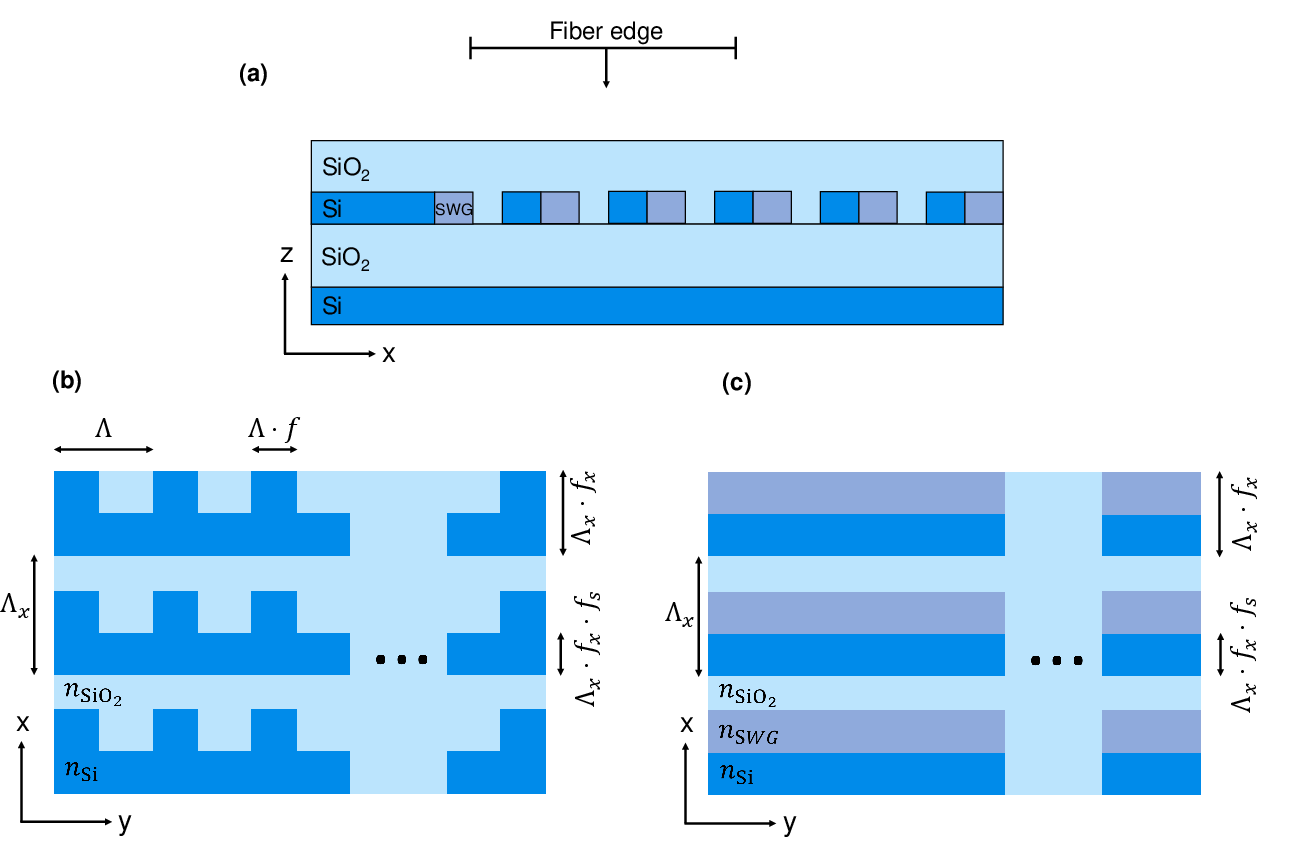
Figure 1: (a) Side view of the proposed grating including the SWG region; (b) actual geometry from the top; (c) effective grating geometry, with effective index nSWG computed via EMT.
Subwavelength Grating Design and Theory
The core innovation lies in the use of SWGs to engineer anisotropic refractive indices by adjusting fill-factors within each grating stripe, breaking symmetry and inducing unidirectional coupling. The effective refractive index is determined analytically using effective medium theory (EMT), both at zeroth and second order. For deep-subwavelength regimes (R≪1), the zeroth-order EMT accurately predicts index modulation; however, in practical fabrication (R<1), the second-order correction aligns more closely with empirical results, enabling precise modeling and device optimization.
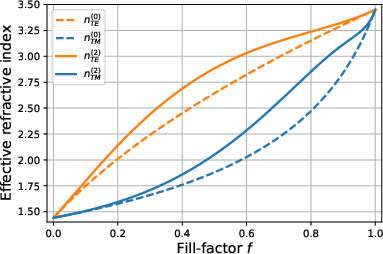
Figure 2: Effective refractive index variation of SWG as a function of fill-factor, calculated by EMT (zeroth- and second-order), for Λ=400 nm and λ=1550 nm.
By selectively patterning one side of the grating stripe to resemble a moth’s eye antireflective metasurface, light is preferentially absorbed and guided to this patterned side, yielding highly directional vertical coupling. This allows fabrication in a single etch step, simplifying process integration compared to multi-etch GCs.
Numerical Simulation and Optimization
3D-FDTD simulations (performed with MEEP) were employed for rigorous analysis and optimization, targeting maximum coupling efficiency at vertical incidence. Five key parameters were subject to optimization (grating fill-factor, spatial fill-factor, SWG fill-factor, period, and transverse period), converging on a design exhibiting 41% efficiency at λ=1550 nm. Simulation outcomes reveal a flat coupling efficiency profile across the C-band, with a -1 dB bandwidth of approximately 50 nm and unidirectionality exceeding 20 dB at the design wavelength.
Experimental Fabrication and Optical Characterization
The coupler was fabricated on a 220 nm SOI platform, with two test layouts constructed: a 2-port geometry for single-coupler transmission evaluation and a 3-port configuration for explicit quantification of unidirectionality by measuring forward and backward transmission.
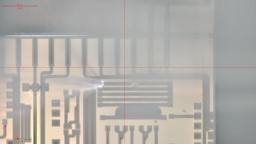

Figure 3: Probe station setup for ME-vGC characterization; (a) top view and (b) side view, highlighting fiber alignment under microscope inspection.
Experimental spectra corroborate the directionally selective coupling predicted by simulations. The best-performing device demonstrated experimentally observed unidirectionality of 12.80±0.02 dB and a single-coupler insertion loss of 8.35±0.02 dB around 1528 nm. These results, while preliminary, validate the anisotropic vertical coupling mechanism.
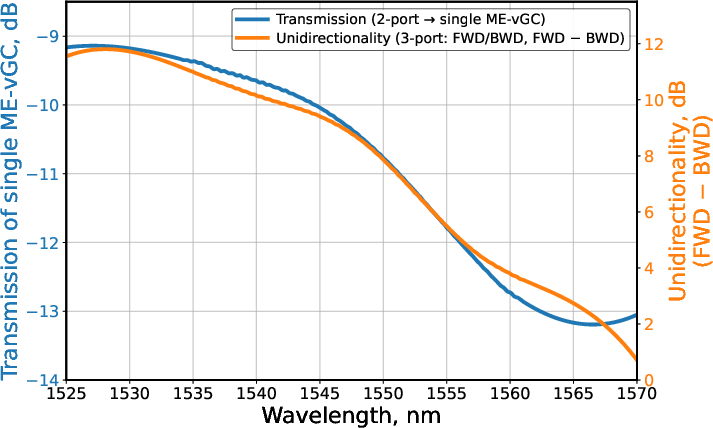
Figure 4: Measured transmission and unidirectionality across wavelength for the best-performing ME-vGC device.
Implications, Constraints, and Perspectives
The single-etch moth’s eye-inspired SWG enables efficient vertical light coupling without complex multi-step fabrication, facilitating integration with VCSELs and opening pathways for wafer-level testing, phased array antenna interfaces, and advanced sensing. The bandwidth and unidirectionality are competitive for practical fiber-to-chip and VCSEL-to-chip optical interconnects, supporting both classical and quantum photonics applications.
However, the efficiency remains fundamentally limited by the single etching step, precluding performance parity with advanced multi-etch designs. Further enhancements are anticipated via grating apodization, teeth geometry optimization, and focusing architecture. The extension to silicon nitride and other photonic platforms broadens applicability, though device reproducibility and deeper theoretical modeling remain future priorities.
Conclusion
The paper introduces a robust methodology for bio-inspired, unidirectional, perfectly vertical grating couplers utilizing subwavelength refractive index engineering. Numerical simulations project 41% coupling efficiency with 50 nm bandwidth and >20 dB unidirectionality, while initial experimental validation substantiates directional coupling with measurable insertion loss and unidirectionality. The design presents significant practical and theoretical implications for integrated photonics, with scope for further optimization and cross-platform adoption.

