- The paper presents closed-form formulas for the average steps until absorption (ASUA) in sea dragon trees, leveraging absorbing Markov chain theory.
- It develops local recurrence relations and explicit solutions for various sea dragon tree configurations, including isolated and multiple leaf attachments.
- The study underscores how local tree structure determines global random walk absorption, offering practical insights for network exploration.
Average Steps until Absorption on Random Walks on Sea Dragon Trees
Introduction and Motivation
The study addresses the expected number of steps, termed the Average Steps Until Absorption (ASUA), for a random walk on a graph G starting at vertex v and terminating upon reaching a designated absorbing vertex u. Explicitly, t(G,v,u) denotes this expected value. The context is driven by applications both in reinforcement learning, where agents must explore state spaces with random movement rather than an optimized policy, and in the theory of stochastic processes on networks.
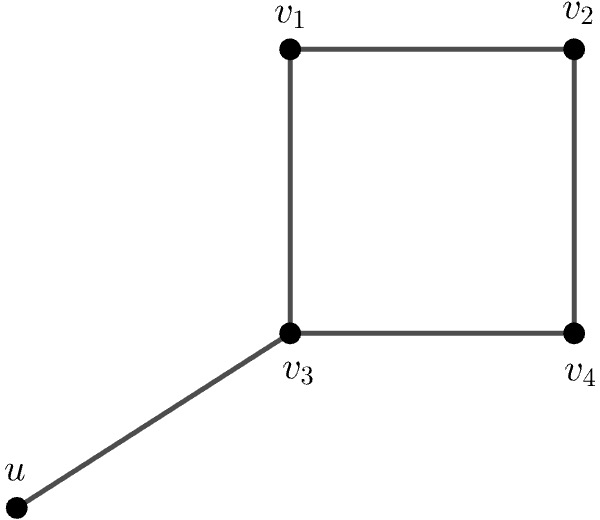
Figure 1: An illustrative graph G as an introductory example for random walks and ASUA analysis.
The analysis is conducted via absorbing Markov chains: the transition matrix for a random walk on G, with the absorbing state at u, is partitioned into transient and absorbing parts, facilitating the direct computation of ASUA via the fundamental matrix N=(I−Q)−1. The central methodological challenge is to generalize ASUA computation beyond single instances to entire families of parameterized graphs, specifically to the wide class of "sea dragon" trees.
Markov Chain Framework and ASUA Equations
The formalism situates the problem within absorbing Markov chains. For G with designated absorbing vertex u, the transition matrix v0 (where v1 encodes inverse degrees and v2 is the adjacency matrix) is partitioned such that v3 captures transitions among non-absorbing states.
Given v4, the ASUA vector v5 solves v6, and equivalently v7. This leads to a system of local constraint equations termed ASUA equations, relating the ASUA at a vertex to those at its neighbors. The central recurrence (Theorem 1) is:
v8
where v9 denotes the mean ASUA of all neighbors of u0. For leaves and path-like components, explicit recurrences yield closed-form solutions.
Analysis of Path and Cycle Graphs
For path graphs u1, the closed-form expression for the ASUA at u2, with absorbing state at u3, is:
u4
for u5. For cycle graphs u6 with absorbing at u7, Theorem 2 establishes:
u8
These explicit results demonstrate the power of the developed recursion for classical families, serving as a foundation for more complex tree structures.
Sea Dragon Trees: Definition and ASUA Analysis
A "sea dragon" is a tree possessing a unique central path (the spine) u9, such that any vertex of degree at least 3 must lie on t(G,v,u)0. The subclasses analyzed (SD1, SD2, SD3, and generalization SD4) differ in the configurations and multiplicity of leaves or stems attached to the spine.
SD1: Isolated Leaves on the Spine
For SD1, where leaves attach individually to distinct spine vertices, Theorem 3 provides a closed-form for t(G,v,u)1, parameterized by the position along the spine and the locations of the branches. The solution traverses section by section along the spine, exploiting the local ASUA recurrences for each segment as dictated by leaf placement.
SD2 and SD3: Multiple Leaves and Stems
SD2 restricts all extra leaves to one spine vertex; SD3 generalizes to a single long "stem" (path) attached at one point on the spine. Theorems 4 and 5 show their ASUA expressions are structurally similar, highlighting that the complexity in ASUA arises from the total “branch excess” rather than the exact geometric arrangement.
SD4: Arbitrary Stems at a Single Spine Vertex
SD4 constitutes the most generalized tree: multiple stems of arbitrary lengths attached to a single vertex. Theorem 6 rigorously proves that, for all these variants, the ASUA at each spine vertex is a combination of quadratic terms in the vertex's index and a linear dependence on the total number and length of attached branches.
The analysis exploits careful induction and classification of all possible neighbor configurations (four types), ensuring that the closed-form candidate solution satisfies the corresponding ASUA equation at every vertex.
Implications and Future Directions
The paper demonstrates that, for sea dragon trees, the local ASUA equations admit closed-form solutions via Markov chain formalism without the need to invert large sparse matrices. Local graph structure (degree at spine vertices, length of attached stems) completely determines the ASUA, simplifying what is usually considered a global property of the Markov process. This yields immediate practical advantages in algorithmic and combinatorial settings—particularly for average-case analysis of tree-like search spaces in AI, network exploration, and related fields.
The theoretical implications are clear: for broad subfamilies of trees, ASUAs can be fully characterized by recurrence relations and linear algebraic techniques, and sharp bounds for overall ASUA ("sum total" or "round-trip" expected steps) can be postulated. Extensions to non-uniform edge weights via parallel edges (adjusting transition probabilities) or the presence of multiple absorbing states demonstrate the robustness and flexibility of the approach.
Conclusion
The research delivers explicit formulas for the expected steps until absorption for random walks on a rich class of trees—sea dragons—by leveraging recursive local equations derived from Markov chain theory. The results highlight the centrality of local structure over global complexity for these families. Future inquiries will likely extend these techniques to broader tree classes, dissect optimization of total absorption time, and address weighted and multi-target scenarios, setting a foundation for further combinatorial and algorithmic exploration of random walks on trees.