Nonlinear Non-Gaussian Density Steering with Input and Noise Channel Mismatch: Sinkhorn with Memory for Solving the Control-affine Schrödinger Bridge Problem
Published 25 Apr 2026 in math.OC, cs.AI, cs.LG, eess.SY, and stat.ML | (2604.23370v1)
Abstract: Solutions to the Schrödinger bridge problem and its generalizations yield feedback control policies for optimal density steering over a controlled diffusion. To numerically compute the same, the dynamic Sinkhorn recursion has become a standard approach. The mathematical engine behind this approach is the Hopf-Cole transform that recasts the conditions for optimality into a system of boundary-coupled linear PDEs. Recent works pointed out that for the control-affine Schrödinger bridge problem, this exact linearity via Hopf-Cole transform, and thus the standard Sinkhorn recursion, apply only if the control and noise channels are proportional. When the channels do not match, the Hopf-Cole-transformed PDEs remain nonlinear, and no algorithm is available to solve the same. We advance the state-of-the-art by designing a Sinkhorn recursion with memory that leverages the structure of these nonlinear PDEs, and demonstrate how it solves the control-affine Schrödinger bridge problem with input and noise channel mismatch. We prove the local stability of the proposed algorithm.
The paper introduces a Sinkhorn with memory algorithm to steer nonlinear, non-Gaussian densities amid channel mismatch by leveraging stored backward trajectory data.
It rigorously establishes local stability using Hilbert’s projective metric with explicit contraction bounds tied to the magnitude of channel mismatch.
Numerical results on 2D nonlinear systems validate the method’s efficacy in mass transfer and control synthesis under non-proportional input and noise channels.
Nonlinear Non-Gaussian Density Steering for Channel-Mismatched CASBP: Sinkhorn with Memory
Problem Setting and Motivation
The paper addresses the control-affine Schrödinger bridge problem (CASBP) formulated for controlled stochastic processes with nonlinear drift, non-Gaussian state PDFs, and mismatched input/noise channels. The objective is optimal steering of the joint state density from an initial distribution ρ0 to a target ρ1 over a finite time horizon, minimizing the expected sum of state and control costs. Unlike classical settings, the focus is on the general case where the noise (diffusion) matrix Σ and input matrix gg⊤ are not proportional—leading to significant mathematical and algorithmic difficulties that preclude direct application of the standard dynamic Sinkhorn recursion, a widely used computational approach in the matched (proportional channel) scenario.
Historically, proportionality of input and noise channels is crucial for achieving linear solvability via the Hopf-Cole transform, which reduces the first-order optimality system to boundary-coupled linear PDEs, thus ensuring global convergence of Sinkhorn dynamics in Hilbert’s projective metric. However, when channel mismatch occurs (i.e., gg⊤∝Σ), the Hopf-Cole PDEs become nonlinear and coupled. Prior work ([teter2025hopf], [11208710], [chen2015optimal]) identified this obstruction but did not provide a practical algorithm for the nonlinear, non-Gaussian, channel-mismatched case.
Main Contributions
The manuscript introduces a Sinkhorn recursion with memory, a generalization of dynamic Sinkhorn dynamics designed for the channel-mismatched CASBP. In this algorithm, each forward integration of the transformed ‘φ’ PDE utilizes the entire history of the most recent backward pass ‘φ’, stored in a temporary buffer. This dependence on trajectory memory is required because the nonlinear terms in the Hopf-Cole transformed PDEs depend functionally on φ, breaking the decoupling present in the matched case. The paper rigorously establishes local stability of this recursion, providing an explicit bound on asymptotic error in Hilbert’s projective metric dependent on the scale of channel mismatch.
Notably, the following results are established:
Local stability with Hilbert metric bounds: For sufficiently small initial error (in a Hilbert ball around a fixed point), iterates of the memory-augmented Sinkhorn recursion remain within the ball with a theoretically derived asymptotic error bound.
Sufficient conditions for non-expansiveness of the constituent mapping B are given in terms of quantities involving the mismatch magnitude ∥λgg⊤−Σ∥∞ and its spatial derivatives.
Explicit analysis of contraction properties for all mapping components using projective geometry, Green’s function bounds for the parabolic PDEs, and Duhamel’s formula for solution representation.
Numerical demonstrations on 2D nonlinear systems with strongly non-Gaussian marginals, highlighting empirical convergence and control synthesis performance.
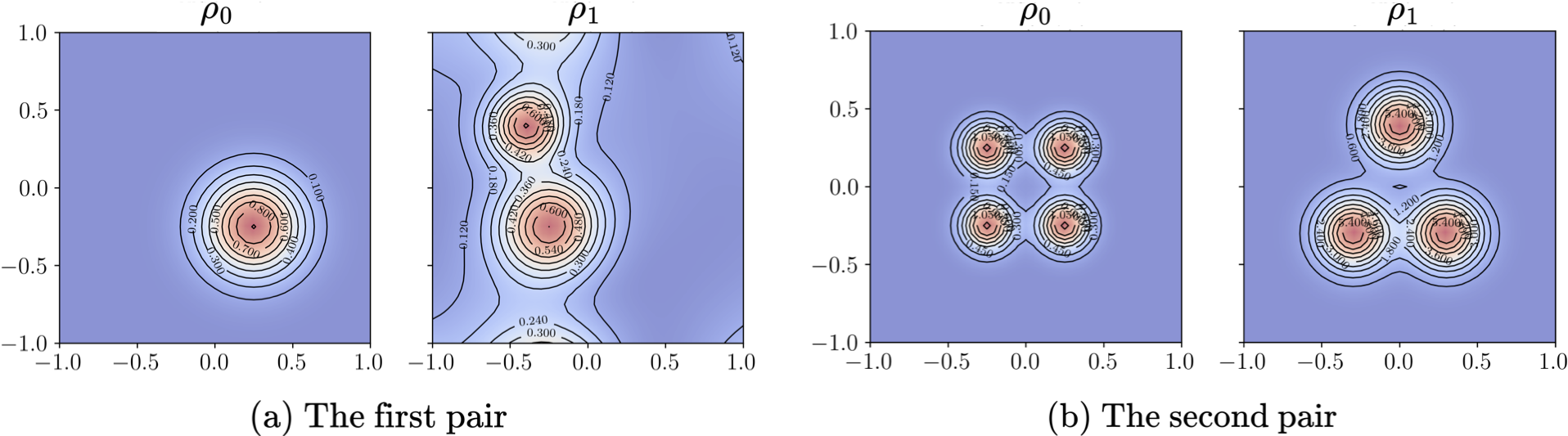
Figure 1: The two pairs of endpoint PDFs used for initialization and target in the numerical experiments, showcasing both unimodal and multimodal non-Gaussian target distributions.
Algorithmic Innovation: Sinkhorn with Memory
The breakthrough here is a dynamic recursion that carefully tracks the inherent asymmetry and nonlinearity in the Hopf-Cole transformed PDEs under channel mismatch. Specifically, the forward update for ρ10 (density factor) at each iteration depends on the full space-time trajectory of ρ11 computed in the previous backward pass—unlike the matched-channel linear case where such dependency is eliminated.
This “memory” is not historical in the sense of previous iterates, but rather a functional buffer holding the PDE solution of the last backward pass. The resulting algorithm proceeds synchronously:
Backward pass: Integrate the nonlinear ρ12 PDE from ρ13 to ρ14; store the solution at all times.
Forward pass: Integrate the ρ15 PDE from ρ16 to ρ17, using the stored ρ18 trajectory in the nonlinear coefficients.
Boundary update: Enforce the product boundary constraints using the prescribed endpoint PDFs.
Iterate: Repeat until changes in Hilbert metric are below tolerance.
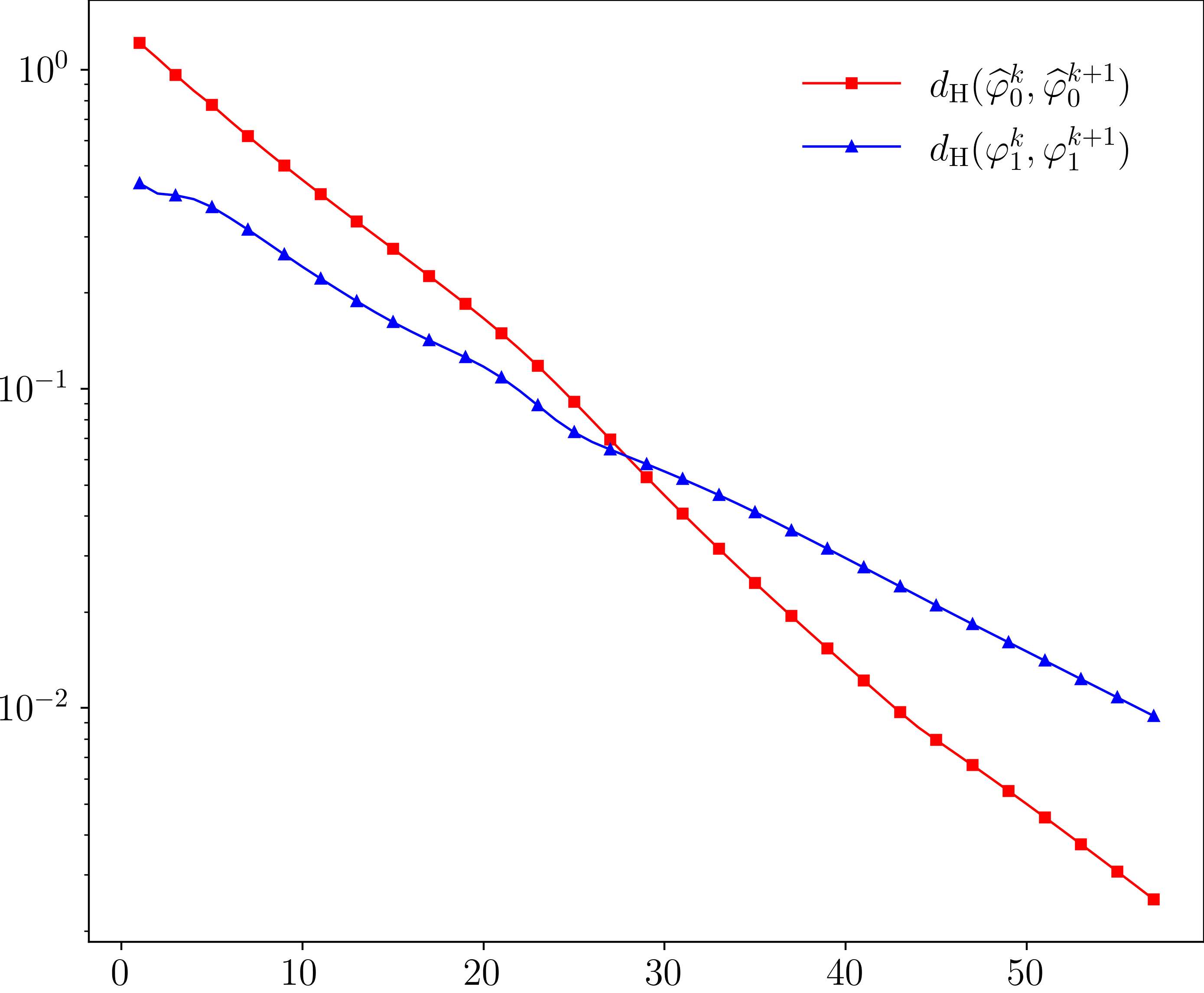
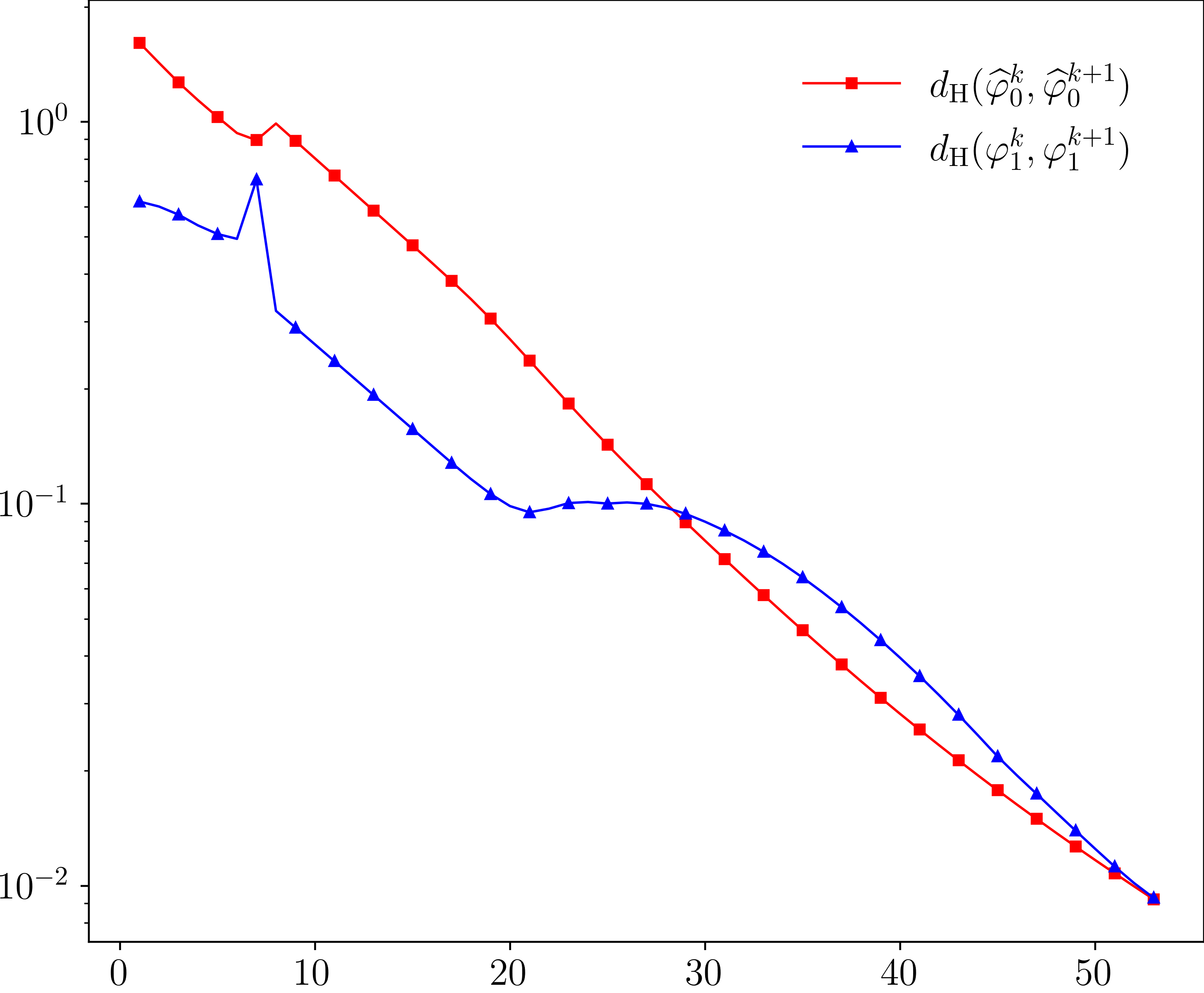
Figure 2: Hilbert metric convergence profiles for the algorithm under two distinct pairs of endpoint PDFs; both cases achieve low asymptotic error, empirically verifying local stability and demonstrating insensitivity to multimodal structure.
Mathematical Analysis
The analysis hinges on precise operator estimates with respect to Hilbert’s projective metric and careful structural exploitation of the parabolic PDE system:
Isometric properties of boundary-division operators ρ19 and non-expansiveness of the backward-in-time nonlinear map Σ0 (given a sufficient positivity condition on the combined “reaction” term Σ1).
Contractivity of forward map Σ2 with the crucial caveat that this holds only locally when trajectories stay within a controlled neighborhood.
Explicit tracking of contraction constants (Σ3, Σ4) depending on spatial bounds of the channel mismatch, problem domain, and solution smoothness.
Iteration error bound: Asymptotic error is capped at Σ5, with Σ6 a function of the channel mismatch and local trajectory variability.
This structure, in contrast to the global convergence in the matched-channel case, only provides local convergence: initialization within a sufficiently small neighborhood of a fixed point is required, and contraction constants degrade as mismatch increases.
Numerical Implementation and Results
The paper applies the Sinkhorn with memory algorithm to a nonlinear, two-dimensional spring-mass-damper system with non-proportional control and noise channels. Both unimodal and multimodal endpoint PDFs are considered, with domain-compactification and finite-difference numerical solvers.
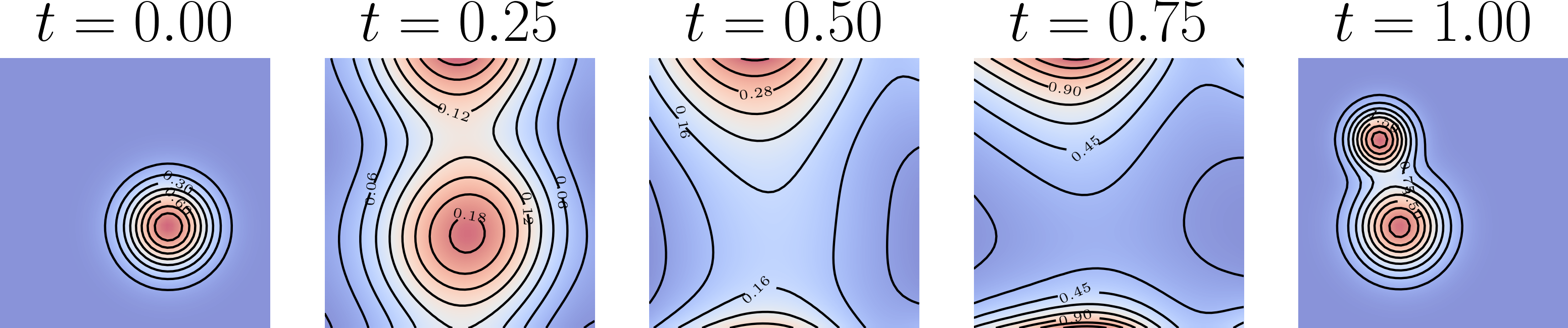
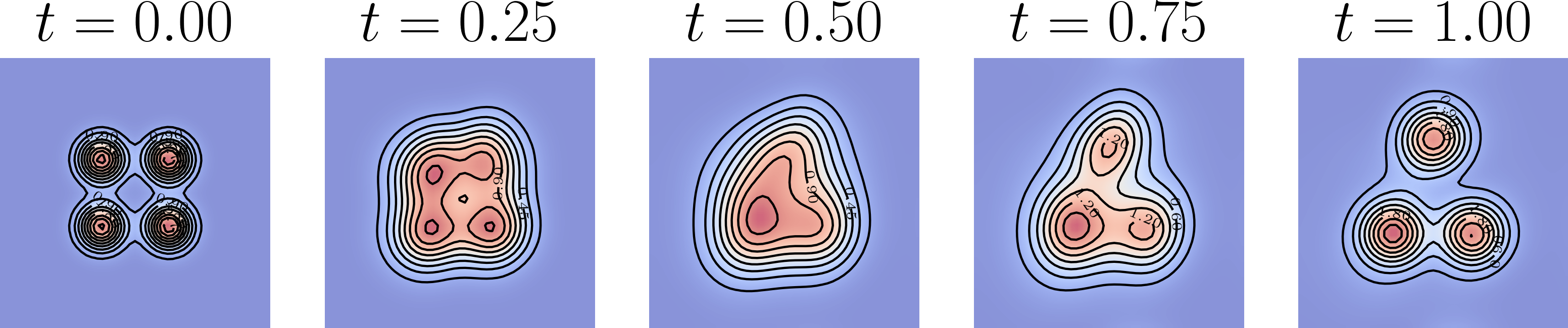
Figure 3: Temporal snapshots of the optimally controlled density Σ7 illustrating successful mass transfer from non-Gaussian initial to target PDFs via nonlinear control synthesis.
Figure 4: Corresponding optimal controls Σ8 across the time horizon, indicating spatially nontrivial actuation patterns required for nonlinear PDF steering.
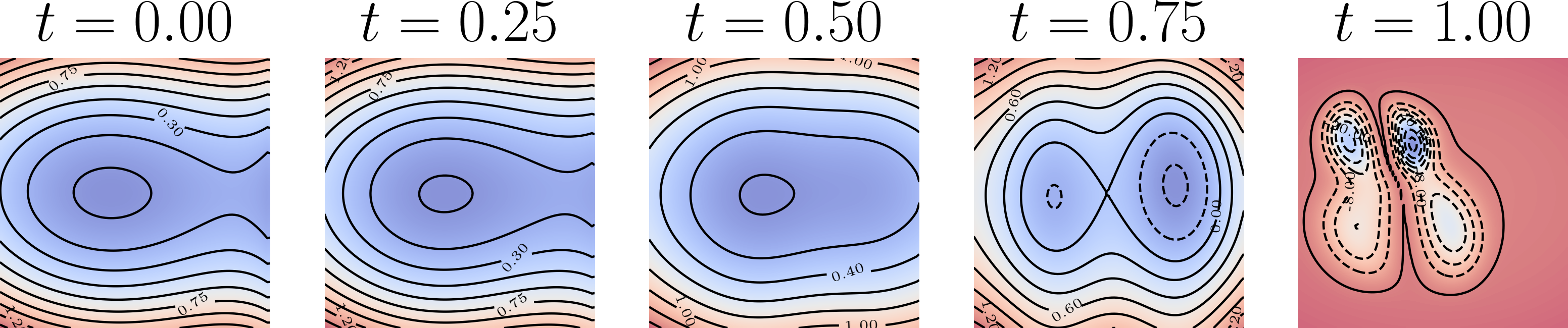
Figure 5: Evolution of Σ9 during the backward pass, showing eventual positivity except for initial transients, supporting the non-expansiveness assertions of the backward operator and the practical efficacy beyond the proven theoretical envelope.
Both convergence in Hilbert metric and quality of the end-to-end density steering are documented. The control fields synthesized are non-trivial, exploiting the full nonlinearity and non-Gaussianity of the system; the methodology is robust to the significant structure in the endpoint distributions.
Implications and Future Directions
Practical:
This framework unlocks high-dimensional, nonlinear, non-Gaussian density steering under operationally realistic circumstances where input and noise channels are not aligned, which arises in robotics, aerospace, and uncertain dynamical systems. The algorithm provides a practicable blueprint for extending optimal mass transport and SBP-based control synthesis to general nonlinear stochastic systems.
Theoretical:
The results refine the understanding of the boundary between linear and nonlinear solvability in stochastic control and density steering. The explicit mapping of algorithmic contraction properties to operator-theoretic and PDE quantities paves the way for further advances in global convergence guarantees, extension to broader cost structures, and lifting the limitations regarding initialization radius or non-strict positivity of reaction terms.
Further, the algorithm could be a foundation for:
Homotopy and warm-start strategies to improve global convergence and basin of attraction.
Analysis and design for systems with structured or state-dependent channel mismatch.
Extensions to high-dimensional PDE discretizations leveraging efficient GPU/sparse solvers and parallelism.
Conclusion
This work provides a comprehensive algorithmic and theoretical treatment of the CASBP under channel mismatch, introducing the "Sinkhorn with memory" approach and rigorously bounding its convergence under a local stability regime. The methodology bridges a previously unsolved gap in stochastic optimal control for nonlinear, non-Gaussian density steering with general input and noise channels, and is supported by both strong mathematical analysis and compelling numerical demonstrations.
Reference
"Nonlinear Non-Gaussian Density Steering with Input and Noise Channel Mismatch: Sinkhorn with Memory for Solving the Control-affine Schrödinger Bridge Problem" (2604.23370)
“Emergent Mind helps me see which AI papers have caught fire online.”
Philip
Creator, AI Explained on YouTube
Sign up for free to explore the frontiers of research
Discover trending papers, chat with arXiv, and track the latest research shaping the future of science and technology.Discover trending papers, chat with arXiv, and more.