- The paper introduces a Markovian feedback policy for discrete-time Schrödinger Bridges and density steering with GMMs, achieving lower KL divergence than non-Markovian methods.
- It formulates the overall transition kernel as a convex combination of optimal component-to-component policies, ensuring tractable interpolation between multimodal marginals.
- Numerical examples in high-dimensional systems validate the method’s effectiveness in generative modeling and control applications, bridging discrete and continuous formulations.
Discrete-Time Schrödinger Bridges and Density Steering for Gaussian Mixture Models
Introduction and Motivation
This work addresses the formulation and solution of discrete-time Schrödinger Bridge (SB) and minimum-effort Density Steering (DS) problems when the marginals are Gaussian mixture models (GMMs). Through the construction of Markovian feedback policies composed as mixtures of elementary component-to-component optimal policies, the paper unifies and extends previous approaches, enabling tractable, expressive control across a wider class of multimodal distributions than canonical Gaussian formulations.
Discrete-time methods are emphasized due to their practical alignment with digital control hardware and their computational efficiency in generative modeling tasks compared to continuous-time approaches, offering faster inference by avoiding the need for fine discretization of SDEs.
Theoretical Framework
The discrete-time SB formulation seeks a stochastic process whose marginals are prescribed at two time points while minimizing the KL divergence from a reference Markov process. For linear systems with additive Gaussian noise and Gaussian initial and final marginals, a closed-form solution exists for both the trajectory law and the corresponding minimal KL cost.
When these marginals are extended to GMMs, exact solutions are intractable, as the SB or DS process must interpolate between arbitrary multimodal distributions. The principal contribution is a construction: given the set of optimal SB or DS policies (processes) for each component-to-component pair, the overall transition kernel at each time is expressed as a convex combination of these policies, with time-varying mixing weights. These weights satisfy both the mixture constraints and are optimized (exactly in DS, with a KL upper bound in SB) to minimize the process cost.
A formal result demonstrates that, for DS, this mixture process is globally optimal within the convex hull of component processes, yielding the same cost as prior non-Markovian approaches but with the operational advantage of memoryless feedback. For SB, the construction is proved less conservative than existing proposals, yielding strictly lower or equal KL divergence.
Markovian Mixture Process Construction
The process is initiated with a GMM ρ0=∑iαiμi and aimed toward ρN=∑jβjνj. For each (i,j) pair, denote pij as the transition process steering from μi to νj. The central kernel at time k is:
pk+1∣k(xk+1∣xk)=ij∑pk+1∣kij(xk+1∣xk)pk(xk)λijpkij(xk)
where pk(xk)=∑ijλijpkij(xk) and λij are subject to the marginalization constraints induced by mixture weights.
This construction results in a Markov process (policy randomization at each step), as opposed to previous methods with randomization only at initialization (non-Markovian “memory” processes). Crucially, the authors prove that randomizing at every step (the Markovian case) yields processes with higher entropy and, therefore, strictly lower or equal KL divergence in the SB setting.
Numerical Realization and Comparative Analysis
The mixture SB and DS processes are illustrated through two high-dimensional examples:
- Mixture Bridging Example: A unimodal Gaussian is steered through SB and DS processes toward an 8-component GMM target in two dimensions. The comparison highlights the geometric and probabilistic differences between SB and minimal effort DS solutions.
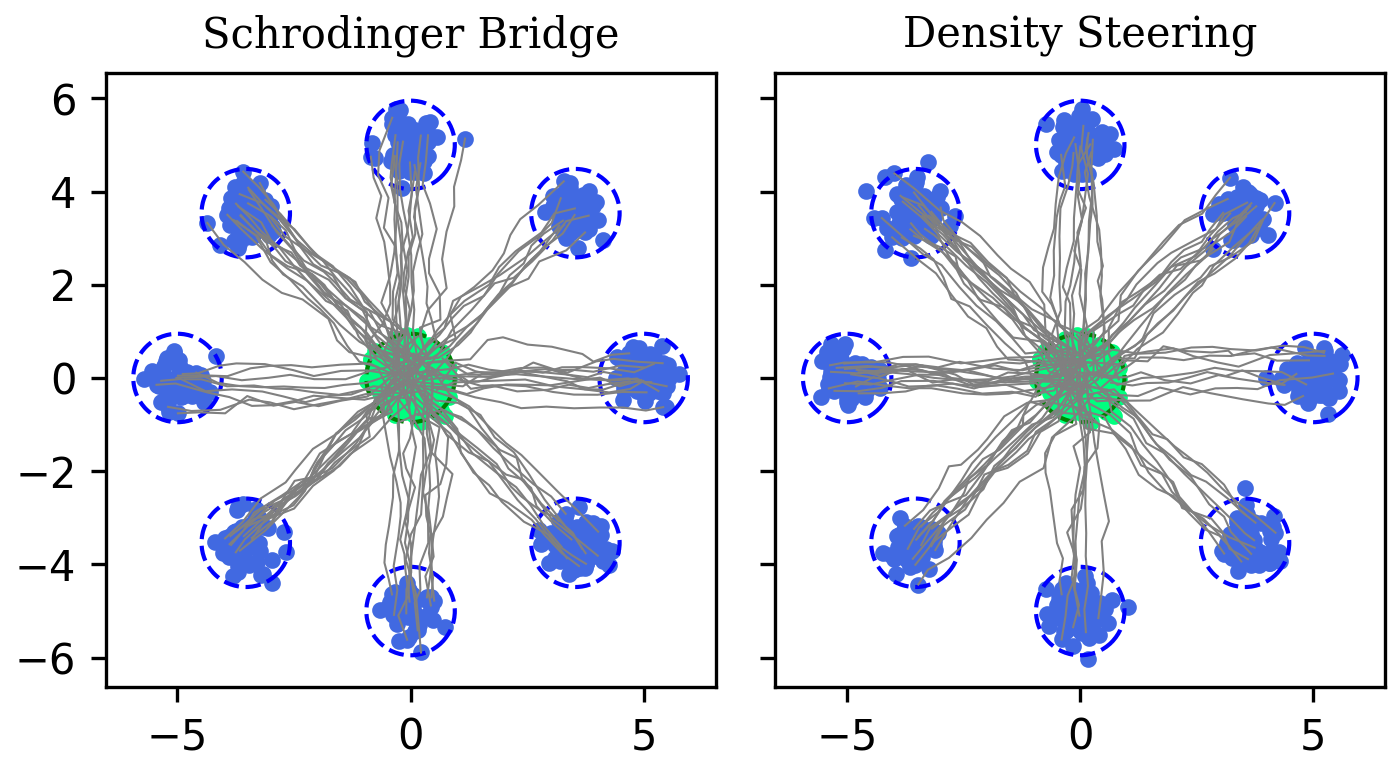
Figure 1: Schrodinger Bridge (left) vs Density steering (right) solutions from initial (green) Gaussian to final (blue) GMM.
- Double Integrator with GMM Marginals: The DS problem is addressed for a double integrator system in 4D, interpolating between multi-component GMMs. The ensemble process accurately maintains the multimodal marginals across time.
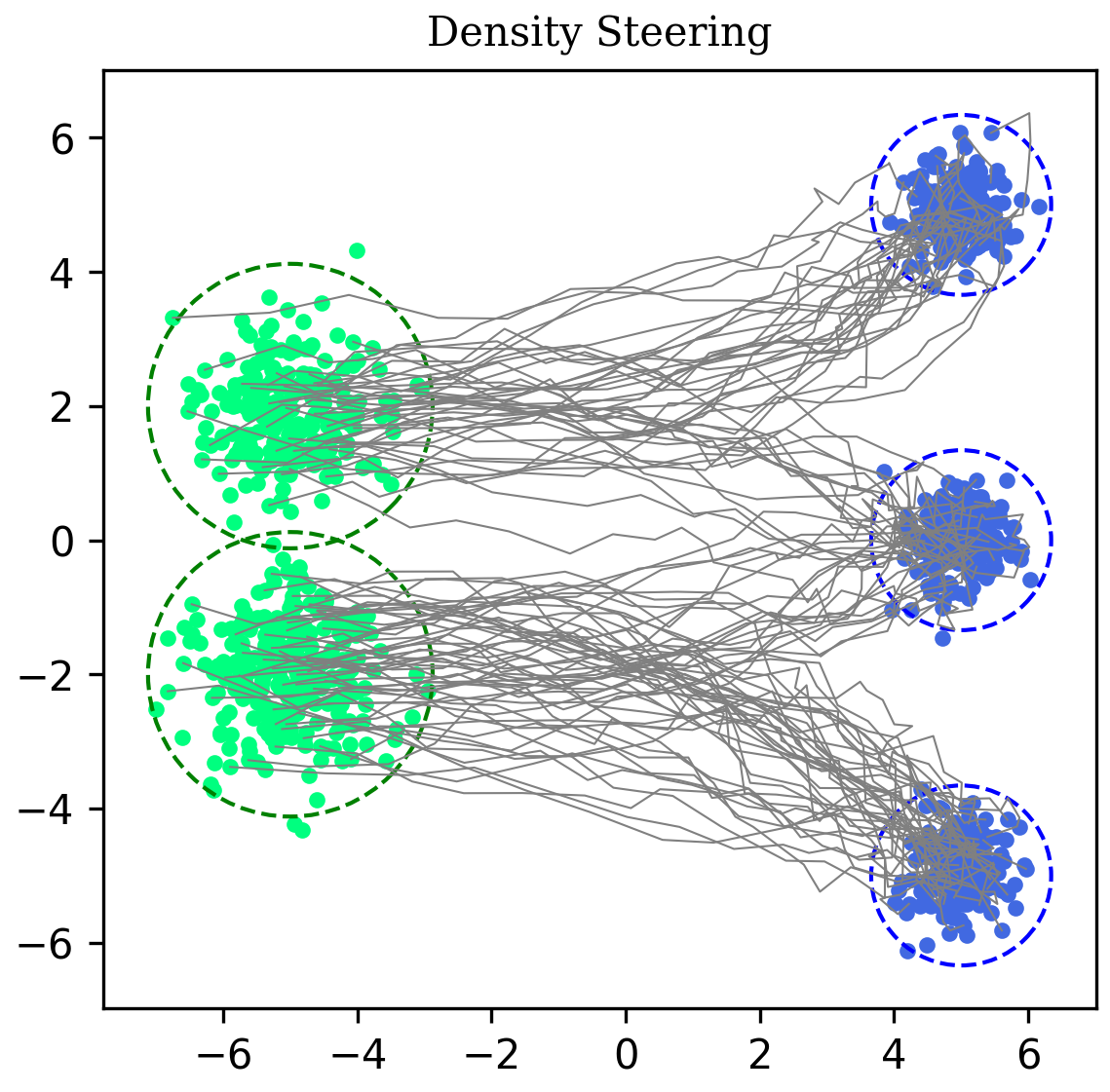
Figure 2: Density steering double integrator dynamics from initial (green) GMM to final (blue) GMM.
These results confirm that the proposed mixture-based controllers perfectly interpolate the intended marginals, with the DS cost matching previous approaches, and the SB cost strictly improving upon non-Markovian baselines.
Theoretical Implications and Continuous-Time Limit
A key contribution is the demonstration that the discrete-time Markovian process, in the limit as the time step vanishes, converges rigorously to the continuous-time SB with GMM marginals as derived in prior work. The authors explicitly link the discrete generator to its continuous analog, confirming that the control law and process semigroup are consistent as ρN=∑jβjνj0. This validates the algorithm as a bridge between tractable, implementable discrete schemes and theoretically optimal continuous-time SB flows.
Implications, Limitations, and Outlook
The formulation enables tractable SB and DS solutions for control and modeling tasks where complex, multimodal, and non-Gaussian marginals are necessary, relevant to autonomous robotics, mean-field population control, and fast generative modeling. Specifically, in generative AI applications, the ability to perform discrete-time inference between arbitrary GMMs can accelerate sampling pipelines relative to SDE-based continuous diffusion models.
A critical claim is that, for SBs, the Markovian feedback randomization always dominates or matches the one-time randomization policy in terms of optimality—this deprecates substantial prior literature’s solutions as unnecessarily conservative in terms of KL cost.
Future directions for this class of methods in AI include extending the framework to nonlinear reference dynamics, arbitrary mixture classes beyond GMMs, and scalable optimization of mixture policies via neural networks or high-dimensional convex programming.
Conclusion
This work rigorously establishes a Markovian feedback policy framework for optimal discrete-time transport and control with GMM marginals in both Schrödinger Bridge and minimum-effort (density steering) contexts. The approach yields operational advantages, sharper SB solutions, and seamless convergence to continuous-time SB as the time step vanishes. These features strengthen potential applications in probabilistic control, robotics, and fast generative modeling, and point toward broader utilization of Markovian feedback policies with multimodal distributions in AI systems.