- The paper establishes that nesting quantitatively governs phase transition types and epidemic activation thresholds in higher-order contagion dynamics.
- It introduces a novel nesting coefficient to interpolate between tightly embedded simplicial complexes and loosely structured random hypergraphs through synthetic and empirical models.
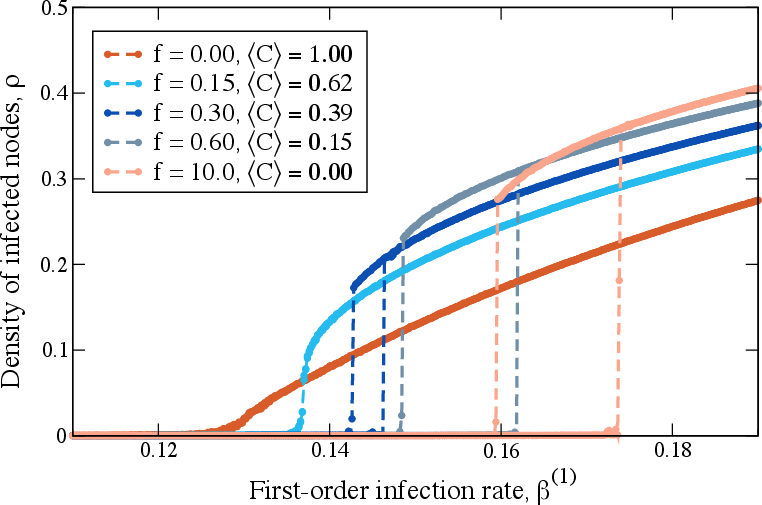
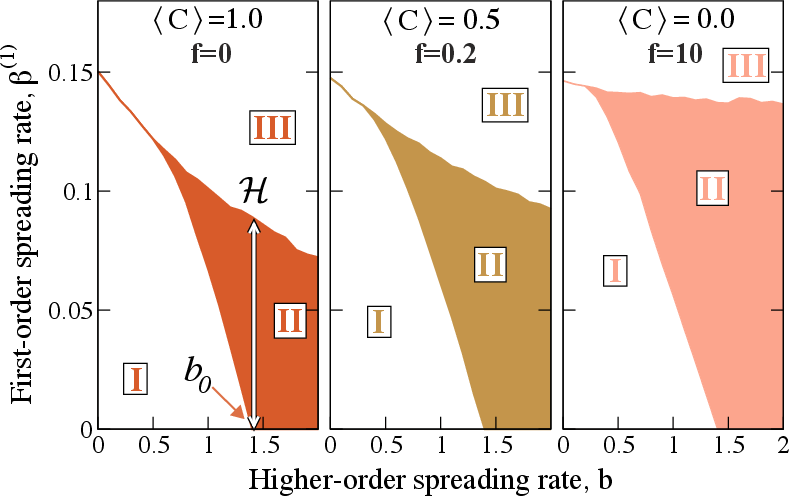
- Simulations and bifurcation analyses reveal that high nesting suppresses bistability and promotes smooth transitions, while low nesting triggers explosive contagion with hysteresis.
Nesting-Induced Control of Phase Transitions in Higher-Order Contagion Dynamics
Introduction
The study "Nesting Controls Phase Transitions in Higher-Order Contagion" (2604.23337) addresses the structural determinants of emergent dynamics in systems with higher-order interactions. In contrast to the conventional dyadic paradigm, the work leverages the richness of hypergraphs—where interactions may involve arbitrary-sized groups—by introducing a formalism to quantify how lower-order interactions are embedded within higher-order ones. This embedding, termed nesting, is demonstrated to play a central role in shaping the qualitative and quantitative aspects of contagion phase transitions. The authors formalize the nesting coefficient, construct synthetic and analyze empirical hypergraphs, and elucidate its mechanistic impact on a higher-order SIS contagion model, thereby establishing nesting as a predictive and unifying mesoscale observable for collective phenomena in complex systems.
Model and Definition of the Nesting Coefficient
The foundational technical innovation is the nesting coefficient, Ch(m), which quantifies to what extent all possible lower-order interactions (m-hyperedges) among nodes in a higher-order interaction (hyperedge h of order mh) are present:
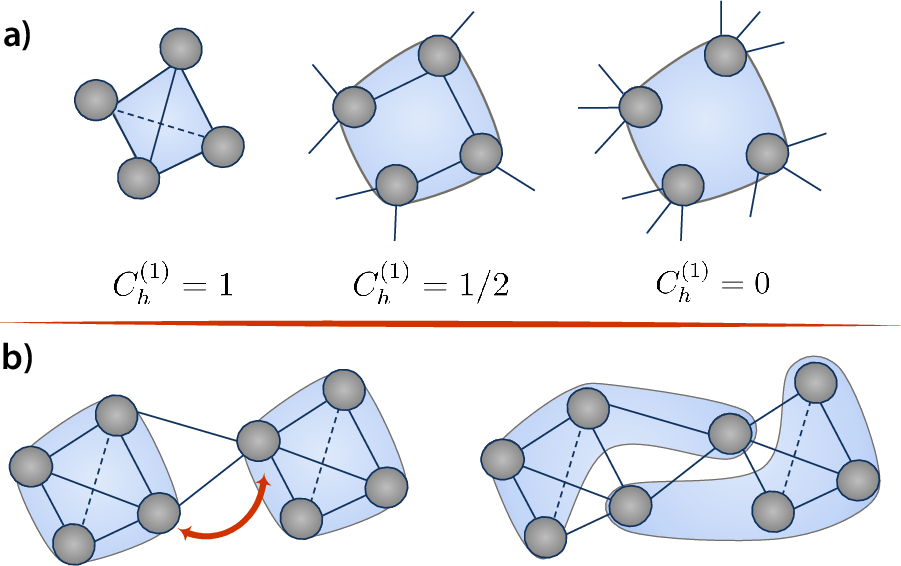
Figure 1: Example of the nesting coefficient of order 1 (pairwise) for a 4-body hyperedge, illustrating that the coefficient is the ratio between the number of present pairwise interactions and the maximum possible.
A crucial observation is that simplicial complexes (SCs) correspond to perfect embedding, while random hypergraphs (HGs) manifest minimal nesting. The flexibility to interpolate between these regimes via controlled local rewiring enables systematic exploration of dynamical consequences.
Synthetic Higher-Order Networks and Rewiring Protocol
Networks are generated using a bipartite configuration model, tuned to specific degree and order sequences. Starting from a SC (maximal nesting), iterative node swaps among hyperedges of equal order decrement nesting without altering the underlying order and degree distributions. The parameter f governs the fraction of hyperedges rewired, tuning the system smoothly from SC (⟨C⟩=1) toward random HG (⟨C⟩→0). This protocol allows precise control over average and order-dependent nesting coefficients.
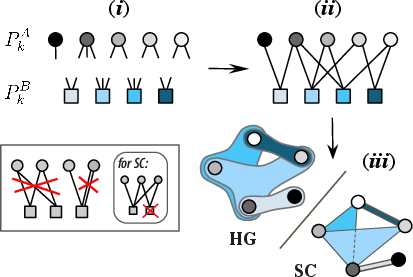
Figure 3: The bipartite configuration model illustrated; circles and squares represent node and group partitions, leading to the construction of higher-order networks with specified distributions.
Contagion Dynamics and Bifurcation Analysis
The dynamical scenario of interest is a higher-order SIS contagion process, where both pairwise and collective group infections are parametrized. Simulations and bifurcation analyses are conducted in the (β(1),b) plane, denoting the rates for pairwise and higher-order infection processes, respectively.
Key findings:
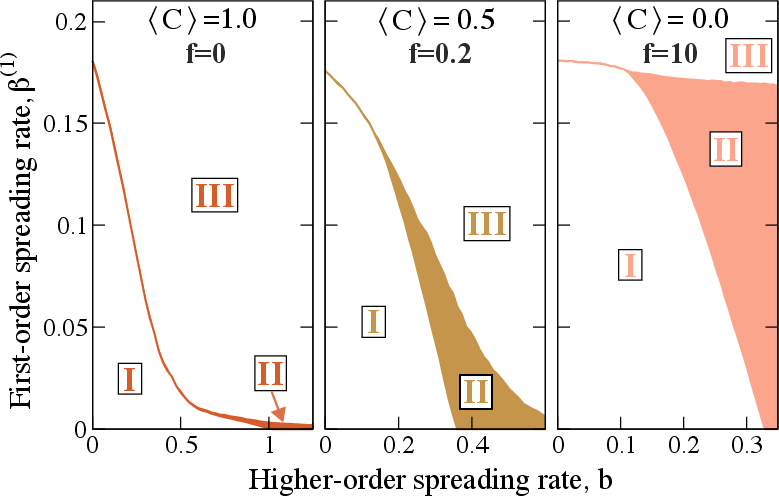
Figure 5: Phase diagrams showing how bistability grows as nesting decreases; (a) triadic-only, (b) m2 systems, with distinct dynamical regimes identified.
Order-Dependent Embedding and Mesoscale Organization
Recognizing the heterogeneity of real networks, the order-dependent nesting coefficient m3 is introduced to resolve how embedding varies across interaction orders. Networks are synthesized with identical average nesting, but with bias targeted at higher or lower orders. The dynamical impact is asymmetric:
- Stronger embedding at lower orders: Further reduces activation threshold, but leaves hysteresis width nearly invariant.
- Stronger embedding at higher orders: Delays activation but does not enlarge discontinuity appreciably.
This decoupling is analyzed both theoretically and empirically.
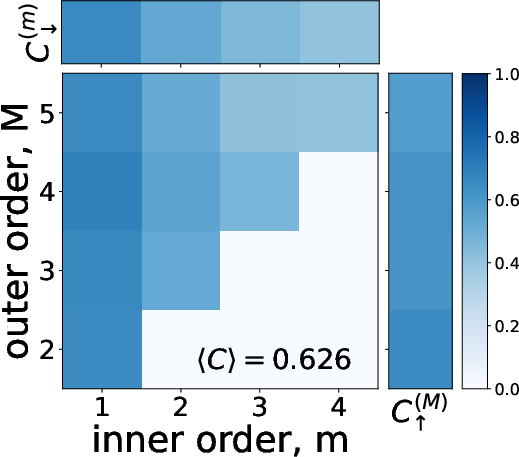
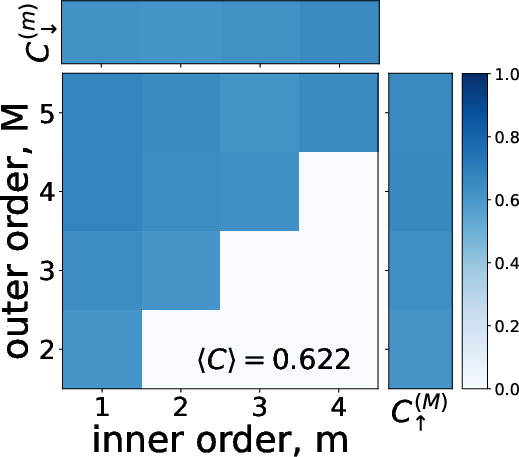
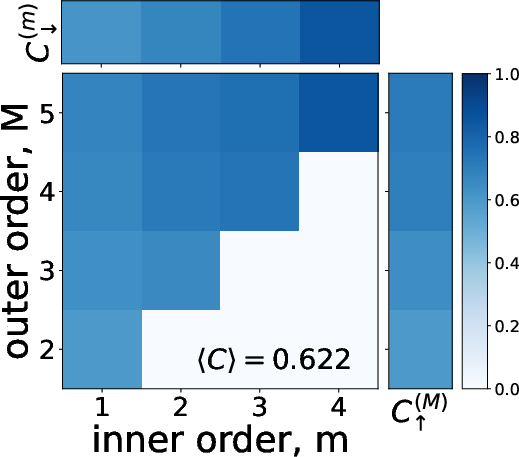
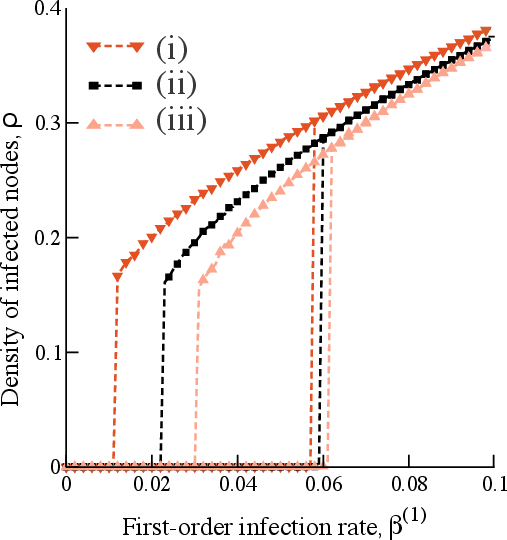
Figure 6: Embedding patterns across orders for (i) negative, (ii) neutral, and (iii) positive correlations; corresponding dynamic responses show threshold modulation decoupled from hysteresis behavior.
Empirical Network Analysis
A broad collection of empirical higher-order networks (proximity, communication, legislative, biological) is examined. Measurement of nesting coefficients reveals:
- Consistent negative order correlations: Embedding is systematically stronger at lower orders across real datasets.
- Strong anti-correlation between average nesting m4 and the scaled width of the hysteresis region m5 (ratio of critical thresholds with/without higher-order spreading), robustly supporting model predictions.
Comparison to null-model networks validates that these nesting patterns cannot be explained by simple degree or order constraints and reflect nontrivial mesoscale organization.
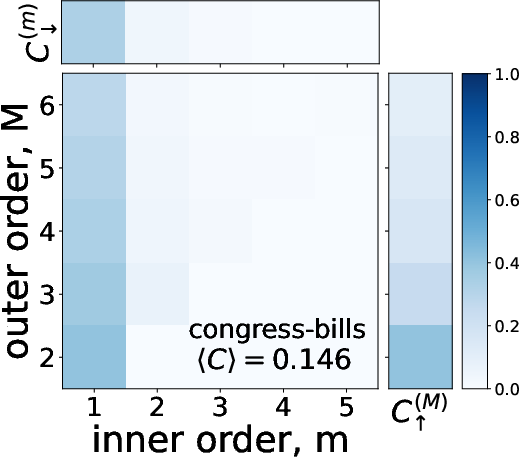
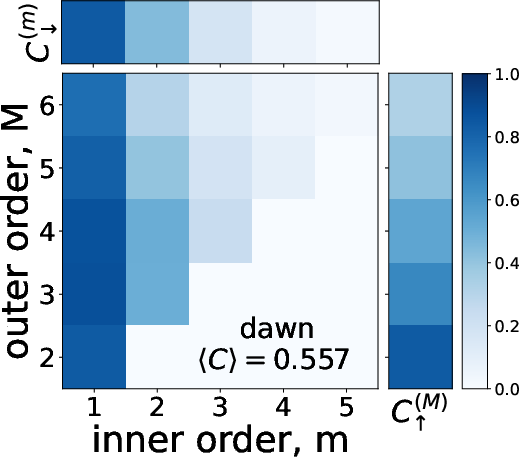
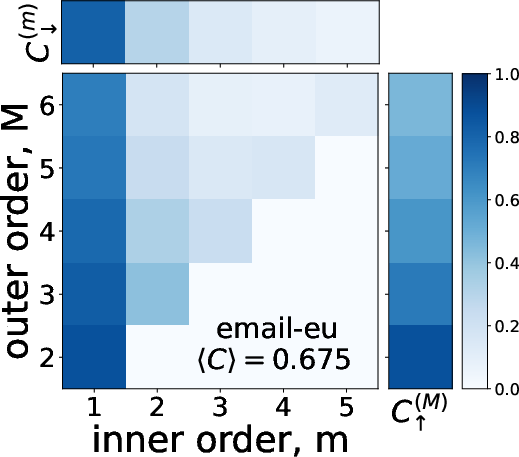
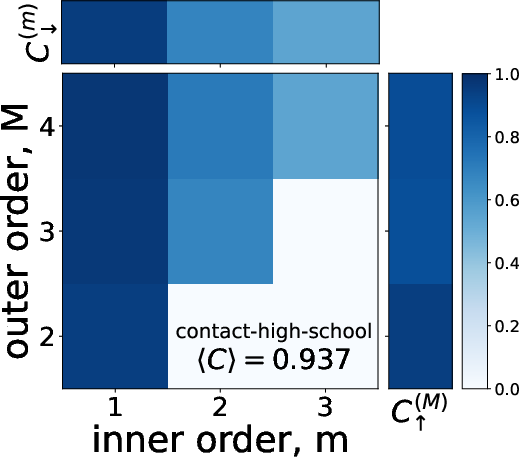
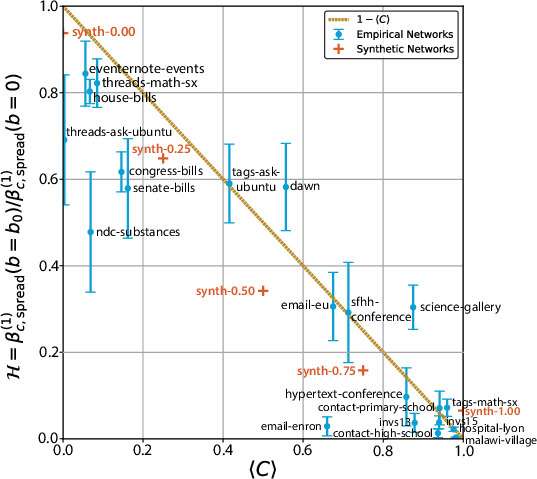
Figure 2: Empirical datasets exhibit characteristic order-dependent embedding (left) and a strong negative trend between nesting and normalized hysteresis length (right), substantiating nesting as a predictor of dynamical regime.
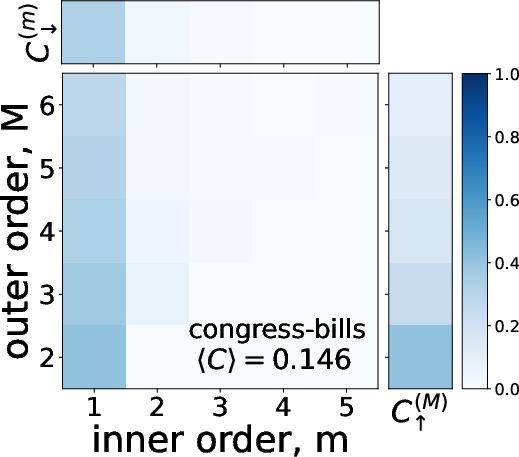
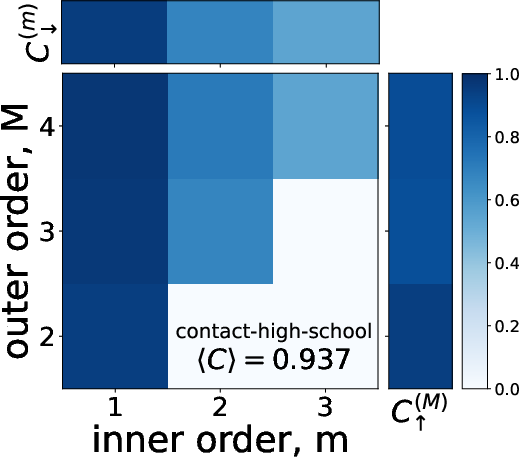
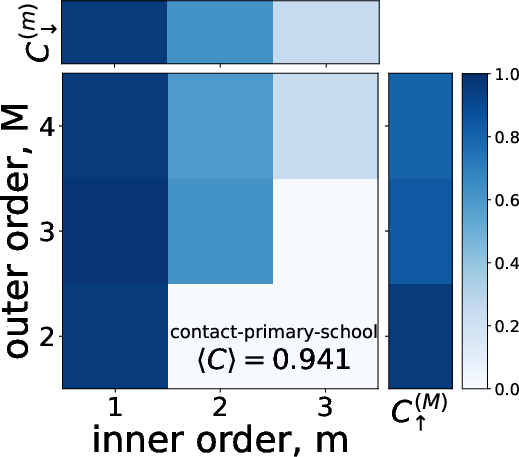
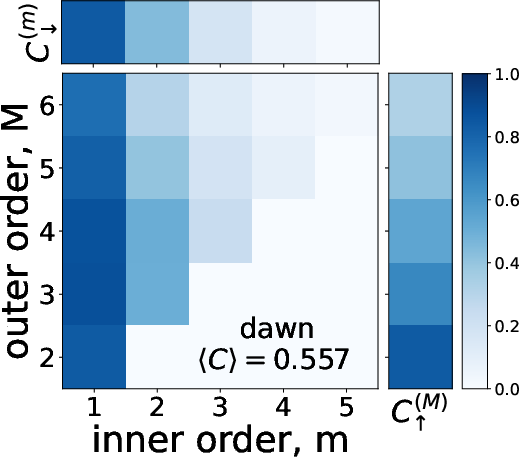
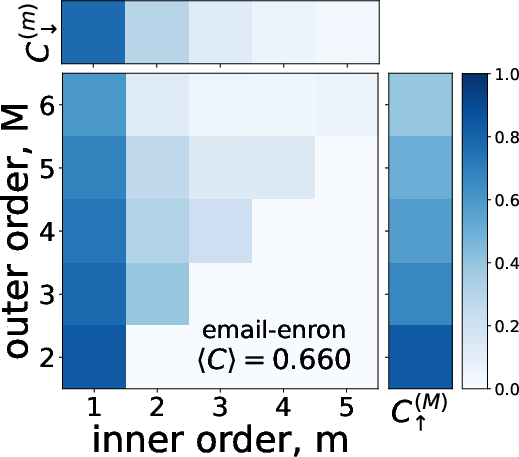
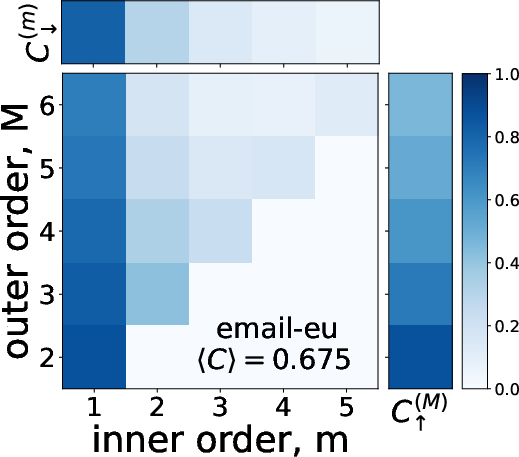
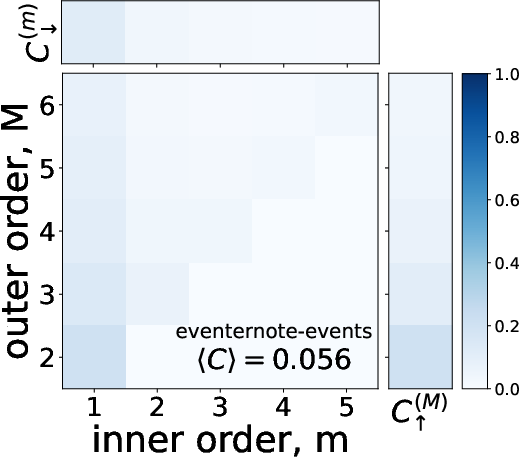
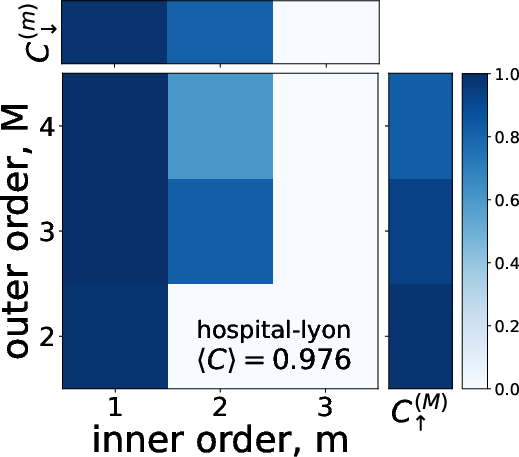
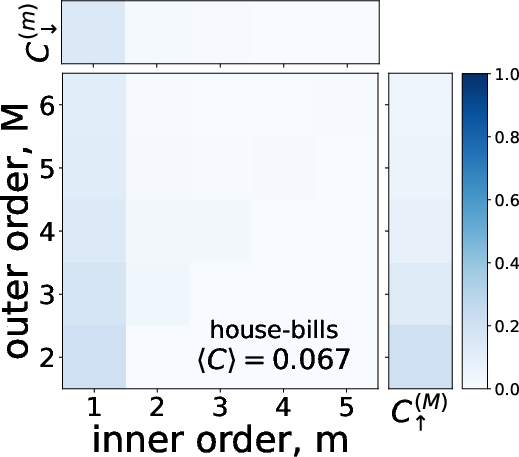
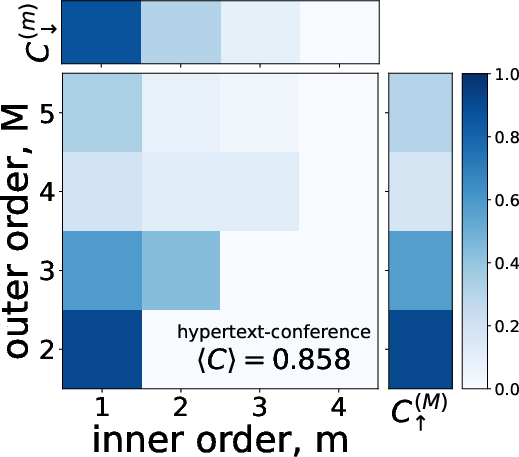
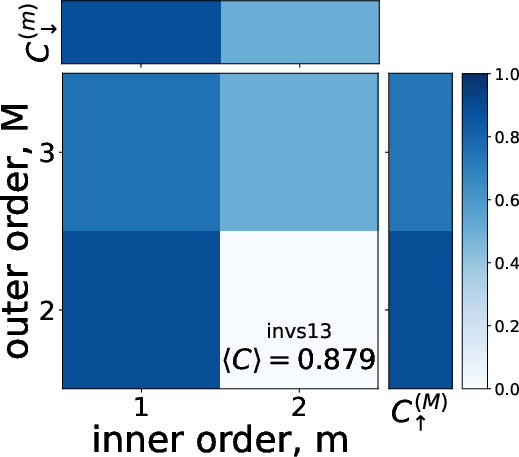
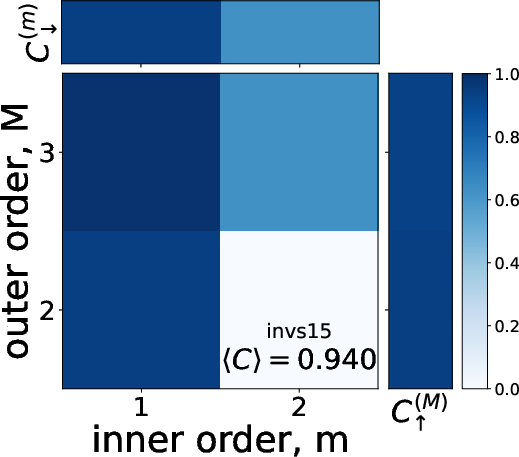
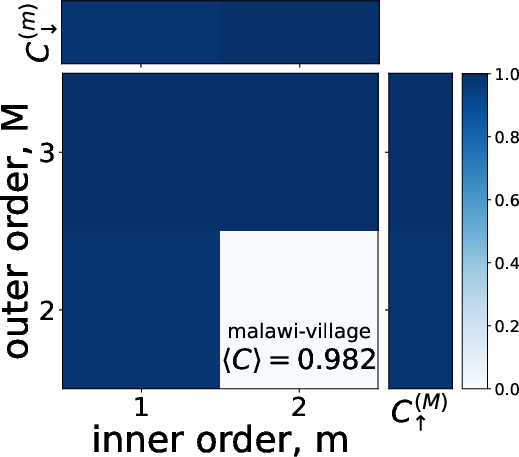
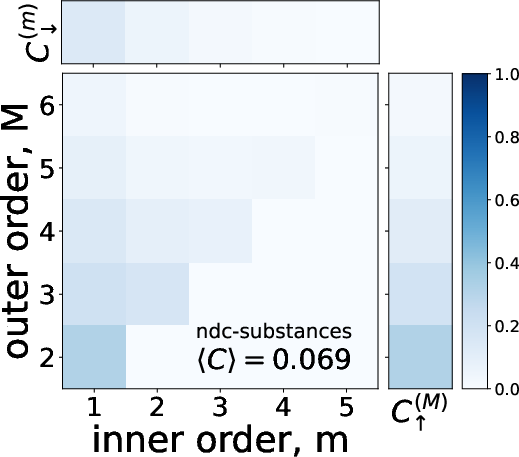
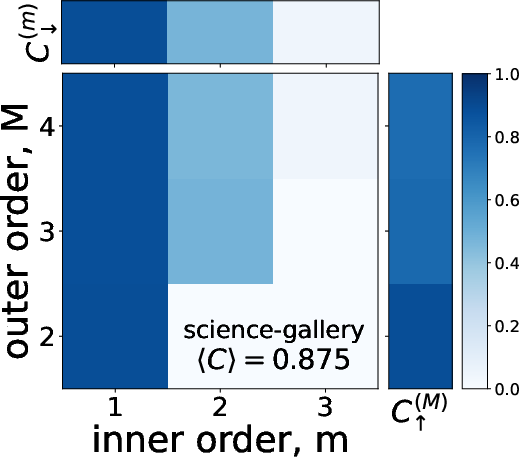
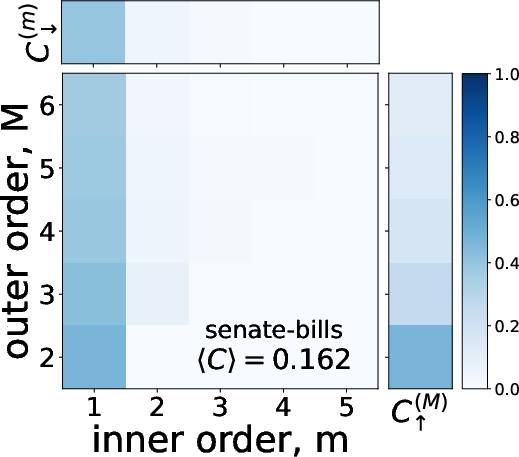
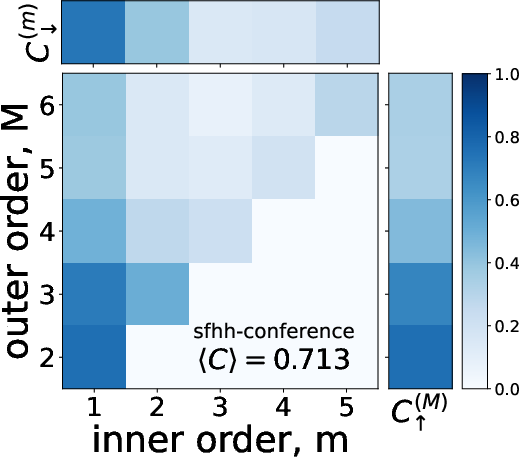
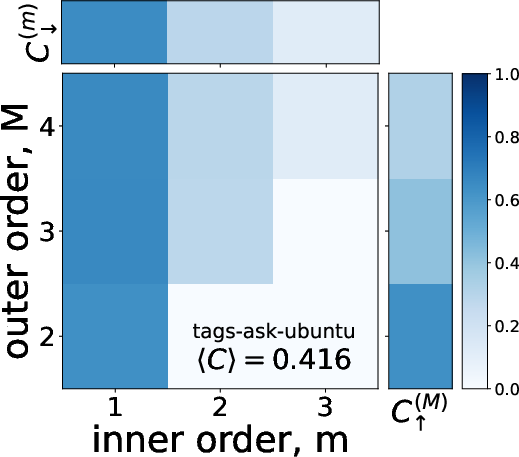
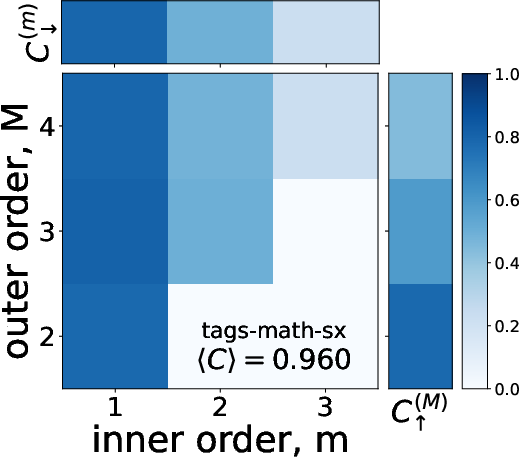
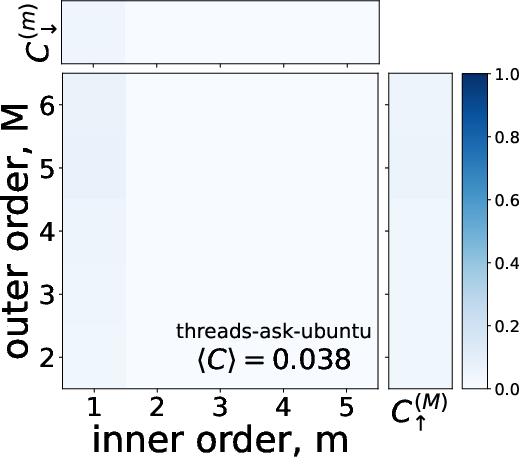
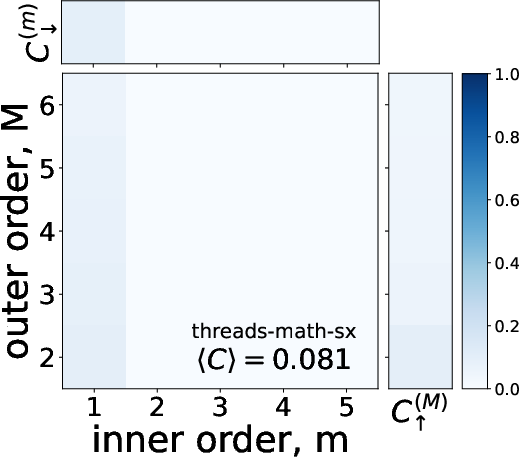
Figure 8: Full matrix of nesting coefficient measurements from empirical datasets evidences structural heterogeneity and consistent cross-order embedding trends.
Implications and Future Directions
The central theoretical implication is that nesting is a structural order parameter that governs the qualitative bifurcation structure of higher-order collective phenomena. This extends beyond contagion, potentially impacting cooperative transitions, consensus formation, and functional dynamics in biological and social systems with complex interaction architectures. Practically, these findings suggest that architectural control (e.g., via targeted interventions on mesoscale embedding) can suppress undesirable abrupt transitions or mitigate hysteresis in engineered or natural systems.
This framework opens several research avenues:
- Development of analytic approaches for general nonequilibrium higher-order processes parameterized by nesting distributions.
- Exploration of control protocols for modifying network mesoscale embedding to engineer system response.
- Extensions to temporal hypergraphs and adaptive higher-order networked systems.
- Investigation of analogous nesting-induced mechanisms in higher-order synchronization, consensus, and percolation.
Conclusion
The study rigorously establishes the nesting coefficient as an essential structuro-dynamical observable for higher-order contagion processes. Nesting modulates both the activation threshold and the nature of phase transitions, with high embedding suppressing bistability and enabling continuous response, and low embedding facilitating explosive behavior. Empirical validation across diverse real-world systems reinforces the centrality of nesting and its order-dependent organization for predicting and controlling collective dynamics in complex networks with higher-order interactions.