- The paper introduces the FAME method to capture the impact of hyperedge nestedness on contagion dynamics.
- It reveals non-monotonic optimal thresholds in simplicial contagion caused by competing pairwise and higher-order interactions.
- It demonstrates that intermediate group size and nonlinearity in voter models minimize consensus time, informing targeted network interventions.
Optimality Phenomena in Group-Driven Social Dynamics on Hypergraphs
Introduction
This work investigates the emergence of optimality phenomena in group-driven social dynamical processes on hypergraphs, focusing on how intrinsic structural properties—especially hyperedge size distributions and nestedness—govern both social contagion and opinion dynamics. Leveraging a higher-order network framework, the study examines two paradigmatic processes: simplicial contagion dynamics, which generalize epidemic spreading to incorporate group-level social reinforcement, and group-driven voter models (GVMs), where opinion updates depend on collective group states. Through a combination of novel analytical approaches and systematic simulation, the paper identifies the central role of competitive effects between simple and higher-order processes in driving non-monotonic, optimal behavior.
Simplicial Contagion Dynamics: Non-monotonic Outbreak Thresholds
The analysis of simplicial contagion dynamics is grounded in SIR and SIS models extended to random hypergraphs, where contagion can occur via both pairwise and group (e.g., size-3) hyperedges and social reinforcement is modeled via a threshold-like mechanism. Of particular interest is the structural property of hyperedge nestedness (denoted by ε), representing the extent to which smaller hyperedges are contained within larger ones.
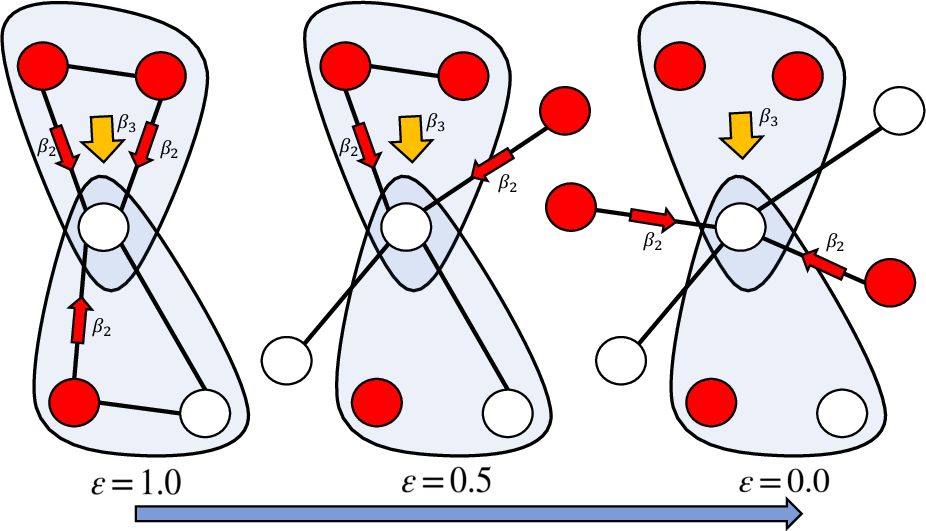
Figure 1: Schematic of simplicial contagion events on a hypergraph with tunable nestedness ε, illustrating infection through both simple (pairwise) and higher-order (size-3) hyperedges.
As empirical and theoretical results demonstrate, the impact of nestedness on global contagion dynamics is fundamentally non-monotonic. This is quantified through the rescaled outbreak threshold λc, the critical infectivity above which epidemic outbreaks occur. The study introduces the facet-based approximate master equation (FAME) method, designed to accurately capture dynamical correlations between contagion events traversing nested structures—exceeding the capabilities of traditional mean-field and more recent group-based compartmental models.
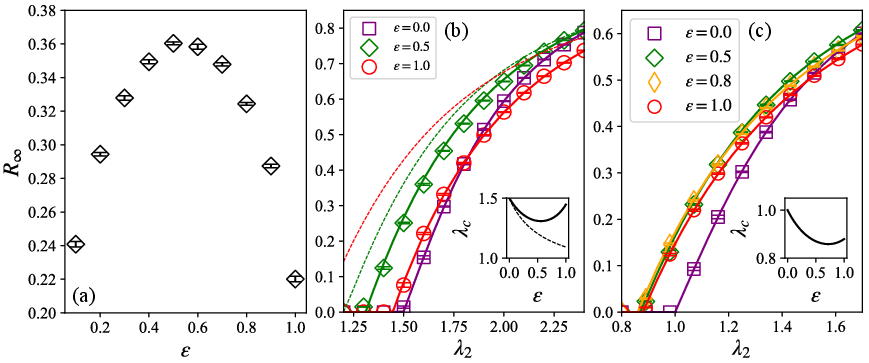
Figure 2: Outbreak size R∞ for simplicial SIR dynamics as a function of nestedness ε and pairwise infectivity, from large-scale simulations and FAME.
Strikingly, both simulations and FAME analysis show that as nestedness increases, epidemic thresholds initially decrease (facilitating contagion), reach a minimum (optimally efficient spreading), and then increase again (hindering spreading). This non-monotonicity arises from the competition between enhanced activation of higher-order contagion pathways (due to increased nestedness) and the concomitant erosion of overall network connectivity (as pairwise edges are sequestered into groups).
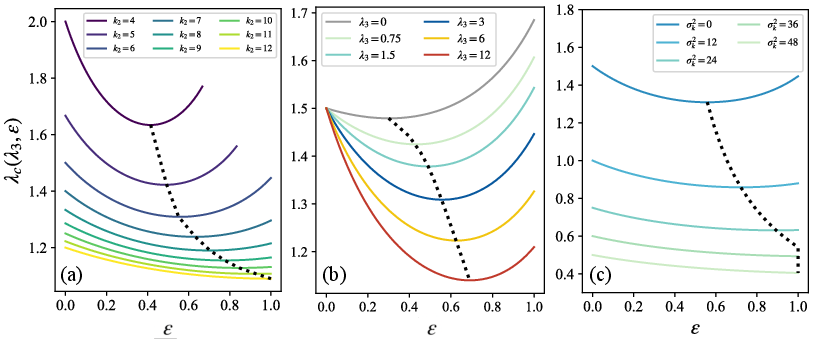
Figure 4: Systematic FAME analysis of λc versus nestedness ε across diverse hypergraph connectivities and degree distributions, confirming that an intermediate ε∗ minimizes the epidemic threshold.
Theoretical exploration also reveals that the optimal nestedness ε∗ is a function of hypergraph connectivity parameters and higher-order infection rates. For fixed higher-order infection rates, increasing the mean and variance of degree distributions shifts ε∗ to higher values. In the regime of pronounced higher-order interactions, fully-nested structures can in fact maximize contagion, provided pairwise connectivity remains sufficient.
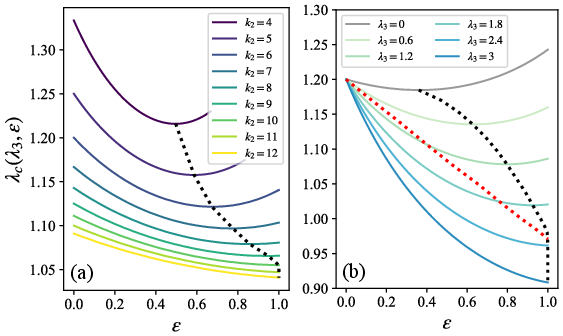
Figure 6: FAME results for SIS dynamics, displaying analogous optimality in outbreak thresholds as a function of ε0 and providing phase transition characterization between discontinuous and continuous regimes.
The findings demonstrate that nontrivial optimality in epidemic thresholds and outbreak sizes can be generically expected in higher-order network contagion models with tunable group overlap, and that the analytic structure of FAME provides a systematic route to understanding such phenomena.
Group-Driven Voter Models: Consensus Time Optimality
Extending beyond contagion dynamics, the paper investigates opinion dynamics through a group-driven voter model (GVM) framework on hypergraphs. The GVM generalizes classic voter models (VMs) by allowing opinion updates through group-based rules; update probability depends on the states of members sharing a hyperedge, parameterized by the group size and a nonlinearity parameter ε1.
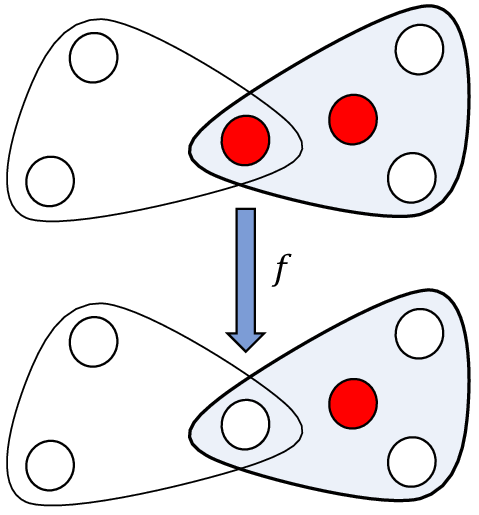
Figure 3: Schematic of the group-driven voter model (GVM) process: node selection, hyperedge selection, and group-dependent flipping probability.
The primary observable is the consensus (exit) time ε2, which denotes the expected time for the system to reach unanimous agreement. Through both mean-field approximation and Monte Carlo simulation, the study establishes that ε3 scales logarithmically with system size, but its prefactor ε4—and thus the rapidity of consensus formation—is itself a non-monotonic function of both group constraint (ε5) and nonlinearity (ε6).
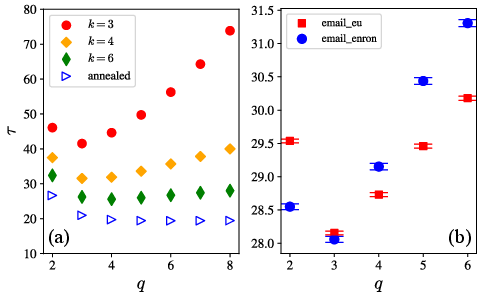
Figure 5: Simulation results for consensus (exit) time ε7 of ε8-GVM on synthetic and empirical quenched hypergraphs, exhibiting efficient consensus at intermediate ε9.
Analytically, for the simplicial GVM (where flipping requires unanimous opposition in a group), increasing mean hyperedge size initially accelerates consensus, up to an optimal value, after which further increases slow it down. For λc0-GVMs, an analogous optimality is observed with respect to nonlinearity: neither the most linear (λc1) nor the most nonlinear (λc2) rules yield fastest consensus, but there is an intermediate λc3 (and λc4) that minimizes λc5. These effects persist across varied group size distributions, including geometric and power-law forms motivated by empirical data.
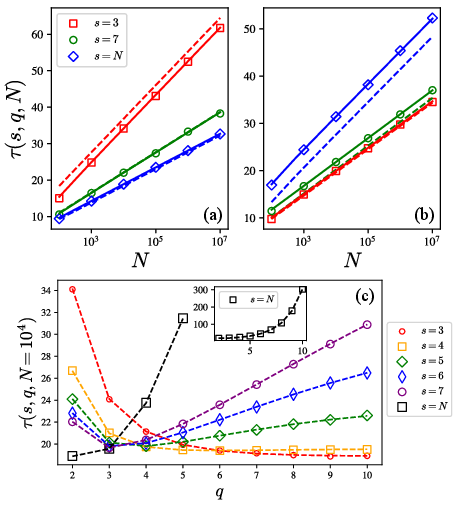
Figure 8: Scaling of consensus time λc6 versus system size λc7 and nonlinearity λc8 on λc9-uniform hypergraphs, showing optimal R∞0 and R∞1.
The theoretical origin of optimality is a competition between the suppression of diffusive fluctuations (promoting drift toward consensus with large R∞2 or R∞3) and the increasing inefficiency of update events as group constraints or nonlinearity become extreme (rendering consensus events vanishingly rare). Thus, only at intermediate regimes is the balance struck for fastest consensus.
Broader Implications and Future Directions
The demonstrated existence of optimal nestedness and nonlinearity/group constraint for efficient contagion or consensus formation has significant theoretical and practical implications. Theoretically, these findings highlight the necessity of considering group overlap and higher-order interactions in the macroscopic description of social dynamics, with direct consequences for real-world interventions and network design.
Practically, recognizing that intermediate levels of group structure and collective reinforcement can optimize spreading or consensus suggests refined strategies for facilitating or impeding information diffusion and collective decision-making in networked systems. For example, institutional or technological interventions may benefit from promoting or disrupting specific levels of group overlap, rather than uniformly increasing or decreasing connectivity or group size.
The FAME analytical approach developed here opens the door to studying a broad class of higher-order dynamical processes—encompassing arbitrary group size, nestedness, and nonlinearity—in a tractable manner. However, the super-exponential scaling of complexity with facet size lays out a critical challenge: to develop principled approximations or dimensionality reduction methods capable of capturing essential higher-order effects at scale.
Conclusion
This work systematically elucidates the emergence of optimality in higher-order social dynamics on hypergraphs, demonstrating that both contagion and consensus processes are governed by non-monotonic dependencies on group structure and update rules. The identification of intermediate optimal nestedness and nonlinearity/group constraint, supported by the FAME methodology and multi-faceted simulation, underlines the nuanced role of higher-order interactions in collective behavior. These results contribute foundational insight toward the analysis and control of complex networked social systems.

